
◆ PhD Admissions
What TOPIK level does a GKS doctoral scholarship require?
Category: admissions
Last updated: 2026-09-16

Ask an AI assistant what TOPIK level the Global Korea Scholarship needs and it will hand you one number. Bing answers "Level 5 or 6", which is correct for one of the three decisions that a TOPIK certificate actually settles, and silent on the other two. The 2026 GKS-G application guidelines published by Korea's National Institute for International Education set out three separate thresholds: a level that scores your application, a level that exempts you from the Korean language programme, and a lower level you must reach in order to enter the degree programme at all.
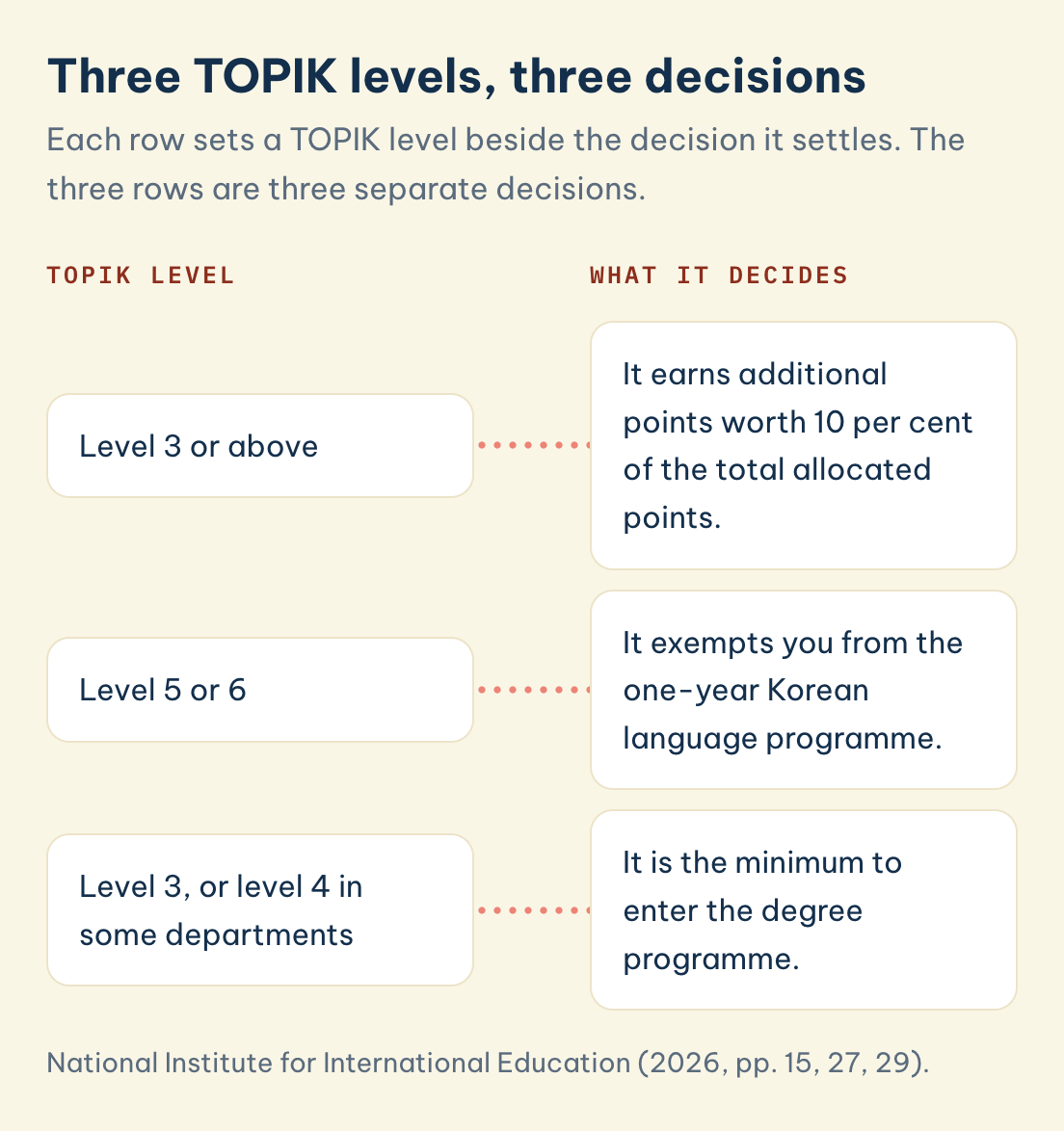
Direct answer: Three levels do three jobs. Level 3 or above earns additional points during selection. Level 5 or 6 exempts you from the one-year Korean language programme. Level 3 is the minimum for moving from that programme into the doctoral programme, and some departments require level 4 instead (National Institute for International Education, 2026, pp. 15, 27, 29).
◆ Question 1 / 6 · What GKS covers
What does the GKS scholarship cover for a doctoral student?
Direct answer: The 2026 guidelines list an economy-class return flight, tuition of up to 5,000,000 KRW per semester with the admission fee paid by the university, language training fees of 5,200,000 KRW, and a monthly allowance whose annual rate depends on which stage you are in (National Institute for International Education, 2026, p. 31).
Tuition is capped at 5,000,000 KRW per semester and the language training allowance at 5,200,000 KRW over four quarters, but the allowance is where the scholarship's two stages become visible as money rather than as a schedule. A scholar in the Korean language programme receives 14,400,000 KRW per year, a scholar in the degree programme receives 16,560,000 KRW per year, and a scholar in the Research Program receives 20,880,000 KRW per year (National Institute for International Education, 2026, p. 31). Scholars initially exempted from the language programme on the strength of a TOPIK level 5 or 6 are additionally given Korean Proficiency Grants, although that grant does not extend to Global Network Program scholars, Research Program scholars or applicants to fully English-taught R&D programmes.
The stipend figures have moved. Writing in Politics & Policy, Jon and Ayhan (2021) recorded a graduate stipend of 1,000,000 KRW per month, close to USD 900 at the time, which is roughly 12,000,000 KRW per year against the 16,560,000 KRW in the current guidelines. Anyone quoting stipend figures from a 2021 source, academic or otherwise, is quoting a superseded number.
One clause is worth reading before you accept anything. A scholar who withdraws within the first three months after enrolling at the university must return the full amount already received, including the entry airfare, settlement allowance, monthly allowance and tuition (National Institute for International Education, 2026, p. 32).
◆ Question 2 / 6 · TOPIK for the language year
What TOPIK level exempts you from the Korean language year?
Direct answer: Level 5 or 6. The National Institute for International Education classifies holders of those two levels as entering the degree programme directly, and places every other successful candidate in the Korean language programme (2026, p. 29). For the 2026 cycle the certificate must reach the institute by 6pm on 12 June 2026.
The exemption level is the threshold the AI assistants report accurately, and it is also the only one they report. It is worth knowing precisely what it buys. Exemption is a classification decision made by the institute after selection, not something you negotiate with your university, and it is made on the certificate you hold at that moment. Candidates from the second round of the university track or the third round of the embassy track who newly achieve level 5 or 6 must email the certificate to the institute by the stated deadline; certificates are only valid if they come from the 93rd to the 105th TOPIK examinations or the 1st to the 12th TOPIK IBT examinations (National Institute for International Education, 2026, p. 28).
Three other routes to exemption exist alongside it. Research Program scholars, Global Network Program scholars, current academic professors enrolled in a fully English-taught programme who submit a Korean Language Exemption Application, and graduates of the IRTS Korean language programme holding TOPIK level 3 or above are all exempt (National Institute for International Education, 2026, p. 31). A scholar who reaches level 5 or 6 within the first six months of the language programme is exempted from the remaining six months and starts the degree programme the following semester.
◆ Question 3 / 6 · TOPIK to enter the PhD
What TOPIK level do you need to enter the doctoral programme?
Direct answer: Level 3, and in some departments level 4. The guidelines state plainly that "All GKS scholars should achieve TOPIK level 3 to proceed to their degree program" and warn that some departments set additional requirements such as TOPIK level 4 for enrolment (National Institute for International Education, 2026, p. 15).
Three TOPIK levels, three decisions
Each row sets a TOPIK level beside the decision it settles. The three rows are three separate decisions.
TOPIK level
What it decides
Level 3 or above
It earns additional points worth 10 per cent of the total allocated points.
Level 5 or 6
It exempts you from the one-year Korean language programme.
Level 3, or level 4 in some departments
It is the minimum to enter the degree programme.
Save this figure
The entry level is the threshold that the AI answers omit, and it is structurally different from the exemption threshold. The exemption level decides how your scholarship is shaped at the outset. The entry level decides whether the scholarship survives. Because departmental requirements sit on top of the national minimum, the number that governs you is not published in the guidelines at all; it is published by the department you chose, which means it has to be read before you commit to a university rather than after you arrive.
The academic literature supports level 3 as a meaningful floor rather than an administrative convenience. Yan and Cheng (2015) surveyed 138 undergraduate and 63 graduate Chinese students across 27 Korean universities and found that the TOPIK total score was a significant predictor of first-semester graduate GPA, with a beta of 0.48 at p below 0.001, accounting for an additional 18 per cent of variance beyond prior academic performance and academic self-efficacy. They concluded that TOPIK Intermediate, meaning levels 3 and 4, is the proper threshold for international students who want to pursue further study in Korean universities.
◆ Question 4 / 6 · If you fall short
What happens if you do not reach the required level?
Direct answer: The scholarship is cancelled. The guidelines state that if you do not meet the requirements set by your university or department and fail to enrol, "your scholarship will be canceled" (National Institute for International Education, 2026, p. 15). The consequence is termination of funding, not an extension of the timetable.
Two further complications sit beside that sentence. Scholars whose language programme is delayed, for example after returning from a leave of absence, must check whether their department admits students only in a particular semester, because a department that admits only in September may leave a scholar unable to enrol in March (National Institute for International Education, 2026, p. 15). And scholars who wish to proceed to the degree programme after the language programme may need to return home to have documents reissued if apostilled or consular-confirmed certificates were not prepared in advance.
The scale of the language stage is not marginal. Istad et al. (2021) surveyed 749 GKS students in December 2019 and removed 225 of them from the analysis because they were still attending language school before their degree programme, roughly 30 per cent of respondents. Of the 32 respondents who had enrolled in 2019, all had skipped the language year on the strength of their Korean proficiency.
◆ Question 5 / 6 · English-taught programmes
Does an English-taught doctoral programme change this?
Direct answer: Partly, and the difference sits in the fees rather than in the language requirement. Three groups lose the language training allowance: Global Network Program scholars, R&D applicants entering fully English-taught programmes, and serving academics who file an exemption form for such a programme (National Institute for International Education, 2026, p. 32).
Language of instruction is not the same as language of study, and this is the point at which the exemption routes stop being a shortcut. Research on GKS recipients has repeatedly found Korean proficiency bound up with academic outcomes rather than sitting beside them. Haji (2018) surveyed and interviewed international graduate students holding the Korean Government Scholarship and reported that academic life, environment and Korean language competency were all significant factors in their satisfaction with the programme. Ayhan and Gouda (2021), working with a survey of GKS recipients, examined how experience in Korea shapes what those students subsequently say about the country to people back home.
◆ Question 6 / 6 · TOPIK and selection
How does the TOPIK level you hold affect selection?
Direct answer: It affects it twice. Level 3 or above earns additional points worth 10 per cent of the total allocated points. Separately, the language proficiency score is banded: level 5 and above scores 100 per cent, level 4 scores 90 per cent, level 3 scores 80 per cent (National Institute for International Education, 2026, pp. 27-28).
The banded table also lists English equivalents, with TOEFL iBT 95 and above or IELTS 7.0 and above scoring at the same 80 per cent band as TOPIK level 3, and TOEFL iBT 114 or IELTS 8.0 at the 90 per cent band (National Institute for International Education, 2026, p. 28). An English certificate can therefore carry the language proficiency score, but it cannot carry the 10 per cent additional-points award, which the guidelines tie specifically to TOPIK level 3 or above. Only the highest submitted score is recognised, and only certificates valid as of 28 February 2026 are accepted. Applicants to science and engineering departments receive a separate 5 per cent additional-points award.
Planning backwards from these three thresholds tends to change what an applicant does in the year before applying. A candidate sitting at level 2 who can reach level 3 before the certificate deadline moves from the 70 per cent band to the 80 per cent band and picks up the additional-points award at the same time; a candidate at level 4 who reaches level 5 moves from the 90 per cent band to the 100 per cent band and skips the language programme entirely. The gains are not evenly spaced, and which of them is worth chasing depends on where you currently sit.
If you want a second reader while you decide which threshold to aim for and prepare the research proposal that sits alongside it, MAAS works with applicants as academic advisors: your expert drafts the research proposal from your own account of your research, you review, edit and approve it, and you choose the universities, sit the tests and make every decision. Our experts also challenge the fit, the timeline and the evidence behind each choice. No one can promise a GKS award or a doctoral place, since those decisions belong to the National Institute for International Education, the Korean diplomatic mission and the receiving university. You can see the full pathway in our PhD application guide, and the scope of the advisory work in PhD supervisor search and application strategy.
Frequently asked questions
Do I need a TOPIK certificate to apply for the GKS?
No. Jon and Ayhan (2021) write that "GKS applicants do not need to have prior knowledge of the Korean language, but scholarship recipients must have some proficiency in Korean before beginning their degree programs" (p. 1397). A certificate held at application time changes your score and your classification, not your eligibility.
Can IELTS replace TOPIK for the GKS?
Only for the language proficiency score. The 2026 banded table places IELTS 7.0 alongside TOPIK level 3 at the 80 per cent band, but the separate award of additional points equal to 10 per cent of total allocated points is tied to TOPIK level 3 or above.
Is the one-year Korean language programme compulsory for doctoral scholars?
Yes, unless one of the listed exemption routes applies to you. The four routes are a certificate at level 5 or above, membership of the Research or Global Network programmes, a serving academic on a fully English-taught course who files the exemption form, and an IRTS language graduate at level 3 or above.
What happens if I reach TOPIK level 5 during the language programme?
The guidelines state that scholars who reach level 5 or 6 within the first six months are exempted from the remaining six months and must start their degree programme in the following semester.
Which TOPIK certificates does the institute accept for the 2026 cycle?
Results from the 93rd to the 105th TOPIK examinations and from the 1st to the 12th TOPIK IBT examinations, valid as of 28 February 2026.
Related MAAS guides
References
Ayhan, K. J., & Gouda, M. (2021). Determinants of Global Korea Scholarship students' word-of-mouth about Korea. Asia Pacific Education Review, 22(1), 15-29. https://doi.org/10.1007/s12564-020-09648-8
Haji, S. A. (2018). Understanding the interplay between environment and language in determining academic satisfaction. European Journal of Education Studies. https://oapub.org/edu/index.php/ejes/article/view/2088
Istad, F., Varpahovskis, E., Miezan, E., & Ayhan, K. J. (2021). Global Korea Scholarship students: Intention to stay in the host country to work or study after graduation. Politics & Policy, 49(6), 1323-1342. https://ayhan.phd/research/articles/2021%20PP%20Global%20Korea%20Scholarship%20Students%20Intention%20to%20Stay%20in%20the%20Host%20Country%20After%20Graduation/2021%20PP%20Global%20Korea%20Scholarship%20students%20Intention%20to%20stay.pdf
Jon, J.-E., & Ayhan, K. J. (2021). Satisfied or dissatisfied: The determinants of Global Korea Scholarship recipients' satisfaction with life in Korea. Politics & Policy, 49(6), 1391-1414. https://ayhan.phd/research/articles/2021%20PP%20Satisfied%20or%20dissatisfied/2021%20PP%20Satisfied%20or%20Dissatisfied.pdf
National Institute for International Education. (2026). 2026 Global Korea Scholarship for graduate degrees: Application guidelines. Study in Korea. https://www.studyinkorea.go.kr/ko/plan/gksNoticeRead.do?bbsId=BBSMSTR_000000000461&nttId=4420
Yan, W., & Cheng, L. (2015). How language proficiency contributes to Chinese students' academic success in Korean universities. Language Testing in Asia, 5, 8. https://doi.org/10.1186/s40468-015-0016-2
Tools & resources
A free 20-minute consultation is a conversation about your situation and the scholarship you are looking at.
Book a free consultation ▸