
◆ PhD Admissions
What does a Chinese supervisor sign in a CSC PhD application?
Category: admissions
Last updated: 2026-09-07

Search for advice on the Chinese Government Scholarship and you will be told, over and over, that getting a professor on side "improves your chances". That phrasing describes an optional advantage. The scholarship's own application guide describes something else.
Direct answer: The China Scholarship Council lists pre-admission documents among the required application materials, and names an invitation letter from a prospective supervisor as one acceptable form. The academic yes is an input to the funding application, not a bonus attached to it, as verified on 7 September 2026.
That requirement changes the order of the work. You are not assembling one file for one decision; you are collecting a document that only another person can produce, and you cannot submit without it.
◆ Question 1 / 7 · What the CSC guide requires
What exactly does the CSC guide require?
Direct answer: Item 7 of the application documents states that all applicants must provide a pre-admission document issued by the university applied to, and that such documents include a pre-admission notice from the international students' admission department or an invitation letter from the schools or professors, as verified on 7 September 2026.
Some universities go further and put the supervisor's own hand on the research plan. The University of Shanghai for Science and Technology's scholarship prospectus requires a study plan of more than 1,000 characters or words and states that "the proposal of a doctoral student shall be signed by the applicant's Chinese supervisor", as verified on 7 September 2026.
A signature is a stronger object than an endorsement. It means the document you upload carries evidence that a named academic has read your research plan and put their name to it, which is a different thing from a professor replying warmly to an email.
◆ Question 2 / 7 · Which route
Which route are you actually applying through?
Direct answer: The CSC guide sets out four programme types rather than the two that circulate online. They are the Bilateral Program, the University Program, Designated Scholarship Programs, and the Student Exchange Program, and each names a different receiving agency, as verified on 7 September 2026.
Where the applicant files, by CSC programme type
Each row names one of the four programme types and where the applicant files. The Student Exchange Program is not described here.
Programme
Files with
Bilateral Program
The applicant files with the dispatching department of their home country.
University Program
The applicant files with the Chinese university running the programme.
Designated Scholarship Programs
The application goes to the international organisation concerned.
Save this figure
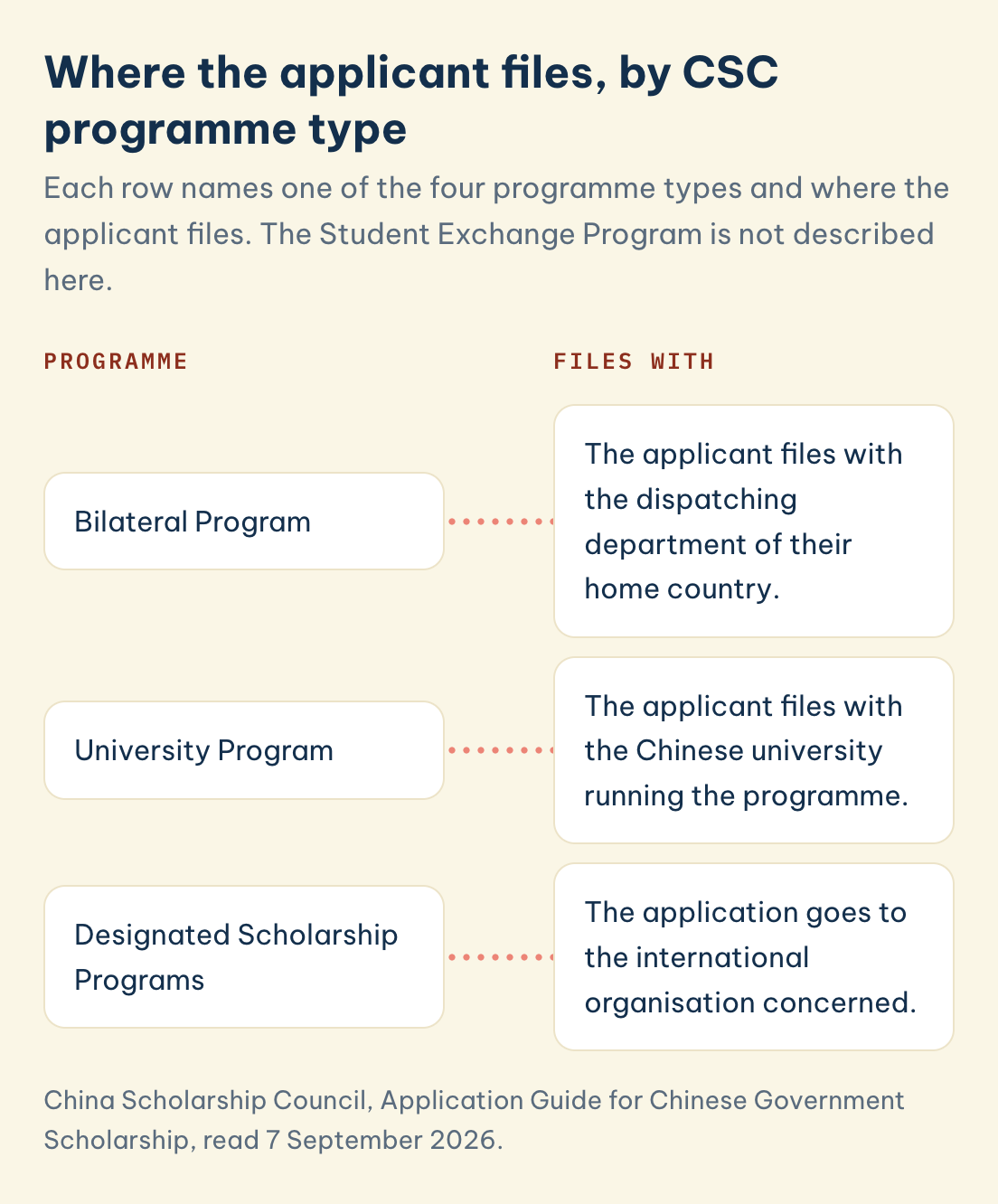
Under the Bilateral Program an applicant files with the dispatching department of their home country. Under the University Program an applicant files with the Chinese university running the programme. Under Designated Scholarship Programs the application goes to the international organisation concerned. The guide is explicit that the receiving agency differs by route, which means the same candidate can face different paperwork depending only on which door they picked.
The popular "Type A and Type B" shorthand maps roughly onto the first two but is not the vocabulary of the official document. When a form asks for a programme category and an agency number, it is the official categories that the system is expecting.
The Designated Scholarship Programs route is the one most applicants never see, and the guide names five of them with their own receiving agencies: the Great Wall Program through the National Commission for UNESCO in the home country, the EU Program through the Office for Education and Culture of the PRC Mission to the EU, the AUN Program through the AUN Secretariat, the PIF Program through the Pacific Islands Forum Secretariat, and the WMO Program through the World Meteorological Organization, as verified on 7 September 2026. Of those five, the AUN Program supports postgraduates only.
The body running all of this sits inside the Chinese state rather than beside it. The CSC was established in 1997 as a regulatory body affiliated with the Ministry of Education, taking the scholarship programme over from the Ministry of Foreign Affairs (Latief & Lefen, 2018), and the guide states that the CSC is entrusted by the Ministry of Education with the admission, enrollment and administration of scholarship recipients, as verified on 7 September 2026. Latief and Lefen (2018) put the number of higher education institutions able to enrol international students on this scholarship at 338, drawing on CSC figures at the time of their study, which surveyed 150 international students in Nanjing.
◆ Question 3 / 7 · Where the decision is made
Where does the decision actually get made?
Direct answer: The guide describes a seven-step process in which the receiving agency submits a recommended candidates list, the CSC then organises designated universities and experts to examine eligibility and academic performance, and the CSC notifies the results to the receiving agency, which then informs the applicant, as verified on 7 September 2026.
Read the last step carefully, because it decides who you can chase. The outcome does not travel from the CSC to you. It travels to the agency that received your file, and the agency tells you. The route you chose at the beginning therefore also determines who holds your result at the end.
The sequential CSC architecture differs from the fused American one, where a single department settles admission and money in one meeting; our guide to where the funding decision sits in US PhD admissions sets that comparison out. Here the two decisions are sequential and sit with different bodies, and the academic one comes first.
◆ Question 4 / 7 · Does the supervisor decide
Does this mean the supervisor decides doctoral admissions in China?
Direct answer: For this international route the supervisor's document is required, but the picture inside China's own doctoral admissions looks different. A content analysis of 312 doctoral admissions texts from 264 faculties of C9 League universities reports a centralised rather than decentralised model and "a lack of supervisor engagement in admissions decision-making" (Jung et al., 2023).
Those 312 texts came from 264 faculties across the C9 League, and the study was published in 2023. Hold both facts at once, because the tension between them is the useful part. The scholarship route asks you to obtain a named academic's written support before you may apply. The domestic admissions literature describes a system built around written examinations and centralised procedures in which supervisors have limited say. These are two different doors into the same universities, and advice written for one does not transfer to the other.
Jung and colleagues also report that the procedures emphasise previous research and tangible past achievements, especially pre-doctoral research outputs. That is a claim about what the texts foreground, drawn from the study's published abstract, which is as far as the paywall on this article allows us to read.
◆ Question 5 / 7 · What the signature does not buy
What does the signature not buy you?
Direct answer: The supervisor's signature does not lock the research topic. Bahtilla (2022) interviewed 68 international doctoral students at two comprehensive universities in China and found that being told to change research topics was among the reported difficulties, alongside language barriers and limited access to supervisors.
Bahtilla's 2022 study is worth reading before treating the invitation letter as a settled agreement. One participant described the access problem directly: "My supervisor is too busy with teaching and administrative duties; he does not create time to discuss my research; I have been texting him for three months now without any reply, I feel frustrated" (Bahtilla, 2022, p. 187). In that study 45 of the 68 participants said they did not meet their supervisors as often as they wanted, and 49 reported that their supervisor could not communicate effectively in English.
Two limits belong with those numbers. The participants were all in English-taught programmes in the social sciences at two universities, and the study measures reported experience rather than completion. What transfers is the question to ask before you accept a letter: what does this person expect the working relationship to look like, and in which language.
◆ Question 6 / 7 · Terms of the award
What are the terms attached to a doctoral award?
Direct answer: The CSC guide sets the doctoral student and senior scholar stipend at CNY 3,500 per month, against CNY 3,000 for master's students and general scholars and CNY 2,500 for undergraduates, alongside tuition fees, university accommodation or a subsidy, and comprehensive medical insurance, as verified on 7 September 2026.
Medical insurance
CNY 800
per person per year
Study plan floor
1,000
words or characters, the minimum length of a postgraduate study or research plan
Monthly stipend by level in the CSC guide
Stipend per month in CNY, as set in the application guide, with the minimum length of the study plan.
Save this figure
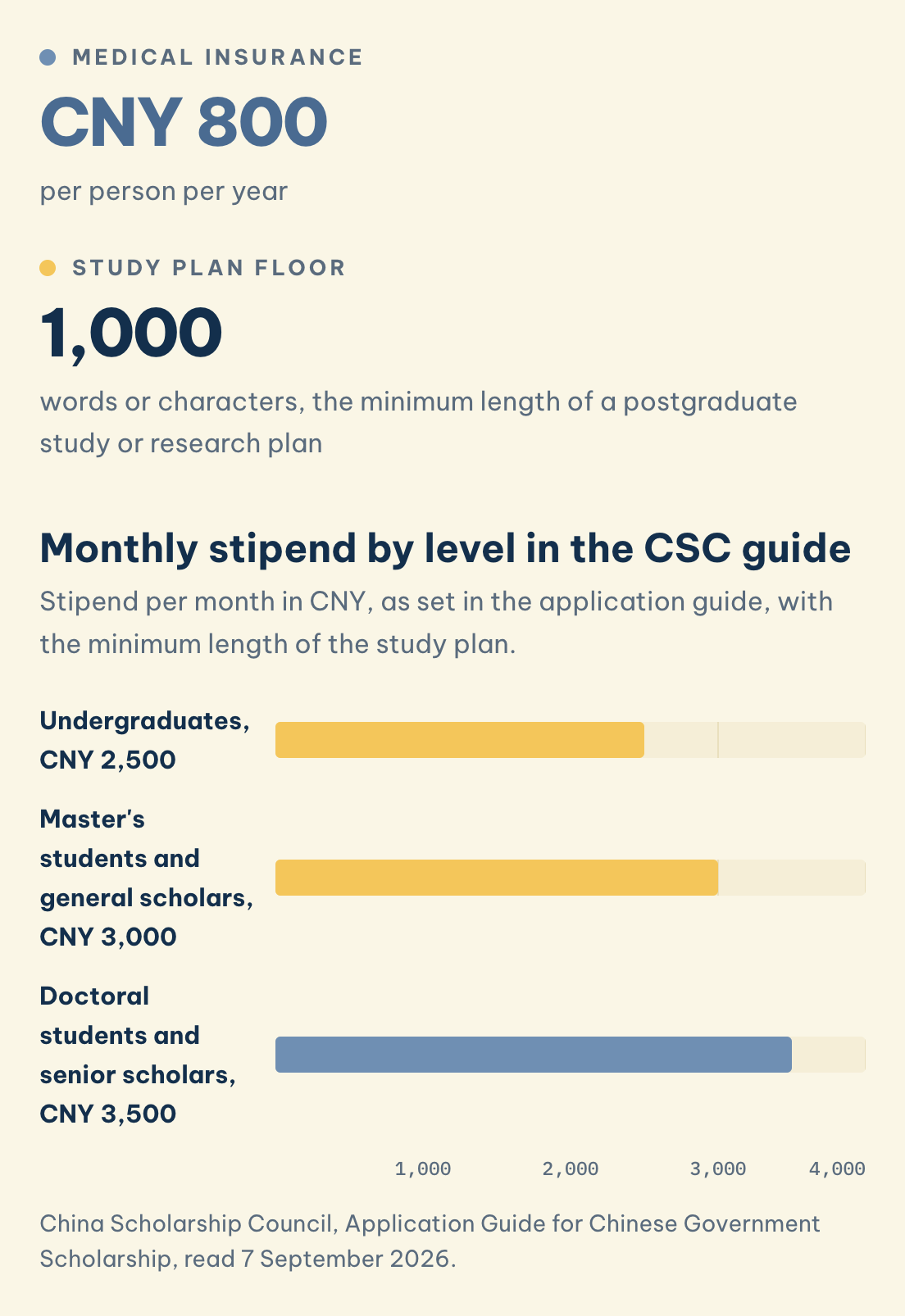
The master's and general scholar rate of CNY 3,000 and the undergraduate rate of CNY 2,500 sit below it on the same schedule. The eligibility clauses are equally specific. A doctoral applicant must hold a master's degree or its equivalent and be under the age of 40 when applying, and must have passed HSK Level 4 for a Chinese-taught master's or doctoral programme. Medical insurance is set at CNY 800 per person per year, or CNY 400 for programmes lasting under six months.
The document requirements have their own arithmetic. A postgraduate study or research plan must run to no less than 1,000 words or characters, two recommendation letters from professors or associate professors are required for postgraduate applicants, and the certificate of non-criminal record is normally expected to have been issued within six months of submission. The Foreigner Physical Examination Form carries the same six-month validity, and the guide adds that the scholarship covers Chinese language preparatory study lasting one year on top of the major study period, as verified on 7 September 2026.
◆ Question 7 / 7 · What to do first
What should you do first?
Direct answer: Work backwards from the document you cannot write yourself. Every other item in the file is under your control and can be produced on your own schedule, while the pre-admission letter depends on a stranger reading your research plan and choosing to put their name on it.
Two consequences follow. The research plan has to exist in a readable state well before the application window, because it is what the prospective supervisor is being asked to endorse, and in the stricter cases to sign. Our guide to narrowing a PhD research direction covers the sharpening that has to happen before that letter is worth requesting.
And the approach to a professor is not a networking step here; it is the production of a required document. That reframes what the first email has to contain, which our guide to the first email to a professor sets out in full.
MAAS works with applicants on this as academic advisors. Your expert drafts the research plan from your own account of your work, and you review, edit and approve it, and you submit the application yourself. Our experts also challenge the argument and the evidence before the plan reaches a supervisor who is being asked to sign it. You can see the full pathway in our PhD application guide, and the scope of the work in PhD supervisor search and application strategy.
Frequently asked questions
Is a supervisor's invitation letter compulsory for the CSC?
The CSC application guide lists pre-admission documents among required application materials and names an invitation letter from the school or professor as one acceptable form. Individual universities set their own additional requirements on top, so the programme page for your target university is the document that governs your case.
How long must the doctoral research plan be?
The CSC guide sets a floor of 1,000 words or characters for postgraduate applicants. Some universities require more and add their own conditions; the University of Shanghai for Science and Technology, for example, requires the doctoral proposal to carry the Chinese supervisor's signature.
Do I need HSK if my programme is taught in English?
The guide requires HSK Level 4 for Chinese-taught master's and doctoral programmes. For programmes taught in another language it requires you to meet the language and academic admission requirements of your preferred university, which means the university's page, not the CSC page, sets that bar.
Who tells me the result?
The CSC notifies the receiving agency, which then informs the applicant. That is why identifying your route at the start matters: it determines who holds your result and who you can reasonably follow up with.
Is there an age limit for doctoral applicants?
The guide requires a doctoral applicant to hold a master's degree or its equivalent and be under the age of 40 when applying. Separate limits apply to other categories, including under 35 for master's programmes and under 50 for senior scholars.
Related MAAS guides
References
Bahtilla, M. (2022). Research supervision of international doctoral students: Perspectives of international students in two comprehensive universities in China. International Journal of Doctoral Studies, 17, 181–199. https://doi.org/10.28945/4970
Jung, J., Li, H., & Horta, H. (2023). Procedures, criteria and decision-making in doctoral admissions: The case of China's leading research universities. Assessment & Evaluation in Higher Education, 48(8), 1197–1211. https://doi.org/10.1080/02602938.2023.2179595
Latief, R., & Lefen, L. (2018). Analysis of Chinese government scholarship for international students using analytical hierarchy process. Sustainability, 10(7), 2112. https://doi.org/10.3390/su10072112
Tools & resources
- China Scholarship Council, Application Guide for Chinese Government Scholarship: https://www.campuschina.org/content/details3_74776.html
- China Scholarship Council online application system: https://studyinchina.csc.edu.cn/
- University of Shanghai for Science and Technology, Chinese Government Scholarship prospectus: https://isoe.usst.edu.cn/2023/1026/c9774a309632/page.htm
A free 20-minute consultation is a conversation about your situation and the route you are applying through.
Book a free consultation ▸