
◆ PhD Admissions
Is an honorary doctorate a real PhD, and can you use Dr?
Category: admissions
Last updated: 2026-10-20

Google's People also ask box for this keyword asks whether an honorary doctorate is a real PhD, whether you can call yourself Dr with one, and whether honorary doctorate degrees are real degrees. The results that follow those questions are crowded with websites selling honorary doctorates, which makes the topic confusing for students who simply want to know what the title means. The short version is that an honorary doctorate is an honour, not a qualification, and the rules for using "Dr" depend on which university awarded it.
Direct answer: An honorary doctorate is an honour a university gives to a person of distinction, and it is not a PhD or any other qualification. It cannot be applied for or bought. Whether the holder may use "Dr" depends on the awarding university: Australian Catholic University forbids it outright, and Macquarie University forbids it outside the university.
◆ Question 1 / 7 · A real PhD?
Is an honorary doctorate a real PhD?
Direct answer: No. A PhD is an earned qualification, and an honorary doctorate is a recognition. The two share the word "doctorate" and nothing else about how they are obtained or what they certify. A PhD needs years of supervised research and an examined thesis, while an honorary award needs neither.
An earned doctorate in the United Kingdom rests on research that the candidate has carried out and defended. The Quality Assurance Agency for Higher Education (QAA) says doctoral degrees are awarded for the creation and interpretation of new knowledge through original research, "of a quality to satisfy peer review, extend the forefront of the discipline, and merit publication" (QAA, 2024, p. 27). Its characteristics statement adds that "All UK doctorates, regardless of their form, continue to require the main focus of the candidate's work to demonstrate an original contribution to knowledge" (QAA, 2020, p. 3).
An honorary award has no such test. Kingston University (2025) sets out the principle in its regulations: "Honorary Awards shall be conferred on persons of distinction who will enhance the reputation of the University and strengthen its mission" (Kingston University, 2025, p. 3). The decision rests on the person's record and on what the award does for the university, so no thesis, supervision or examination is involved. That is the difference in kind, and it is why the answer to "is it a real PhD?" is no even when the ceremony looks the same as a graduation.
◆ Question 2 / 7 · A real degree?
Are honorary doctorate degrees real degrees?
Direct answer: Honorary doctorates are real honours awarded by real universities, but they are not formal qualifications. Australian Catholic University (n.d.) calls the titles "honorific titles only and not formal qualifications under the Australian Qualifications Framework". The letters record an honour, not completed study.
The distinction matters because people use "degree" for two different things. A degree is normally a qualification, meaning the university certifies that you completed a programme and met its learning outcomes. An honorary degree certifies something else, which is that the university wishes to honour you. Australian Catholic University (n.d.) also notes that an honorary degree may be awarded "whether or not such person has graduated at a university", which would make no sense for a qualification.
Macquarie University (n.d.) makes the same separation visible in the title itself. Its policy says honorary degrees are identified by the inclusion of "Hon" in the post-nominals, so a holder writes something like HonDSc and not DSc. The Australian National University (n.d.) lists post-nominals in the same style, including HonDSc, HonLittD, HonLLD and HonDUniv. Kingston University (2025, p. 4) lists its titles as Hon DArts, Hon DAD, Hon DEng, Hon LLD, Hon DLitt, Hon DSc and Hon DUniv. In every case the "Hon" tells the reader that the letters record an honour.
◆ Question 3 / 7 · Using the title Dr
Can you call yourself Dr with an honorary doctorate?
Direct answer: It depends on the university, and two of four Australian policies forbid it, either outright or outside the university. The four give four different answers, so no single rule applies, and the only safe guide is the policy of the university that made the award.
Can an honorary doctor use the title Dr?
Each row sets one Australian university's policy beside the rule it gives on the title.
University policy
Rule on the title Dr
Australian Catholic University
Not permitted; the award is an honorific title, not a formal qualification
Macquarie University
Not permitted before the name outside the university
Australian National University
Only at activities or events associated with the university
University of Canberra
Permitted only when the post-nominal is also used
Save this figure
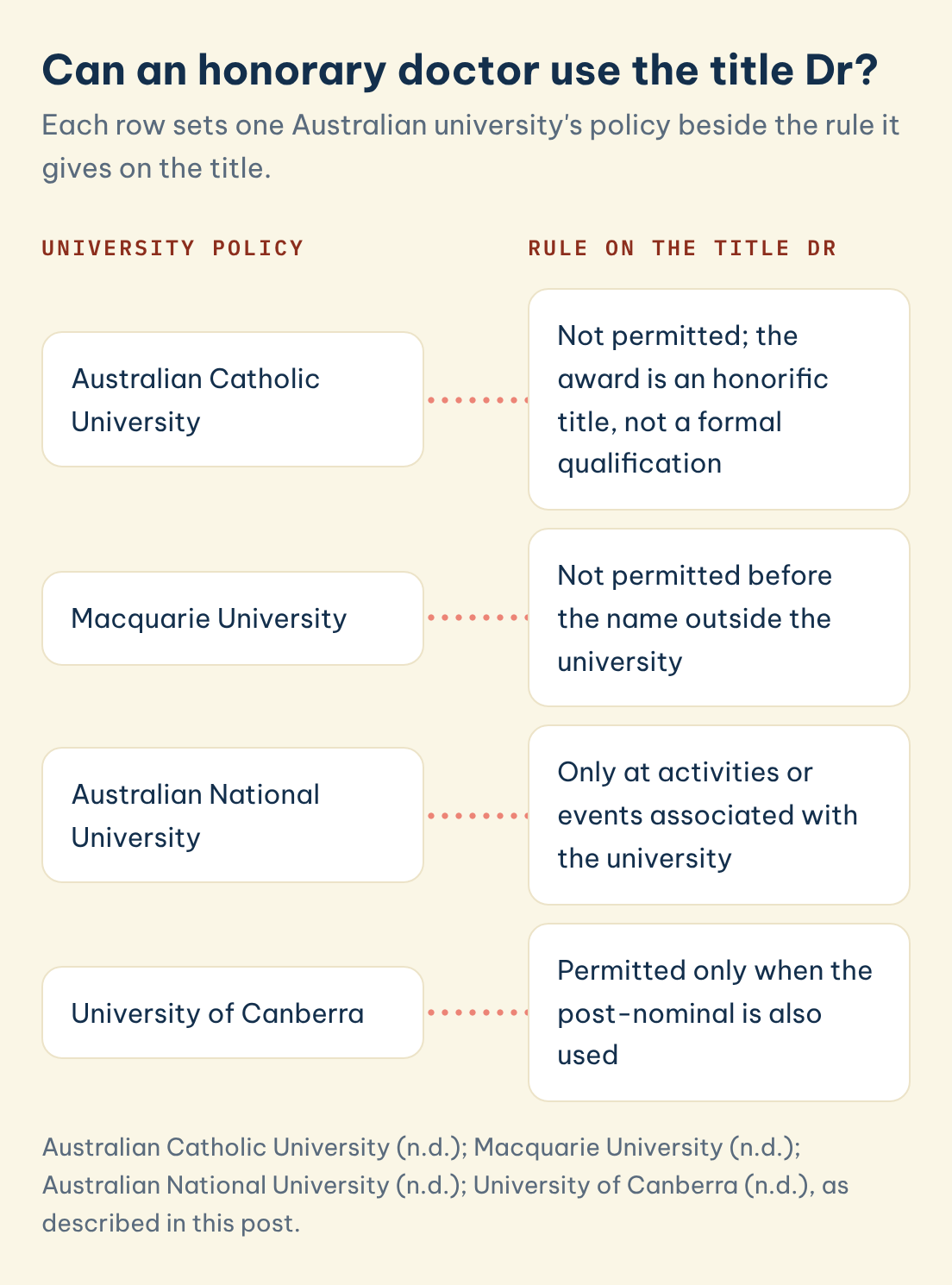
Australian Catholic University (n.d.) says plainly that "it is not permissible for an individual who is awarded an honorary degree to use the title 'Doctor' or 'Dr'", although the post-nominal is allowed. Macquarie University (n.d.) says "Recipients of Honorary Degrees are not entitled to use the titles 'Doctor' or 'Dr' before their names outside the University", which leaves some room inside the institution.
The Australian National University (n.d.) limits use to university occasions: "Use of the title 'Doctor' or 'Dr', associated with an honorary degree of the University, is only permitted when participating in an activity or event associated with the University." University of Canberra (n.d.) is more generous again, since a recipient is entitled to preface their name with "Dr" only when the post-nominal is also used. The practical lesson is that you should read the policy of the university that made the award, and that using "Dr" on a business card, a profile or a passport application on the strength of an honorary degree may break that university's rules.
The table below sets the main differences side by side.
| Feature | Honorary doctorate | Earned PhD |
|---|---|---|
| How it is obtained | Conferred by the university on a person of distinction | Earned through admission, supervised research and examination |
| Study or thesis | None required | Original thesis defended before examiners |
| Qualification status | Honorific title, not a formal qualification (Australian Catholic University, n.d.) | Doctoral qualification at the top of the UK framework (QAA, 2024, p. 27) |
| Use of "Dr" | Set by each university; forbidden outside the university at some | Normal title of the holder |
| Post-nominal | For example Hon DLitt or HonDUniv | PhD |
| Can you apply? | No; the university chooses the recipient | Yes, through a programme application |
◆ Question 4 / 7 · How recipients are chosen
How do you get an honorary doctorate, and can you apply for one?
Direct answer: You cannot apply for one. The university selects recipients, and eligibility rules often exclude people who work or study there. Kingston University (2025, p. 3) bars current staff and students from receiving its honorary awards, and the process runs through nomination and a committee decision.
Kingston University (2025) states that honorary awards may not be conferred on people employed by the university at the time, and that current staff and students are not eligible. The regulation also expects the recipient to be present at a ceremony, with an award in their absence treated as exceptional. The Australian National University (n.d.) does not confer its honorary degrees in absentia. These details point to a process run by the institution from the inside, with a nomination, a committee and a ceremony, and no route for a member of the public to submit a request.
For this reason, a website offering you an honorary doctorate in exchange for payment or a form is not offering what a university awards. Search results for this keyword are crowded with such sites, and we do not name them here. A certificate sold online is not a university honorary degree. It carries no recognition from a degree-awarding body, and presenting it as a doctorate in a CV, on a profile or in an application could mislead the person reading it.
◆ Question 5 / 7 · Free certificates online
Is there a free honorary doctorate certificate?
Direct answer: A certificate that anyone can download or order is not an honorary degree. Real honorary degrees are conferred by a university on someone it has chosen, and the university's own regulations decide who qualifies. A downloaded certificate carries no recognition from any degree-awarding body.
The phrase "free honorary doctorate degree certificate" appears among Google's related searches for this keyword, and the demand behind it is understandable. Someone wants the look of the title without the years of study. The sources above show why that route does not exist: the award responds to a person's distinction and contribution, not to a request. If a site invites you to claim a doctorate, check whether the issuing body is a university with degree-awarding powers, then read that university's honorary awards policy to see how recipients are chosen.
◆ Question 6 / 7 · What it lets you do
What can you do with an honorary doctorate?
Direct answer: You can record the honour with its post-nominal, and in some universities you can use "Dr" at university events. You cannot treat it as a qualification, for example for entry to a PhD programme or for a role that requires a doctorate.
The honour belongs on a list of achievements, written the way the awarding university specifies. Macquarie University (n.d.) and the Australian National University (n.d.) both direct holders to the "Hon" form of the post-nominal. What the honour does not do is replace study. Because Australian Catholic University (n.d.) classes the titles as outside the Australian Qualifications Framework, an honorary doctorate would not meet an admission rule or a job requirement that asks for a doctoral qualification.
◆ Question 7 / 7 · Dr through study
What should you do if you want the title Dr through study?
Direct answer: The route to the title Dr as a qualification is an earned PhD, which means applying to a programme, finding a supervisor and producing original research that examiners assess. Honorary awards are not a shortcut to it, because no university grants one on request.
An earned doctorate requires a research question, a supervisor who will support it and a programme that accepts your application. If you are still deciding whether the degree is right for you, Should you do a PhD? What the degree certifies explains what the qualification actually tests. The order of the application work is covered in PhD application resources. Its adviser support covers the PhD application stage, and the page for PhD Application Strategy and Execution sets out what that includes and what you approve at each step.
Frequently asked questions
Is an honorary doctorate a real PhD?
No. A PhD is earned through original research that meets the standard described by the Quality Assurance Agency for Higher Education (QAA, 2020, p. 3). An honorary doctorate is conferred on a person of distinction and involves no thesis (Kingston University, 2025, p. 3).
Can you call yourself Dr. with an honorary PhD?
The answer depends on the university. Australian Catholic University (n.d.) does not permit it, Macquarie University (n.d.) does not permit it outside the university, and the Australian National University (n.d.) permits it only at university events. University of Canberra (n.d.) allows "Dr" only when the post-nominal is also used.
Are honorary doctorate degrees real degrees?
Honorary doctorates are real honours from real universities, but not qualifications. Australian Catholic University (n.d.) describes them as honorific titles and not formal qualifications under the Australian Qualifications Framework.
How to get an honorary doctorate?
You cannot apply for one. The university decides, and Kingston University (2025, p. 3) excludes current staff and students from eligibility. Awards given for payment by websites are not university honorary degrees.
What can you do with an honorary doctorate?
You can note the honour and use its "Hon" post-nominal as the awarding university allows, and in some cases use "Dr" at university events. It does not count as a doctoral qualification (Australian Catholic University, n.d.).
Is there a free honorary doctorate degree certificate?
No genuine free certificate exists. A certificate that is offered to anyone is not a university honorary degree, because a university confers the award on a person it has chosen.
Related MAAS guides
References
Australian Catholic University. (n.d.). Statute 6.2: Admission to degrees: Honorary degrees. https://policy.acu.edu.au/document/view.php?id=38&version=1
Australian National University. (n.d.). Policy: Honorary degrees. https://policies.anu.edu.au/ppl/document/ANUP_011613
Kingston University. (2025). Academic regulations 11: Honorary awards 2025-2026. https://assets.kingston.ac.uk/m/3db38fe36c804a13/original/Policies-2025-26_AR11-Honorary-awards-2025-2026-A1.pdf
Macquarie University. (n.d.). Honorary degree policy. https://policies.mq.edu.au/document/view.php?id=88
Quality Assurance Agency for Higher Education [QAA]. (2020). Characteristics statement: Doctoral degree. https://www.qaa.ac.uk/docs/qaa/quality-code/doctoral-degree-characteristics-statement-2020.pdf
Quality Assurance Agency for Higher Education [QAA]. (2024). The frameworks for higher education qualifications of UK degree-awarding bodies. https://www.qaa.ac.uk/docs/qaa/quality-code/the-frameworks-for-higher-education-qualifications-of-uk-degree-awarding-bodies-2024.pdf
University of Canberra. (n.d.). Honorary appointments policy. https://policies.canberra.edu.au/document/view-current.php?id=224
Not sure how this guide applies to your own case? Talk it through with MAAS in a free 20-minute consultation.
Book a free consultation ▸