
◆ Admissions
How do you get an Erasmus Mundus scholarship for a master's?
Category: admissions
Last updated: 2026-10-22
An Erasmus Mundus scholarship is not a single fund with a single form. It belongs to an Erasmus Mundus Joint Master (EMJM), a master's programme run by a consortium of universities, and each consortium takes its own applications, sets its own English requirement and picks its own scholarship holders. For 2027 entry the application windows are opening now, and the first deadlines fall in early January 2027, so the useful work starts with choosing programmes rather than hunting for a scholarship page.
Direct answer: You apply directly to the Erasmus Mundus Joint Master you want, not to one central fund. Each consortium selects its own students and decides who receives the scholarship, worth up to EUR 1,400 a month. Entry needs a bachelor's degree, English requirements differ by programme, and most deadlines for 2027 entry fall in January.
◆ Question 1 / 6 · How to apply
How do I get an Erasmus Mundus scholarship?
Direct answer: Pick a Joint Master from the Erasmus Mundus catalogue, then apply on that programme's own website, ticking the scholarship option. The consortium selects students and decides who receives funding. Applications for courses starting the following academic year are usually submitted between October and January, so shortlist programmes early.
The European Commission describes Erasmus Mundus Joint Masters as international masters jointly designed and delivered by at least 3 institutions from at least 3 different countries, lasting 1 to 2 academic years (60, 90 or 120 ECTS credits) (European Commission, 2025a). Students apply directly to the institution running the chosen programme, and the course catalogue lists the programmes on offer. Each programme website carries the entry requirements and the steps of the application process, with and without a scholarship (European Commission, 2025a). The Programme Guide puts the legal weight on the consortium: selection, recruitment and monitoring of individual students fall under its sole responsibility, and only some of the students it selects may benefit from a scholarship (European Commission, 2025b). Applying, then, means preparing one file per programme, usually a CV, academic transcripts, a motivation letter and references (GLOBE also asks for a short introduction video) (GLOBE EMJM, 2026), which is why the choice of how many programmes to enter matters more than any single document. You can compare how a motivation letter differs from a statement of purpose in statement of purpose vs motivation letter.
◆ Question 2 / 6 · Who is eligible
Who is eligible to receive the Erasmus Mundus scholarship?
Direct answer: Anyone with a bachelor's degree or a recognised equivalent, or in the last year of bachelor studies, who has not already held an EMJM scholarship. Nationality is generally not a bar at EU level, since scholarships are open worldwide, though individual programmes set their own rules and consortia are asked to keep a geographical balance.
The Erasmus+ students page asks for a bachelor's degree (first degree), or a final year of bachelor studies with graduation before the master's starts, or a bachelor's-equivalent level of learning that is officially recognised in the degree-awarding country (European Commission, 2025a). That also answers the bachelor question people search for: the scheme funds master's study, and a bachelor's degree is the entry condition, not the level it pays for. The Programme Guide adds that "EMJM scholarships can be offered to students from all over the world. However, consortia should ensure geographical balance – i.e. no more than 10% of the total number of scholarships awarded during project implementation should be awarded to candidates from the same nationality" (European Commission, 2025b, p. 282). The word is "should", and it is guidance addressed to consortia over the whole project, not a quota on applicants. Students who have previously obtained an EMJM scholarship cannot apply for another (European Commission, 2025b, p. 282). Individual programmes add their own conditions, so GLOBE states that all nationalities are eligible, while Euroculture says applicants of most nationalities are eligible and excludes people who already received certain Erasmus Mundus or Erasmus+ scholarships at joint master or PhD level (GLOBE EMJM, 2026; Euroculture EMJM, 2026).
◆ Question 3 / 6 · What it pays
What does the Erasmus Mundus scholarship pay?
Direct answer: The 2026 Programme Guide calculates the scholarship as EUR 1,400 a month for the length of the programme, covering travel, visa, installation and subsistence. Scholarship holders pay no tuition or application fees, and a programme can fund at most 50 scholarships, excluding top-ups for targeted world regions.
| Item | What the Programme Guide or programme site says |
|---|---|
| Monthly amount | EUR 1,400 per month of the master's programme (European Commission, 2025b, p. 283) |
| Duration covered | Full-time enrolment for the whole programme, for example 12, 18 or 24 months (European Commission, 2025b, p. 282) |
| Costs it contributes to | Travel, visa, installation and subsistence (European Commission, 2025b, p. 282) |
| Fees for holders | No tuition fees or other mandatory participation costs, and no student application fees (European Commission, 2025b, p. 282) |
| Scholarships per programme | At most 50 over the grant agreement, excluding top-ups for targeted regions (European Commission, 2025b, p. 283) |
The scholarship is a contribution to costs, not a full cost-of-living guarantee, and the Guide's wording is "a contribution to the costs incurred by the beneficiary students" (European Commission, 2025b, p. 282). Programme sites confirm the same figure in practice. Euroculture lists EUR 1,400 per month through its 24-month programme with a full tuition fee waiver and health insurance, and GLOBE lists a monthly stipend of EUR 1,400 for 24 months including all participation fees (Euroculture EMJM, 2026; GLOBE EMJM, 2026). Check your own cost of living in the host countries you would move through, because a programme with study periods in 2 or 3 countries means 2 or 3 sets of rent deposits.
◆ Question 4 / 6 · IELTS
Is IELTS required for Erasmus Mundus?
Direct answer: The Commission sets no single IELTS score. Each programme sets its own English requirement, and the two programmes checked here range from IELTS 5.5 at GLOBE to 6.5, with no section below 6.5, at Euroculture. Read the entry requirements on the programme website before booking a test.
English minimum by programme
IELTS Academic overall score each programme asks for, 2027 intake.
Programme
IELTS minimum
GLOBE
5.5
Euroculture
6.5
Save this figure
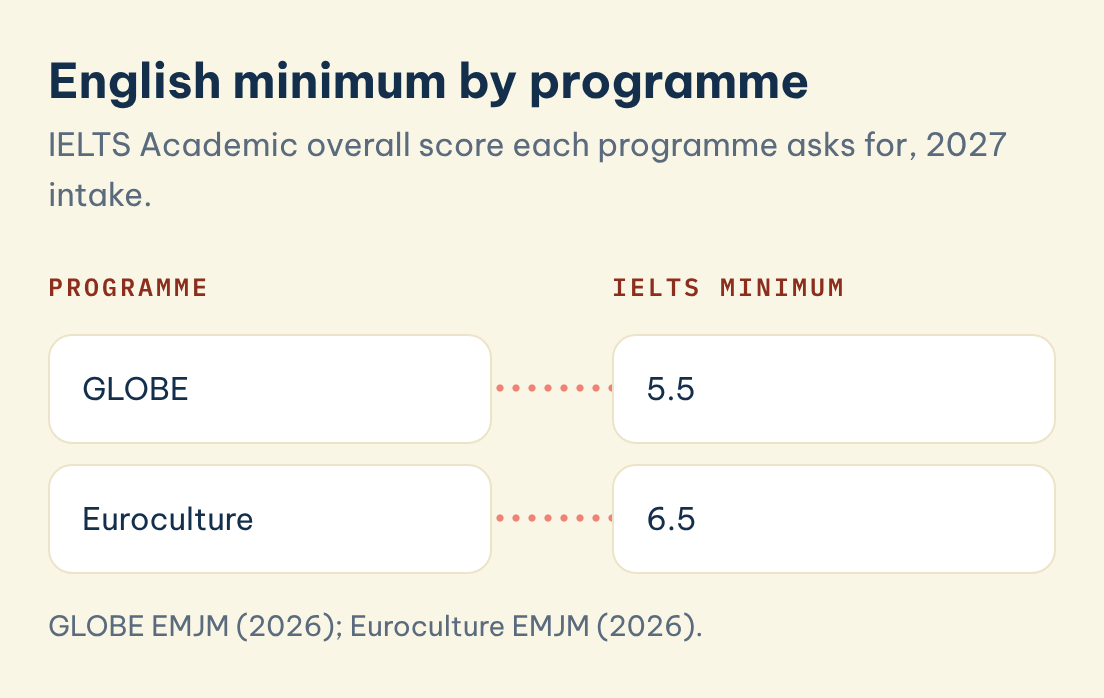
Because the Erasmus+ page sends you to each master's website for entry requirements, the English threshold is a programme decision (European Commission, 2025a). GLOBE (2027-2029 intake) requires at least B2 and accepts IELTS with a minimum of 5.5 or TOEFL iBT with at least 72 points (GLOBE EMJM, 2026). Euroculture requires IELTS Academic with an overall 6.5 and no section below 6.5 (Euroculture EMJM, 2026). A minimum is the entry ticket to be considered, so a candidate sitting on the exact minimum is in a weaker position than the minimum suggests when places are limited. If you are comparing tests, PTE Academic vs IELTS and the TOEFL iBT score guide for 2026 cover the formats, and IELTS Academic vs General Training explains which version a university accepts.
◆ Question 5 / 6 · 2027 deadlines
When is the Erasmus Mundus scholarship 2027 deadline?
Direct answer: There is no single date. The Commission says most applications fall between October and January for courses starting the following academic year. For 2027 entry, GLOBE closes on 4 January 2027, while Euroculture sets 15 January 2027 as the scholarship deadline.
| Programme | Applications open | Scholarship deadline | Source |
|---|---|---|---|
| GLOBE (2027-2029) | 28 September 2026 | 4 January 2027 | GLOBE EMJM (2026) |
| Euroculture (2027-2029) | 15 October 2026 | 15 January 2027, results at the end of March 2027 | Euroculture EMJM (2026) |
Euroculture states plainly that to be considered for an Erasmus Mundus scholarship, a complete application must arrive by 15 January 2027 (Euroculture EMJM, 2026). As a rule of thumb, working backwards from a 4 January deadline means recommenders need your request by early November and a language test result should be in hand before December. A similar pattern is covered for doctoral funding in why scholarship deadlines come before programme deadlines.
◆ Question 6 / 6 · How hard it is
How difficult is it to get an Erasmus Mundus scholarship?
Direct answer: Hard, and no official EU-wide success ratio exists, so any single percentage you see is not from the Commission. Programme figures show the scale. One programme, CYBERUS, reported 5,480 applications, 427 interviews, 128 registered students and 88 full scholarships. Treat that as one example, not a general rate.
The French evaluation council Haut Conseil de l'évaluation de la recherche et de l'enseignement supérieur (HCERES) reported that CYBERUS "has received 5,480 applications, conducted 427 interviews, registered 128 students, and graduated 51," and that of the registered students, 88 received full scholarships (Haut Conseil de l'évaluation de la recherche et de l'enseignement supérieur, 2025). That is a single cybersecurity programme with its own pool, so it shows how many applications one consortium can face, not what a typical applicant's chances are. The competition also operates at programme level: the Commission's agency reported that 30 EMJMs were selected among 58 applications in the second 2021-2027 call (European Education and Culture Executive Agency, 2023). Since the Programme Guide only asks consortia to keep nationalities balanced, it does not fix how many places go to any region, so a good case rests on the programme's own criteria. The Commission notes that almost 50,000 students have taken part since 2004 (European Commission, 2025a), which is a measure of scale, not of selectivity.
Practical consequences follow from this. Apply to several programmes, because each runs its own selection and your file is judged against that programme's pool. Keep the file specific to each course, since a general letter reads as general. If you want a second reader while you shortlist programmes and build each application, MAAS works with applicants as academic advisors on study abroad statement of purpose consulting. You choose the programmes and make every decision, our experts challenge the fit and the structure of your own account, and you review, edit, approve and submit it yourself. No one can promise a place or a scholarship, because that decision belongs to the consortium. For doctoral funding rather than master's, see Erasmus PhD scholarship and funded positions in Europe.
Frequently asked questions
Is the Erasmus Mundus scholarship the same as Erasmus+ study exchange?
No. An Erasmus Mundus Joint Master is a full master's programme run by a consortium, while the Erasmus+ exchange is a mobility period within a degree at a home university. Scholarship rules in this post apply to the Joint Masters only.
Do I apply for the scholarship separately from the programme?
You apply on the programme's own website, and the scholarship option is part of that application. The consortium selects students and decides who receives the scholarship (European Commission, 2025b).
Can I apply to more than one Erasmus Mundus master's?
The sources checked here set no limit on how many programmes you can apply to, and each programme runs its own application. Read each programme's rules before you submit, since they may differ.
Does the scholarship cover tuition?
Programmes cannot charge scholarship holders tuition fees or other mandatory costs related to participation, and the monthly amount is a contribution to travel, visa, installation and subsistence (European Commission, 2025b, p. 282).
Is a 10% limit per country a rule that blocks my application?
No. The Guide says consortia should ensure that no more than 10% of scholarships awarded during the project go to candidates of the same nationality, which is guidance to consortia and not a bar on applicants (European Commission, 2025b, p. 282).
Can I study the master's online?
Not fully. The Programme Guide states that Erasmus Mundus Joint Masters must include compulsory physical mobility for all enrolled students, and virtual mobility cannot replace it (European Commission, 2025b, p. 277).
Related MAAS guides
References
European Commission. (2025a). Erasmus Mundus Joint Masters (students). Erasmus+. https://erasmus-plus.ec.europa.eu/opportunities/individuals/students/erasmus-mundus-joint-masters
European Commission. (2025b). The Erasmus+ programme guide 2026. https://erasmus-plus.ec.europa.eu/sites/default/files/2025-11/programme-guide-2026_en.pdf
European Education and Culture Executive Agency. (2023). Erasmus Mundus: Analysis of the results of the second 2021-2027 call. Joint Masters and Design Measures. Publications Office of the European Union. https://doi.org/10.2797/38904
Euroculture EMJM. (2026). Application procedure. https://www.euroculturemaster.eu/application-procedure
GLOBE EMJM. (2026). Apply. https://globe-master.eu/apply/
Haut Conseil de l'évaluation de la recherche et de l'enseignement supérieur. (2025). Evaluation report: CYBERUS Erasmus Mundus Joint Master in Cybersecurity. https://backend.deqar.eu/reports/HCERES/370730_20251205_1218_A2027-EV-0561718N-DEI-ETAB270026169-RD.pdf
Tools & resources
Not sure how this guide applies to your own case? Talk it through with MAAS in a free 20-minute consultation.
Book a free consultation ▸