
◆ Admissions
IELTS Academic or General Training: which test do you need?
IELTS General Training and IELTS Academic share a name, a nine-band scale and two identical sections, yet they are different tests with different purposes. Picking the wrong one can mean booking, paying for and sitting a test that your university or immigration office will not accept. This guide sets out what changes between the two, who each is meant for, and how to check which one your own route asks for.
◆ Question 1 / 7 · The difference
What is the difference between IELTS Academic and General Training?
Direct answer: Listening and Speaking are the same in both tests, while Reading and Writing differ. IELTS (n.d.-a) says Academic is likely the right choice if you plan to study in an English-speaking country, and General Training suits people migrating, or training or studying below degree level.
The four IELTS sections and which ones are shared
Tap a section to see how the two tests treat it.
Listening
The same in both tests.
Reading
Differs. Academic uses texts for a non-specialist audience, with a total text length of 2150 to 2750 words. General Training uses everyday and work texts, with a total of 2150 to 2375 words. Both have 40 questions.
Writing
Differs. Task 1 is a description of visual information in Academic and a letter in General Training. Task 2 is at least 250 words in about 40 minutes in both.
Speaking
The same in both tests.
Save this figure
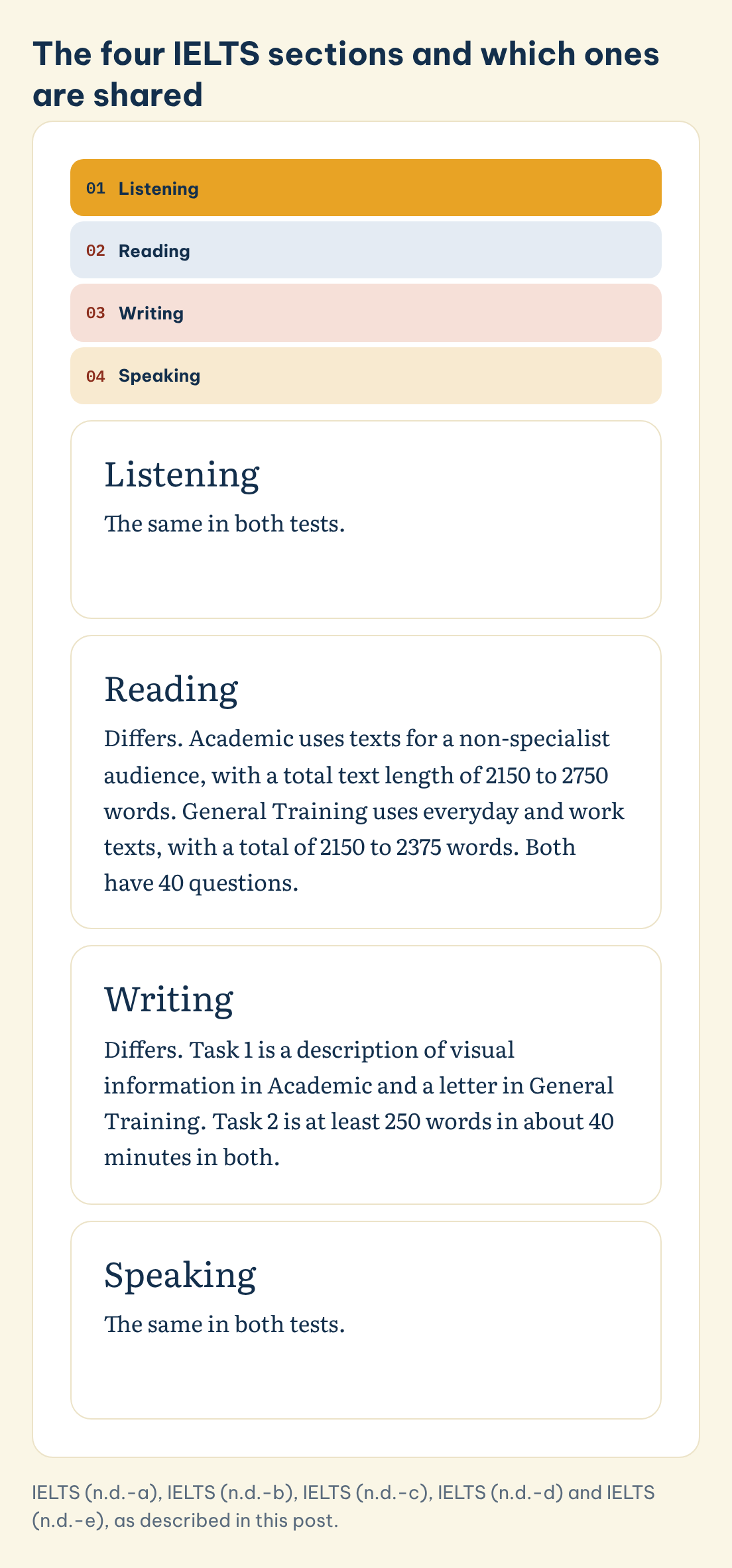
IELTS states the split in one sentence: "In both the General Training and the Academic tests, the Speaking and Listening sections are the same. However, the Reading and Writing sections of these tests differ." (IELTS, n.d.-a). In practical terms, two of the four sections are shared, so any practice you do for Listening and Speaking carries over whichever test you finally book. The sections that do not carry over are the ones where the content is built for a different purpose.
The purpose is where the choice starts. IELTS (n.d.-a) says that if you plan to study in a country where English is spoken, the Academic test is likely the right choice. It describes General Training as suitable for people wishing to migrate to a country where English is spoken, naming Australia, Canada, New Zealand and the UK, and for people wishing to train or study at below degree level. The same page adds that General Training "assesses everyday English language skills that you will need in social situations and in workplace environments" (IELTS, n.d.-a).
◆ Question 2 / 7 · Which test
Which test do you need for study, migration or a visa?
Direct answer: It depends on the purpose and on the body asking for the score. IELTS (n.d.-a) advises that you "always check entry requirements" for your target country, institution or association before choosing a test, so the receiving organisation's page outranks any general guide.
The table below sets out what the sources read for this post say about each purpose. It is a map of where to look, not a substitute for the requirement page of your own university or visa route.
| Your purpose | What the source says | Source |
|---|---|---|
| Study in an English-speaking country | Academic is likely the right choice | IELTS (n.d.-a) |
| Migrate to Australia, Canada, New Zealand or the UK | General Training is suitable | IELTS (n.d.-a) |
| Train or study below degree level | General Training is suitable | IELTS (n.d.-a) |
| Canada Express Entry | "You must take the IELTS General Training option." | Immigration, Refugees and Citizenship Canada (n.d.) |
| Australia Student visa (subclass 500) | The instrument lists both IELTS Academic and IELTS General Training as approved tests | Australian Government (2025) |
| UK visas | IELTS for UKVI is the test named for visa types including the Student visa | IELTS (n.d.-a) |
The last two rows deserve care, because they are the ones most often misread. For Canada, the page of Immigration, Refugees and Citizenship Canada (n.d.) is direct: "You must take the IELTS General Training option." That wording sits in the Express Entry language-testing rules. For Australia, the Student visa instrument names both versions, so the test type you need there is a matter of reading the instrument and your provider's own entry rules, not of assuming one answer.
◆ Question 3 / 7 · Reading and Writing
How do Reading and Writing differ between the two tests?
Direct answer: Academic Reading uses texts for a non-specialist audience at undergraduate or postgraduate level, and General Training Reading uses everyday and work texts. Writing differs in Task 1: a description of a graph, table, chart or diagram in Academic, and a letter in General Training.
Writing and Reading: Academic beside General Training
Each row sets the Academic version beside the General Training version.
Academic
General Training
Writing Task 1: describe a graph, table, chart or diagram, at least 150 words in about 20 minutes
Writing Task 1: write a letter responding to a situation, at least 150 words in about 20 minutes
Writing Task 2: discuss a point of view, argument or problem, at least 250 words in about 40 minutes
Writing Task 2: a semi-formal or neutral discursive essay, at least 250 words in about 40 minutes
Reading: 3 sections, 40 questions, total text length 2150 to 2750 words
Reading: 3 sections, 40 questions, total text length 2150 to 2375 words
Save this figure
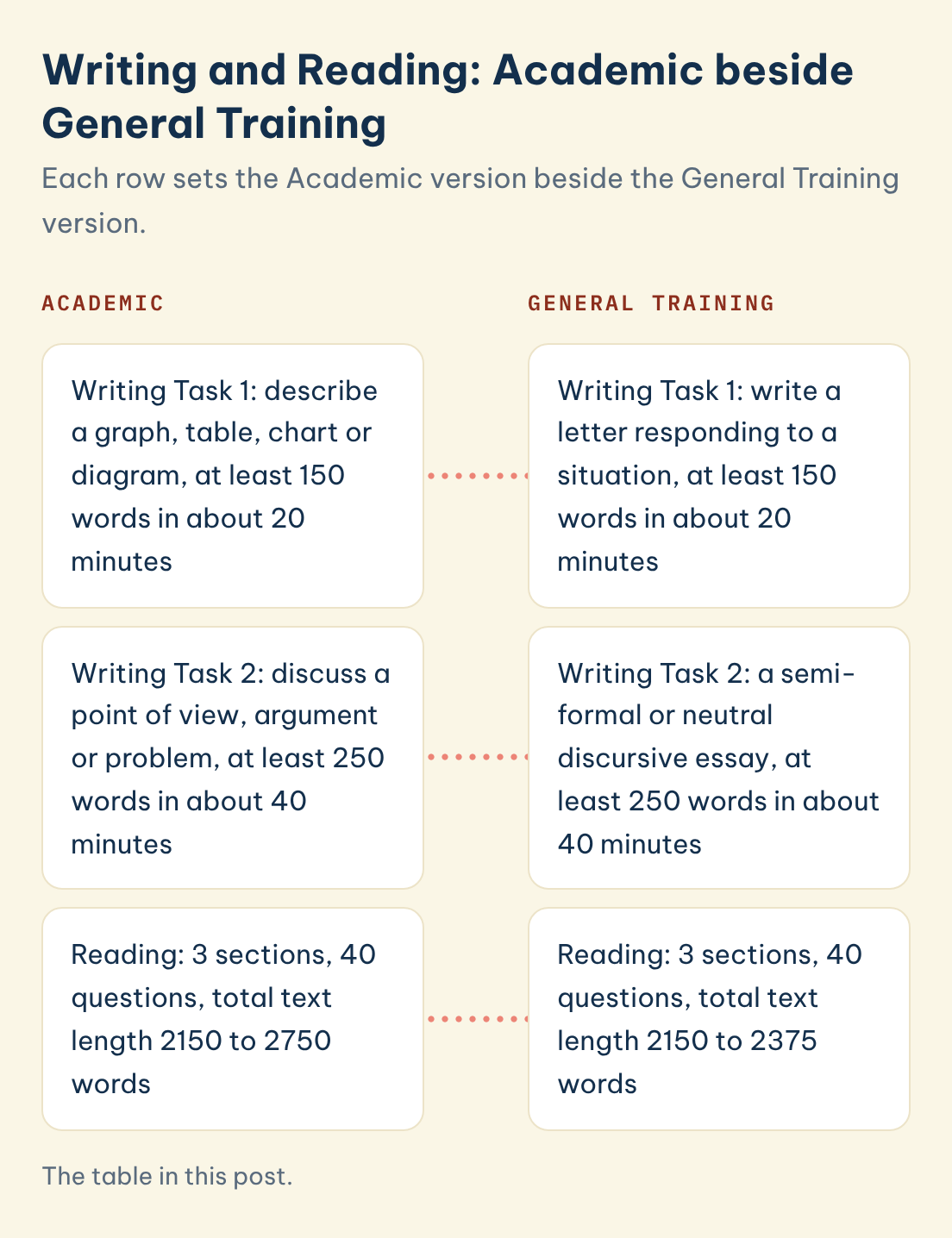
The sections are built from different material. IELTS (n.d.-d) says Academic Reading texts "come from books, journals, magazines, newspapers and online resources, written for a non-specialist audience", on topics of general interest to students at undergraduate or postgraduate level. General Training Reading starts from daily life. Section 1 deals with everyday topics, such as notices, advertisements and timetables, Section 2 focuses on work topics, such as job descriptions, contracts and training materials, and Section 3 deals with a topic of general interest (IELTS, n.d.-e).
| Feature | Academic | General Training |
|---|---|---|
| Reading sections | 3 | 3 |
| Reading questions | 40 | 40 |
| Total Reading text length | 2150 to 2750 words | 2150 to 2375 words |
| Writing Task 1 | Describe visual information: a graph, table, chart or diagram | Respond to a situation by writing a letter |
| Writing Task 1 length | At least 150 words in about 20 minutes | At least 150 words in about 20 minutes |
| Writing Task 2 | A point of view, argument or problem to discuss | A semi-formal or neutral discursive essay |
| Writing Task 2 length | At least 250 words in about 40 minutes | At least 250 words in about 40 minutes |
Both Writing tasks run to the same length in the two tests, and for both, "Task 2 contributes twice as much as Task 1 to the Writing score" (IELTS, n.d.-b). The difference is in what Task 1 asks you to do. In Academic you "describe some visual information in your own words" (IELTS, n.d.-b). In General Training you respond to a situation with a letter, for example asking for information or explaining a situation, and the task lists the information to include as three bullet points. IELTS (n.d.-c) adds that depending on the task, the letter may be personal, semi-formal or formal in style.
◆ Question 4 / 7 · Easier or not
Is General Training easier than Academic?
Direct answer: The sources read for this post do not say so. Both tests report on the same nine-band scale (IELTS, 2023), and no official statement was found comparing how raw scores convert between them. Treat claims that one test is easier as unverified, and judge by which tasks you write and read well.
People often say that General Training is the easier option, and it is natural to wonder whether that is true. The Reading texts of General Training are shorter in total, with a stated range of 2150 to 2375 words against 2150 to 2750 for Academic (IELTS, n.d.-d; IELTS, n.d.-e). But a shorter text range is not evidence that a given band is easier to reach, and no official statement about how raw scores convert to bands differently between the two tests was found while preparing this guide. It would be a mistake to build a plan on that rumour.
What can be checked is how Writing Task 1 is judged. The published band descriptors carry one title for both tests, "Scoring criteria for Academic and General Training tests", with the same four criteria. Within Task Achievement, however, the wording is test-specific. At band 4, the descriptors read: "(Academic) Few key features have been selected." and "(General Training) Not all bullet points are presented." (IELTS, 2023, p. 3). So an Academic candidate is judged on the key features picked from visual data, and a General Training candidate on the bullet points, purpose and tone of a letter. Neither skill is a shortcut. They are different habits, and each needs its own practice.
◆ Question 5 / 7 · Canada, Australia, UK
Do Canada, Australia and the UK ask for the same test?
Direct answer: Not in the sources checked. Canada's Express Entry page says you must take the IELTS General Training option, Australia's Student visa instrument lists both IELTS Academic and General Training as approved, and IELTS names IELTS for UKVI for UK visas, so confirm the variant with your sponsor.
Because migration routes and study routes can sit in the same country, it is easy to assume one test fits the whole country. It does not. For Canada, the relevant page is about Express Entry, and its wording is "You must take the IELTS General Training option." (Immigration, Refugees and Citizenship Canada, n.d.). The same page adds: "We don’t accept IELTS One Skill Retake for Express Entry." That is a rule about one route, and it should not be read as a rule for study permits or for every institution in Canada.
For Australia, the Migration (English Language Tests and Evidence Exemptions for Subclass 500 (Student) Visas) Instrument 2025 lists approved tests that include "IELTS Academic" and "IELTS General Training" (Australian Government, 2025). For the UK, IELTS (n.d.-a) says the IELTS for UKVI test is the one to take for visa types that include the Skilled Worker visa and the Student visa. The pages read for this guide do not say which variant a particular course or route needs, so confirm that with the sponsor. For a related question about when a certificate is needed at all, see our guide to whether an English-taught master's replaces IELTS.
◆ Question 6 / 7 · Taking it online
Can you take IELTS General Training online?
Direct answer: Check the booking page for your country before you plan around it. The official format pages read for this guide do not settle whether a remote General Training option exists where you live, so do not assume one, and ask the organisation requesting your score whether it accepts a remotely taken test.
"IELTS General Training online" is one of the searches Google suggests alongside the main query, so many candidates are clearly asking. A general guide cannot answer it for you, because availability can differ by country and by test centre, and the organisation asking for your score may have its own view on how the test was taken. These are two separate questions: whether you can book a particular format, and whether the receiving body accepts it.
The safest order is to settle the requirement first. Ask the university, employer or immigration office which test type and which format it accepts, then book accordingly. A band score from the wrong test, or from a format the receiving body does not recognise, is a costly thing to discover after the fact. The same caution applies to practice material found under searches for a General Training book, a PDF or a free practice test: the format description on ielts.org is the reference point, and any other material is only as good as its match to that description.
◆ Question 7 / 7 · Preparing
How should you prepare once you know your test?
Direct answer: Start with the two sections you share, then practise the tasks that belong only to your test. A 1-1 tutor can talk through Writing Task 1 and Task 2 with you, but nothing here promises a band, and your own requirement page sets the score you need.
Preparation advice you find under searches such as "IELTS General Training practice test", "IELTS General Training PDF" or "IELTS General Training Reading test PDF" is easy to find and uneven in quality. The most reliable material is the format description on ielts.org itself, because it tells you how many questions, how many words and which task types the real test uses. Use that as your checklist, then choose practice that matches it.
If you want a person to work through this with you, MAAS offers 1-1 university subject tutoring, in which a tutor explains and discusses the task types with you at your own pace. It is a conversation about how to prepare, and it does not set grade targets or promise a result. If you are applying for a doctorate, the same logic applies to the per-skill minimums that programmes publish, which we cover in why a PhD offer can hinge on your lowest IELTS band.
Frequently asked questions
Is IELTS General Training the same as Academic for Listening and Speaking?
Yes. IELTS (n.d.-a) states that the Speaking and Listening sections are the same in both tests, while the Reading and Writing sections differ.
Which test do I need for university?
IELTS (n.d.-a) says that if you plan to study in a country where English is spoken, the Academic test is likely the right choice. It also tells you to check entry requirements for your institution before choosing, so the university's own page decides.
Which test do I need for Canada Express Entry?
Immigration, Refugees and Citizenship Canada (n.d.) says: "You must take the IELTS General Training option." That page also says IELTS One Skill Retake is not accepted for Express Entry.
How long are the Writing tasks?
Task 1 needs at least 150 words in about 20 minutes, and Task 2 needs at least 250 words in about 40 minutes, in both tests (IELTS, n.d.-b; IELTS, n.d.-c). Task 2 contributes twice as much as Task 1 to the Writing score.
What is the main difference in Writing Task 1?
In Academic you describe visual information such as a graph, table, chart or diagram. In General Training you respond to a situation by writing a letter, guided by three bullet points (IELTS, n.d.-b; IELTS, n.d.-c).
Is General Training easier than Academic?
No official statement was found that says so. The two tests use one nine-band scale, and the Reading text range is shorter in General Training, but that alone does not show that a band is easier to reach.
Related MAAS guides
- Why does a PhD offer hinge on your lowest IELTS band? for how per-skill minimums work
- Is an English-taught master's enough to skip IELTS for a PhD? for when a certificate is not needed
- UK Clearing for international students for late-cycle entry choices
- 1-1 university subject tutoring for what a tutoring engagement covers
References
Australian Government. (2025). Migration (English Language Tests and Evidence Exemptions for Subclass 500 (Student) Visas) Instrument 2025 (F2025L00906). Federal Register of Legislation. https://www.legislation.gov.au/F2025L00906/asmade/2025-08-05/text/original/pdf
IELTS. (2023). Writing band descriptors [PDF]. https://ielts.org/cdn/ielts-downloadable-assets/ielts-guidance-and-support/ielts-guides/ielts-writing-band-descriptors.pdf
IELTS. (n.d.-a). IELTS test types: Academic and General Training. Retrieved October 22, 2026, from https://ielts.org/take-a-test/test-types
IELTS. (n.d.-b). IELTS Academic: Writing test format. Retrieved October 22, 2026, from https://ielts.org/take-a-test/test-types/ielts-academic-test/ielts-academic-format-writing
IELTS. (n.d.-c). IELTS General Training: Writing test format. Retrieved October 22, 2026, from https://ielts.org/take-a-test/test-types/ielts-general-training-test/ielts-general-training-format-writing
IELTS. (n.d.-d). IELTS Academic: Reading test format. Retrieved October 22, 2026, from https://ielts.org/take-a-test/test-types/ielts-academic-test/ielts-academic-format-reading
IELTS. (n.d.-e). IELTS General Training: Reading test format. Retrieved October 22, 2026, from https://ielts.org/take-a-test/test-types/ielts-general-training-test/ielts-general-training-format-reading
Immigration, Refugees and Citizenship Canada. (n.d.). Language testing. Government of Canada. Retrieved October 22, 2026, from https://www.canada.ca/en/immigration-refugees-citizenship/services/immigrate-canada/express-entry/documents/language-requirements/language-testing.html
This guide is general information about the IELTS test types. Always check the requirement page of your own university, employer or immigration route before you book a test.
Not sure how this guide applies to your own case? Talk it through with MAAS in a free 20-minute consultation.
Book a free consultation ▸