
◆ UK undergraduate admissions
How UK Clearing works for international students
UK Clearing is the route universities use to fill places they still have on courses, and international students can use it in the same way UK students can. According to UCAS (2026a), you can use Clearing if you apply after 30 June, have no offer, missed the conditions of your offers, or got the grades you needed but want to change course. This guide, written on 20 October 2026, follows the 2026 cycle that closed on 19 October, so treat the dates as a worked example and confirm the 2027 dates on ucas.com. It explains eligibility, the steps, how to phone a university, what to prepare and why visa timing deserves attention from the first day.

◆ Question 1 / 7 · Can international students
Can international students use Clearing?
Direct answer: Yes. According to UCAS (2026a), overseas applicants, EU applicants among them, follow the same Clearing route on UCAS Hub as applicants from the UK, although the documents and the timing differ. Eligibility depends on your situation, for example applying after 30 June or not holding an offer, so check the criteria before you start.
UCAS (2026a) lists four situations in which Clearing applies to you: you are applying after 30 June, you do not have an offer from a UK university or college, you did not meet the entry requirements of your conditional offer, or you got the grades you needed but want to change course. UCAS (2026b) adds a fifth route, which is to decline your firm place using the "decline my place" button in your application.
What differs for international students is the paperwork and the timing rather than the rules. UCAS (2026a) points to extra documents or tests, the earlier release of some international results, and the option of sharing access to your UCAS Hub with an international adviser. UCAS (2026b) also notes that UCAS Conservatoires do not use Clearing, so a conservatoire place is found through the course search tool instead.
◆ Question 2 / 7 · When does Clearing open
When does Clearing open and close?
Direct answer: In the 2026 cycle Clearing ran from 2 July to 19 October 2026. UCAS (2026b) says that within that window you can apply for a course using Clearing if you are not holding an offer and the course still has places.
Dates move each year, so name the cycle before you plan around them. The table collects the 2026 dates that UCAS (2026a, 2026b) gives.
| Date in the 2026 cycle | What it marks |
|---|---|
| 30 June | Applying after this date means you can use Clearing |
| 2 July | Clearing opens |
| 6 July | International Baccalaureate results are published |
| 4 August | Results day for exams taken in Scotland |
| 13 August | A level results day for UK students |
| 19 October | Clearing closes |
UCAS (2026a) adds that universities add course vacancies continuously from the start of Clearing up to 13 August, and that a lot of extra places become available around then. It also warns that some universities may not list all of their available places until UK results day. An IB student who has results on 6 July therefore has a head start and should still keep checking, because the list of vacancies keeps growing.
Because this guide was written the day after the 2026 window shut, there is no live Clearing to join today. If you missed it or need a new plan, the 2027 cycle dates are on the UCAS website, and the question of what to do next is better answered with an adviser than by guessing.
◆ Question 3 / 7 · How does Clearing work, step
How does Clearing work, step by step?
Direct answer: You find vacancies, contact the university, receive an informal offer, then add it as your Clearing choice in your UCAS application once the university gives permission. UCAS (2026b) says you can only add one choice at a time, so speak to a university before you add anything, and do not add a choice you are unsure of.
The table below follows the sequence set out by UCAS (2026a, 2026b), with the points that catch international applicants most often.
| Step | What you do | What to watch |
|---|---|---|
| 1. Research | Use the UCAS search tool, university websites, open days and student reviews | UCAS (2026b) calls its search the only official vacancy list, so use it as the starting point |
| 2. Contact | Phone, email or use online chat to ask about places | Have your Clearing number and Personal ID ready so the university can look you up |
| 3. Informal offer | Ask whether the university would accept you and ask about accommodation | You can collect more than one informal offer before choosing |
| 4. Add your choice | Choose "Add Clearing choice" after you have permission from the university | This counts as definitely accepting the offer, so do not add a choice you are unsure of |
| 5. Confirmation | Wait for the university to accept or decline the choice | Most offers made in Clearing are unconditional, so the university normally accepts the choice once you add it |
| 6. If declined | Return to research and try again | You can repeat this until 19 October in the 2026 cycle |
Two other UCAS features are worth knowing. UCAS (2026b) says that if you are in Clearing, you are matched to your top 50 courses under "My matches", where you can tell universities you are interested and they may call you if they still have vacancies and you meet their requirements. UCAS (2026a) also describes Clearing Plus, which uses the information in your application to suggest relevant courses.
The "decline my place" button deserves a warning. UCAS (2026a) states that it is not reversible, so arrange an offer for the new course before you use it.
◆ Question 4 / 7 · How do you call a university
How do you call a university in Clearing?
Direct answer: Prepare your numbers, your reasons for choosing the course, and a list of questions before you dial, and speak to the university yourself. UCAS (2026c) says you need your Personal ID, your Clearing number and your grades or Tariff points in front of you.
UCAS (2026c) recommends having bullet points ready on why you want the place and what you have achieved, together with a written list of each university's name, phone number and course code and title, plus space to note down anything important. It also suggests a quiet place with good phone signal. Its advice on tone is simple: be positive, enthusiastic and polite, and research the course first, because if you cannot show why you want to go, you may not be offered a place.
Calling is not the only route. UCAS (2026a) says you can phone, email or use online chat, and UCAS (2026c) adds that some universities can also be contacted through online forms, social media or live chat. UCAS (2026c) also says that a parent or guardian should not take the call for you, and that you should speak to the university directly.
A short opening script, written in your own words, keeps the call efficient:
- Say your name, that you are an international applicant, and the course you are calling about.
- Give your Clearing number and Personal ID.
- State your qualification and grades, and say whether English test results are available.
- Explain in two sentences why this course fits what you have studied.
- Ask whether they can make an offer, what they need from you next, and by what date.
If you are weighing which of several courses to accept, our guide to UCAS Tariff points helps you read how universities state their requirements.
◆ Question 5 / 7 · What should you prepare
What should you prepare before Clearing?
Direct answer: Gather your academic qualifications, your English language certificates and your visa information, and collect university contact details in advance. UCAS (2026a) lists those three areas of information as what to have ready before you call, and having them to hand makes each call shorter and your answers clearer.
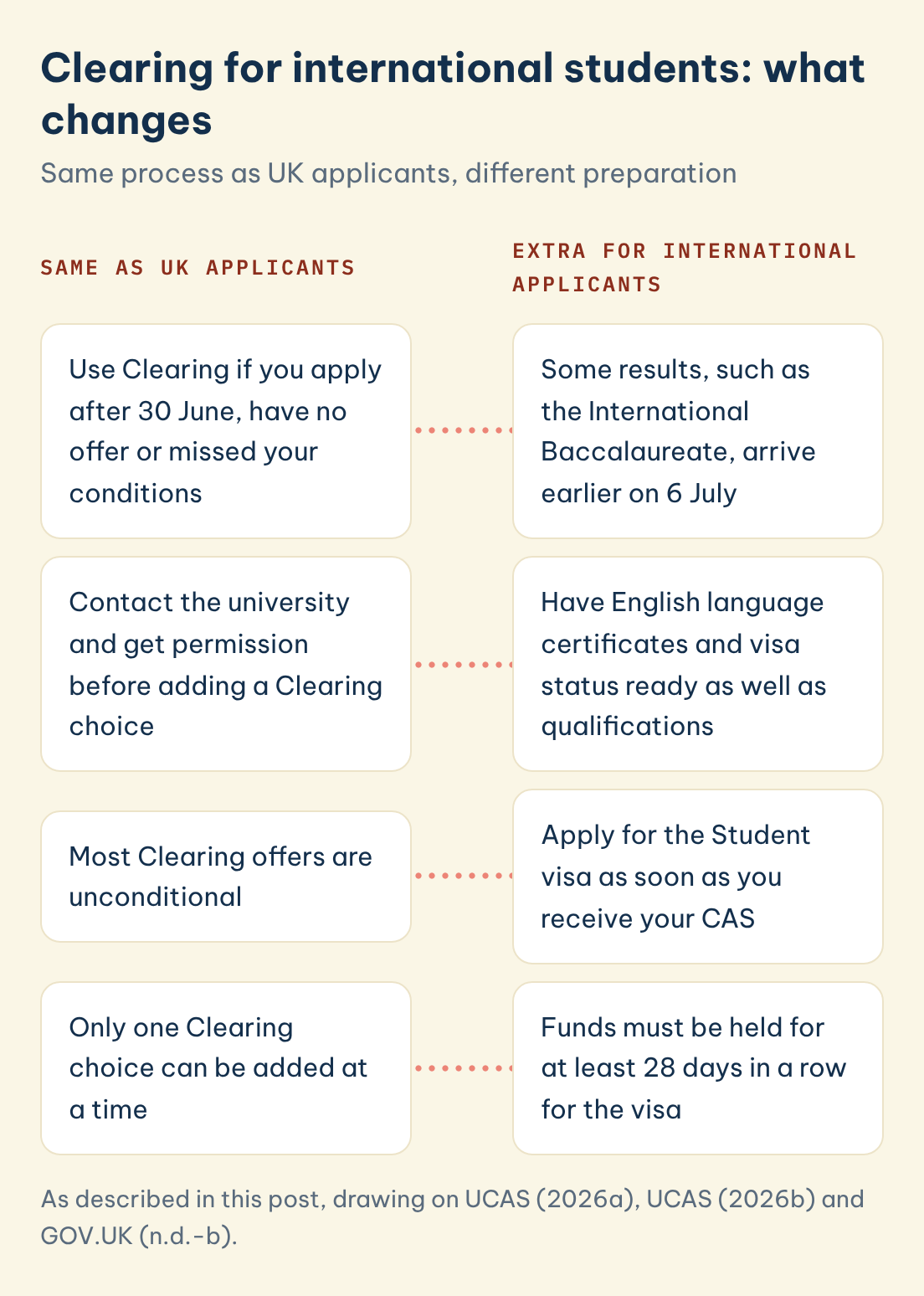
Clearing for international students: what changes
Same process as UK applicants, different preparation
Same as UK applicants
Extra for international applicants
Use Clearing if you apply after 30 June, have no offer or missed your conditions
Some results, such as the International Baccalaureate, arrive earlier on 6 July
Contact the university and get permission before adding a Clearing choice
Have English language certificates and visa status ready as well as qualifications
Most Clearing offers are unconditional
Apply for the Student visa as soon as you receive your CAS
Only one Clearing choice can be added at a time
Funds must be held for at least 28 days in a row for the visa
Save this figure
International applicants should also expect questions about English. UCAS (2026a) says students who are not native English speakers may also need to complete an English language exam and provide test certificates. Our guide to IELTS band requirements per skill explains why an overall band can hide a weak component, which matters when a university states a minimum for each skill.
A preparation checklist for the week before you call:
- Results and transcripts in a form you can read out and send quickly.
- English test certificate, or a clear answer to whether your university accepts another route.
- Passport details, since both the university and later the visa application will ask for them.
- Evidence of finances, because the visa requires proof of funds, described below.
- A shortlist of courses with phone numbers, course codes and the dates the vacancies were listed.
- Your UCAS Hub login, and a decision on whether to share access with an adviser. UCAS (2026a) says an adviser may be able to find courses, upload documents or submit a choice on your behalf once you give permission.
For applicants applying directly to Clearing for the 2026 cycle after 30 June, UCAS (2026a) says an optional document upload service lets you add supporting information to specific sections of the application.
◆ Question 6 / 7 · What are the visa and CAS
What are the visa and CAS timing risks?
Direct answer: Apply for your Student visa as soon as you receive your Confirmation of Acceptance for Studies (CAS), because UCAS (2026a) says a decision usually takes three weeks once you have applied, but times can vary by country and visa service.
Clearing compresses everything into a short period, and the visa is the step with the least flexibility. GOV.UK (n.d.-a) says you can apply for a Student visa once you have been offered a place on a course by a licensed student sponsor, and that you will usually get a decision within 3 weeks if you apply from outside the UK. It also says the earliest you can apply from outside the UK is 6 months before your course starts, and that you cannot travel before the start date given on your visa.
The documents are specific. GOV.UK (n.d.-c) says you must provide a current passport or other valid travel documentation and a CAS from your course provider, and that you may need proof of funds, an ATAS certificate where your course and nationality require it, and tuberculosis test results, among other items.
On money, GOV.UK (n.d.-b) says you need enough to pay your course fee for one academic year of up to 9 months, as shown on your CAS, plus £1,529 per month for up to 9 months for courses in London or £1,171 per month for courses outside London. The funds must be held for at least 28 days in a row, and the end date of that period must be within 31 days of the date you apply. Those amounts are the figures shown on the GOV.UK pages when this guide was written, so check them again before you apply.
The timing risk is simple. A Clearing offer can arrive late, the CAS has to come from the university after you accept, and the visa decision then takes weeks. UCAS (2026a) advises you to work closely with your chosen university after accepting and to check accommodation early, because Clearing students receive their place a bit later than others. Ask the university, at the offer stage, when it will issue the CAS and what it needs from you to do so.
◆ Question 7 / 7 · How does MAAS help
How does MAAS help with applications?
Direct answer: A MAAS adviser helps you plan the order of your steps, read entry requirements and rehearse the conversation, while you make every decision and write every word yourself. MAAS gives advice and process support, and the admission decision always belongs to the university.
MAAS's admissions consulting service is advisory coaching on application strategy, programme fit and interview preparation, and it does not write statements for students or promise an admission result. You can see the advisers on our experts page, and a free 20-minute discovery call is a low-pressure way to talk through your timeline. You can book one here.
Frequently asked questions
Can international students apply through UK Clearing?
Yes. UCAS (2026a) states that "International students, including EU and other overseas students, can use Clearing in the same way UK students can", using the same UCAS Hub process.
When does Clearing close?
In the 2026 cycle Clearing was open from 2 July to 19 October 2026 (UCAS, 2026b). Check the UCAS website for the 2027 cycle dates before planning.
Do I have to phone the university myself?
UCAS (2026c) says you should speak to the university directly rather than let a parent or guardian take the call. UCAS (2026a) says you can also use email or online chat.
How long does a Student visa take after I accept a Clearing place?
UCAS (2026a) says it usually takes three weeks once applied for, but times vary by country and visa service. GOV.UK (n.d.-a) gives a usual decision time of 3 weeks from outside the UK.
What do I need to have ready before I call a university?
UCAS (2026c) lists your Personal ID, Clearing number and grades or Tariff points, plus reasons for wanting the course. UCAS (2026a) adds qualifications, English language certificates and visa status.
References
GOV.UK. (n.d.-a). Student visa: Overview. https://www.gov.uk/student-visa
GOV.UK. (n.d.-b). Student visa: Money you need. https://www.gov.uk/student-visa/money
GOV.UK. (n.d.-c). Student visa: Documents you'll need to apply. https://www.gov.uk/student-visa/documents-you-must-provide
UCAS. (2026a). Clearing guide for international students. https://www.ucas.com/applying/after-you-apply/clearing-and-results-day/what-is-clearing/clearing-guide-for-international-students
UCAS. (2026b). What is Clearing? https://www.ucas.com/applying/after-you-apply/clearing-and-results-day/what-is-clearing
UCAS. (2026c). Top tips for contacting universities during Clearing. https://www.ucas.com/applying/after-you-apply/clearing-and-results-day/what-is-clearing/top-tips-for-contacting-universities-during-clearing
Not sure how this guide applies to your own case? Talk it through with MAAS in a free 20-minute consultation.
Book a free consultation ▸