
◆ UK undergraduate admissions
UCAS tariff points explained: what 112, 120 and 128 points mean
UCAS Tariff points turn your qualifications and grades into a number, and at A level 112 points is BBC, 120 is BBB and 128 is ABB across three subjects. UCAS (2026b) says providers use that number to judge whether you meet their entry requirements, but not every university uses it and not every qualification has a value. This guide gives the A level and AS level tables from the official UCAS Tariff tables for the 2026 and 2027 cycles (the A level values are the same in both), works through the combinations behind the most common totals, and explains where grades matter more than points, including for international qualifications.

◆ Question 1 / 7 · What are UCAS Tariff points
What are UCAS Tariff points?
Direct answer: UCAS Tariff points translate qualifications and grades into a numerical value. UCAS (2026b) explains that the value depends on the qualification's size and the grade achieved, and that many, but not all, qualifications have one, so a missing value is not automatically a problem for your application.
The Tariff exists so that universities can compare very different qualifications against familiar ones. UCAS (2026a) describes its purpose as helping universities and colleges compare qualifications fairly, especially less common ones, against A levels, which supports fairer decisions when offers are made. Tariff points only apply to Level 3 or SCQF Level 6 qualifications, so a GCSE does not earn any (UCAS, 2026a).
Two points of caution come directly from UCAS. First, the UCAS calculator is an indicative guide, and each university or college decides which qualifications it accepts and how many points it will count (UCAS, 2026a). Second, having a qualification on the Tariff does not mean it counts towards the entry requirements of any particular course, even at a provider that uses Tariff points (UCAS, 2026b). The number is a convenient common currency, not an entitlement.
◆ Question 2 / 7 · How many UCAS points is each
How many UCAS points is each A level grade worth?
Direct answer: In the UCAS Tariff tables for the 2027 cycle, which applies to students applying now, a single A level is worth 56 points for A*, 48 for A, 40 for B, 32 for C, 24 for D and 16 for E. UCAS (2026c, 2026d) gives the same values in the 2026 and 2027 tables.
The table below is taken from the A Level rows of the official Tariff tables, together with the AS level rows from the same workbook (UCAS, 2026c).
| Grade | A level points | AS level points |
|---|---|---|
| A* | 56 | not applicable |
| A | 48 | 20 |
| B | 40 | 16 |
| C | 32 | 12 |
| D | 24 | 10 |
| E | 16 | 6 |
The A level points rise in steps of 8 between grades, which makes mental arithmetic easy: every grade you move up is worth 8 points. UCAS (2026a) also explains how the AS level relates to the A level, positioning it at 40% of the A level, or as close to that as possible, at each grade, so UCAS describes AS grade A as aligned to A level grade B and an AS grade E sits below an A level grade E.
A practical consequence is that AS points do not simply stack on top of an A level in the same subject. UCAS (2026a) notes that universities generally count only the highest level of achievement, so they may not count an AS level if you have an A level in the same subject.
◆ Question 3 / 7 · What grade combinations make
What grade combinations make 112, 120 and 128 points?
Direct answer: With three A levels, BBC makes 112 points, BBB makes 120 and ABB makes 128. Several other combinations reach the same totals, which is why an offer written in points is more flexible than an offer written as three fixed grades, although course pages may add subject conditions.
Using the A level values (A* 56, A 48, B 40, C 32, D 24, E 16), which UCAS (2026c, 2026d) gives in both the 2026 and 2027 tables, the arithmetic is simply addition. The table shows a few combinations for each total.
| Total points | Combinations of three A levels | Working for the first row |
|---|---|---|
| 112 | BBC, ACC, A*CD | B 40 + B 40 + C 32 = 112 |
| 120 | BBB, ABC, A*CC | B 40 + B 40 + B 40 = 120 |
| 128 | ABB, AAC, A*BC | A 48 + B 40 + B 40 = 128 |
Here is a worked example. A student predicted A in Business Studies, C in Geography and C in Psychology has 48 + 32 + 32 = 112 points, so on points alone the profile matches an offer of 112, just as BBC would. The same student with an A* in Business Studies instead of an A would have 56 + 32 + 32 = 120 points.
Be careful with the word "alone", though. A points-based offer from a university may come with conditions on specific subjects or grades, and UCAS (2026a) points out that some universities limit the qualifications they accept, for example by counting Tariff points only from the highest scoring three A levels or Scottish Highers. The arithmetic above tells you how a total is built, and the course page tells you whether your particular combination is allowed.
◆ Question 4 / 7 · Do universities ask
Do universities ask for points or for grades?
Direct answer: Both appear in practice. Some providers write offers in Tariff points, while many write them as grades, because UCAS (2026a) states that Tariff points are not used by every university or college. Check the wording on each course page before you compare totals.
UCAS points and grades: what each tells you
Two ways universities write the same entry requirement
Offer stated in points
Offer stated in grades
Counts how a total is built, so BBC, ACC and A*CD can all make 112
Names the grades you must reach, sometimes with required subjects
Some universities, colleges and conservatoires refer to Tariff points
Many universities base offers on qualifications and grades
Universities may count points only from the highest scoring three A levels
An AS level may not count if you hold an A level in the same subject
A qualification without points may still be accepted
A qualification on the Tariff does not mean it counts for every course
Save this figure
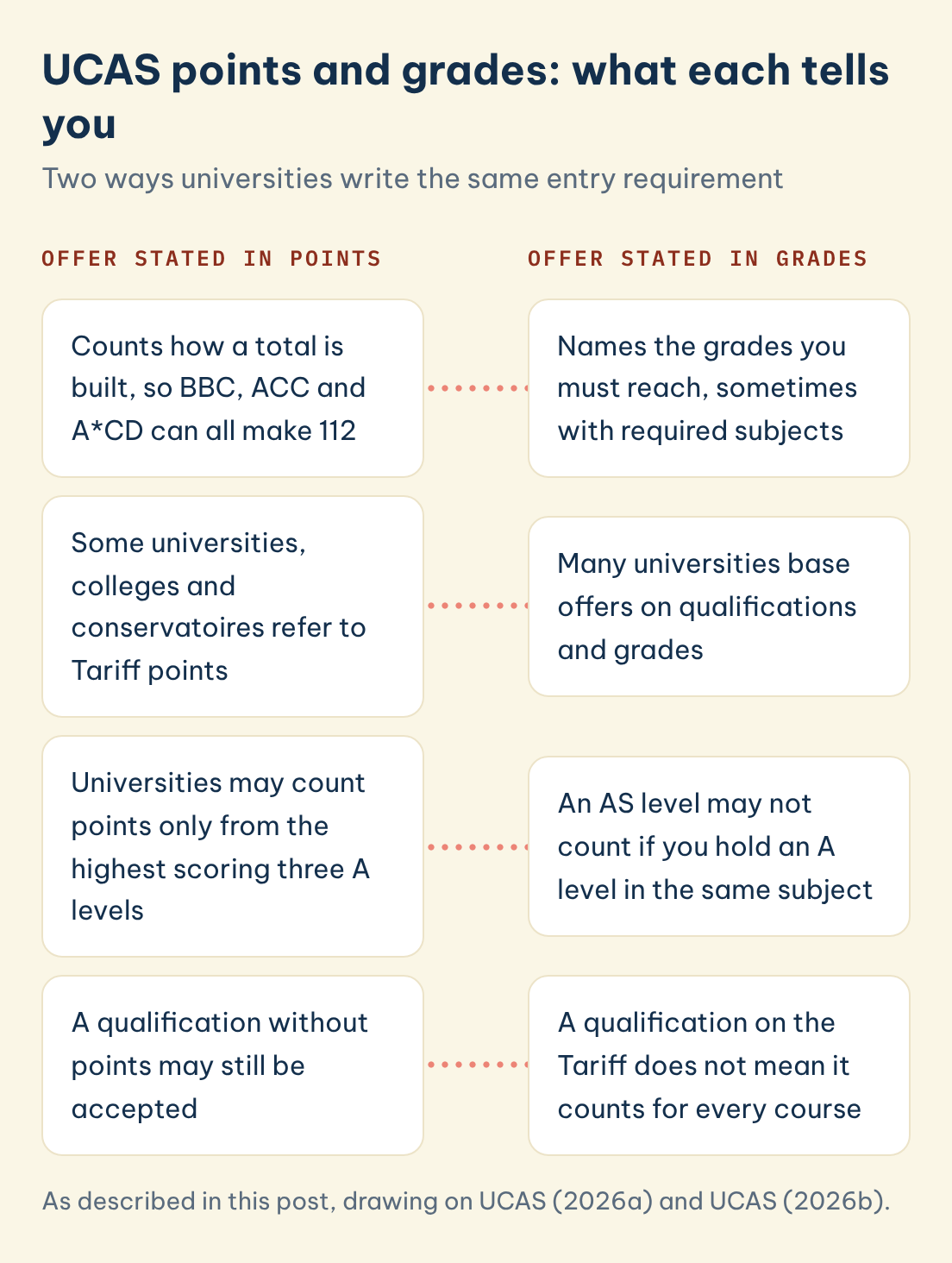
UCAS (2026b) says some universities, colleges and conservatoires refer to Tariff points in their entry requirements, and that qualifications without Tariff points may be accepted too. In other words, two courses that both look like "112" can be written very differently. One may say "112 UCAS Tariff points from at least two A levels" while another says "BBC including Economics", and these are not interchangeable.
When you read a course page, check these items in order:
- Whether the offer is stated as grades, points, or both. Where both appear, the grades usually define the minimum shape of your results and the points describe how a total is assembled.
- Whether specific subjects are required. A points total does not replace a required subject.
- Which qualifications are counted. If you have a mix, for example A levels plus a BTEC, look for the university's own statement on how it counts them.
- Whether extra items count. UCAS (2026c) gives the Extended Project its own values, 28 points at A*, 24 at A and 20 at B, but a university may or may not include it in an offer.
For a student comparing several courses, writing the requirement for each in two columns, "stated as grades" and "stated as points", prevents the common mistake of assuming that reaching the number automatically satisfies a grade-based offer.
◆ Question 5 / 7 · Do international
Do international qualifications carry UCAS points?
Direct answer: A few overseas qualifications, such as the IBO Certificate in Higher Level, have a Tariff value, but most do not, and a missing value is not a rejection. UCAS (2026b) notes that a qualification lacking points can still be accepted, so read each course's entry requirements or ask the provider.
The UCAS calculator covers Level 3 UK qualifications regulated by bodies such as Ofqual, Qualifications Wales, CCEA and QAA, and SCQF Level 6 qualifications accredited by SQA and SCQF (UCAS, 2026a). UCAS (2026c, 2026d) gives one national school-leaving certificate from outside the UK, the Irish Leaving Certificate, its own sheet in the Tariff tables, but most do not appear there, including Vietnam's national high school certificate.
The International Baccalaureate is an example of a mixed picture. UCAS (2026d) lists the IBO Certificate in Higher Level in the 2027 Tariff tables, which apply to students applying now, at 56 points for grade 7 (listed as H7), 48 for H6, 40 for H5, 32 for H4, 24 for H3, 16 for H2 and 12 for H1. The 2026 tables gave lower values from H5 down (H5 32, H4 24, H3 12) and no points for H2 or H1 (UCAS, 2026c). That means an IB Higher Level subject can be translated into the same scale as an A level, whereas a qualification absent from the tables cannot.
If your qualification has no Tariff value, do not read that as a rejection. Look for the international entry requirements on the course or university page, or ask the admissions office what your certificate is worth for the course you want. Our guide to IELTS band requirements per skill covers the English-language side of those requirements, which sit alongside the academic ones.
◆ Question 6 / 7 · Where does a points total
Where does a points total mislead you?
Direct answer: A points total can mislead when it hides weak individual grades, a missing required subject, or a qualification the university will not count. UCAS (2026b) reminds students that a place on the Tariff does not guarantee a qualification will count for a particular course.
Consider two students who both hold 120 points. One has BBB in three relevant subjects. The other has A*CC but is missing the subject the course requires. On the arithmetic they are identical, and for an offer that names required subjects they are not. A related mistake is double counting: adding an AS level to an A level in the same subject, when the university will count only the higher level.
Treat the Tariff as a way to understand and compare, then use the course page as the rule. You can also see the UCAS calculator for any qualification that is listed, remembering that UCAS (2026a) calls it an indicative guide.
◆ Question 7 / 7 · How does MAAS help
How does MAAS help with university admissions?
Direct answer: A MAAS adviser helps you read entry requirements, plan which courses fit your results and timeline, and gives developmental feedback on the application you write yourself. MAAS does not write your statement, and it cannot promise any admission outcome because the decision belongs to the university.
MAAS's admissions consulting service is advisory. Your adviser coaches the strategy and structure and reviews your drafts, while the words and the story remain yours, and the final decision belongs to the university. If you are working out how your results map onto the offers you are seeing, a free 20-minute discovery call is a good starting point, and you can book one here. You can also see the advisers on our experts page. If you are also looking at how Clearing works for results that come in lower than expected, our guide to UK Clearing for international students walks through the steps.
Frequently asked questions
How many UCAS points is an A level worth?
In the 2026 UCAS Tariff tables an A level is worth 56 points at A*, 48 at A, 40 at B, 32 at C, 24 at D and 16 at E (UCAS, 2026c). The 2027 tables list the same A level values.
What grades are 112 UCAS points?
With three A levels, BBC, ACC and A*CD all make 112 points when you add the values in the UCAS (2026c) Tariff tables. Whether a university accepts a particular combination depends on its own entry requirements.
Do all UK universities use UCAS Tariff points?
No. UCAS (2026a) states that not all universities and colleges use Tariff points and that many base their offers on qualifications and grades, so read the requirement on each course page.
Does my international qualification have UCAS points?
Possibly, but many do not. UCAS (2026b) says "Not all qualifications are on the Tariff, so don't worry if you can't find your qualification", because a university may still accept it, so check the course entry requirements or contact the university. UCAS (2026d) includes the IBO Higher Level certificate in the 2027 tables.
Do AS levels add points to my A levels?
Not for the same subject. UCAS (2026a) says universities generally count only the highest level of achievement, so an AS level may not be counted if you hold an A level in the same subject.
References
UCAS. (2026a). Calculate your UCAS Tariff points. https://www.ucas.com/applying/before-you-apply/what-and-where-to-study/entry-requirements/calculate-your-ucas-tariff-points
UCAS. (2026b). UCAS Tariff points. https://www.ucas.com/applying/before-you-apply/what-and-where-to-study/entry-requirements/ucas-tariff-points
UCAS. (2026c). 2026 Tariff tables [Data set]. https://www.ucas.com/media/205211/download
UCAS. (2026d). 2027 Tariff tables [Data set]. https://www.ucas.com/media/229086/download
Not sure how this guide applies to your own case? Talk it through with MAAS in a free 20-minute consultation.
Book a free consultation ▸