
◆ PhD application
Why does a PhD offer hinge on your lowest IELTS band?
Look at a Test Report Form issued by IELTS, the International English Language Testing System jointly administered by the British Council, IDP IELTS Australia and Cambridge Assessment English, and notice something easy to miss: the overall band is the only number on it that no examiner awarded. Four examiners scored four skills, and the overall is arithmetic performed afterwards on those results, a kind of arithmetic that lets one strength cover a weakness.
Admissions offices know this, which is why so many doctoral programmes publish a second line under the overall figure, setting a floor for each skill separately. That second line is not administrative fussiness. It is the school restoring the information the average removed.

◆ Question 1 / 5 · How 6.5 hides 5.0
How can a 6.5 conceal a Writing band of 5.0?
Direct answer: Because the overall band is the mean of four component scores, rounded to the nearest half band, so a low skill is offset by the three around it. Its own worked example shows Listening 6.5, Reading 6.5, Writing 5.0 and Speaking 7.0 averaging to 6.25, reported as an overall band of 6.5.
One candidate's four skills and the overall band
Tap a skill to see how it sits in IELTS's published worked example.
Listening
Band 6.5 in the worked example.
Reading
Band 6.5 in the worked example.
Writing
Band 5.0. IELTS labels that level a Modest User on its published nine-band scale, described as a partial command of the language likely to involve many mistakes.
Speaking
Band 7.0 in the worked example.
Overall
Arithmetic performed afterwards on the four results. The average is 6.25, reported as an overall band of 6.5.
Save this figure
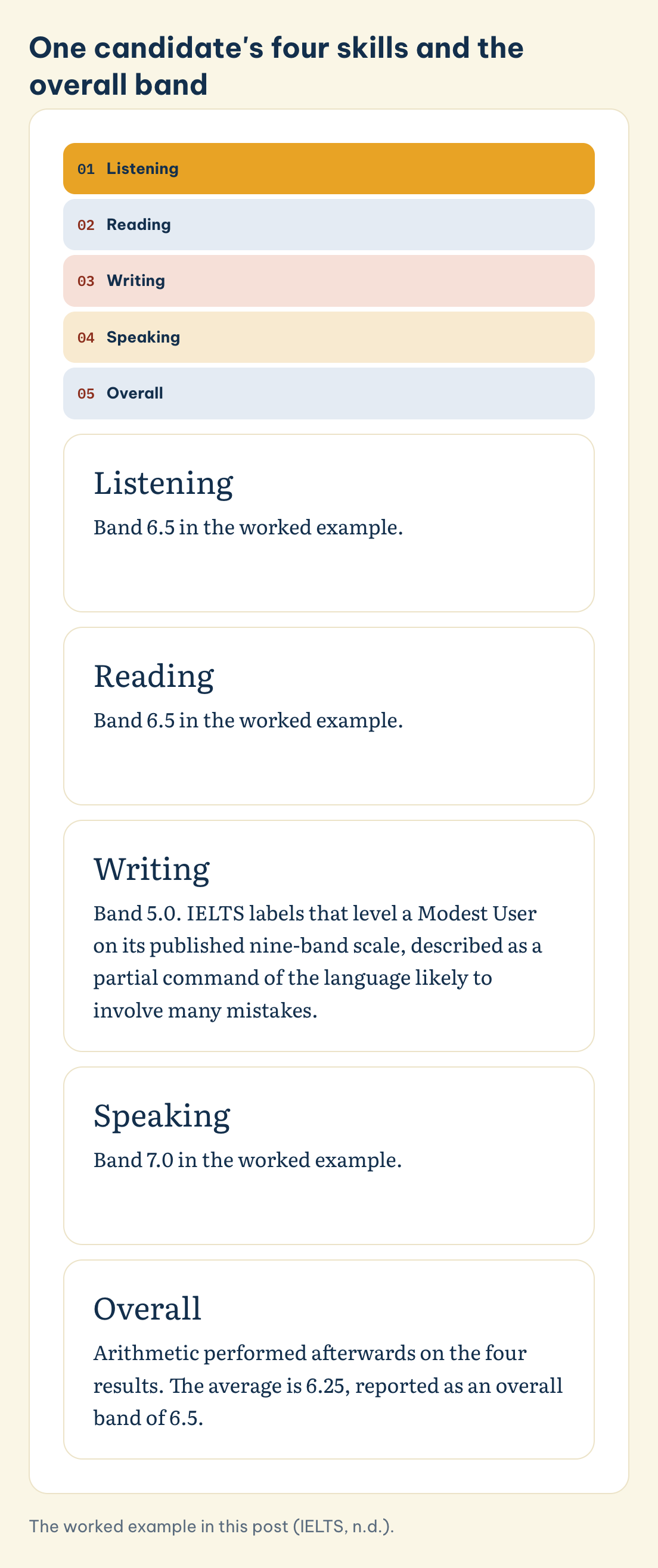
IELTS states the method plainly: "The overall band score is the average of the four section band scores rounded to the nearest half band" (IELTS, n.d.). The clearest illustration of this comes from IELTS itself. Its published worked example describes a candidate scoring Listening 6.5, Reading 6.5, Writing 5.0 and Speaking 7.0, an average of 6.25, which is reported as an overall band of 6.5 (IELTS, n.d.). That candidate holds a certificate reading 6.5 while one of the four skills sits at band 5. IELTS labels that level a Modest User on its published nine-band scale, described as a partial command of the language likely to involve many mistakes. On that same scale, band 6 is a Competent User, band 7 a Good User, and band 9 an Expert User, so the certificate is reporting a Competent User overall while one component still reads Modest. IELTS also publishes an approximate equivalence to the Common European Framework of Reference for Languages (CEFR), the scale maintained by the Council of Europe and used across European education systems: IELTS reports band 7.0 to 8.0 as broadly equivalent to CEFR C1, and band 5.5 to 6.5 as equivalent to B2.
The rounding compounds it. Where the average ends in .25 the overall is rounded up to the next half band, and where it ends in .75 it is rounded up to the next whole band (IELTS, n.d.). So the reported figure is generous in two separate ways: the averaging lets skills compensate for one another, and the rounding then moves the result upward rather than to the nearer value.
None of the averaging and rounding described above is a flaw in the test. A single summary figure is genuinely useful when someone wants a quick sense of overall language ability. It becomes misleading only when it is asked to answer a question it was never built to answer, which is whether this particular applicant can carry out this particular degree.
◆ Question 2 / 5 · What a floor protects
What is a component minimum actually protecting?
Direct answer: The two skills a doctorate is mostly made of, which are sustained academic writing and defending an argument aloud under questioning.
A doctorate is unusual among degrees in how narrowly it draws on language. Coursework degrees spread the load across reading, listening in lectures, seminar discussion and written assessment. A research degree concentrates it. The thesis is a long written artefact produced over years, and the viva is an oral examination in which you are questioned on it. A Writing band that a taught programme could absorb becomes, on a research degree, a weakness sitting directly on the two activities that determine the outcome.
This concentration of language demand onto writing and speaking is why a floor on Writing, or a floor on Speaking, tends to appear at doctoral level even where the overall requirement has not moved. The school is not asking for a higher applicant in general. It is asking that the strength be present in the specific place the degree will spend it.
There is a further consequence that applicants rarely anticipate. Where an interview forms part of the assessment, your spoken English is evaluated a second time by people who are not examiners of language, in a setting where nervousness and technical vocabulary both work against you. A Speaking band that cleared the published floor by a narrow margin is worth treating as information about the interview rather than as a box already ticked.
◆ Question 3 / 5 · Why the floor matters
If a higher band does not predict success, why does the floor matter?
Direct answer: Because the floor is doing a different job from prediction. It excludes; it does not forecast.
Fairness requires noting that the research literature offers modest support for treating language scores as a predictor of academic outcomes. A meta-analysis of the predictive validity of IELTS scores, published in Higher Education Research & Development, reports relationships with academic performance that are small rather than substantial (Gagen & Faez, 2024). A review of predictive validity work on IELTS Academic, the format PhD applicants sit rather than IELTS General Training, published in the International Journal of Applied Linguistics, reaches a similarly cautious position about how much a band score can be expected to tell an institution (Pearson, 2020), and longitudinal work following students over time, published in Language Testing, finds the association between proficiency test scores and achievement to be limited and to vary by context (Barkaoui, 2025).
The tempting conclusion is that the requirement is therefore not worth much attention. That conclusion does not follow, and it is worth seeing why. A weak correlation across a whole population says that among applicants who already cleared the bar, higher scores do not reliably separate the ones who will do well. It says nothing about applicants below the bar, because they were never admitted and so never appear in the data at all. The evidence describes the range above the threshold. The threshold itself is outside its reach.
What this does justify is a shift in where effort goes. Pushing an already sufficient overall band from 7.0 to 7.5 buys very little in an assessment that is decided on research capability. Lifting a single component from below the line to above it changes whether your file is read. The first is optimisation with a low ceiling. The second is the difference between an application and no application.
◆ Question 4 / 5 · Where floors live
Where do these floors actually live?
Direct answer: In at least three places that are published separately, and which do not have to agree with one another.
Three layers where a floor can be published
Each row sets a layer beside what tends to be different about it.
Layer and who sets it
What tends to be different
Institution-wide minimum, set by central admissions
The headline figure, usually the lowest of the three
Programme or faculty requirement, set by the department admitting you
Often higher, and more likely to name a specific skill
Funding, visa or pre-sessional conditions, set by a scholarship body, an immigration authority or a language centre
Assessed on its own terms and on its own timetable
Save this figure
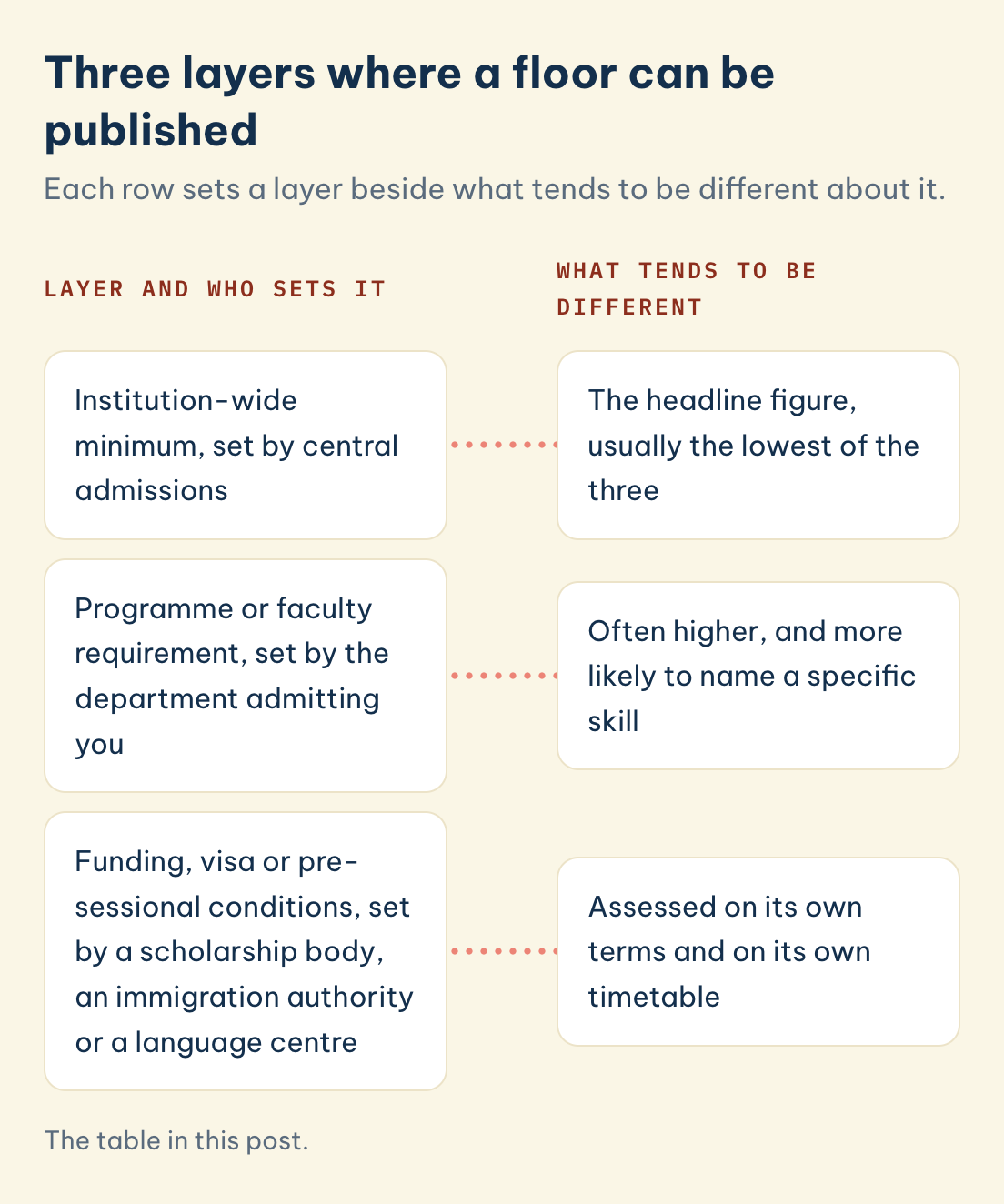
| Layer | Who sets it | What tends to be different |
|---|---|---|
| Institution-wide minimum | Central admissions | The headline figure, usually the lowest of the three |
| Programme or faculty requirement | The department admitting you | Often higher, and more likely to name a specific skill |
| Funding, visa or pre-sessional conditions | Scholarship body, immigration authority, language centre | Assessed on its own terms and on its own timetable |
Reading only the first layer is the common error, because it is the figure that appears in search results and in prospectuses. The department page is where a specific skill is most likely to be named, and a visa condition, such as the UK Visas and Immigration (UKVI) English-language requirement set by the Home Office and assessed through IELTS for UKVI rather than IELTS Academic, can operate on a different scale again.
When you open one of these pages, search the text for the words that signal a per-skill rule rather than an overall one: component, sub-score, each of the four, no less than, in every section, minimum in each. If a page states only a single figure, that absence is itself worth confirming with the department rather than assuming, because published wording is revised between admission cycles and an older cached page will not tell you so.
The same layering decides an earlier question, which is whether you need a test at all. One graduate school can waive the certificate for any English-taught master's while another in the same university accepts only degrees earned in a listed country, a split set out in our guide to whether an English-taught master's replaces IELTS.
MAAS will not repeat any school's stated requirement here, and you should be wary of any guide that does. Requirements change by cycle, and a figure copied into a blog post ages quietly without ever announcing that it has.
◆ Question 5 / 5 · Below the line
One skill is below the line. What now?
Direct answer: Establish the deadline the score has to satisfy before deciding whether to re-sit, because the timing question usually settles the strategy question.
Three checks before you decide to re-sit
Tap a check to see what it asks. The post lists them in this order.
Step 1 of 3
Deadline
Which date the score must be valid at. IELTS advises that results be treated as valid for 2 years while noting that organisations may choose to accept them for longer, and that period is measured against a date the institution sets rather than the date you plan to arrive (IELTS, n.d.).
Step 2 of 3
Route
Whether the programme offers a conditional route, such as a pre-sessional language course, which converts a shortfall from a barrier into a longer timeline.
Step 3 of 3
Skill
Whether the component in question is the one your target field leans on, because a Writing shortfall on a research degree is a more serious matter than the same shortfall elsewhere.
Save this figure
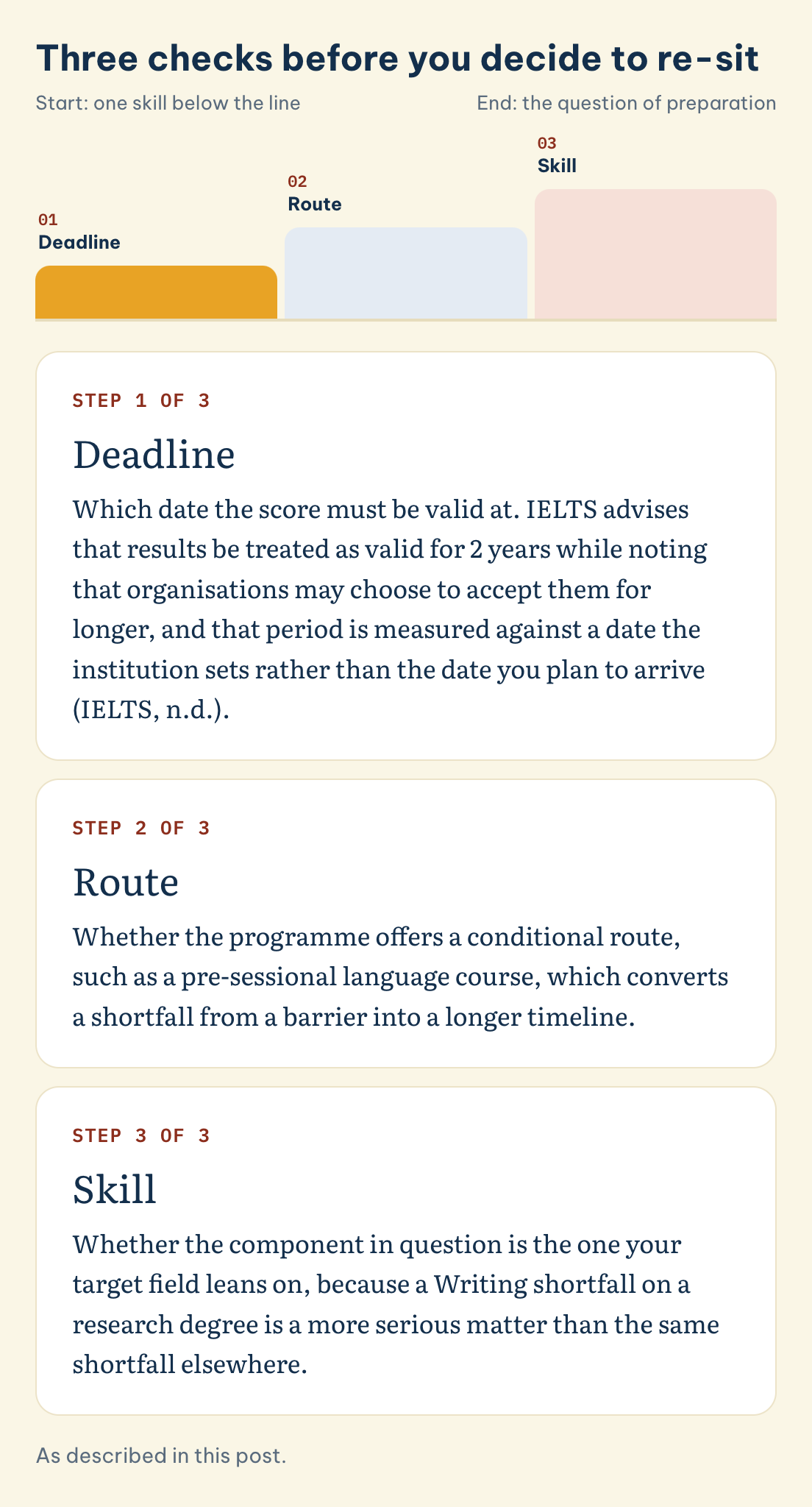
Three things are worth checking in order. First, which date the score must be valid at, since IELTS advises that results be treated as valid for 2 years while noting that organisations may choose to accept them for longer, and that period is measured against a date the institution sets rather than the date you plan to arrive (IELTS, n.d.). Second, whether the programme offers a conditional route, such as a pre-sessional language course, which converts a shortfall from a barrier into a longer timeline. Third, whether the component in question is the one your target field leans on, because a Writing shortfall on a research degree is a more serious matter than the same shortfall elsewhere.
Only after those three does the question of preparation become tractable. A re-sit means retaking the whole test, which runs about 2 hours and 45 minutes across all four sections: Listening lasts 30 minutes, Reading 60 minutes, Writing 60 minutes, and Speaking 11 to 14 minutes. But preparing for it does not mean preparing for all of it equally, and the four bands on your existing form tell you precisely where the return on that preparation is highest.
Running this alongside a proposal and a shortlist is where applicants tend to lose a cycle, not because any single step is hard, but because the deadlines belong to different bodies and none of them coordinates with the others.
Frequently asked questions
Does the overall band matter at all, or only the components?
Both, and they are checked separately. You have to clear the overall figure and every component floor the programme publishes. Meeting one does not compensate for the other, which is the whole point of the second line existing.
My overall is comfortably above the requirement. Am I safe?
Not necessarily, and this is the situation the component rule was written for. Work out the average of your four bands by hand and look at which skill is carrying the others. If one sits noticeably below the rest, check the department page specifically for a per-skill minimum before assuming the requirement is met.
Can I ask a department to waive a component minimum?
You can ask, and the answer belongs to the institution alone. Waivers and alternative evidence routes exist at some places and not at others, and nobody outside the institution decides them. What is worth doing is finding out whether a route exists for your profile before spending a term preparing for a test you may not need in that form.
Does a strong Writing band help my proposal get taken seriously?
Only indirectly. The band gets your file read; the proposal is what a supervisor forms a view on. They are assessed by different people against different criteria, and one does not substitute for the other.
How long before someone can look at my case with me?
Within 48 hours when our network already covers that field. If it does not, MAAS opens a dedicated recruitment round for your case, which usually takes about 2 weeks.
Related MAAS guides
- Is there a PhD programme with lower entry requirements? for how a published minimum differs from fit
- Do you need the GMAT or GRE for a PhD? for how admissions tests behave at doctoral level
- What does a reader notice in your PhD proposal first? for the self-check before you send anything
- PhD application guide for admissions systems and contact order
- PhD Application Strategy and Execution for what an engagement covers
References
Barkaoui, K. (2025). The relationship between English language proficiency test scores and academic achievement: A longitudinal study of two tests. Language Testing, 42(3), 253-282. https://doi.org/10.1177/02655322251319284
Gagen, T., & Faez, F. (2024). The predictive validity of IELTS scores: A meta-analysis. Higher Education Research & Development, 43(4), 873-888. https://doi.org/10.1080/07294360.2023.2280700
IELTS. (n.d.). IELTS scoring in detail. Retrieved August 18, 2026, from https://ielts.org/take-a-test/your-results/ielts-scoring-in-detail
Pearson, W. S. (2020). The predictive validity of the Academic IELTS test. ITL - International Journal of Applied Linguistics, 172(1), 85-120. https://doi.org/10.1075/itl.19021.pea
A free 20-minute consultation with a MAAS adviser, to talk through where your IELTS bands sit against the programmes on your shortlist.
Book Free Discovery ▸