
◆ Writing Tips
How do you describe charts in IELTS Writing Task 1?
In IELTS Academic Writing Task 1 you have about 20 minutes to turn a graph, chart or table into at least 150 words of your own description. IELTS (n.d.-a) asks you to describe the visual information in your own words, and the band descriptors reward a clear overview of the main trends. This guide covers the format, the marking criteria, a four-paragraph plan and the mistakes that cost marks.
◆ Question 1 / 7 · What are the format
What are the format and rules of IELTS Writing Task 1?
Direct answer: Task 1 gives you one or more graphs, charts or tables, or a diagram of an object, device, process or event. You should spend no more than 20 minutes and write at least 150 words, describing the information in your own words (IELTS, n.d.-a).
The whole Writing test lasts 60 minutes and has two tasks, and IELTS (n.d.-a) states that Task 2 contributes twice as much as Task 1 to the Writing score. That weighting explains the usual advice on time: Task 1 deserves a fast, disciplined 20 minutes, and the remaining time belongs to the essay. The same page says candidates must organise, present and possibly compare data, which is a more specific job than listing numbers.
You may also see the phrase "General" next to Task 1 in search results. The General Training test uses a different Task 1, which is a letter, and this guide covers the Academic version only. If you are sitting General Training, check the official format page for your own test before you plan, because the structure below will not transfer. For a related admissions question, our guide to the IELTS band per skill that PhD offers require explains why a single weak Writing score can matter more than a strong overall band.
◆ Question 2 / 7 · How is IELTS Writing Task 1
How is IELTS Writing Task 1 marked?
Direct answer: Examiners score four criteria, and the first for Task 1 is Task Achievement, alongside Coherence and Cohesion, Lexical Resource, and Grammatical Range and Accuracy. IELTS (n.d.-b) says the criteria are weighted equally and the score on the task is the average.
Task Achievement is the criterion most specific to charts. At band 7 the public descriptors say of the Academic task: "It presents a clear overview, the data are appropriately categorised, and main trends or differences are identified" (IELTS Partners, 2023, p. 1). Two words in that line deserve attention. "Categorised" means you group data into sensible families before describing them, and "overview" means a short statement of the overall picture, not a list of figures. IDP Staff (2022) makes the same point in plain terms, writing that "A clear overview needs to be presented to reach a band 7 and higher."
The descriptors also describe what goes wrong lower down. At band 5 the recounting of detail is "mainly mechanical" and there may be a tendency to focus on details without referring to the bigger picture (IELTS Partners, 2023, p. 2). Treat that as a warning about the most common habit in practice essays, which is to walk through the chart line by line. This post makes no promise about which band a given script will receive, because examiners read the whole script against all four columns.
◆ Question 3 / 7 · What is the best 4-paragraph
What is the best 4-paragraph structure for a chart description?
Direct answer: Write an introduction, an overview and two body paragraphs. IDP Staff (2022) describes the first short paragraph as the introduction and the second as the overview, which is a short paragraph describing the overall picture. The body paragraphs then group and compare the data.
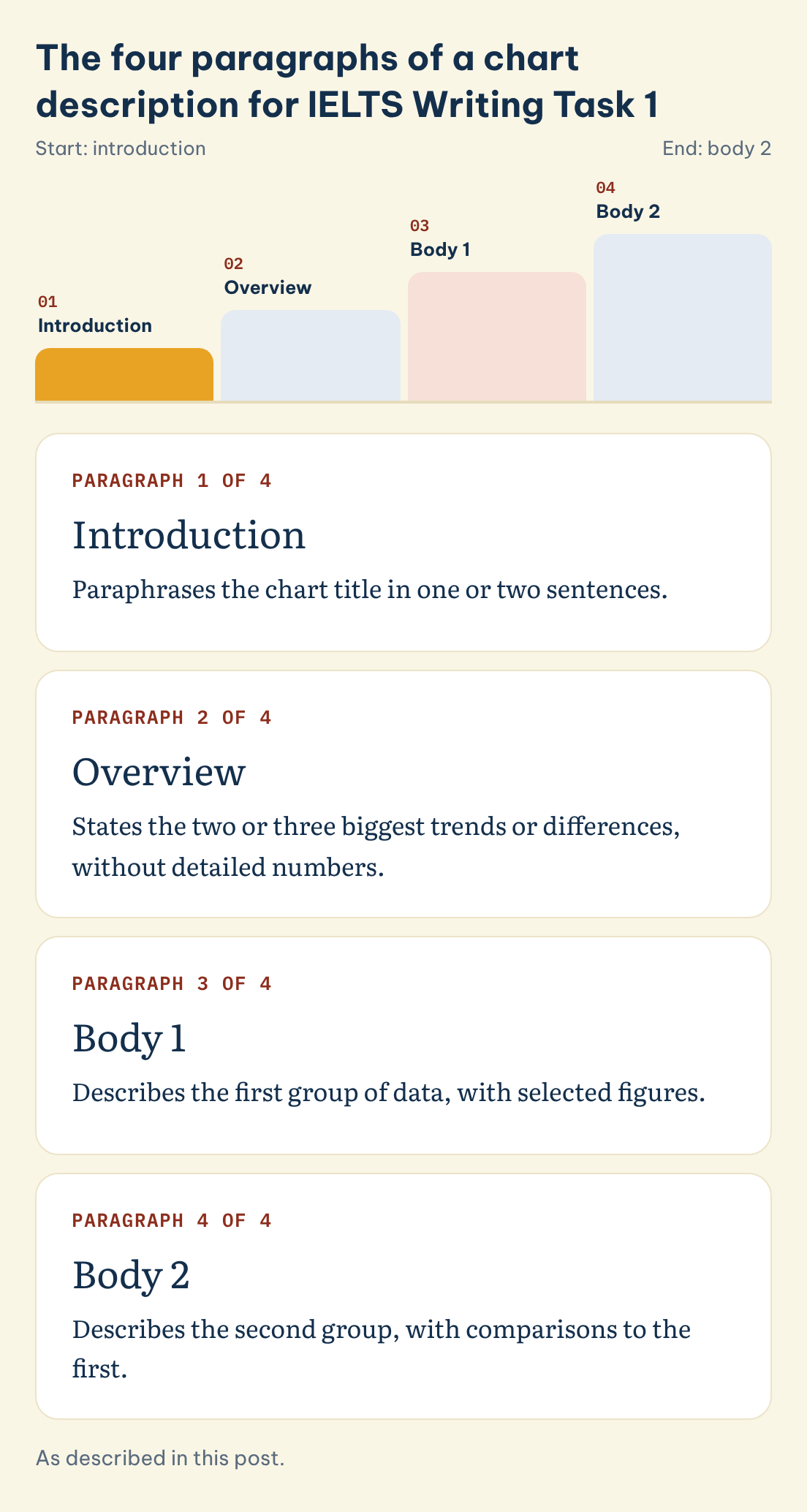
The table below shows what each paragraph does and which marking criterion it mostly serves.
| Paragraph | What it does | Mainly serves |
|---|---|---|
| Introduction | Paraphrases the chart title in one or two sentences | Lexical Resource |
| Overview | States the two or three biggest trends or differences, without detailed numbers | Task Achievement |
| Body 1 | Describes the first group of data, with selected figures | Task Achievement, Coherence |
| Body 2 | Describes the second group, with comparisons to the first | Coherence and Cohesion |
The four paragraphs of a chart description for IELTS Writing Task 1
Tap a paragraph to see what it does.
Paragraph 1 of 4
Introduction
Paraphrases the chart title in one or two sentences.
Paragraph 2 of 4
Overview
States the two or three biggest trends or differences, without detailed numbers.
Paragraph 3 of 4
Body 1
Describes the first group of data, with selected figures.
Paragraph 4 of 4
Body 2
Describes the second group, with comparisons to the first.
Save this figure
The order matters less than the presence of the overview. Some candidates place it after the body paragraphs, and nothing in the band descriptors forbids that, but writing it second means you cannot forget it. Because the descriptors for band 7 mention categorising the data, plan your two body paragraphs around groups, such as the rising categories in one and the falling categories in the other, instead of one paragraph per year or per line. Our guides on how to write an essay introduction and how to write an essay conclusion cover the same opening and closing habits that carry over to Task 2.
◆ Question 4 / 7 · What does a sample overview
What does a sample overview paragraph look like?
Direct answer: A good overview names the main trend or the biggest contrast in general terms and leaves detailed figures for the body. Here is an original skeleton you can adapt, with brackets where your chart's categories and direction go. It mirrors the overview described by IDP Staff (2022).
Take a line chart with several categories over a period. A skeleton overview might read: "Overall, [category A] rose steadily across the period, whereas [category B] fell, and [category C] stayed broadly stable. [Category A] was the most common option at the end of the period." Notice what it leaves out. It has no dates, no exact percentages and no explanation of why the trends happened, because the task asks you to describe the information and not to speculate about causes.
Your body paragraphs then add the evidence. A skeleton body sentence could be: "In [first year], [category A] stood at [figure], but by [last year] it had reached [figure], overtaking [category B]." Choose a few key figures that support your overview and group the rest. This follows the band 6 wording in the descriptors, which refers to information that is appropriately selected and supported using figures or data (IELTS Partners, 2023, p. 2). Selection is part of the skill. A script that includes every number reads as mechanical, and a script that includes none leaves the overview unsupported.
◆ Question 5 / 7 · What types of question
What types of question appear in Task 1?
Direct answer: Questions fall into data types and non-data types. IELTS (n.d.-a) lists graphs, charts and tables, and separately a diagram of an object, device, process or event. Your approach to the overview changes with the type, so identify it before you write.
The table below sets out how the plan shifts.
| Question type | What the overview should capture | Language focus |
|---|---|---|
| Line graph | Overall direction of each line, the highest and lowest points | Trend verbs and adverbs |
| Bar chart | Largest and smallest categories, and any clear contrast | Comparatives and superlatives |
| Table | The main differences between rows or columns | Comparison and grouping |
| Pie charts | The biggest shares and how they change between charts | Proportions, fractions |
| Process or diagram | The number of stages and the overall purpose or result | Passive voice, sequencing |
A journal study of this task by Khrabrova (2016) examined Academic Writing Task One as a task in which candidates comprehend graphic information and process it in written discourse. Her abstract names the use of appropriate vocabulary for describing trends alongside academic functional phrases and grammar features as part of successful graph description. The practical reading is that vocabulary for trends and comparisons should be practised as a set, together with the grammar that carries it. Only the abstract of that paper was available for this guide, so treat it as supporting evidence and not as a complete account.
◆ Question 6 / 7 · Where can you find
Where can you find questions, samples and practice material?
Direct answer: Start with the official format page and the public band descriptors, then practise with charts you describe yourself and check against the four criteria. Treat any published sample as an illustration of structure, not as wording to copy, because an examiner reads your own script.
Searches such as "sample answer", "questions" and "practice" lead to many tutoring sites, and the quality varies widely. A reliable habit is to judge any sample by the public descriptors. Does it present a clear overview? Are the data categorised? Are the main trends or differences identified? If the sample fails those tests, its band label is not a good guide. The official band descriptors are free to read on ielts.org.
A simple practice routine uses three steps. First, spend two minutes on the chart and write the overview sentence before anything else. Second, write the introduction and the two body paragraphs within the remaining time, keeping to 20 minutes in total. Third, reread against the four columns and note which one you neglected. Doing this under time conditions teaches more than reading ten model answers, since the descriptors reward what you produce and not what you recognise.
◆ Question 7 / 7 · How can MAAS help you
How can MAAS help you prepare for Task 1?
Direct answer: MAAS works as a tutor and advisor. In one-to-one tutoring a mentor can explain the marking criteria, review your practice descriptions and suggest what to change. You write and revise your own scripts, and MAAS does not set a score target for tutoring.
MAAS university subject tutoring (1-on-1) is matched to your discipline and your goals, which suits candidates who need a steady practice routine more than a one-off explanation. A mentor can look at how you group data, whether your overview stands alone, and whether your paragraphs hold together, and then give feedback you apply to the next attempt. Tutoring is a support, not a promise of a particular result, and your performance on the day depends on your own preparation.
Frequently asked questions
How long should I spend on IELTS Writing Task 1?
IELTS (n.d.-a) says you should spend no more than 20 minutes on the task. Task 2 contributes twice as much to the Writing score, so save the remaining time for it.
How many words do I need to write?
You must write at least 150 words (IELTS, n.d.-a). A short, well-organised description with a clear overview is better than padding it with every figure.
Do I need an overview to reach band 7?
The band 7 descriptor says the response presents a clear overview, and IDP Staff (2022) states that a clear overview is needed for band 7 and higher.
Are all marking criteria weighted the same?
IELTS (n.d.-b) states that the criteria are weighted equally and that the score on the task is the average of them.
What is the difference between Task 1 Academic and General?
Academic Task 1 asks you to describe visual information such as a graph, chart, table or diagram (IELTS, n.d.-a). General Training uses a different Task 1, so check the official page for your test type.
Should I include every number from the chart?
No. The band 6 wording refers to information that is appropriately selected and supported using figures or data (IELTS Partners, 2023, p. 2). Choose figures that support your overview and group the rest.
References
IDP Staff. (2022, December 18). Academic Writing Task 1 [Web article]. IDP IELTS. https://ielts.idp.com/pakistan/prepare/article-overview-task-1-ielts-academic-writing
IELTS. (n.d.-a). IELTS Academic: Writing [Web page]. IELTS Partners. https://ielts.org/take-a-test/test-types/ielts-academic-test/ielts-academic-format-writing
IELTS. (n.d.-b). IELTS scoring in detail [Web page]. IELTS Partners. https://www.ielts.org/en-us/for-organisations/ielts-scoring-in-detail
IELTS Partners. (2023). Writing band descriptors (Writing Task 1 band descriptors, public version) [PDF]. https://ielts.org/cdn/ielts-downloadable-assets/ielts-guidance-and-support/ielts-guides/ielts-writing-band-descriptors.pdf
Khrabrova, V. (2016). Graph description as an issue in L2 academic English writing. Journal of Language and Education, 2(4), 46-54. https://doi.org/10.17323/2411-7390-2016-2-4-46-54
Not sure how this guide applies to your own case? Talk it through with MAAS in a free 20-minute consultation.
Book a free consultation ▸