
◆ Writing Tips
How to write an essay introduction: three parts markers look for
An essay introduction sets the question in context, states your answer with the reason for it, and previews the order of the argument. University writing guides describe these jobs under different headings, but they agree on the content. This guide groups them into three parts, shows each part in an annotated example introduction that we wrote for this post, and then covers length, timing and the mistakes that most often weaken an opening. Each claim is attributed to the university page it comes from, and those pages are listed under References.

◆ Question 1 / 6 · What it has to do
What does an essay introduction actually have to do?
Direct answer: An essay introduction has to show the marker, within a few sentences, what the essay is about, what your answer to the question is, and how the essay will argue for it. Monash University (2025) says the reader needs to know your argument at the very beginning so that they can evaluate your reasoning and evidence.
An introduction is easiest to write once you stop treating it as a ceremonial opening and start treating it as a short, working summary of the whole essay. The University of Queensland School of Political Science and International Studies (2021), in its essay guide, goes as far as advising students who are unsure how to structure an introduction to look at abstracts and the opening paragraphs of journal articles and book chapters as models. That is a useful test for your own draft: if the marker read only your first paragraph, would they know the question you are answering, your answer to it and the route you will take?
Notice what the sources do not ask for. The University of North Carolina at Chapel Hill Writing Center (n.d.) says that "your direct answer to the assigned question will be your thesis," and it describes five weaker types of introduction, among them the placeholder that exists only to fill the introduction space. A good introduction is therefore less a matter of style than of content: it must contain a claim that the body can then support.
◆ Question 2 / 6 · The three parts
What are the three parts of an introduction?
Direct answer: The three parts are context and focus, position, and route map. This grouping is our synthesis of the four-part model at the University of Technology Sydney (n.d.) and the four elements listed by Monash University (2025), which both cover the same ground in more steps.
The three parts of an essay introduction
What each part does and what it tells the marker
Part of the introduction
What it does for the reader
Context and focus
Shows why the question matters, then narrows to your angle
Position
States your answer together with the reason for it
Route map
Lists the main points of the body in the order they appear
Written last or first
Either can work, but the introduction must match the finished essay
Common failure
Filler openings, dictionary definitions and a vague position
Save this figure
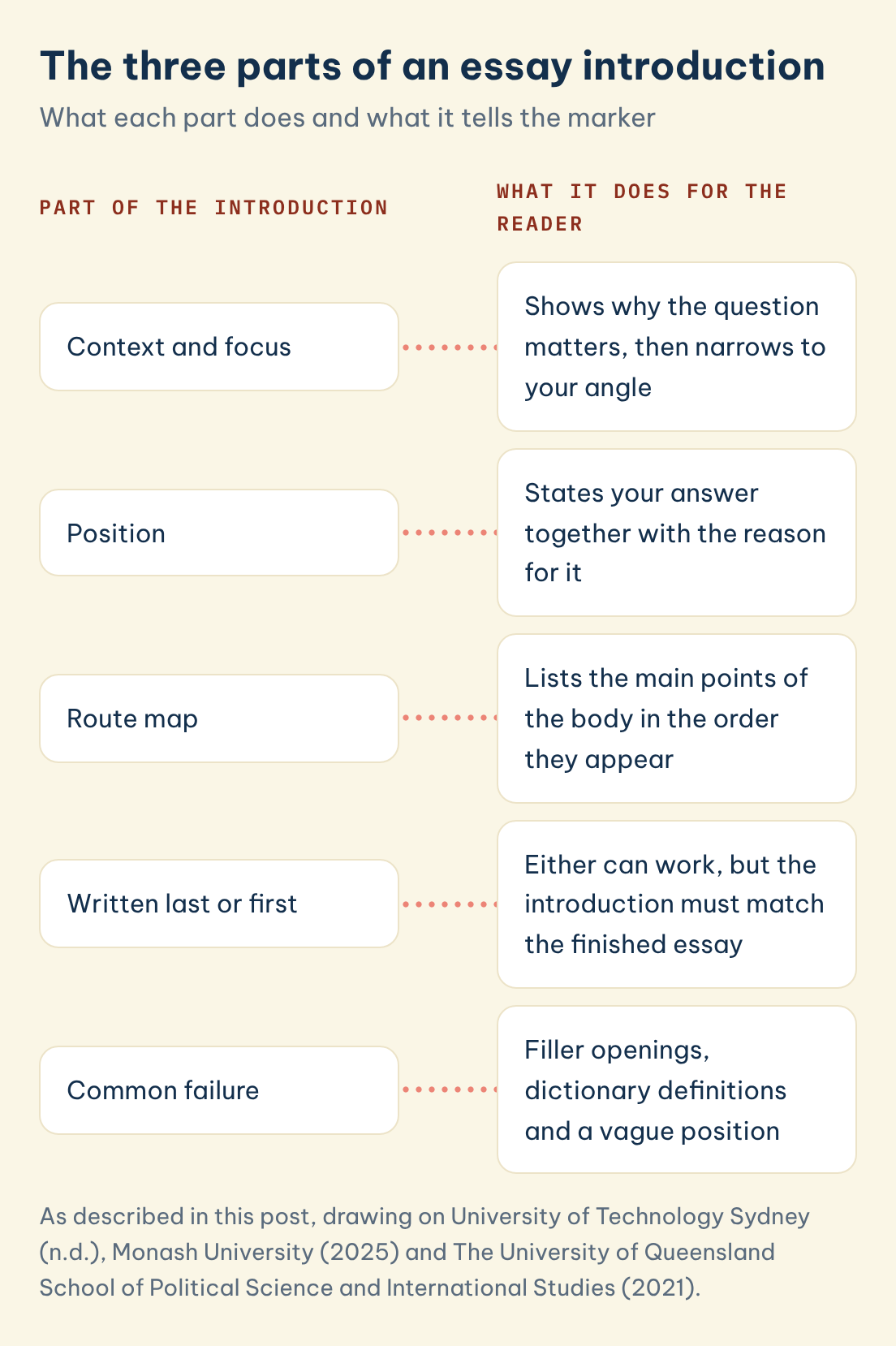
The University of Technology Sydney (n.d.) lists context, topic, outline of structure and argument, and notes that the argument may not be required for every type of assignment. Monash University (2025) lists an introduction to the topic, a sense of why it matters, the main question or goal of the essay, and the argument that will be developed. Merging the overlapping items gives three parts, which the table below sets out in the order a reader meets them.
| Part | What it does | Question it answers for the marker | Typical length |
|---|---|---|---|
| 1. Context and focus | Gives just enough background to show why the question matters, then narrows to the angle you will take | Does the writer understand the question and where it sits? | One to three sentences |
| 2. Position | States your answer to the question and the main reason you give for it | What is the writer actually arguing? | One to three sentences |
| 3. Route map | Names the main points of the body in the order they will appear | Will the essay be easy to follow? | One or two sentences |
Two details from the sources are worth adding. First, the University of Technology Sydney (n.d.) gives no word count for the context and says it can be one sentence or several depending on the length and complexity of the assignment, so the lengths in the table are a guide for a typical coursework essay and not a rule. Second, the same page notes that the exact structure of an introduction may differ according to the type of assignment, so treat the order in the table as the usual pattern and not a fixed rule.
◆ Question 3 / 6 · A finished example
What does a finished introduction look like?
Direct answer: A finished introduction carries all three parts in a single focused paragraph, usually in the order context, position, route map. The example below is our own invention, written to show the pattern, and the labels in square brackets mark where each part begins.
Suppose the question is: Should cities charge drivers to enter their central districts? An introduction that does the three jobs could read as follows.
[Context] Many cities that struggle with congested and polluted centres have considered charging drivers to enter them, and the debate usually turns on whether such charges change behaviour or simply move the problem elsewhere. [Focus] This essay concentrates on the effect of charging on traffic volumes and on fairness between road users, because these are the two grounds on which schemes are most often defended and attacked. [Position] It argues that an entry charge is justified only when public transport alternatives exist before the charge begins, since without them the charge falls hardest on people who have no other way to travel. [Route map] The essay first considers the evidence on traffic reduction, then examines the fairness objection, and finally sets out the conditions under which a charge can be defended.
Look at what each sentence is doing. The first sentence places the question in a wider debate without a sweeping claim about all of human history. The second narrows the topic, which matches the advice of the University of Reading (2026) that an open-ended question must be limited and that the introduction should explain how and why you decided to limit it. The third sentence is the position, and it contains a reason as well as an answer. Monash University (2025) makes exactly this distinction: if you merely answer the question without stating your reasons you have given an answer, but not an argument. The fourth sentence is the route map, and it lists the body in the order the reader will meet it.
Compare that paragraph with a version that stops after the first sentence. It would be accurate and pleasant to read, but a marker could not tell what the essay will claim, and they would have to wait until the conclusion to find out.
◆ Question 4 / 6 · Length and timing
How long should it be, and should you write it first or last?
Direct answer: The sources give no single length that fits every essay. On timing, most of them suggest drafting the body first and writing the introduction last, although one university guide accepts either order as long as you revise the introduction to fit the finished essay.
On length, the University of Canterbury Department of History (2024), writing about history essays, suggests that two or three succinct paragraphs are enough for the introduction once the body is complete. That is a discipline-specific remark, so treat it as an upper limit for a long essay and not as a target for a short one. For a typical coursework essay, MAAS's view is that a single well-built paragraph is usually enough, though your module guide has the final say.
On sequence, the advice is more varied than students expect. Tai Poutini Polytechnic (n.d.) says plainly not to try to write the introduction first, and to write the introduction and conclusion at the end of the process. The University of Prince Edward Island Robertson Library (n.d.) gives the reason: writing the introduction last allows it to be more concise, because it helps to know what is being introduced. The same page adds that some writers prefer to write chronologically, in which case an outline should come first. The University of Queensland School of Political Science and International Studies (2021) describes both routes and warns that an introduction written first will often need revising as the essay develops, and that whichever method you use, the body must be consistent with the introduction and conclusion.
A practical way to combine these views is to write a one-sentence working answer before you start, draft the body, and then write the real introduction with the finished argument in front of you. If you recheck the route map against the final order of your paragraphs, as the University of Technology Sydney (n.d.) advises after any restructuring, the introduction will promise what the essay delivers. Our guide on how to start an essay covers the planning that comes before this stage, and how to write an essay conclusion covers the paragraph that comes after it.
◆ Question 5 / 6 · Common mistakes
Which mistakes weaken an essay introduction?
Direct answer: The common mistakes are a filler opening, a dictionary definition used from habit, an announcement in place of an argument, a vague position, and a route map that the body does not follow. Several of these are named directly in the university pages cited below.
Five problems come up repeatedly in the sources.
- The filler opening. The University of North Carolina at Chapel Hill Writing Center (n.d.) describes a placeholder introduction as one that exists just to take up the introduction space in your paper. Sweeping statements about history, society or human nature belong in this group.
- The dictionary definition. The same page calls dictionary introductions ineffective because they are so overused. A definition belongs in the introduction only when the question turns on the meaning of a term. The University of Canterbury Department of History (2024) makes the same point for history essays, noting that some essays hinge on the meaning of a key word or concept.
- Announcing instead of arguing. The University of Technology Sydney (n.d.) suggests that a phrase such as "The purpose of this paper is to" makes the aim clear, and the University of Prince Edward Island Robertson Library (n.d.) lists clichés such as "this essay is about" among the things to avoid. The two views are compatible. A signpost phrase is fine when it leads into a real claim, and weak when it is the whole sentence.
- A vague position. If your thesis could be defended by anyone on any side, it is not yet a position. The University of North Carolina at Chapel Hill Writing Center (n.d.) says your direct answer to the assigned question will be your thesis, so check that your answer is arguable.
- A route map that does not match the body. The University of Technology Sydney (n.d.) advises making sure the outline matches your final structure. The same page advises you to double check your introduction against the body if you change your structure.
◆ Question 6 / 6 · How MAAS helps
How can MAAS help with essay introductions?
Direct answer: A MAAS mentor works with you on your own draft: you write the introduction, and the mentor reads it, points out which of the three parts is missing or weak, and explains why. The essay stays yours from outline to final draft.
MAAS's essay and assignment support runs in three stages, outline, draft and final, and at each one you do the writing while a mentor gives feedback. Nothing is written or submitted on your behalf. If you are comparing introductions and unsure whether yours states a position, a free 20-minute discovery with MAAS, a Ho Chi Minh City company, is a conversation about where your draft stands, with no obligation. You can book one here. For the wider structure around the introduction, see our step-by-step guide to the university essay, and for the question words that shape what your position must do, see assignment command words explained.
Frequently asked questions
What should an essay introduction include?
Three things: context that narrows to your angle, your position with the main reason for it, and a route map of the body. Monash University (2025) lists the topic, its importance, the main question or goal, and the argument, which covers the same ground.
How long should an essay introduction be?
The sources give no fixed number. The University of Technology Sydney (n.d.) says the context may be one sentence or several depending on the assignment, and the University of Canterbury Department of History (2024) suggests two or three succinct paragraphs for a history essay. For a short coursework essay, one focused paragraph is usually enough.
Should I write the introduction first or last?
Either can work, but many sources favour last. Tai Poutini Polytechnic (n.d.) says not to write it first, while the University of Queensland School of Political Science and International Studies (2021) accepts both routes and warns that an early introduction will probably need revising. Write a working answer first, then the real introduction once the body exists.
Does the introduction need a thesis statement?
In most essays, yes. The University of North Carolina at Chapel Hill Writing Center (n.d.) says your direct answer to the assigned question will be your thesis, although the University of Technology Sydney (n.d.) notes it may not be required for every type of assignment, such as a summary task.
Is it acceptable to start with a question or a quotation?
It can be, if it leads into your position quickly. The University of North Carolina at Chapel Hill Writing Center (n.d.) mentions an intriguing example, a puzzling scenario and a thought-provoking question as ways to draw readers in, but the opening is a means to the thesis and not a substitute for it.
References
Monash University. (2025). Sample Arts History essay. Student Academic Success. https://www.monash.edu/student-academic-success/excel-at-writing/annotated-assessment-samples/arts/arts-history-essay/sample-arts-history-essay
Tai Poutini Polytechnic. (n.d.). The essay writing process. https://tpp.ac.nz/assets/Explore/Services-and-facilities/Library/The-essay-writing-process.pdf
University of Canterbury, Department of History. (2024). Department of History concise guide to essay writing. https://www.canterbury.ac.nz/content/dam/uoc-main-site/documents/pdfs/guides/concise-guide-to-writing-history-essays-2024-final.pdf
University of North Carolina at Chapel Hill Writing Center. (n.d.). Introductions. https://writingcenter.unc.edu/tips-and-tools/introductions/
University of Prince Edward Island Robertson Library. (n.d.). Essay writing. Writing Centre. https://libraryupei.ca/writingcentre/essays
The University of Queensland, School of Political Science and International Studies. (2021). Essay guide. https://polsis.uq.edu.au/files/45340/POLSIS%20Essay%20Guide%202021%20Version%281%29.pdf
University of Reading. (2026). Planning and structuring your essay. Essay writing LibGuide. https://libguides.reading.ac.uk/essays/planning
University of Technology Sydney. (n.d.). How to write an introduction. HELPS academic skills. https://uts.edu.au/for-students/current-students/support/helps/self-help-resources/academic-skills/how-write-introduction
Not sure how this guide applies to your own case? Talk it through with MAAS in a free 20-minute consultation.
Book a free consultation ▸