
◆ Writing Tips
How do you write a thesis statement your marker will reward?
Direct answer: Write one or two sentences that answer the question your assignment asks and take a position a reasonable reader could dispute. Indiana University Bloomington Writing Tutorial Services (n.d.) calls this a condensation of the argument that follows. Then test it by asking whether a marker could sensibly disagree with you.
◆ Question 1 / 9 · What is a good way to write
What is a good way to write a strong thesis?
Direct answer: Start from the assignment question, not from a topic. Indiana University Bloomington Writing Tutorial Services (n.d.) advises distilling the assignment into one question and then answering it in one or two sentences. Treat that first answer as a working thesis and adjust it as your reading develops.
The most common reason a thesis fails is that it is a topic wearing a sentence. Indiana University Bloomington Writing Tutorial Services (n.d.) describes a thesis as the answer to the question your paper explores, and The Writing Center, University of North Carolina at Chapel Hill (n.d.) adds that it should directly answer the question you were asked. The same centre says a thesis is the result of a lengthy thinking process, which is a useful warning if you hope to write the final version in the first ten minutes. Your first sentence is a working thesis, and you revise it after you have read the sources, tested the evidence and drafted a few paragraphs. A practical routine is to write the working version straight after your essay plan, keep it visible while you draft, and rewrite it once the body is finished. Indiana University Bloomington Writing Tutorial Services (n.d.) gives three reasons to bother: a thesis helps you test ideas, organise an argument and guide the reader. Our guide to making an essay plan shows where that sentence sits in the plan.
◆ Question 2 / 9 · Why do markers write
Why do markers write "Argument!" in the margin?
Direct answer: Wingate (2012) links this comment to essays that report and describe without taking a position of their own. Wingate (2012) studied essays at a British university and found that students often did not realise they had to develop their own position, which is exactly what a thesis statement signals.
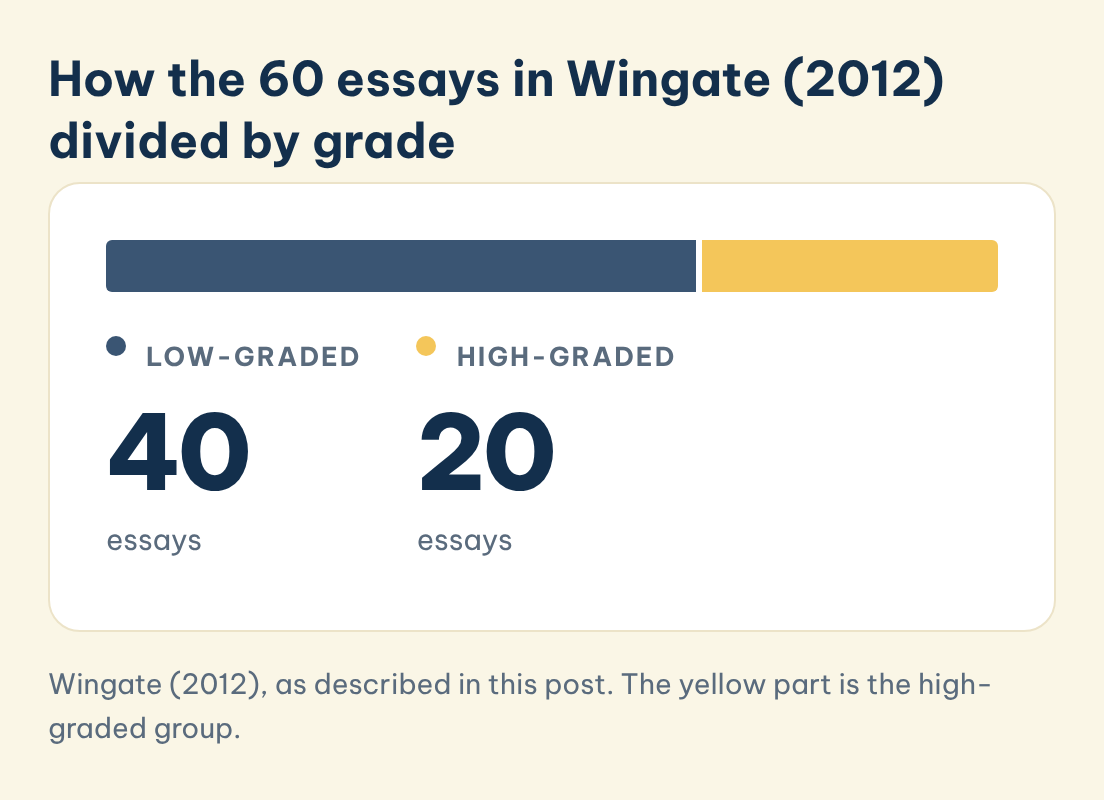
The study opens with the problem in plain terms: "Tutors’ feedback comments are often of the categorical type, such as the imperative ‘Argument!’ written in the margins of student essays" (Wingate, 2012, p. 145). The study surveyed 117 first-year applied linguistics students and analysed 60 essays from three modules with comments from five tutors, 40 of them low-graded and 20 high-graded, in an article on pages 145–154 of the Journal of English for Academic Purposes. Wingate (2012) reports that students held partial or incorrect ideas of what argument means, and that the key gap was not knowing they must develop a position. School essays often reward stating a claim in a fixed format, while a university marker wants a considered opinion that comes from analysing conflicting sources. A thesis statement is where that opinion first appears on the page, so a missing or vague one tells the marker early that the argument may also be missing.
How the 60 essays in Wingate (2012) divided by grade
Of the 60 essays marked by five tutors, 40 were low-graded and 20 were high-graded.
Low-graded
40
essays
High-graded
20
essays
Save this figure
◆ Question 3 / 9 · What are the 5 rules
What are the 5 rules of a thesis statement?
Direct answer: Indiana University Bloomington Writing Tutorial Services (n.d.) lists four attributes: a debatable subject, a scope the assignment allows, one main idea, and an assertion of your conclusions. Adding the University of North Carolina at Chapel Hill advice to answer the question gives five rules, which is our own grouping.
The five-rule list is a MAAS synthesis, not a quotation from either university, so the sources below support each rule separately. The first rule is that reasonable people could disagree with the claim, because The Writing Center, University of North Carolina at Chapel Hill (n.d.) says a thesis makes a claim that others might dispute. The second is that you can treat it in the space the assignment gives you. The third is that it expresses 1 main idea. The fourth is that it asserts a conclusion instead of announcing a topic. The fifth is that it answers the question set, which makes 5 rules in all. Naydan (n.d.) adds a point about length: a thesis is usually one sentence, but in a long essay it might run to a whole paragraph. For a typical coursework essay, keep it to one or two sentences.
| Rule | Source | Quick test |
|---|---|---|
| Debatable subject | Indiana University Bloomington Writing Tutorial Services (n.d.) | Could a reasonable person argue the opposite? |
| Can be treated in the assignment | Indiana University Bloomington Writing Tutorial Services (n.d.) | Can I support it within the word count? |
| One main idea | Indiana University Bloomington Writing Tutorial Services (n.d.) | Can I state it without "and also"? |
| Asserts a conclusion | Indiana University Bloomington Writing Tutorial Services (n.d.) | Does it say what I think, not just what I will discuss? |
| Answers the question | The Writing Center, University of North Carolina at Chapel Hill (n.d.) | Does the marker find a direct reply to the question? |
◆ Question 4 / 9 · What is an example
What is an example of a strong thesis statement?
Direct answer: A strong example is specific, takes a position and gives a reason. Indiana University Bloomington Writing Tutorial Services (n.d.) builds one from a plain topic in five stages, finishing with a sentence in which a statistic supports an argument about what schools should be required to do.
The sequence below is the staged example from Indiana University Bloomington Writing Tutorial Services (n.d.), shown in 5 steps. It is useful because each stage fixes one weakness of the one before. The topic "Sugar consumption." is only a subject. Narrowing it to "Reducing sugar consumption by elementary school children." gives a focus but no position. A sentence saying that more attention should be paid to food and beverage choices takes a position, yet stays vague about who should act and how. The next version cites a statistic, which is specific but merely reports it, so it is still not a thesis. The final version, which opens "Because half of all American elementary school children consume nine times the recommended daily allowance of sugar", joins the evidence to an assertion that schools should be required to act. Read in order, the stages show how to move from topic to arguable claim.
| Stage | What it does | Why it falls short or succeeds |
|---|---|---|
| 1. Topic | Names a subject | No focus and no position |
| 2. Narrowed topic | Limits the group and the issue | Focused, but still no claim |
| 3. Position | Says more attention is needed | A position, but vague |
| 4. Statistic | Reports a specific figure | Specific, but it merely reports a statistic |
| 5. Assertion with support | Links the figure to what schools should do | Debatable, specific and supported |
◆ Question 5 / 9 · How do you write a thesis
How do you write a thesis statement in the introduction?
Direct answer: Place it near the beginning, most often at the end of the first paragraph. Two university guides, from the University of North Carolina at Chapel Hill (n.d.) and the University of Michigan (Naydan, n.d.), say the sentence guides the reader and puts forward a point that can be debated.
Placing the thesis at the end of the opening paragraph gives you room to set the context first and then arrive at your claim, so the marker reads the context and the answer in sequence. That position also lets the thesis do its second job, which The Writing Center, University of North Carolina at Chapel Hill (n.d.) describes as a road map: after reading it, the marker should know where the essay is going. Naydan (n.d.) also describes the thesis as a roadmap. Do not hide the thesis in the middle of a long paragraph, and do not open with it before the reader knows what you are answering. Some assignment types differ, so check your brief and any marking criteria, since a task such as a summary may not require an arguable claim. Our guide to writing an essay introduction covers the surrounding paragraph in more detail.
◆ Question 6 / 9 · Is there a thesis statement
Is there a thesis statement formula?
Direct answer: There is a useful pattern, but no official formula. The last stage in the Indiana example joins a reason to a claim: "Because" followed by the evidence, then what should happen or what is true. Treat it as a drafting aid, not a template.
The pattern "because [evidence], [claim]" has 2 parts and comes from our reading of the Indiana example, so it is a MAAS drafting aid rather than a rule from the university. Its strength is that it forces you to put a reason and a position into the same sentence, which covers two of the four attributes at once. Its weakness is that you can fill it with a weak reason and get a sentence that looks complete but proves nothing. Chung and Crosthwaite (2024) compared argumentative essays by Vietnamese L2 English writers with those of L1 English writers and found that high-rated texts were linked to more judgemental evaluation, while low-rated texts expressed more personal feelings. Their study rated whole essays rather than thesis statements, but it suggests that a thesis which evaluates and judges sits closer to what raters rewarded than one that says how you feel. Chung and Crosthwaite (2024) also found that the L2 writers in their study were more explicit than L1 writers. Use the pattern, then check the verb: does it assert a judgement the evidence can support?
◆ Question 7 / 9 · How do you write a thesis
How do you write a thesis statement for a research paper?
Direct answer: Use the same logic, but make the claim narrower and tied to your sources. Wingate (2012) says university writing needs a considered opinion based on analysis of conflicting sources, so your thesis should take a side among the views you have read, not just summarise them.
A research paper asks you to engage with the literature, which changes what a thesis can be. Wingate (2012) describes two patterns attributed to Groom: the solipsistic voice, which offers opinion without the literature, and the unaverred voice, which assembles a patchwork of summaries without the writer's own claims. A strong thesis avoids both. It states a position, and it signals that the position was reached by weighing sources. In practice, write a sentence that names your claim and the kind of evidence behind it, then check that each body paragraph supports that claim. Our guide to writing a research paper explains how the thesis connects to the rest of the paper. If your assignment is an informative or descriptive task, the sources used here do not address that format, so follow your brief and ask your tutor what kind of claim is expected.
◆ Question 8 / 9 · How can you improve a weak
How can you improve a weak thesis? Before and after
Direct answer: Move the sentence one step at a time from topic to narrowed topic to position, then add the reason. Each change should remove one weakness, which is how the Indiana sequence works. Always test the result against the question set, not against your own interest.
The table below uses the sugar example from Indiana University Bloomington Writing Tutorial Services (n.d.) because its stages are published, so you can see each repair. It also adds a short diagnosis you can apply to your own sentence. Notice that the improved version is not longer for the sake of length. It is longer because it carries a reason and an assertion. If your own sentence names a topic, announces what you will discuss, or reports a fact, use the matching diagnosis and make the single change it suggests before moving on.
| If your sentence... | Diagnosis | Next change |
|---|---|---|
| Names a topic | No claim | Ask the assignment question and answer it |
| Announces "This essay will discuss..." | Describes, does not assert | State what you conclude |
| Reports a fact or statistic | Specific but not a thesis | Say what the fact means or what should follow |
| Takes a vague side | Position without detail | Name who, what and why |
| Gives a reason and a debatable claim | Close to a thesis | Check scope against word count |
◆ Question 9 / 9 · How can MAAS help you test
How can MAAS help you test your thesis?
Direct answer: In the essay and assignment support service, an expert in your field works with you through Outline → Draft → Final and builds a structured model draft with rationale notes, so you can see how a thesis drives an argument. You then write and submit your own essay.
Many students arrive with a topic and a deadline but no settled claim. The model draft and its notes show where a claim describes instead of argues, and you use them as a reference while you decide your own position, find the evidence and write each paragraph in your own words. That keeps the work yours and gives you someone to check your reasoning against before the marker does. If you are further along and need help with the closing section, the guide to writing an essay conclusion is a sensible next read.
Frequently asked questions
What is a good way to write a strong thesis?
Answer the assignment question in one or two sentences, take a position that could be disputed, and revise it as you read. Indiana University Bloomington Writing Tutorial Services (n.d.) describes the thesis as the answer to the question your paper explores.
What are the 5 rules of a thesis statement?
The five-rule list here is a MAAS grouping of four attributes from Indiana University Bloomington Writing Tutorial Services (n.d.) plus answering the question, as advised by The Writing Center, University of North Carolina at Chapel Hill (n.d.).
How long should a thesis statement be?
Usually one or two sentences. Naydan (n.d.) says it is usually one sentence but may be longer, even a whole paragraph, in a long essay.
Where does the thesis statement go?
Early in the essay, and usually as the last sentence or two of the opening paragraph, according to The Writing Center, University of North Carolina at Chapel Hill (n.d.).
Can a thesis statement just report a statistic?
No. In the Indiana sequence, the statistic sentence is specific but merely reports a statistic, so it still needs a claim that says what follows from the figure.
How do I write a thesis statement for an informative essay?
The sources used in this guide do not cover informative essays specifically. Follow your assignment brief and ask your tutor whether an arguable claim is expected.
Related guides
References
Chung, T. T., & Crosthwaite, P. R. (2024). Stance-taking through APPRAISAL in L1 and L2 English argumentative essays: Insights from Vietnamese L2 English. International Review of Applied Linguistics in Language Teaching. Advance online publication. https://doi.org/10.1515/iral-2024-0079
Indiana University Bloomington Writing Tutorial Services. (n.d.). How to write a thesis statement. https://wts.indiana.edu/writing-guides/how-to-write-a-thesis-statement.html
Naydan, L. (n.d.). How do I write an intro, conclusion, & body paragraph? Sweetland Center for Writing, University of Michigan. https://lsa.umich.edu/sweetland/undergraduates/writing-guides/how-do-i-write-an-intro--conclusion----body-paragraph.html
The Writing Center, University of North Carolina at Chapel Hill. (n.d.). Thesis statements. https://writingcenter.unc.edu/tips-and-tools/thesis-statements/
Wingate, U. (2012). ‘Argument!’ helping students understand what essay writing is about. Journal of English for Academic Purposes, 11(2), 145–154. https://doi.org/10.1016/j.jeap.2011.11.001
Not sure how this guide applies to your own case? Talk it through with MAAS in a free 20-minute consultation.
Book a free consultation ▸