
A research paper answers a question you set yourself, using sources you find, judge and put into conversation with each other. The work that decides the grade happens before the drafting, when you narrow the question. One study of first-year research papers puts that first hurdle bluntly: "students struggle with defining an appropriate and feasible focus for their topics" (Rinto et al., 2016, p. 749). That study appears in College & Research Libraries, volume 77, pages 749 to 764.
This guide covers the undergraduate version of the genre. If your brief asks for a shorter argued piece built on set readings, the university essay guide fits better, and if it asks you to propose a study you have not run yet, see the research proposal guide. For the wider picture see the MAAS guide to writing a university assignment.
◆ Part 1 / 7 · What a research paper is
What a research paper is, and how it differs from an essay
Direct answer: A research paper answers a question you set, using evidence you gather and evaluate, rather than arguing mainly from set readings. An essay can rest on the module's texts. A research paper requires you to find sources, weigh them, and build a case those sources support (Rinto et al., 2016).
The practical difference is where the risk sits. In an essay the reading list is given, so the work is interpretation. In a research paper you choose the sources, so a weak search damages the argument before you write a sentence. Chisholm and Spencer (2019) found source use was exactly where first-year writers struggled, and that instructors found it hard to name the specific problem. Their study appears in Communications in Information Literacy, volume 13, pages 43 to 60. Once the paper is drafted, how to write the abstract for a research paper covers the summary readers see first.
Narrowing therefore matters more in a research paper than in any other undergraduate genre. Rinto et al. (2016) analysed first-year topics against a rubric and found only 6.8% reached the exemplary level for being arguable (p. 757).
◆ Part 2 / 7 · The thesis is the spine
The thesis statement is the spine
Direct answer: Your thesis is 1 sentence stating the position the paper defends, placed at the end of the introduction. It is not a summary of your topic. Every section afterwards should visibly serve it, which is what turns a pile of reading into an argument.
A descriptive thesis names a subject. An arguable thesis names a position someone could reasonably dispute. "This paper examines remote work and productivity" is descriptive. "Remote work raises measured productivity for individual tasks but lowers it for work requiring coordination" is arguable, because it can be supported or refuted.
University writing centres converge on placing that sentence at the end of the introduction so the reader knows what is being claimed before any evidence arrives (George Washington University, n.d.; University of Wisconsin–Madison Writing Center, n.d.-a).
◆ Part 3 / 7 · Argument over sources
Let the argument organise the paper, not the sources
Direct answer: Build the paper around the points you are making, not around one source per paragraph. A paragraph that walks through one source, then the next, is a reading list in prose. Group your notes by claim, then decide which sources support each claim.
How source-led and claim-led paragraphs differ
Each row sets what happens in a source-led paper beside what happens in a claim-led one.
Source-led paragraphs
Claim-led paragraphs
Most paragraphs begin with an author's name
Each paragraph begins with a claim
The paper walks through one source, then the next, so it reads as a reading list in prose
The paper is built around the points you want to make, with notes grouped by claim
The sources are driving the paper
Each claim decides which sources support it
Save this figure
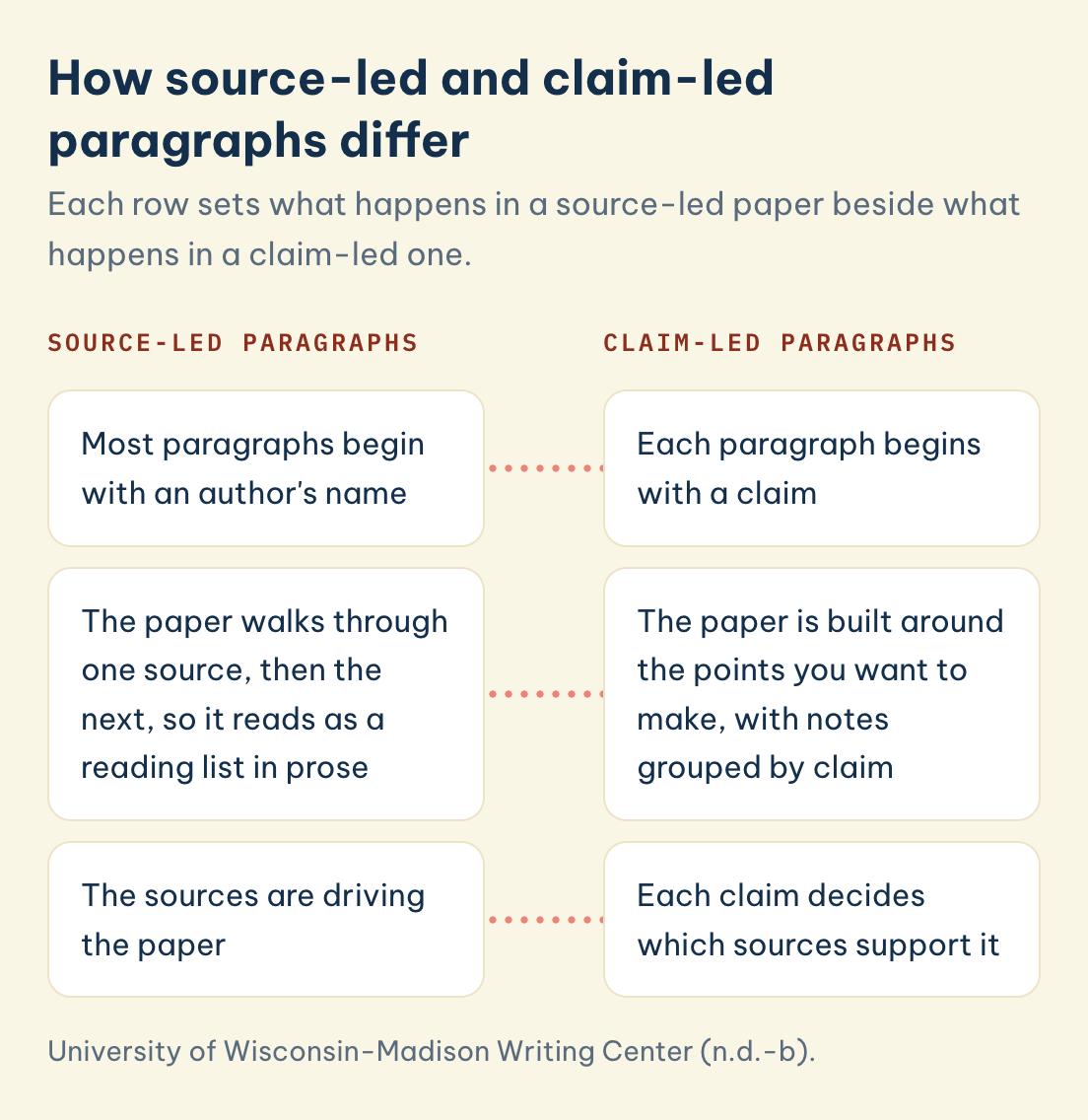
Source-led organisation is the single most common structural failure, and it is visible from the paragraph openings. If most paragraphs begin with an author's name rather than a claim, the sources are driving. Writing-centre guidance states the rule directly: build the paper around the points you want to make rather than letting your sources organise it (University of Wisconsin–Madison Writing Center, n.d.-b).
The repair is mechanical. Write a sentence outline in which every line is a claim, then attach sources underneath each line. Any source that will not attach to a claim is either a claim you have not written yet, or reading you do not need.
◆ Part 4 / 7 · Sources and anchor source
How many sources, and what an anchor source does
Direct answer: Source counts come from your brief, not a general rule. What matters more is whether 1 or 2 sources anchor the paper. Silva (2021) found that most first-year papers showed evidence of an anchor source, and that papers lacking one showed significant rhetorical problems.
In that pilot study, 21 of 30 papers, or 70% of the sample, showed evidence of an anchor source, and 6 of the 9 papers without one showed significant rhetorical problems (Silva, 2021). The study appears in Signum: Estudos da Linguagem, volume 24, pages 43 to 61.
An anchor source is the work your paper argues with, extends or disputes throughout, rather than cites once. It gives the paper a position to push against, which is why its absence shows up as a rhetorical problem and not merely a citation problem (Silva, 2021).
Evaluating sources is part of the work, not a preliminary to it. A source is worth citing when you can say what it argues, how it knows, and where it sits relative to your claim (Chisholm & Spencer, 2019).
◆ Part 5 / 7 · The usual structure
The structure most briefs expect
Direct answer: Most undergraduate research papers run introduction, background or literature, method where relevant, findings or analysis, discussion, and conclusion. Your own brief overrides this. Map out your approach by composing a detailed sentence outline before drafting, so the sequence is settled before the prose is (Concordia University Library, n.d.).
Not every discipline uses all of those sections. A history or literature paper may have no method section at all, while an empirical psychology paper will be judged on it. Read a marked example from your own department before assuming the shape.
Cite as you draft rather than afterwards, and work from whole sources rather than stray sentences. Howard et al. (2010) examined 18 student research papers and found that not one of them summarised a source; the students paraphrased, copied or patchwrote from individual sentences instead. Their warning is that borrowing at sentence level leaves a writer permanently at risk of echoing the source's wording without meaning to, and that it does nothing to make the writer understand what the source actually argues. That study appears in Writing & Pedagogy, volume 2, pages 177 to 192.
◆ Part 6 / 7 · What goes wrong most
What goes wrong most often
Direct answer: What goes wrong is consistent, starting with a topic in place of a question, a thesis that describes rather than argues, paragraphs organised by source, sources cited without being evaluated, and citations added after drafting rather than during it, which is how the link between a sentence and its source gets lost (Howard et al., 2010).
- A topic, not a question. Only 6.8% of first-year topics reached the exemplary level for being arguable (Rinto et al., 2016).
- A descriptive thesis. If nobody could disagree with it, it is a subject heading.
- Source-led paragraphs. Claims first, sources underneath (University of Wisconsin–Madison Writing Center, n.d.-b).
- No anchor source. Papers lacking one showed significant rhetorical problems (Silva, 2021).
- Citations bolted on at the end. Record the source with the sentence, while you still know which sentence came from where (Howard et al., 2010).
◆ Part 7 / 7 · Where a second reader helps
Where a second reader helps most
The highest-value moment for outside input on a research paper is early, when the question is still moving. Once 3,000 words exist, a weak question is expensive to fix, because the structure is built on it. A reader in your discipline can tell you whether the question is arguable, whether your source base is balanced or lopsided, and whether your thesis is doing work. Through academic support at MAAS, a discipline-matched expert works with you through Outline, Draft and Final against the rubric your department will actually mark against. You write and submit the paper yourself.
Frequently asked questions
Is a research paper the same as an essay?
No. An essay usually argues from set readings, while a research paper requires you to locate and evaluate sources yourself. The selection of evidence is part of what is assessed (Rinto et al., 2016).
Where should the thesis statement go?
At the end of the introduction, so the reader knows the claim before the evidence arrives (George Washington University, n.d.). One sentence is enough.
How many sources does a research paper need?
Your brief sets the number. Beyond that count, check whether 1 or 2 sources anchor the argument rather than appearing once each (Silva, 2021).
Can I use the same structure for every discipline?
No. A method section is expected in empirical work and often absent in humanities papers. Read a marked example from your own department first.
When should I start citing?
While drafting. Recording the source alongside the sentence keeps the link between a claim and the work it came from, which is the link that is hardest to rebuild later (Howard et al., 2010).
References
Chisholm, A., & Spencer, B. (2019). Through the looking glass: Viewing first-year composition through the lens of information literacy. Communications in Information Literacy, 13(1), 43–60. https://doi.org/10.15760/comminfolit.2019.13.1.4
Concordia University Library. (n.d.). How to write a research paper. Concordia University. https://library.concordia.ca/help/writing/research-paper.php
George Washington University. (n.d.). A guide to writing a research paper. University Writing Program, Columbian College of Arts & Sciences. https://writingprogram.gwu.edu/guide-writing-research-paper
Howard, R. M., Serviss, T., & Rodrigue, T. K. (2010). Writing from sources, writing from sentences. Writing & Pedagogy, 2(2), 177–192. https://doi.org/10.1558/wap.v2i2.177
Rinto, E., Bowles-Terry, M., & Santos, A. J. (2016). Assessing the scope and feasibility of first-year students' research paper topics. College & Research Libraries, 77(6), 749–764. https://doi.org/10.5860/crl.77.6.749
Silva, M. L. (2021). Anchoring the first-year research paper: A pilot study of FYW student citation practices. Signum: Estudos da Linguagem, 24(1), 43–61. https://doi.org/10.5433/2237-4876.2021v24n1p43
University of Wisconsin–Madison Writing Center. (n.d.-a). Thesis and purpose statements. The Writing Center. https://writing.wisc.edu/handbook/processandstructure/thesis_or_purpose/
University of Wisconsin–Madison Writing Center. (n.d.-b). Writing a research paper. The Writing Center. https://writing.wisc.edu/handbook/academicwriting/planresearchpaper/
A free 20-minute consultation is a conversation about your situation and the research paper you are writing.
Book a free consultation ▸