
◆ Research proposal
How do you write a research proposal?
A research proposal is the document you write before a study happens, setting out what you intend to investigate, how you will do it, and why it is worth doing (University of Hull, n.d.; Monash University, n.d.). One standard definition puts it plainly: "The proposal is a detailed plan or 'blueprint' for the intended study, and once it is completed, the research project should flow smoothly" (Sudheesh et al., 2016, p. 631).
At undergraduate level the test is narrower than most students assume. You are not asked for an original contribution to the field, but whether this exact study can be finished by you, with your access and your skills, in the weeks you have (Sudheesh et al., 2016). Where the proposal sits among the other assignment types is set out in the MAAS guide to writing a university assignment. If your proposal is the first stage of a dissertation, the dissertation proposal guide is the closer match. For a worked, annotated example at taught master's level, see a research proposal example for a UK master's.

◆ Section 1 / 6 · What it is
What an undergraduate research proposal is
Direct answer: An undergraduate proposal pitches a feasible, supervisor-approved study, and University of Hull (n.d.) places it in the second year of undergraduate study, before the independent project it serves. It needs a brief literature snapshot, 1 answerable question, and a realistic single-semester plan. Unlike a doctoral proposal, it does not have to fill a genuine gap in scholarship.
That difference is structural, not a matter of length. Monash University (n.d.) sets out the full section list a proposal can carry, but an undergraduate brief asks for a deliberate subset rather than a shrunken copy of every section. Check which sections your brief names, because writing the ones it omits spends words you need elsewhere.
The audience is narrower too. A doctoral or funding proposal must persuade a panel and an ethics committee, while an undergraduate proposal has to persuade 1 supervisor that the plan is sound (Sudheesh et al., 2016). Abdulai and Owusu-Ansah (2014) trace the trouble students have in writing proposals for their supervisors to not fully grasping what a proposal is, which makes it a comprehension problem before it is a writing problem.
◆ Section 2 / 6 · Length and sections
How long a proposal should be, and what goes in it
Direct answer: Your brief sets the length. University of Kent (2025) reports that word counts vary but average 1500 to 2000 words for a research proposal, while University of Hull (n.d.) says only that the count is usually tight with a lot to say. The sections below are the standard ones (Monash University, n.d.).
The seven sections a proposal can carry
Tap a section to read what it holds, as the post lists them. Your own brief decides which of them it asks for.
Item 1 of 7
Title
Short and descriptive, naming the topic directly.
Item 2 of 7
Context
Context that narrows to the specific problem, not a full review.
Item 3 of 7
Sources
A handful of key sources positioning the gap, separated from the project's later full review by brevity and purpose (University of Hull, n.d.).
Item 4 of 7
Question
1 narrow, answerable question, occasionally 2 (Sudheesh et al., 2016).
Item 5 of 7
Method
What data, how collected, how analysed, visibly matched to the question (Sudheesh et al., 2016).
Item 6 of 7
Ethics
A brief acknowledgement where people or sensitive data are involved (Sudheesh et al., 2016).
Item 7 of 7
Timeline
A phase plan fitted to the weeks you have (Hamel Center for Undergraduate Research, n.d.).
Save this figure
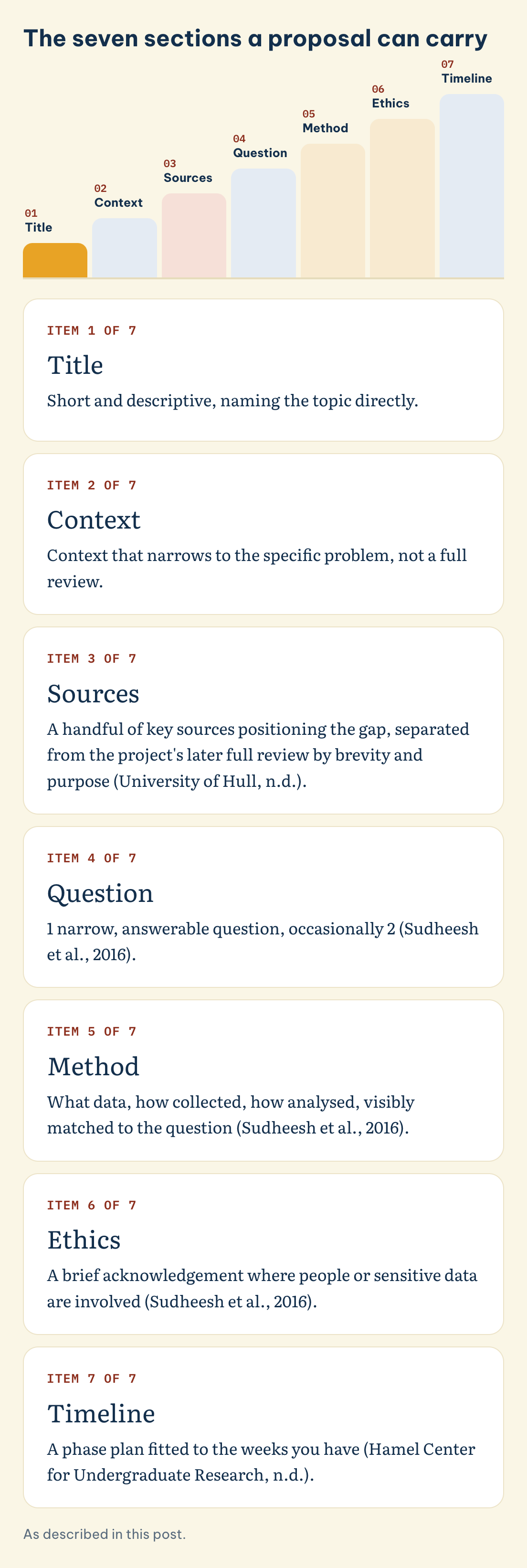
- Working title: short and descriptive, naming the topic directly.
- Background and problem statement: context that narrows to the specific problem, not a full review.
- Literature snapshot: a handful of key sources positioning the gap, separated from the project's later full review by brevity and purpose (University of Hull, n.d.).
- Research question: 1 narrow, answerable question, occasionally 2 (Sudheesh et al., 2016).
- Method: what data, how collected, how analysed, visibly matched to the question (Sudheesh et al., 2016).
- Ethics: a brief acknowledgement where people or sensitive data are involved (Sudheesh et al., 2016).
- Timeline: a phase plan fitted to the weeks you have (Hamel Center for Undergraduate Research, n.d.).
Departments count length differently, so read your own brief before trusting any general figure. Georgetown University School of Foreign Service in Qatar (n.d.) sets 4 to 6 pages for its Senior Honors Thesis proposal, stating no rule on spacing and none on excluding references, figures and tables, while Northwestern University Office of Undergraduate Research (n.d.) sets no page count at all and instead requires four named subheadings, introduction, background or literature review, methodology and qualifications, for its undergraduate research grant applications. University of Kent (2025) counts in words rather than pages, putting the average at 1500 to 2000 words and noting the figure shifts by department. Ädel et al. (2024) found that the local guidelines governing undergraduate thesis supervision underspecify what is expected of supervisor and student alike, which is why two departments can hold different expectations of the same genre.
◆ Section 3 / 6 · Feasibility
Feasibility is the whole test
Direct answer: An undergraduate proposal succeeds or fails on whether a reader believes you personally, with your actual time, access and skills, can finish this exact study in the weeks available. The Hamel Center for Undergraduate Research (n.d.) lists an over-large project among the common pitfalls that lead to a proposal being rejected.
This separates a proposal from its sibling genres. A literature review is judged on how completely it synthesises what is known, a doctoral proposal on originality, and an undergraduate proposal on whether the plan is survivable, which is why a modest question answered properly beats an ambitious one answered partly.
Being realistic is not being unambitious. Sudheesh et al. (2016) put credibility, achievability and practicality at the centre of what an evaluation committee assesses, and note the researcher must hold a realistic understanding of what can be achieved.
◆ Section 4 / 6 · Topic and question
A topic is not a research question
Direct answer: A topic names an area of interest. A question names something a specific method could answer. "Social media and wellbeing" is a topic. "Does daily screen time predict self-reported sleep quality among first-year students at one university?" is a question, because it names a population, a measure and a boundary.
The evidence that this is the hard part is direct. Rinto et al. (2016) content-analysed first-year students' research topics against a rubric and found only 6.8% scored at the exemplary level for being an arguable topic, the lowest-scoring category they measured (p. 757). Students struggled most with defining a feasible focus.
The Hamel Center for Undergraduate Research (n.d.) names the related failure directly, describing a proposal that sets out only the technical tasks a student will perform. Stanford Undergraduate Research and Independent Projects (n.d.) puts the same point at the top of its own list, calling inadequate rationale for doing the project at hand the single most common deficiency in student proposals. A reader should finish your first paragraph knowing what you will do and why it matters.
◆ Section 5 / 6 · The timeline
The timeline that makes or breaks it
Direct answer: Your timeline must fit inside the actual module window, with named milestones and slack for delay. The Hamel Center for Undergraduate Research (n.d.) lists a missing or vague timetable among the common pitfalls that lead to a proposal being rejected, alongside the project simply being too large.
Write the timeline backwards from the submission date, which Monash University (n.d.) calls the best planning trick, starting at your end date and working backwards by listing what you have to do. Put ethics approval, if your study needs it, before data collection, because that queue is outside your control and is the step most likely to consume weeks you assumed you had. Then check the method is still possible inside what remains (Sudheesh et al., 2016).
◆ Section 6 / 6 · Mistakes that sink it
The mistakes that sink undergraduate proposals
Direct answer: Proposals fail in a few predictable ways, starting with proposing a topic rather than a question, omitting the rationale, planning a project too large for the time available, writing a vague timeline, choosing a method by familiarity rather than fit, and over-scoping the literature section so it crowds out method and feasibility.
- A topic in place of a question. Arguability scored lower than any other criterion measured on first-year topics, reaching exemplary in 6.8% of them (Rinto et al., 2016).
- No stated rationale. Stanford Undergraduate Research and Independent Projects (n.d.) calls inadequate rationale the single most common deficiency in student proposals, and a list of technical tasks is not a rationale (Hamel Center for Undergraduate Research, n.d.).
- Too much project. A project too large to be managed by an undergraduate in the time allotted (Hamel Center for Undergraduate Research, n.d.).
- Method chosen by habit. A survey because it is the only tool you know is not a reason; the method must answer the stated question (Sudheesh et al., 2016).
- A review that swallows the proposal. Hull warns explicitly against writing the project's full review inside the proposal (University of Hull, n.d.).
When you want a second pair of eyes on your proposal
Plenty of students draft a proposal without help, and that is a reasonable way to do it. What an expert reader adds is a feasibility check before you commit a semester to the wrong plan: someone in your field can tell you whether the question is answerable with your method, whether the timeline survives an ethics queue, and where a reader will stop believing you. Through academic support at MAAS, a discipline-matched expert sits with the plan at Outline, Draft and Final, checking it against the criteria your department published. The proposal you hand in is written by you.
Frequently asked questions
How long should my research proposal be?
Your brief sets the figure. University of Kent (2025) reports that word counts vary but usually average 1500 to 2000 words, and University of Hull (n.d.) says only that the count is tight. Doctoral and funding proposals are considerably longer, so do not borrow their length as a target.
Do I need original findings to propose a study?
No. Originality of contribution is a doctoral standard. An undergraduate proposal is assessed on whether a feasible, well-matched plan has been designed (Sudheesh et al., 2016), and Abdulai and Owusu-Ansah (2014) set out the essential ingredients such a plan is expected to contain.
How detailed should the method be?
Detailed enough to be checked. Name the data, the sample, the tools and the analysis rather than describing them in general terms, so a reader can judge whether the method answers your question (Sudheesh et al., 2016).
What if my study needs ethics approval?
Say so in the proposal and place approval before data collection in the timeline (Sudheesh et al., 2016). Undergraduate proposals usually need a brief acknowledgement rather than a full ethics application.
Can I change my question later?
Usually yes, with your supervisor's agreement, but a proposal built on a question you already doubt wastes the review. Settle the question, then write the method to match.
References
Abdulai, R. T., & Owusu-Ansah, A. (2014). Essential ingredients of a good research proposal for undergraduate and postgraduate students in the social sciences. Sage Open, 4(3). https://doi.org/10.1177/2158244014548178
Ädel, A., Skogs, J., Lindgren, C., & Stridfeldt, M. (2024). The supervisor and student in Bachelor thesis supervision: A broad repertoire of sometimes conflicting roles. European Journal of Higher Education, 14(2), 207–227. https://doi.org/10.1080/21568235.2022.2162560
Georgetown University School of Foreign Service in Qatar. (n.d.). How to write a research proposal. Student Research Guide. https://guides.qatar.georgetown.edu/studentresearch/proposal
Hamel Center for Undergraduate Research, University of New Hampshire. (n.d.). Writing an effective research proposal. https://www.unh.edu/undergrad-research/students/writing-effective-research-proposal
Monash University. (n.d.). Features of a research proposal. Student Academic Success. https://www.monash.edu/student-academic-success/excel-at-writing/how-to-write/research-proposal/features-of-a-research-proposal
Northwestern University Office of Undergraduate Research. (n.d.). Proposal writing. Northwestern University. https://undergradresearch.northwestern.edu/advising/proposal-writing/
Rinto, E., Bowles-Terry, M., & Santos, A. J. (2016). Assessing the scope and feasibility of first-year students' research paper topics. College & Research Libraries, 77(6), 749–764. https://doi.org/10.5860/crl.77.6.749
Stanford Undergraduate Research and Independent Projects. (n.d.). Detailed project proposal guidelines. Stanford University. https://undergradresearch.stanford.edu/apply/writing-project-proposal/detailed-project-proposal-guidelines
Sudheesh, K., Duggappa, D. R., & Nethra, S. S. (2016). How to write a research proposal? Indian Journal of Anaesthesia, 60(9), 631–634. https://doi.org/10.4103/0019-5049.190617
University of Hull. (n.d.). Research proposals. University of Hull Library. https://libguides.hull.ac.uk/other/proposals
University of Kent. (2025). Developing a research proposal. Skills for Academic Success. https://student.kent.ac.uk/studies/research-projects-and-dissertations/how-to-write-a-research-proposal
A free consultation with MAAS academic support, to talk through whether your question, method and timeline look feasible before you commit a semester to them.
Book Free Discovery ▸