
◆ Thesis and dissertation
How do you write a dissertation proposal for a bachelor's or master's?
A dissertation proposal sets out what you will research, why it matters to your field, and how you will carry the study out, usually in 800 to 3,000 words. To write one, state a focused research question, review enough literature to justify the gap, defend the methods you have chosen, and show a timeline that proves the project fits the time you have.
This guide covers the proposal you write partway through a taught degree, a bachelor's or a master's, at UK and Australian universities. Every claim below traces to a published university guide or a peer-reviewed paper, and the full source list sits at the end so you can check the original guidance yourself. If you are applying for a PhD place rather than proposing a project inside a taught programme, see the guide to PhD research proposals instead, because that document also has to win over an admissions panel. If yours is a shorter undergraduate proposal set as coursework, the undergraduate research proposal guide covers that scale, where feasibility inside a single semester is the whole test.

◆ Section 1 / 8 · What it is
What a dissertation proposal is, and who it has to persuade
Direct answer: A dissertation proposal gives a snapshot of your planned study: the topic, why you chose it, and how you will research it, answering what you intend to research, why it matters, and how you will carry it out. It has to persuade your reader, usually a supervisor, that the project is well thought through and should be approved.
The University of Westminster's dissertation guidance gives the plainest definition. The purpose of a dissertation proposal is to provide a snapshot of what your study involves, presenting the topic, justifying your reasons for choosing it, and outlining how you are going to research it (University of Westminster, n.d.). The University of Southern California describes the same document through its goal, which is twofold: to present and justify the need to study a research problem, and to present the practical ways in which the proposed study should be conducted (University of Southern California, n.d.). The Australian National University compresses all of that into the three questions that organise the rest of this guide: a persuasive proposal sets out what you intend to research, why it matters, and how you plan to carry it out (Australian National University, n.d.-a). A proposal presupposes a settled topic, and narrowing a broad interest into a dissertation topic is how you get there.
The word doing the real work in those definitions is persuade. The University of Hull is explicit that the main function of a research proposal is to convince the reader that your research is well thought through, has a clear purpose and should be approved, and that a convincing, clearly written case tends to earn a high mark when the proposal is marked as a separate assignment (University of Hull, n.d.). Your reader is not a neutral recipient of information; they are deciding whether to let the project go ahead.
Where the proposal sits in a taught degree
In a bachelor's or master's programme, the proposal is an approval gate partway through the degree. Hull's guidance notes that it is often set as a separate assignment, usually in the second year of undergraduate study or early in a master's, and Westminster adds that after submission you are usually assigned a supervisor with expertise in your field, who feeds back on the viability of the topic, how to focus the scope, and the research methods (University of Hull, n.d.; University of Westminster, n.d.).
The same document works differently at doctoral level. RMIT University's guidance on preparing a research proposal, for instance, is written for applicants to postgraduate research programmes, where the proposal must also persuade a selection panel before any supervision begins (RMIT University, n.d.). If that is your situation, the MAAS guide to PhD research proposals covers that document; everything below assumes you are already enrolled and proposing a supervised project.
◆ Section 2 / 8 · A genuine question
Before you write a word: check you are asking a genuine question
Direct answer: Before drafting, check that you are asking a genuine research question rather than seeking evidence for an idea you have already decided is true. A genuine question addresses a real gap in your field and can survive evidence pointing either way; one built to produce only a single answer will not.
RMIT University's guidance contains what may be the most useful sentence in this whole literature. Unsuccessful proposals, it observes, tend to suffer from a number of common problems, and the most common is that the researcher is not really asking a genuine research question but seeking supporting evidence for a preconceived idea. The self-check it offers deserves a place above your desk: "are you seeking new knowledge or trying to prove something you think you know?" (RMIT University, n.d.).
The Australian National University frames the same requirement positively: good research starts with identifying an important problem or gap in knowledge in your field or discipline that you can address or fill (Australian National University, n.d.-a). Starting from a strong conviction is not a failure in itself, and many worthwhile projects begin as a hunch formed on a placement or in a seminar. The difficulty starts when the proposal is built so that only one answer can come out, because a genuine question has to be able to survive evidence pointing either way, and an experienced marker can usually tell within a page which kind of document they are holding.
◆ Section 3 / 8 · The sections
The sections examiners expect, and the job each one does
Direct answer: A dissertation proposal typically covers the same recurring sections: title and aim, background and research questions, a literature review that justifies the gap, a methodology that defends the chosen approach, a timeline proving the project is feasible, and a current reference list, each doing a distinct job while together communicating what, why and how the project works.
The six sections of a dissertation proposal and the job of each
Tap a section to see the job it has to do.
Title and aim
Its job: signal the subject, scope and methodological approach, and break the aim into objectives.
Background and research questions
Its job: introduce the problem, position it in the field, and state the question or aim.
Literature review
Its job: justify the question, the framework and the method by showing the gap.
Methodology
Its job: defend why these methods are the right way to answer the question, ethics included.
Timeline
Its job: show milestones for each stage and prove the project fits the time available.
References
Its job: show the proposal is grounded in real, current reading.
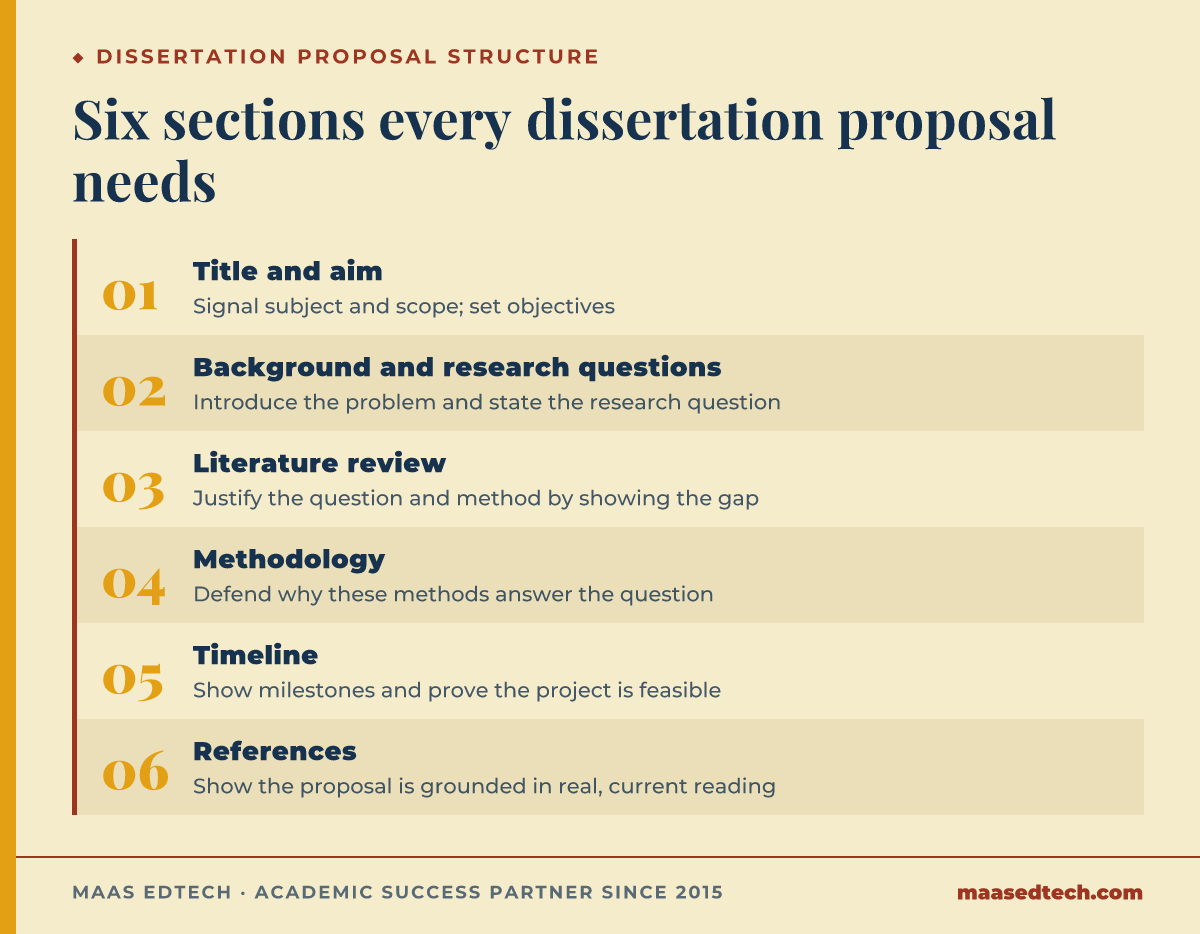
Section names vary more than students expect. The Australian National University notes that the structure of your proposal may be dictated by your college, school or even supervisor, and offers its suggested headings as a menu to adopt or adapt, because the underlying task never changes: communicate the what, why and how of the intended project (Australian National University, n.d.-b). Current scholarship confirms broadly the same component set, from introduction and problem statement through literature review, methodology, timeline and references (Bernard, 2025). The table below maps the recurring sections to the job each one must do.
| Section | The job it has to do | Source |
|---|---|---|
| Title and aim | Signal the subject, scope and methodological approach; break the aim into objectives | Coventry University (n.d.); University of New South Wales (n.d.) |
| Background and research questions | Introduce the problem, position it in the field, state the question or aim | University of Hull (n.d.); University of Westminster (n.d.) |
| Literature review | Justify the question, the framework and the method by showing the gap | Australian National University (n.d.-c) |
| Methodology | Defend why these methods are the right way to answer the question, ethics included | The University of Sheffield (n.d.); University of New South Wales (n.d.) |
| Timeline | Show milestones for each stage and prove the project fits the time available | University of Sydney (n.d.); University of New South Wales (n.d.) |
| References | Show the proposal is grounded in real, current reading | Australian National University (n.d.-c) |
Title and aim
Coventry University's Centre for Academic Writing suggests that a working title can carry three signals at once: the main subject of your research, the scope of it, and the methodological approach you will use to examine it (Coventry University, n.d.). The University of New South Wales adds the discipline of setting out the specific objectives of the research, the concrete steps that together deliver the aim, rather than leaving the aim as one broad sentence (University of New South Wales, n.d.).
Background and research questions
The background section introduces the reader to the research problem and positions it within the existing literature, covering the rationale for the research and what you intend to accomplish (University of Hull, n.d.; University of Westminster, n.d.). The research question itself carries more weight than any other line in the document, so if yours is still moving, settle it first; the MAAS guide to research questions and objectives covers how to sharpen both.
A literature review that justifies, not just surveys
In a proposal, the review's job is narrower and more pointed than the dissertation chapter it will later become. The Australian National University states it directly: the literature review justifies your research question, your theoretical or conceptual framework, and your method, and it does so by critically examining what is currently known and identifying the gap your project will address (Australian National University, n.d.-c). Hull's guidance reduces it to the two questions the review must answer: why is this a piece of research that needs doing, and why do it the way you are suggesting (University of Hull, n.d.). Hull also notes that a review written for a proposal differs from the full project review in brevity and purpose, so you are selecting literature to make a case, and the deeper survey comes later. For what the full-scale version demands, see the literature review guide.
Methodology: reasons, not a list of methods
The Australian National University warns that methodology should not be confused with procedure: a procedural section outlines the process of what will be done, while a methodology section in a proposal justifies why you are taking your approach (Australian National University, n.d.-c). The University of Sheffield gives the same instruction more bluntly: do not simply compile a list of methods, explain why this is the most appropriate, valid and reliable way to answer your question, and remember you should always be defending your choices (The University of Sheffield, n.d.). The University of New South Wales adds an element students routinely forget at proposal stage: name the ethical and safety issues you have identified and how you propose to proceed (University of New South Wales, n.d.). The reasoning this section demands carries straight into the dissertation itself, and the guide to writing a dissertation methodology continues that argument.
Timeline and feasibility
The University of Sydney calls the work plan a critical component of the proposal, because it indicates feasibility within the timeframe, and asks you to consider the milestones you aim to achieve at each stage of the research (University of Sydney, n.d.). The University of New South Wales treats milestones as the steps needed to meet your goals and timelines as the plan for when each will be completed, formatted as a simple table or list covering literature research, stages of investigation and chapter drafts (University of New South Wales, n.d.). Sheffield folds the same test into the research design itself: demonstrate the feasibility of the project, keeping in mind time and other constraints (The University of Sheffield, n.d.).
Keeping your reference list current
A proposal should be fully referenced (University of Hull, n.d.), and the Australian National University offers the habit that saves marks late in the process: keep a current reference list that you update as you write, and do not leave it until the end (Australian National University, n.d.-c). If your programme uses APA, the MAAS APA 7th referencing guide covers the format in detail.
◆ Section 4 / 8 · How long
How long should a dissertation proposal be?
Direct answer: There is no single length. University of Westminster allows 800 to 3,000 words across levels, University of Sydney caps a standard proposal at about 2,000 words, and RMIT University describes it as a two to five page overview. Confirm the actual limit in your module handbook before you plan the document.
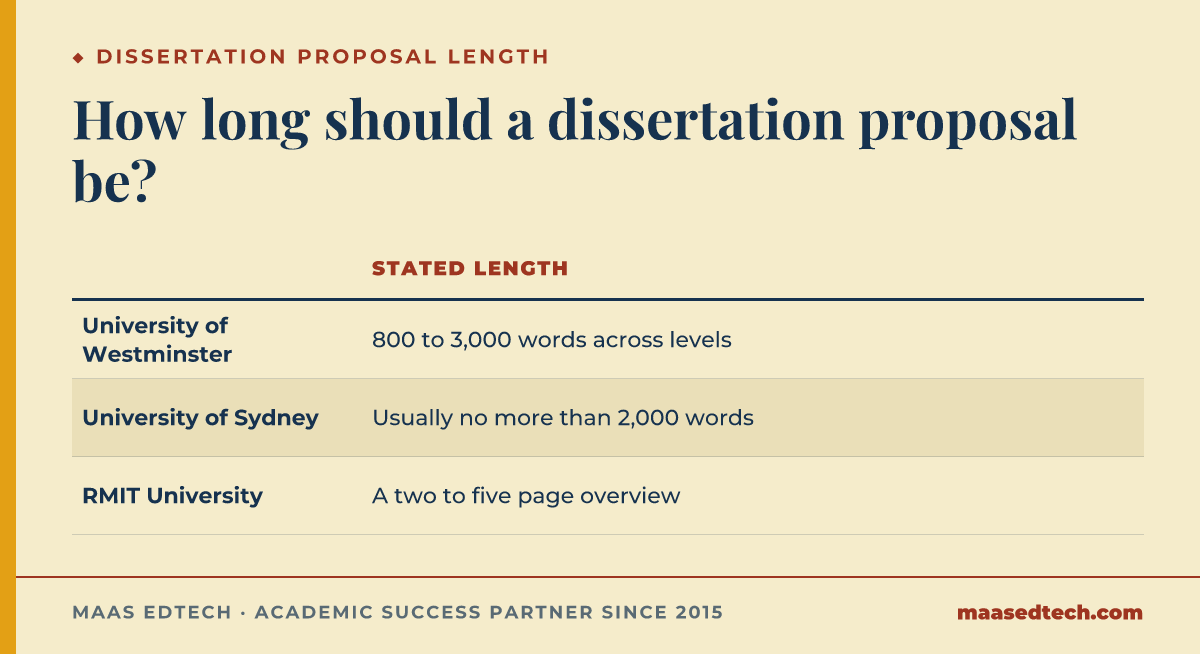
There is no single answer, and three published guides show how wide the honest range is (RMIT University, n.d.; University of Sydney, n.d.; University of Westminster, n.d.).
| University guidance | Stated length |
|---|---|
| University of Westminster | 800 to 3,000 words across undergraduate, postgraduate and doctoral levels |
| University of Sydney | Usually no more than 2,000 words |
| RMIT University | A two to five page overview |
Because requirements differ this much between institutions, and often between schools of the same institution, confirm the limit in your module handbook before you plan the document, and check with your supervisor or research coordinator where anything is unclear (University of Sydney, n.d.). Sydney's guidance adds that presenting the idea clearly and concisely is itself read as evidence of your ability as a researcher.
◆ Section 5 / 8 · Common mistakes
The mistakes that get proposals sent back
Direct answer: Proposals get sent back for seeking evidence to prove a preconceived idea instead of asking a genuine question, drifting into unrelated tangents instead of staying focused, skipping landmark studies in the literature review, failing to delimit the scope, opening with vague statements, and starting to write too late in the process.
Six mistakes that get proposals sent back
Tap a mistake to see what the post says about it.
Item 1 of 6
Proving, not asking
The most common failure RMIT University identifies is seeking supporting evidence for a preconceived idea rather than asking a genuine research question (RMIT University, n.d.).
Item 2 of 6
All over the map
The University of Southern California lists failure to be concise first among proposal mistakes: the document must stay focused rather than diverge into unrelated tangents without a clear sense of purpose (University of Southern California, n.d.).
Item 3 of 6
Landmark studies
The same guide warns against failing to cite landmark works in the literature review, because a proposal should be grounded in the foundational research that frames the topic (University of Southern California, n.d.).
Item 4 of 6
No scope
Failing to state the boundaries of the study, the time period, the place and the people it covers, leaves the reader unable to judge whether the project is achievable (University of Southern California, n.d.).
Item 5 of 6
Vague opening
Peer-reviewed guidance on the proposal process warns against starting with broad, vague statements, packing the introduction with detail that belongs in the literature review, and framing a problem that is not grounded in the relevant literature (Bernard, 2025).
Item 6 of 6
Writing too late
The Australian National University treats writing as a constant process: draft the research question, introduction and review as early as you can, because the act of writing exposes problems before they become critical (Australian National University, n.d.-c).
- Proving instead of asking. The most common failure RMIT University identifies is seeking supporting evidence for a preconceived idea rather than asking a genuine research question (RMIT University, n.d.).
- Being "all over the map". The University of Southern California lists failure to be concise first among proposal mistakes: the document must stay focused rather than diverge into unrelated tangents without a clear sense of purpose (University of Southern California, n.d.).
- Skipping the landmark studies. The same guide warns against failing to cite landmark works in the literature review, because a proposal should be grounded in the foundational research that frames the topic (University of Southern California, n.d.).
- Never delimiting the scope. Failing to state the boundaries of the study, the time period, the place and the people it covers, leaves the reader unable to judge whether the project is achievable (University of Southern California, n.d.).
- Opening vague and overloading the introduction. Peer-reviewed guidance on the proposal process warns against starting with broad, vague statements, packing the introduction with detail that belongs in the literature review, and framing a problem that is not grounded in the relevant literature (Bernard, 2025).
- Starting to write too late. The Australian National University treats writing as a constant process: draft the research question, introduction and review as early as you can, because the act of writing exposes problems before they become critical (Australian National University, n.d.-c).
◆ Section 6 / 8 · The three tests
The gate every proposal has to clear, restated
Direct answer: Every proposal has to clear the same three tests regardless of institution-specific formatting: a genuine research question, a literature review that justifies the project rather than simply surveying the field, and a timeline proving the project is feasible in the time available. Passing all three is everything a supervisor needs.
Strip away the institution-specific formatting and the same three tests recur across all nine guides cited in this article: a genuine question (RMIT University, n.d.; Australian National University, n.d.-a), a literature review that justifies rather than surveys (Australian National University, n.d.-c; University of Hull, n.d.), and a timeline that proves the project is feasible in the time available (University of Sydney, n.d.; University of New South Wales, n.d.). A proposal that passes all three, in a document as short as 800 words or as long as 3,000, is doing everything a supervisor needs it to do.
◆ Section 7 / 8 · It will change
Your proposal will change, and that is expected
Direct answer: Nothing locks you into your original proposal. As your reading deepens, the project is expected to shift, and the University of Westminster is explicit that you are not bound by it. The one fixed rule is to flag any major change to your supervisor first, since redrafting is normal, not a sign the idea was weak.
The University of Westminster says it in so many words: you are not bound by your proposal (University of Westminster, n.d.). Your project is likely to evolve and may move in a new direction, and your supervisor knows this happens as you read deeper into the field; the one obligation is to discuss any major development with your supervisor first. The University of New South Wales describes proposal writing as an iterative process in which you will most likely prepare multiple drafts, improving each one with feedback from your supervisors, and the University of Sydney confirms that your supervisor will work with you to refine the proposal ahead of submission (University of New South Wales, n.d.; University of Sydney, n.d.). Redrafting can feel like evidence that the idea was weak, but on this point the guidance is unanimous: the feedback loop is the process working as designed.
The style should nonetheless sound certain about what it proposes. Hull's advice is to be assertive and write in the future tense, so "This research will examine" rather than "This research might", with the past and present tenses reserved for the literature review; and because conventions differ, check whether your tutor prefers first person or third person writing before you commit (University of Hull, n.d.).
◆ Section 8 / 8 · Sources
Where this guidance comes from
Every claim above traces to a named source rather than to a generic "best practice" list. Nine university writing centres are cited directly: the University of Westminster, the University of Southern California, the Australian National University, the University of Hull, RMIT University, Coventry University, the University of New South Wales, The University of Sheffield, and the University of Sydney. Because these are institutional guidance pages rather than dated journal articles, the References list them with a retrieval date rather than a publication year. The one peer-reviewed exception is Bernard (2025), writing in the Journal of Research Initiatives, whose systematic review of the proposal process is the source for the mistakes around vague openings and ungrounded problem statements described above.
WHEN YOU WANT A SECOND PAIR OF EYES BEFORE YOU SUBMIT
MAAS academic mentoring pairs you with a postgraduate-qualified mentor who reads your draft the way an approver will, pressure-tests the question, the justification and the plan, and gives structured feedback across drafts before you submit. The reading, the decisions and the writing remain your own.
Most proposals that come back for revision fail on questions a second reader would have raised in ten minutes. Is the question genuine, are the methods defended rather than listed, is the timeline honest about the term you actually have? MAAS academic mentoring pairs you with a postgraduate-qualified mentor who reads your draft the way an approver will, pressure-tests the question, the justification and the plan, and gives structured feedback across drafts before you submit. The reading, the decisions, and the writing remain your own.
Frequently asked questions
What sections does a dissertation proposal need?
Expect six recurring parts: a title and aim, background with your research questions, a literature review that shows the gap, a methodology that defends your approach, a timeline that proves the project is feasible, and a current reference list. Your college, school or supervisor may dictate the headings, yet every version has to explain what you will do, why, and how (Australian National University, n.d.-b).
How long should a dissertation proposal be?
Most taught-degree dissertation proposals fall between 800 and 3,000 words (University of Westminster, n.d.), the University of Sydney caps its standard proposal at about 2,000 words, and RMIT University describes a proposal as a 2 to 5 page overview. Because requirements differ this widely, always confirm the limit in your module handbook or with your supervisor before you start.
Does a capstone project need a proposal too?
Usually yes, and New Mexico State University assesses it separately with a minimum of 5 sources. A capstone is judged on application rather than on contribution to knowledge, so the contents differ. Our capstone project guide sets out what those programmes require.
What is the difference between methodology and methods in a proposal?
A methods or procedure section describes what you will do, while a methodology section justifies why that approach is right for your question (Australian National University, n.d.-c). The University of Sheffield gives the same instruction: do not simply compile a list of methods, explain why your choice is the most appropriate, valid and reliable way to answer the question.
Do I have to stick to my proposal once it is approved?
No. The University of Westminster states that you are not bound by your proposal and that your project is likely to evolve, and the University of New South Wales describes proposal writing as an iterative process of multiple drafts improved with supervisor feedback. Discuss significant changes with your supervisor rather than making them silently.
What is the most common reason a dissertation proposal is sent back?
RMIT University identifies it directly: the researcher is not really asking a genuine research question but seeking supporting evidence for a preconceived idea. Before submitting, ask yourself whether you are seeking new knowledge or trying to prove something you already believe.
Should I write my dissertation proposal in first or third person?
There is no universal rule; the University of Hull advises checking whether your tutor prefers first person or third person writing. What the guidance does agree on is voice: write assertively in the future tense, for example "This research will examine", rather than tentative phrasing.
How is a dissertation proposal different from a PhD research proposal?
A taught-degree dissertation proposal is submitted partway through a bachelor's or master's programme so a supervised project can be approved, typically in 800 to 3,000 words (University of Westminster, n.d.). A PhD research proposal is normally prepared when applying to a research degree (RMIT University, n.d.), so it must also persuade an admissions panel. If you are applying to a PhD programme, see our guide to PhD research proposals.
Which section takes the longest to get right?
Usually the literature review and the methodology. University of Hull's two-question test and The University of Sheffield's instruction to justify every method choice both target these two sections specifically (University of Hull, n.d.; The University of Sheffield, n.d.). Budget more redrafting time here than for the title, background or timeline, and check the literature review and methodology guides before you draft either one.
Does a longer proposal signal a stronger project?
No. University of Sydney's guidance states plainly that presenting an idea clearly and concisely is itself read as evidence of a researcher's ability, and a proposal padded past 3,000 words at Westminster or past 2,000 at Sydney more often signals an unfocused question than a well-developed one (University of Sydney, n.d.; University of Westminster, n.d.). RMIT's 2 to 5 page overview makes the same point from the opposite direction: brevity is expected, not penalised.
References
- Australian National University. (n.d.-a). Research proposals. Retrieved July 2, 2026, from https://www.anu.edu.au/students/academic-skills/research-writing/research-proposals
- Australian National University. (n.d.-b). Structuring. Retrieved July 2, 2026, from https://www.anu.edu.au/students/academic-skills/research-writing/research-proposals/structuring
- Australian National University. (n.d.-c). Writing. Retrieved July 2, 2026, from https://www.anu.edu.au/students/academic-skills/research-writing/research-proposals/writing
- Bernard, D. M. (2025). The dissertation research proposal process: A systematic approach. Journal of Research Initiatives, 8(5), Article 6. https://digitalcommons.uncfsu.edu/jri/vol8/iss5/6
- Coventry University. (n.d.). Writing a dissertation proposal. Retrieved July 2, 2026, from https://libguides.coventry.ac.uk/CAWhomepage/WritingaDissertationProposal
- RMIT University. (n.d.). Preparing a research proposal. Retrieved July 2, 2026, from https://www.rmit.edu.au/research/research-degrees/how-to-apply/preparing-a-research-proposal
- University of Hull. (n.d.). Research proposals. Retrieved July 2, 2026, from https://libguides.hull.ac.uk/other/proposals
- University of New South Wales. (n.d.). Writing research proposals. Retrieved July 2, 2026, from https://www.unsw.edu.au/student/managing-your-studies/academic-skills-support/toolkit/honours-postgraduate/proposal
- The University of Sheffield. (n.d.). How to write a research proposal. Retrieved July 2, 2026, from https://sheffield.ac.uk/study-skills/research/methods/proposal
- University of Southern California. (n.d.). Writing a research proposal. Retrieved July 2, 2026, from https://libguides.usc.edu/writingguide/assignments/researchproposal
- University of Sydney. (n.d.). How to write a research proposal. Retrieved July 2, 2026, from https://www.sydney.edu.au/study/help/advice/how-to-write-a-research-proposal.html
- University of Westminster. (n.d.). Writing a proposal. Retrieved July 2, 2026, from https://libguides.westminster.ac.uk/starting-your-dissertation/writing-a-proposal
A free 20-minute consultation with MAAS Academic Mentoring, to talk through your proposal. The reading, the decisions and the writing remain your own.
Book Free Discovery ▸