
APA 7th referencing has two halves that must always match: a short in-text citation with the author and year, and a full entry in an alphabetical reference list at the end. Get those two talking to each other and you have solved most of what markers check.
For international students at UK and Australian universities, clean referencing is some of the easiest marks to earn and the easiest to lose. Markers use it as a proxy for academic care, and reference errors are a common trigger for academic-integrity queries even when the work is entirely your own. This guide answers the APA 7th questions MAAS mentors are asked most, from in-text basics to citing AI tools. For the related question of who counts as an author on a paper, see our guide to authorship criteria and ORCID. If your department uses Harvard instead of APA, the Harvard referencing guide is the one to open next.
Author: MAAS Learning Skills Desk
Last updated: 2026-06-29
Category: citation-formatting
What is APA 7th edition, and when do you use it?
Direct answer: APA 7th is the referencing style of the American Psychological Association, used widely in psychology, education, nursing, business, and the social sciences. You use it when your unit guide or assignment brief specifies APA, and you should always confirm the required style in your own course shell before you start.
Evidence: The Publication Manual of the American Psychological Association (American Psychological Association, 2020) is the authoritative source for the style, and the APA Style website mirrors it for free (American Psychological Association, n.d.). The seventh edition simplified several rules from the sixth, including dropping the publisher location and listing up to 20 authors in full in a reference entry; with 21 or more authors, the entry gives the first 19, an ellipsis, and then the final author.
Example: A MAAS education student was marked down for mixing APA 6th and 7th conventions copied from old templates online. We rebuilt her reference list against the current APA Style site, and the formatting marks she had been losing every assignment came back.
How do you format an in-text citation in APA 7th?
Direct answer: An APA in-text citation gives the author surname and the year, either in parentheses at the end of the sentence (Smith, 2021) or woven into the sentence as Smith (2021) argues. When you quote directly, add the page number: (Smith, 2021, p. 14).
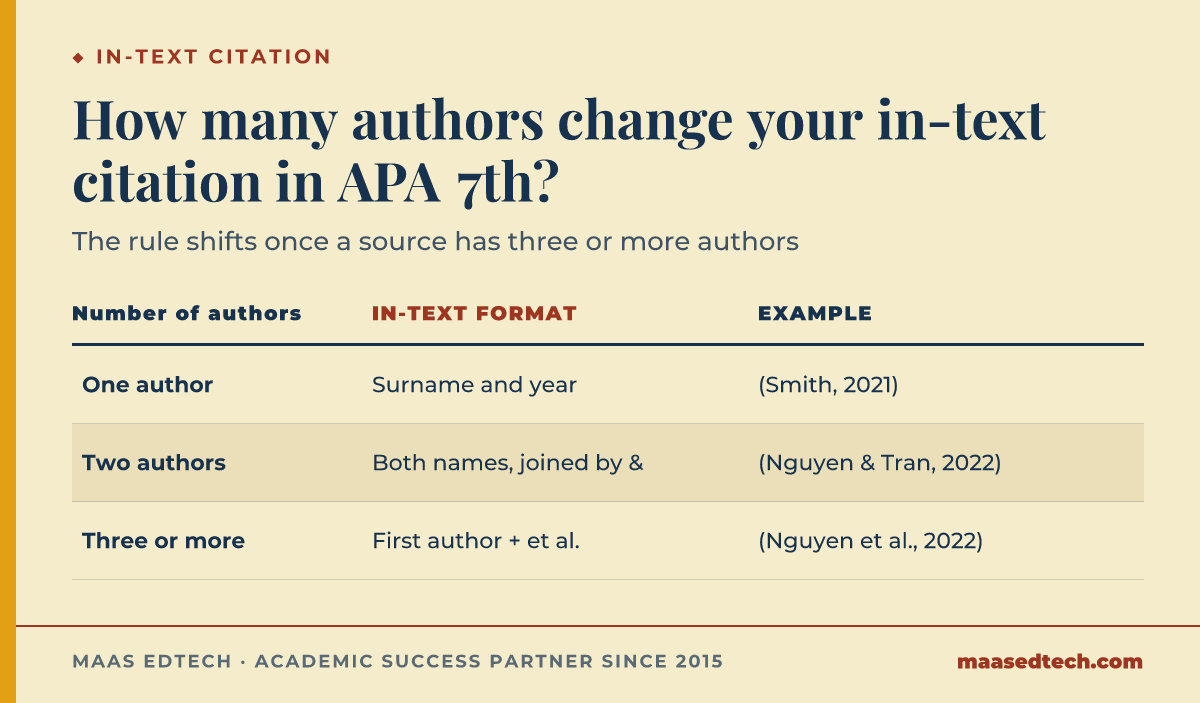
Evidence: APA uses an author–date system (American Psychological Association, 2020). For two authors, name both every time joined by an ampersand inside parentheses, (Nguyen & Tran, 2022), or by "and" in the running text. For three or more authors, give the first author followed by "et al." from the very first citation, which is a change from older referencing habits many students still carry.
Example: A MAAS business student wrote "(Nguyen et al, 2022)" throughout, missing the full stop after "al". A five-minute pass fixed every instance, and the consistency alone lifted the presentation mark.
How do you build a reference list entry?
Direct answer: Every reference entry follows the same order: author, year, title, and source. The list is alphabetical by author surname, double-spaced in a true assignment, with a hanging indent so the first line sits to the left and the rest indent.
Evidence: APA 7th structures entries around those four elements (American Psychological Association, 2020). A journal article reads: Author, A. A. (Year). Title of the article. Title of the Journal, volume(issue), pages. https://doi.org/xxxx. A book reads: Author, A. A. (Year). Title of the book (edition). Publisher. Every source named in your text must appear in the list, and every entry in the list must be cited in the text.
Example: A MAAS nursing student had eight references in her list but only five cited in the text. A marker reads that as padding. We removed the three uncited entries and added in-text citations for two she had genuinely used but forgotten to cite.
How do you cite a source with no author or no date?
Direct answer: With no author, move the title into the author position and cite a shortened title in text. With no date, use "n.d." (no date) in place of the year, in both the in-text citation and the reference entry.
Evidence: APA 7th gives explicit rules for missing elements (American Psychological Association, n.d.). For an organisation as author, use the full name, for example (World Health Organization, 2023). For a webpage with no date, the in-text citation reads (World Health Organization, n.d.), which signals to the reader that the source itself carried no publication date rather than that you forgot it.
Example: A MAAS student cited a government webpage as "(2024)" based on the date she accessed it. We corrected it to "n.d." with a retrieval date, because the page showed no publication date, and the distinction matters to a marker checking source quality.
How do you cite AI tools like ChatGPT in APA 7th?
Direct answer: APA treats a generative AI tool as a software source: name the company as author, the model and year, and describe the tool in brackets, with the prompt reported in your text or an appendix. Always check whether your university permits AI use for the task first, and disclose it as your institution requires.
Evidence: APA's official guidance cites ChatGPT in the form OpenAI. (2023). ChatGPT (version) [Large language model]. https://chat.openai.com, and recommends describing how you used it in your methods section, or in your introduction if the work is an essay or literature review (McAdoo, 2023). Referencing an AI tool does not make undisclosed or prohibited use acceptable, so the disclosure rules of your unit always come first.
Example: A MAAS student used an AI tool to brainstorm essay structure, which her unit allowed with disclosure. We helped her cite it correctly and add a one-line note on how it was used, keeping her within both the APA format and her university's integrity policy.
What are the most common APA referencing mistakes?
Direct answer: The recurring errors are in-text citations that do not match the reference list, mixing APA 6th and 7th rules, missing "et al." formatting, and inconsistent capitalisation or italics. Each is small on its own, but together they read as carelessness to a marker.
Evidence: Because APA is an author–date system, the single most damaging error is a mismatch between text and list (American Psychological Association, 2020). Markers and academic-integrity processes both check that every cited source is real and traceable, so a broken or missing reference can escalate from a formatting deduction to an integrity query even when the work is your own.
Example: A MAAS student lost marks across three assignments for the same five formatting habits. We built her a one-page personal checklist of those exact errors, and she ran it before every submission. The deductions stopped.
Frequently asked questions
How do I format in-text citations in APA 7th referencing?
For one author or two, every surname appears each time, and two authors are joined by an ampersand inside parentheses, as in (Nguyen & Tran, 2022), or by "and" when the names sit in your sentence. From three authors on, write the first surname plus "et al." starting at the very first citation, which differs from older habits (American Psychological Association, 2020). A direct quotation also needs a page number, as in (Smith, 2021, p. 14).
Do I need a reference for every sentence?
No. You cite when you draw on a specific source's idea, data, or words. Your own analysis and linking sentences do not need citations, but any claim that came from a source does.
What is the difference between a reference list and a bibliography?
A reference list contains only the sources you actually cited. A bibliography can include background reading you did not cite. APA uses a reference list by default unless your unit asks for a bibliography.
How do I cite a source I read about in another source?
Cite the source you actually read, using "as cited in". For example: (Smith, 2018, as cited in Nguyen, 2022). Only the source you read goes in the reference list. Where possible, find and read the original.
Does APA 7th require a DOI or URL?
Include a DOI when one exists, formatted as a link. For online works without a DOI, include the URL. For most print books, no URL is needed.
Can a referencing tool do this for me?
Reference generators speed up formatting, but they make errors, especially with edition rules and missing-element cases. Always check the output against the APA Style site rather than trusting it blindly.
Ready to make your referencing watertight?
Worried about referencing or an integrity query? Submit your work for a quote for our Academic Integrity Check, which includes APA, Harvard, and MLA formatting review and paraphrasing coaching on work you wrote yourself. We coach you to reference correctly; we do not write the work for you.
References
- American Psychological Association. (2020). Publication manual of the American Psychological Association (7th ed.). https://doi.org/10.1037/0000165-000
- American Psychological Association. (n.d.). APA Style. Retrieved June 29, 2026, from https://apastyle.apa.org
- McAdoo, T. (2023, April 7). How to cite ChatGPT. APA Style Blog. https://apastyle.apa.org/blog/how-to-cite-chatgpt
Tools & resources
- Purdue Online Writing Lab. (n.d.). APA formatting and style guide (7th edition). Retrieved June 29, 2026, from https://owl.purdue.edu/owl/research_and_citation/apa_style/apa_formatting_and_style_guide/
- RMIT University. (n.d.). Easy Cite referencing tool. Retrieved June 29, 2026, from https://www.rmit.edu.au/library/study/referencing
Related guides
- Free course: Academic writing essentials for postgraduate students: three short lessons on theoretical frameworks, the viva and APA 7th referencing, published free on the OpenLearn Create platform of The Open University
- Who qualifies as an author on a research paper?: authorship, credit, and ORCID
- How do you disclose AI use in a research paper?: for the integrity side of AI tools
- What is the difference between APA 7th and Harvard referencing?: how APA compares to the Harvard variants
- How do you title an essay in APA, MLA and Chicago?: title case, sentence case, and where the title sits on the page
- Academic Integrity Check service: APA/Harvard/MLA formatting review and paraphrasing coaching
- Academic Support service: Outline → Draft → Final coaching for essays and reports
This article is part of the MAAS Journal series for international students. MAAS coaches students to reference and write to standard. We do not write or submit work on a student's behalf.
Open licence. This lesson is released under Creative Commons Attribution 4.0 International (CC BY 4.0). You may share, translate and adapt it for any purpose, including commercially, provided you give appropriate credit to MAAS Education Technology JSC and link back to this page. The citable open-access version, with a permanent DOI, is deposited at Zenodo.