
◆ Academic integrity
How to disclose AI use in a research paper or assignment
To disclose AI use in an assignment or research paper, add an AI acknowledgement naming the tool, what you used it for and how you edited the result, after checking what your course allows. For Vietnamese students studying in Australia and the UK, getting this right is now an academic-integrity issue: most universities expect you to declare more than incidental AI help, and silence is what creates the risk.
This guide answers the seven questions Vietnamese international students ask MAAS academic mentors most often when they prepare an honest, policy-compliant AI acknowledgement for a coursework essay, research paper, or dissertation.

◆ Question 1 / 7 · Meaning
What does it mean to disclose AI use in your university work?
Direct answer: Disclosure means telling your marker, in writing, that you used a generative AI tool, which tool it was, and what you used it for. Universities call this an acknowledgement or a declaration. It is a transparency statement, not an admission of misconduct, when AI use is permitted, the acknowledgement is exactly what keeps your work honest and compliant.
Evidence: UK and Australian sector bodies frame responsible, transparent AI use as compatible with academic integrity rather than opposed to it (Russell Group, 2023; Quality Assurance Agency for Higher Education [QAA], 2023). University guidance is consistent: when AI tools are permitted, students must acknowledge their use, usually in a declaration or citation (University of Melbourne, n.d.).
Example: A Vietnamese undergraduate MAAS coached at an Australian university worried that admitting she used an AI tool to check her English would look like misconduct. Her mentor reframed it: a clear acknowledgement is what an honest student does, and the real danger is using AI quietly and hoping no one asks.
◆ Question 2 / 7 · Grammar checks
Do you have to disclose AI you used only for grammar and spell-checking?
Direct answer: Often you do not, if the tool only fixed spelling, grammar, and punctuation on words you wrote. But the moment AI generates sentences, rewrites your argument, summarises sources, or produces ideas, you cross into use that must be acknowledged. When you are unsure, the safe rule every university gives is to declare it.
Evidence: University guidance distinguishes incidental use, such as basic spelling and grammar checking, from substantive use that shapes content, and advises students to default to disclosing assistance when in doubt (University of Edinburgh, n.d.; University of Melbourne, n.d.). The threshold can vary by course, so the tool's purpose, not its name, decides whether to declare it.
Example: A MAAS-coached student used an AI editor only to correct article and verb-tense errors across her essay. Her mentor confirmed this was incidental language help, but they still logged the tool and kept a copy of the prompts, so the decision was defensible if her marker ever asked.
◆ Question 3 / 7 · What is allowed
How do you check what your university and course actually allow?
Direct answer: Read three things before you use any AI tool: your university's academic-integrity policy, your course or subject guide, and the specific assignment brief. Permissions differ, some tasks allow AI freely, some allow it only for limited purposes, and some ban it entirely. If the rule is unclear, ask your subject coordinator before you submit, not after.
Three things to read before you use any AI tool
Tap a document to see why it comes first.
Document 1 of 3
University policy
Read your university's academic-integrity policy, because universities set their own permitted, restricted and prohibited uses.
Document 2 of 3
Course guide
Read your course or subject guide, because permissions differ, with some tasks allowing AI freely and some allowing it only for limited purposes.
Document 3 of 3
Assignment brief
Read the specific assignment brief, because some tasks ban AI entirely, and if the rule is still unclear, ask your subject coordinator before you submit, not after.
Save this figure
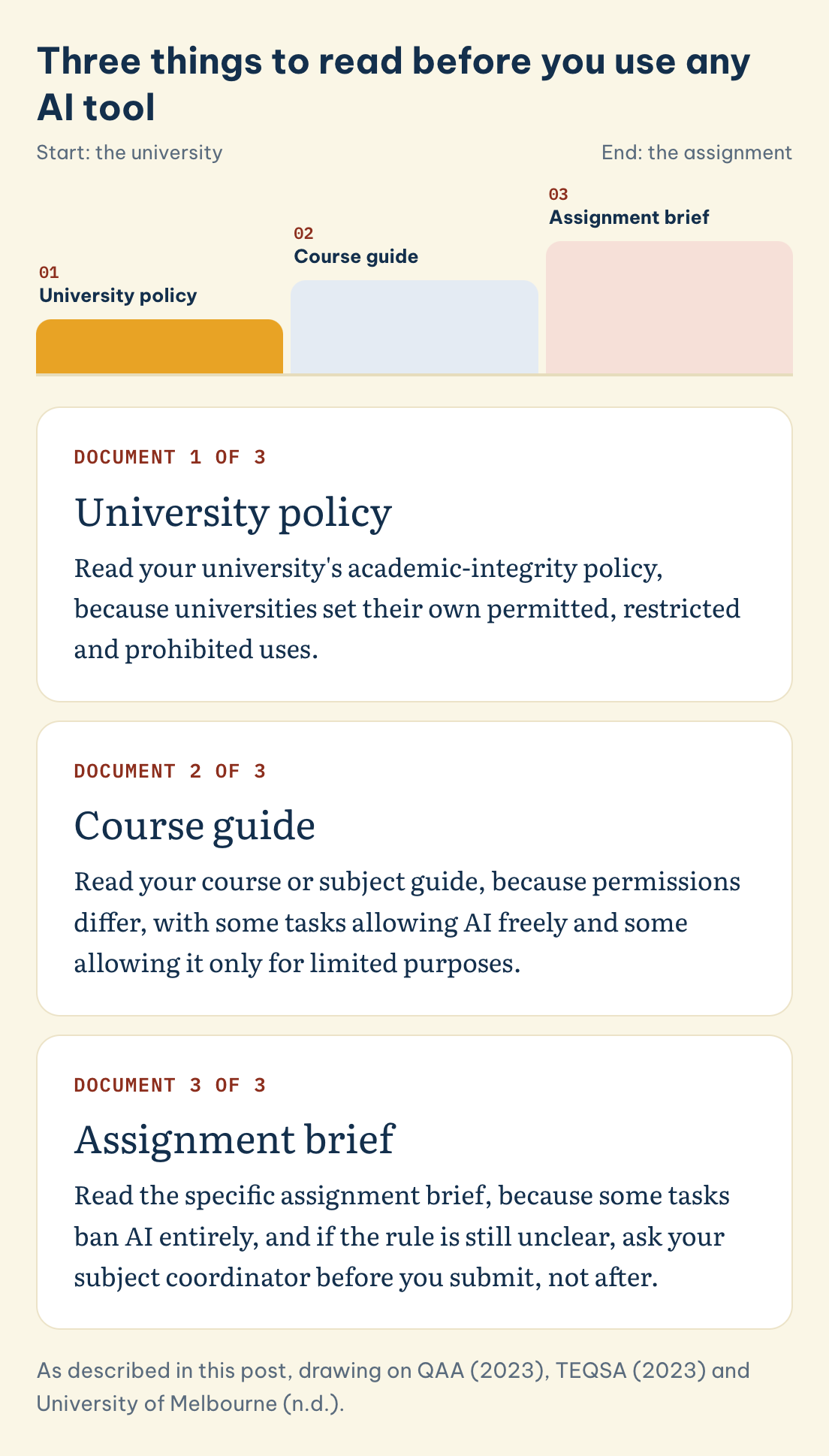
Evidence: Sector guidance leaves the detail to individual providers and assessments, so universities set their own permitted, restricted, and prohibited uses (QAA, 2023; Tertiary Education Quality and Standards Agency [TEQSA], 2023). University student guidance therefore tells students to confirm that their subject coordinator has authorised AI use, and how, before relying on it for assessed work (University of Melbourne, n.d.).
Example: A Vietnamese student assumed AI help was allowed because a friend in another subject used it. His MAAS mentor had him read his own assignment brief, which restricted AI to brainstorming only. He adjusted his workflow and wrote an acknowledgement that matched what his course actually permitted.
◆ Question 4 / 7 · Writing it
Where and how do you write an AI acknowledgement?
Direct answer: Put the acknowledgement where your university tells you, usually a short "Acknowledgements" or "Declaration" section, often at the start or end of the work. Name the tool, its publisher, the link, what you used it for, and how you edited the result. One clear, specific sentence per use is stronger than a vague catch-all line.
The four elements of an AI acknowledgement
Tap an element to see what to write and why markers want it.
Tool and link
Write the full name of the tool, who makes it and the URL, because that identifies exactly what assisted you.
Purpose
Write the specific task, for example brainstorming or proofreading, because it shows the help was within allowed limits.
Scope and prompts
Write what you asked and how much it shaped the work, because it lets the marker judge your contribution.
Your modifications
Write how you reviewed, edited and verified the output, because it confirms you remain the author.
Save this figure
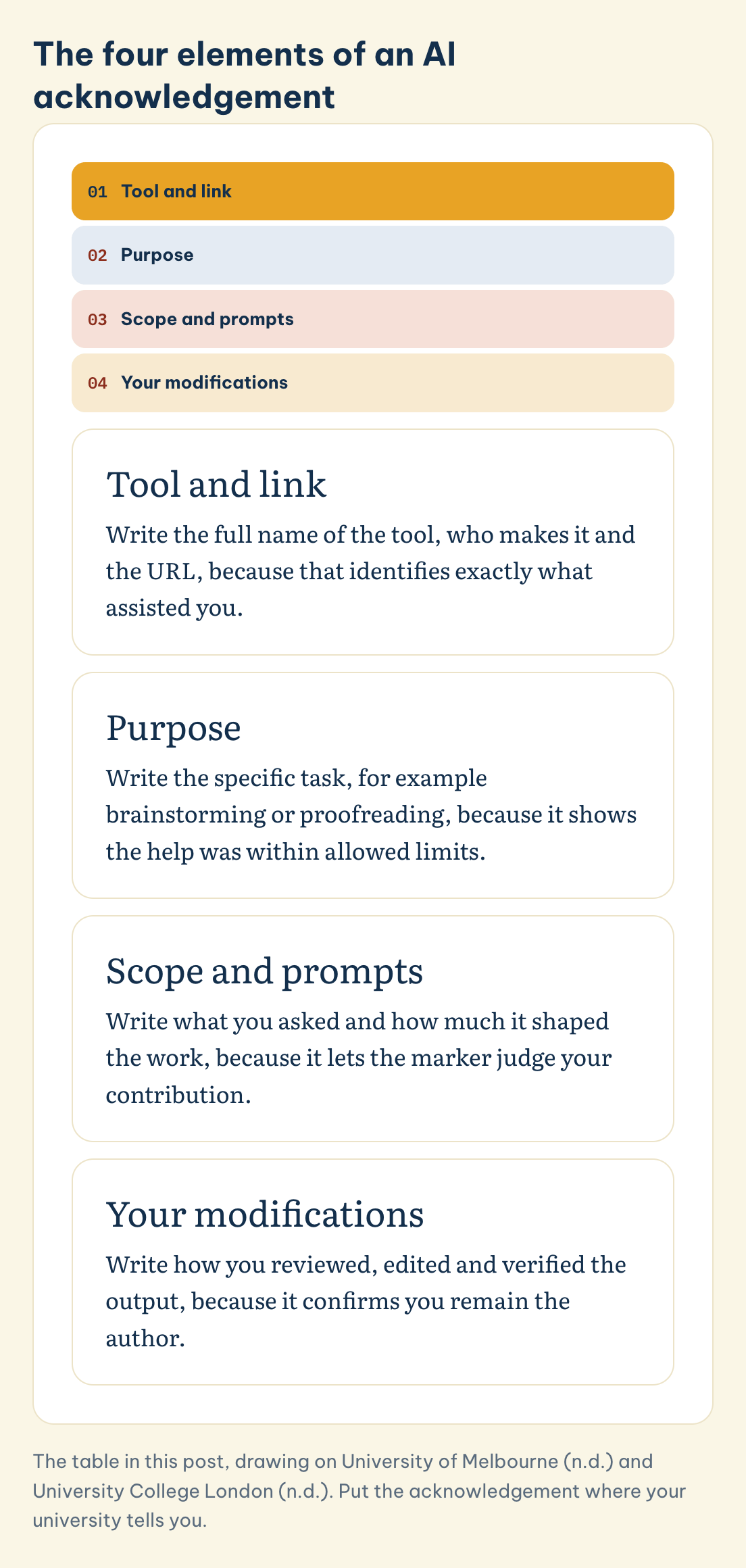
Evidence: University guidance asks students to list the AI tool, publisher, URL, and a brief description of how it was used, and many recommend keeping the prompts and a note on your modifications (University of Melbourne, n.d.; University College London, n.d.). "A declaration is a personal statement that you write to describe for readers how you have used AI tools and technologies to prepare an assessment" (University of Melbourne, n.d.). A model acknowledgement reads: "I acknowledge the use of [tool, publisher, URL] to summarise my initial notes and to proofread my final draft."
Example: A MAAS mentor coached a Vietnamese student to replace "AI was used in this essay" with a precise line naming the tool, stating she used it to brainstorm headings and check grammar, and confirming she wrote and revised all content herself, turning a vague disclosure into one a marker could trust.
Where you are unsure whether your own use of AI crosses the line your institution draws, the Academic Integrity Check reviews the work and tells you plainly, before a marker does.
| Element of an AI acknowledgement | What to write | Why markers want it |
|---|---|---|
| Tool, publisher, and link | Full name, who makes it, and the URL | Identifies exactly what assisted you |
| Purpose | The specific task, e.g. brainstorming or proofreading | Shows the help was within allowed limits |
| Scope and prompts | What you asked and how much it shaped the work | Lets the marker judge your contribution |
| Your modifications | How you reviewed, edited, and verified the output | Confirms you remain the author |
◆ Question 5 / 7 · Acknowledge or cite
What is the difference between acknowledging AI and citing it?
Direct answer: An acknowledgement is a personal statement that you used a tool to help produce the work; a citation credits AI-generated content you actually included, with an in-text reference and a bibliography entry. Use an acknowledgement for assistance like proofreading or brainstorming, and add a citation when you quote or directly use AI output.
Acknowledging AI and citing it are two separate steps
Each row compares what the two steps do.
Acknowledgement
Citation
A personal statement that you used a tool to help produce the work
Credits AI-generated content you actually included, with an in-text reference and a bibliography entry
Use it for assistance like proofreading or brainstorming
Add it when you quote or directly use AI output
Save this figure
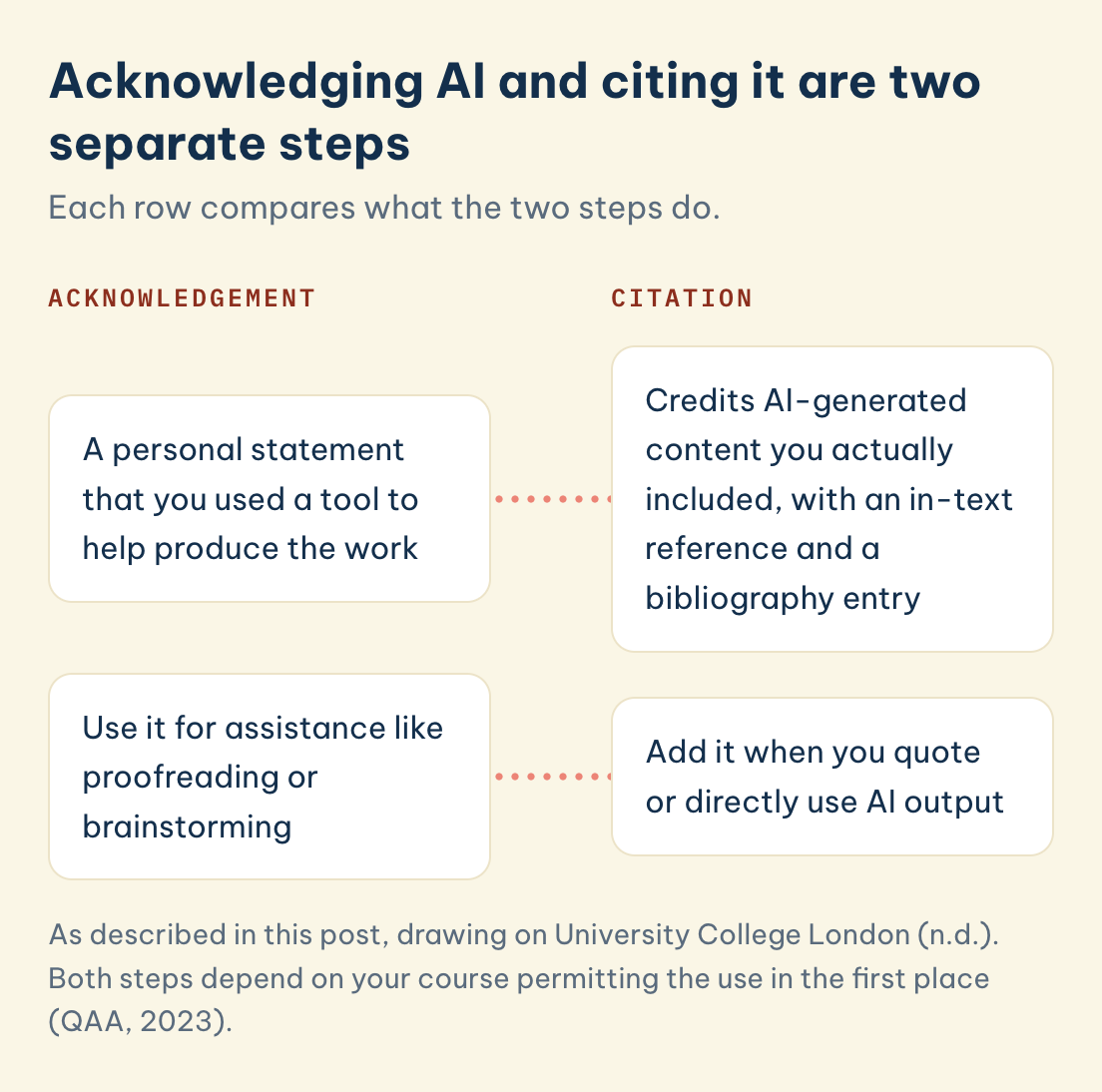
Evidence: University library guidance treats acknowledgement and referencing as related but separate steps: declare assistance in an acknowledgement, and reference specific AI output using your required citation style when it appears in your work (University College London, n.d.). Both depend on your course permitting the use in the first place (QAA, 2023).
Example: A Vietnamese student had pasted an AI-generated definition into her literature review. Her MAAS mentor showed her that this needed a citation, not just an acknowledgement, and helped her decide it was better to rewrite the definition in her own words and cite the original scholarly source instead.
◆ Question 6 / 7 · Not disclosing
What happens if you use AI without disclosing it?
Direct answer: Undisclosed AI use, where disclosure was required, is treated as an academic-integrity breach and can lead to penalties from a failed task to a misconduct finding. Universities are redesigning assessment around AI rather than relying on detection alone, so the safe assumption is that undeclared use will eventually surface, not pass quietly.
Evidence: Australian regulators stress that detection tools alone are unreliable and that assessment is being reformed to assure learning authentically and ethically (Tertiary Education Quality and Standards Agency [TEQSA], 2023). UK sector guidance similarly ties acceptable AI use to maintaining academic standards and integrity (QAA, 2023; Russell Group, 2023), which is why undeclared substantive use is a serious matter.
Example: A MAAS mentor reviewing a draft noticed a paragraph in the unmistakable voice of unedited AI output, alongside a reference that did not exist. Rather than risk a misconduct allegation, the student rewrote the passage in her own words, checked every source, and added an honest acknowledgement of how she had used the tool.
◆ Question 7 / 7 · From the start
How can Vietnamese and ESL students disclose AI use safely from the start?
Direct answer: Decide your AI approach before you write. Read your course's rules, separate light language help from substantive use, keep a short log of which tools you used and the prompts, and verify every AI-touched fact yourself. Building this habit early turns the final acknowledgement into a two-minute task instead of a worry.
Evidence: Because ESL students often lean on AI for language support, university guidance is especially clear that they should default to disclosing more than incidental use and keep records of how tools were used (University of Edinburgh, n.d.; University of Melbourne, n.d.). Transparency, not avoidance, is what keeps that support within the rules.
Example: A MAAS mentor coached a Vietnamese student through the Outline → Draft → Final model with transparency built in: the outline noted where language tools were allowed, the draft logged each tool and prompt, and the final stage produced a precise acknowledgement matched to her university's format. The student stayed the author throughout, with the mentor advising rather than producing the work.
Frequently asked questions
Do I need to disclose AI if I only used it to translate my work into English?
Treat translation as substantive use and acknowledge it. AI translation can change meaning, nuance, and emphasis, so it is not the same as a spell-check. Name the tool, say you used it for translation, confirm you checked the result yourself, and check first that your course allows translation tools.
Which AI uses count as needing disclosure?
Generative uses that produce or transform content, drafting text, summarising sources, generating ideas, code, or images, generally need acknowledgement when permitted. Narrow utilities that only check spelling, grammar, or punctuation usually count as incidental, but your course rules and assignment brief have the final say.
Can I get in trouble for acknowledging AI use?
Acknowledging permitted use is not what triggers penalties; using AI invisibly, or for tasks your course bans, is. A clear declaration signals good academic practice. The risk lies in non-disclosure or in using AI in a way your assignment did not allow, not in being honest about help you were permitted to use.
Where exactly should the acknowledgement go in my paper?
Follow your university's format, which is usually a short "Acknowledgements" or "Declaration" section at the start or end of the work. If your guidance does not specify, a clearly labelled declaration before or after the main text, naming the tool and purpose, is the safe default.
Should I keep the prompts and AI outputs I used?
Yes. Many universities recommend saving your prompts, the original AI output, and a note on how you changed it. Keeping these records lets you answer any question from your marker quickly and shows that you reviewed and edited the content rather than submitting it unchanged.
Can MAAS help me write a compliant AI acknowledgement for my assignment?
Yes. MAAS Academic Support coaches Vietnamese students through reading their course's AI rules, drawing the line between incidental and substantive use, and writing a clear acknowledgement using the Outline → Draft → Final model. Book a consultation through our contact page.
Ready to submit with a clear, honest AI acknowledgement?
A transparent AI acknowledgement is one of the cheapest ways to protect your grade and your integrity record, and it is far easier to plan with an expert than to defend after a misconduct query. MAAS Academic Support starts with a free 20-minute consultation and matches you to a qualified expert within 48 hours when our network already covers that field, or in about two weeks if MAAS has to recruit for it. It sets a three-tier Pass, Merit or Distinction target grade with you at the start and 45 days of follow-up support after submission. Among the experts it draws on, 23% hold doctorates. We coach; you stay the author.
Book an Academic Support consultation with MAAS →
Related guides
- What does a Turnitin similarity score actually mean?: reading originality reports without panic
- Why is my original writing being flagged as AI?: what AI-detection tools get wrong and how to respond
- How do you make an AI health study reproducible for a Q1 journal?: disclosing AI use so reviewers can verify your results
- How do you write a reflection essay?: an assessment type where your own voice matters most
- How do you reference correctly in APA 7th edition?: including how to cite ChatGPT and other AI tools
- What is the difference between APA 7th and Harvard referencing?: choosing and applying the right style consistently
- Academic Integrity Check service: originality and AI-use guidance before you submit
- Academic Support service: mentor-led help across essays, research papers, and assignments
- Meet the MAAS experts: the mentors behind our academic support
References
- Quality Assurance Agency for Higher Education. (2023). Reconsidering assessment for the ChatGPT era: QAA advice on developing sustainable assessment strategies. Retrieved June 19, 2026, from https://www.qaa.ac.uk/sector-resources/generative-artificial-intelligence/qaa-advice-and-resources
- Russell Group. (2023). Principles on the use of generative AI tools in education. Retrieved June 19, 2026, from https://www.russellgroup.ac.uk/policy/policy-briefings/principles-use-generative-ai-tools-education
- Tertiary Education Quality and Standards Agency. (2023). Assessment reform for the age of artificial intelligence. Retrieved June 19, 2026, from https://www.teqsa.gov.au/guides-resources/higher-education-good-practice-hub/gen-ai-knowledge-hub
- University College London. (n.d.). Acknowledging and referencing GenAI. Retrieved June 19, 2026, from https://library-guides.ucl.ac.uk/referencing-plagiarism/acknowledging-genAI
- University of Edinburgh. (n.d.). Using generative AI in your studies: Guidelines for students. Retrieved June 19, 2026, from https://information-services.ed.ac.uk/computing/comms-and-collab/elm/generative-ai-guidance-for-students/using-generative
- University of Melbourne. (n.d.). Acknowledging AI tools and technologies. Retrieved June 19, 2026, from https://students.unimelb.edu.au/academic-skills/resources/academic-integrity/acknowledging-AI-tools-and-technologies
This article is part of the MAAS Journal series for Vietnamese international students. MAAS Academic Support is an academic success partner; we coach students through the Outline → Draft → Final delivery model with developmental feedback from qualified mentors. We do not write, submit, or guarantee the grade of work on a student's behalf, and we always encourage you to follow your own university's rules on generative AI.
A free 20-minute consultation with a MAAS academic mentor, to talk through your course's AI rules and your own acknowledgement.
Book Free Discovery ▸