

Rule 01
Up to 20 authors
An APA 7th entry lists up to 20 authors in full.
◆ Citation and referencing
The difference between APA and Harvard referencing is that APA 7th is one published standard, while Harvard is a family of author-date styles that vary by university. Vietnamese students moving between assignments often assume "Harvard" means one fixed rulebook, the way APA 7th does, and that assumption is where marks quietly go missing. APA 7th is a single published manual that every user follows, so a citation is simply right or wrong against one rule. Harvard is different: it is a family name covering many author-date styles that vary from one university to the next, so following the wrong department's version can read as careless.
This guide sets the two side by side, where they agree, where they diverge in the in-text citation and the reference list, and how to decide which one you should be using so you can follow whichever your department requires without second-guessing every full stop.
◆ Question 1 / 7 · Same system?
Direct answer: They share the same basic mechanism but not the same status. Both are author-date systems, a short citation in the text, such as (Nguyen, 2023), points to a full entry in an alphabetical list. The crucial difference is that APA 7th is a single authoritative standard, while Harvard is a generic label for author-date styles with no single governing document.
Evidence: APA 7th is defined in one place, the American Psychological Association (2020) Publication Manual, seventh edition, which every user follows, so an APA reference is either correct or incorrect against a fixed rule. Harvard has no equivalent single manual; the closest thing to a standard is Pears and Shields (2025), whose Cite Them Right sets out one widely used Harvard style, but individual universities publish their own Harvard variants alongside it. The practical effect is that "I used APA" is a precise claim, while "I used Harvard" is not, until you say whose Harvard.
Example: A MAAS-mentored student insisted she had "done Harvard correctly" but lost marks anyway. Her mentor showed her that her department's Harvard guide differed from the online generator she had used, same style name, different rules. Once she matched her referencing to her own department's guide, the errors disappeared.
◆ Question 2 / 7 · No single owner
Direct answer: Because no single body owns it. APA 7th is maintained by the American Psychological Association, which updates and enforces one version. "Harvard" simply describes the author-date approach, and each institution adapts it, so two universities can both call their style "Harvard" and still punctuate, capitalise, and format web sources differently.
Evidence: Pears and Shields (2025) present Harvard as one style among several in their guide, precisely because it has no official governing manual to point to. Dawe et al. (2021) documented how "local variations between faculty or discipline-based citation guides resulted in confusion for students," to the point that their university reduced the number of endorsed styles to cut down the inconsistency. When a style has no single owner, the authority becomes your own institution's guide, not a national manual. Our Harvard referencing guide works through the Cite Them Right patterns in full and shows where two named UK university variants punctuate the same web source differently.
Example: A student transferring between two Australian universities found her referencing marked down at the second, despite both requiring "Harvard." Her mentor explained the cause, the second university's Harvard variant used a different web-source format and helped her switch to the new guide rather than argue that her old one was also "Harvard."
◆ Question 3 / 7 · In-text
Direct answer: Very little, and that similarity is a trap. Both cite author and year in brackets, and both add a page number for a direct quotation. The differences are small points of punctuation that vary more within Harvard than between APA and any one Harvard variant, a comma after the author, the abbreviation for "page," and how multiple authors are joined.
Evidence: The American Psychological Association (2020) fixes the APA form as (Author, Year, p. X), a comma after the author and an ampersand between two authors, as in (Nguyen & Tran, 2023). Pears and Shields (2025) show that many Harvard variants drop the comma, writing (Nguyen 2023), and some use "and" rather than the ampersand in the text. Because these choices are set by each institution's Harvard guide rather than by a central manual, the only safe move is to copy the exact form your guide shows.
Example: A student mixed (Smith, 2023) and (Smith 2023) across the same essay, following two different online examples. Her mentor pointed out that consistency matters more than which form is "right," and that the fix was to choose her department's form and apply it to every citation without exception.
◆ Question 4 / 7 · Reference list
Direct answer: The reference list is where the two diverge most visibly. APA 7th has fixed rules for the heading, capitalisation, and web sources; Harvard variants handle the same elements differently, especially for online material, where APA uses a DOI or URL and many Harvard styles add an explicit access date.
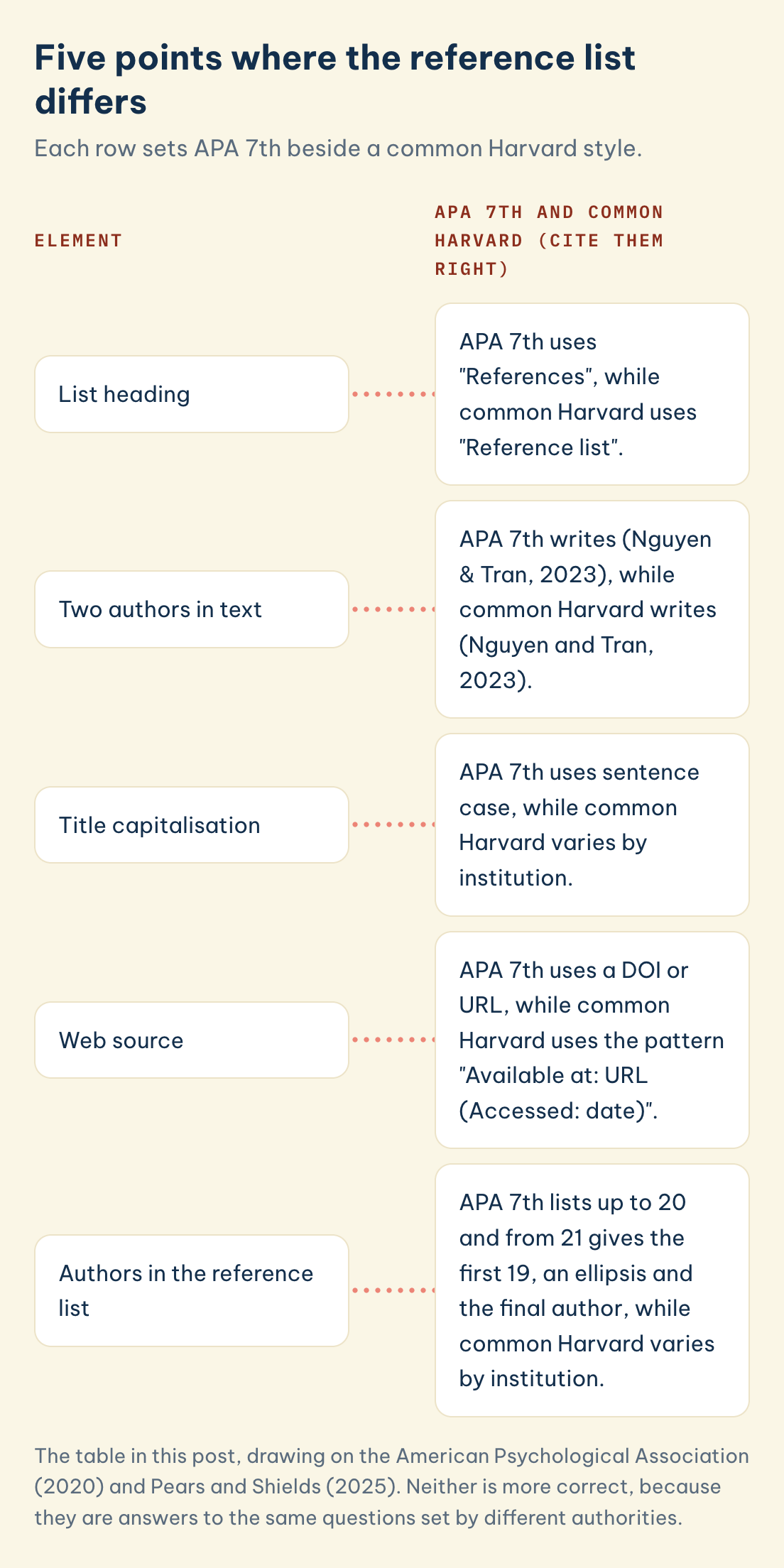
Five points where the reference list differs
Each row sets APA 7th beside a common Harvard style.
Element
APA 7th and common Harvard (Cite Them Right)
List heading
APA 7th uses "References", while common Harvard uses "Reference list".
Two authors in text
APA 7th writes (Nguyen & Tran, 2023), while common Harvard writes (Nguyen and Tran, 2023).
Title capitalisation
APA 7th uses sentence case, while common Harvard varies by institution.
Web source
APA 7th uses a DOI or URL, while common Harvard uses the pattern "Available at: URL (Accessed: date)".
Authors in the reference list
APA 7th lists up to 20 and from 21 gives the first 19, an ellipsis and the final author, while common Harvard varies by institution.
Authors an APA entry lists in full
20
is the most an APA 7th entry lists in full, and from 21 authors it shows the first 19, an ellipsis and the final author
An APA 7th entry lists up to 20 authors in full.
An APA 7th entry shows the first 19, an ellipsis and the final author, and never uses "et al." in the list.
APA 7th uses a DOI or URL, while many Harvard styles add an explicit access date in the pattern "Available at: URL (Accessed: date)".
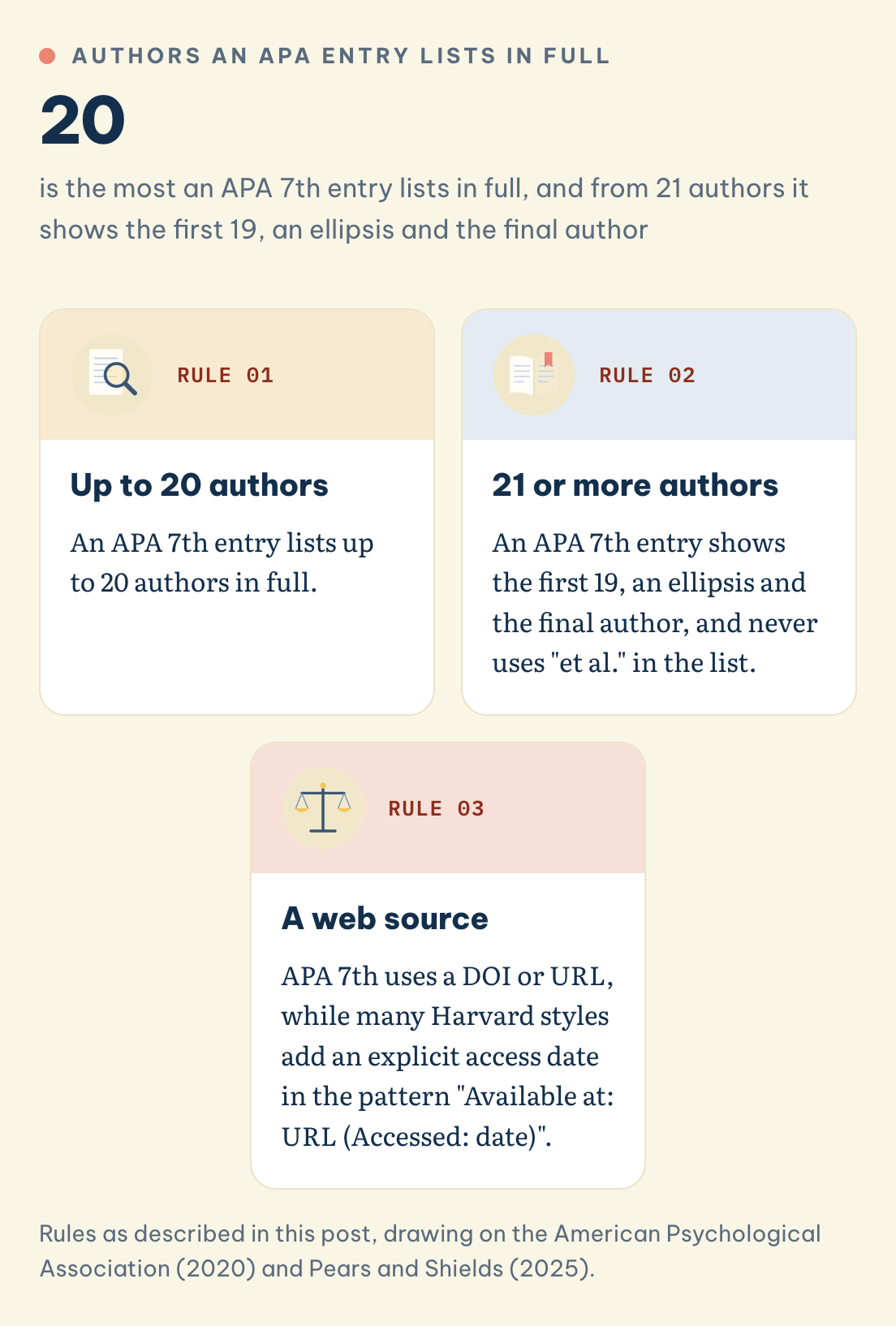
Evidence: The American Psychological Association (2020) requires the list to be headed "References," article and book titles in sentence case, the journal title and volume in italics, a DOI presented as a full link, and up to 20 authors listed in full, with 21 or more shown as the first 19, an ellipsis, and the final author, never "et al." in the list. Pears and Shields (2025) show common Harvard conventions that differ on several of these points, often "Reference list" as the heading, and for a web source the pattern "Available at: URL (Accessed: date)," which APA does not use. Neither is more correct; they are answers to the same questions set by different authorities.
| Element | APA 7th | Common Harvard (Cite Them Right) |
|---|---|---|
| List heading | References | Reference list |
| Two authors, in text | (Nguyen & Tran, 2023) | (Nguyen and Tran, 2023) |
| Title capitalisation | Sentence case | Varies by institution |
| Web source | DOI or URL | Available at: URL (Accessed: date) |
| Authors listed in the reference list | Up to 20; 21 or more: first 19, …, final author | Varies by institution |
Example: A student's reference list mixed APA sentence-case titles with Harvard "Accessed" dates, having copied entries from two sources. Her mentor helped her rebuild the list against a single guide, and the hybrid entries, correct in neither system, became consistent in one.
◆ Question 5 / 7 · Which to use
Direct answer: Use the one your department specifies, and treat that instruction as non-negotiable. Psychology, education, and many social and health science programmes use APA; business, science, and humanities programmes in the UK and Australia often use a Harvard variant. The decision is almost never yours to make; it is set by your course, and the reliable source is your module handbook or library guide.
Evidence: Dawe et al. (2021) found that universities deliberately endorse a small set of named styles and expect students to follow the institution's own guide rather than a generic online version. The American Psychological Association (2020) and Pears and Shields (2025) both function as reference standards, but which one applies to you is decided by your programme, not by the manuals themselves.
Example: A student doing a joint business-and-psychology degree used APA in one module and Harvard in another and assumed she could pick one for both. Her mentor confirmed each module's requirement from the handbooks, and she kept them separate, the same source, referenced two ways, for two different markers.
◆ Question 6 / 7 · Lost marks
Direct answer: Almost always because they followed a Harvard variant that was not their institution's, or mixed several without realising. Because "Harvard" is not one standard, an online generator set to a different Harvard flavour will produce entries that look plausible but do not match the guide the marker uses.
Evidence: Dawe et al. (2021) reported that inconsistent guidance across a single institution left both students and support staff unsure which version was authoritative: "Examples and rule interpretations varied widely, and were sometimes contradictory" (Dawe et al., 2021). Van Note Chism and Weerakoon (2012) found that learning a citation style is as much about overcoming the assumption that one's prior habits transfer as it is about the rules themselves, an assumption that bites hardest when a style name like "Harvard" hides real differences underneath.
Example: A student submitted a Harvard-referenced essay generated by a citation tool and lost several marks for formatting. Her mentor compared the tool's output line by line with her department's guide, and every error traced back to the tool using a different Harvard variant. Switching to the department guide, and checking each entry by hand, closed the gap.
◆ Question 7 / 7 · Consistency
Direct answer: Choose the exact guide your department names, use it as your only reference, and check every citation and entry against it rather than trusting a generator. Consistency within one guide matters more than any single rule, and it is entirely within your control.
Three habits for keeping either system consistent
Tap a habit to see what it asks of you.
Habit 1 of 3
Choose the guide
Choose the exact guide your department names.
Habit 2 of 3
Use only that guide
Use it as your only reference, because errors almost always come from mixing sources rather than from the rules being unclear.
Habit 3 of 3
Check by hand
Check every citation and entry against it rather than trusting a generator, for example with a one-page cheat sheet of the in-text form, the list heading and the web-source pattern.
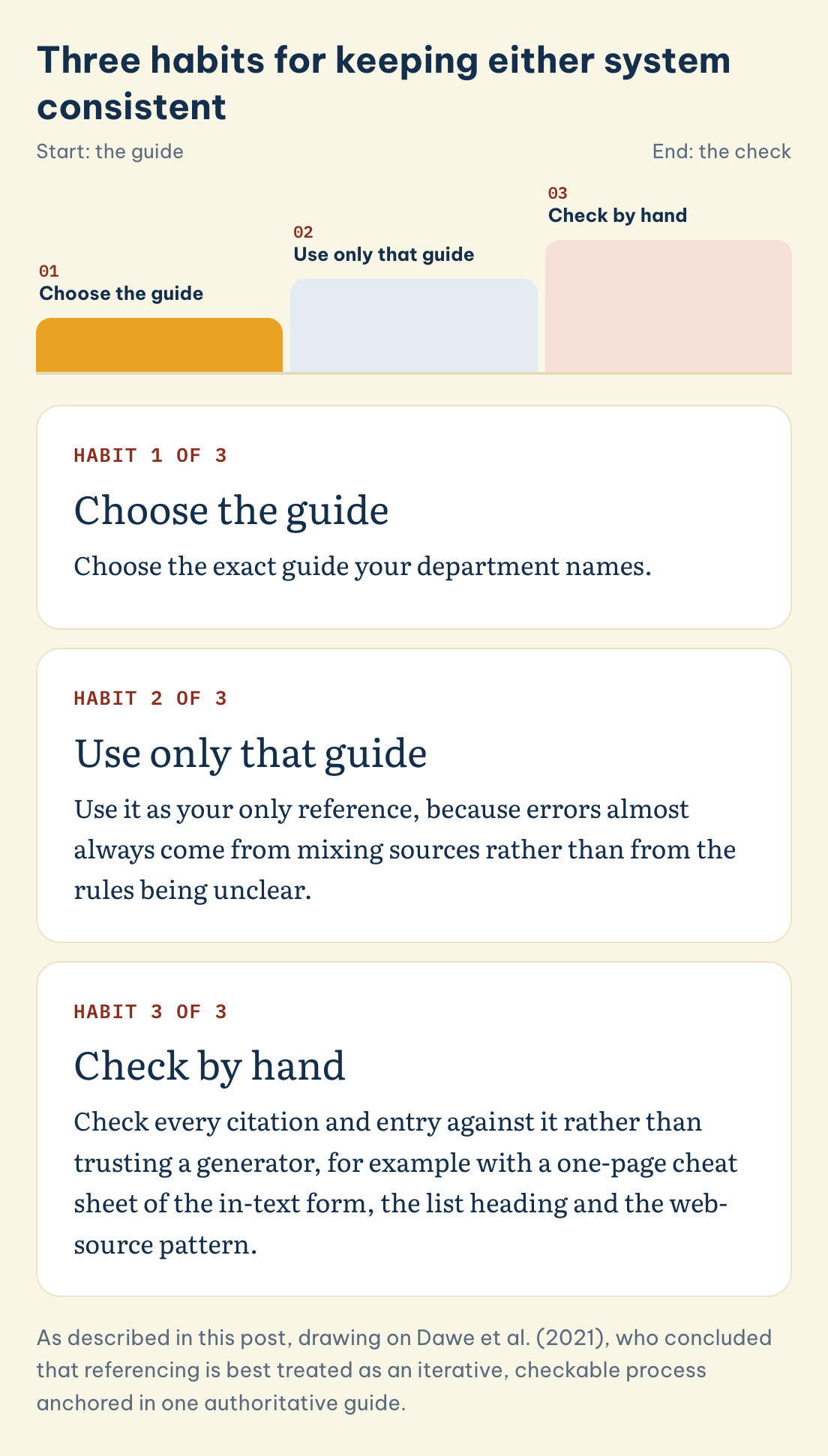
Evidence: Because the American Psychological Association (2020) and each Harvard guide such as Pears and Shields (2025) are internally consistent systems, errors almost always come from mixing sources rather than from the rules being unclear. Dawe et al. (2021) concluded that referencing is best treated as an iterative, checkable process anchored in one authoritative guide, not a memory test.
Example: A MAAS-mentored student built a one-page cheat sheet from her department's guide, in-text form, list heading, and web-source pattern and checked her whole reference list against it before submitting. The habit turned referencing from a source of anxiety into a five-minute final check.
No. Both are author-date systems, yet they differ in status. APA 7th is fixed by one manual, the American Psychological Association (2020) Publication Manual, whereas Harvard is only a family name, so each university publishes its own variant and a correct Harvard reference depends on whose guide your department follows.
Neither is harder in itself; APA is arguably easier to get right because there is one fixed standard, whereas "Harvard" varies by institution, so you must first identify exactly which Harvard your department uses.
Only if you set it to your institution's specific Harvard variant and then check its output against your department's guide. Generators often default to a different Harvard flavour, which produces plausible but non-matching entries.
Only in small punctuation details, a comma after the author, the page abbreviation, and ampersand versus "and." The differences are minor, but consistency with your department's exact form is what earns the marks.
Harvard variants are common across business, science, and humanities programmes in both countries, while APA dominates psychology, education, and the social and health sciences. Always confirm with your own course.
Most often because it followed a different Harvard variant than your marker's, or mixed two styles. Match your department's named guide and apply it consistently to fix it.
Yes. The MAAS Academic Integrity Check reviews your APA or Harvard formatting and coaches your paraphrasing on work you wrote yourself, through the Outline → Draft → Final model. Book a consultation through our contact page.
The difference between APA and Harvard is not really about rules; it is about knowing that APA is one fixed standard while Harvard is many, and then following the exact guide your department names. A mentor can show you how to lock your referencing to a single authoritative source and check it in minutes.
MAAS Academic Mentoring pairs you with an editorial mentor within 48 hours when our network already covers that field, or in about two weeks if MAAS has to recruit for it. Referencing follows whichever style your university, department or supervisor requires, and your mentor shows you how to check in-text citations against the reference list the same way an examiner will. Your first 20-minute consultation is free. We coach you to reference correctly; we do not write the work for you.
Book an Academic Integrity Check with MAAS →
This article is part of the MAAS Journal series for Vietnamese international students. MAAS Academic Mentoring is an advisory partner; we coach students on referencing and academic integrity through a phase-by-phase delivery model. We do not write, submit, or guarantee the outcome of any student's work.
A free 20-minute discovery call with a MAAS advisor, to talk through your referencing and your department's guide.
Book Free Discovery ▸