
◆ Thesis and dissertation
How do you write a literature review at bachelor's, master's and PhD level?
To write a literature review, search the research on your topic, evaluate what you find, and synthesise it into an argument about what is known and missing. That task is the same at every level; what changes between a bachelor's dissertation, a master's thesis and a PhD is how widely you must read, how independently you must judge, and how much of the argument has to be your own.
This guide covers the constant part first, then how expectations scale; the doctoral guidance and worked examples for Vietnamese researchers remain below, in the PhD section.

◆ Part 1 / 9 · What it is
What a literature review is, and what it is not
Direct answer: To write a literature review, per University of Queensland Library, search the research on your topic, evaluate what you find, and synthesise it into an argument about what is known and missing, both a process and a product University of Southampton Library (2026) names. What changes across degree levels is how widely you read and how independently you judge.
The University of Queensland Library (n.d.) defines a literature review as "a survey and critical analysis of what has been written on a particular topic, theory, question or method". Survey means covering the relevant research; critical analysis means weighing what you find, not just reporting it. The University of Southampton Library (2026) adds that the review is both a process, the searching and evaluating that runs alongside the whole project, and a product, the written text presenting your argument about the field.
A literature review is also not a theoretical framework: the review surveys and evaluates the field, while the framework selects the theories your study will think with. The guide to writing a theoretical framework maps that boundary.
Literature review vs annotated bibliography
An annotated bibliography evaluates each source separately, entry by entry, while a literature review collates, links and evaluates sources around themes, so studies appear in conversation instead of standing in a queue (Sheffield Hallam University Library, n.d.). If your draft could be reordered alphabetically without losing anything, it is still a bibliography.
◆ Part 2 / 9 · What it does
What the review does for your project
Direct answer: This chapter exists to justify your topic, not to prove wide reading. Per Monash University Library, it locates gaps in the field, puts your work in conversation with the theorists your study draws on, and previews the methods similar research has used, the mapping exercise Hart (1998) first framed.
All research needs to be situated in the work that came before it, and Monash University Library (n.d.) names 3 jobs the review performs: locating the gaps in existing research and justifying why your study is needed, locating the theorists and theories your work can draw on, and identifying the methodologies your field has used. The idea that a review argues a case rather than inventories sources traces back at least to Hart's (1998) influential guide, which reframed the review as a mapping exercise rather than a summary chore, and the framing still shapes how UK and Australian marking rubrics describe the task. Seen from the reader's side, the review establishes what is already known, which approaches have been applied, and where their strengths and weaknesses lie (Eriksson & Kovalainen, 2008, as cited in University of Queensland Library, n.d.). For a book-length treatment of the process, Ridley (2025) remains the standard student guide.
◆ Part 3 / 9 · How expectations scale
How expectations scale from bachelor's to master's to PhD
Direct answer: The task stays the same across levels; what rises, per University of Westminster Library (2026), is the expectation. Two demands are constant, per UNSW Sydney and Monash University Library: the review must critically examine the literature rather than list it, and it must situate your project in the field. What rises is coverage, judgment and contribution.
The difference between bachelor's, master's and PhD levels is often assumed to be just length, and that assumption is tempting but wrong. A more useful picture is that the task holds still while expectations rise: as you progress through higher education, the expectations on your ability to synthesise increase (University of Westminster Library, 2026).
What stays the same at every level
Two demands are constant. The review must critically examine the literature rather than simply list it (UNSW Sydney, n.d.), and it must situate your own project in the field (Monash University Library, n.d.). At any level, a marker asks: did this writer judge what they read, and why does this project belong here?
What rises: coverage, judgment and contribution
The comparison below describes tendencies across UK and Australian programmes; your programme handbook always has the final word.
How expectations scale across degree levels
Tap a level to see its scope of reading, its voice and judgment, and what the review must justify.
Bachelor's
The reading is selective, with key studies around one bounded question. The voice is guided by module reading and supervisor steer. The review must justify that the question is worth asking and joins a conversation.
Master's
The reading is wider, chosen against explicit criteria. The voice is independent, as you weigh methods and evidence in your own voice. The review must justify that a specific gap exists and your design responds to it.
PhD
The reading approaches comprehensive, including adjacent literatures. The voice is authoritative, a sustained argument ordering the field. The review must justify that the thesis makes an original contribution to knowledge.
Save this figure
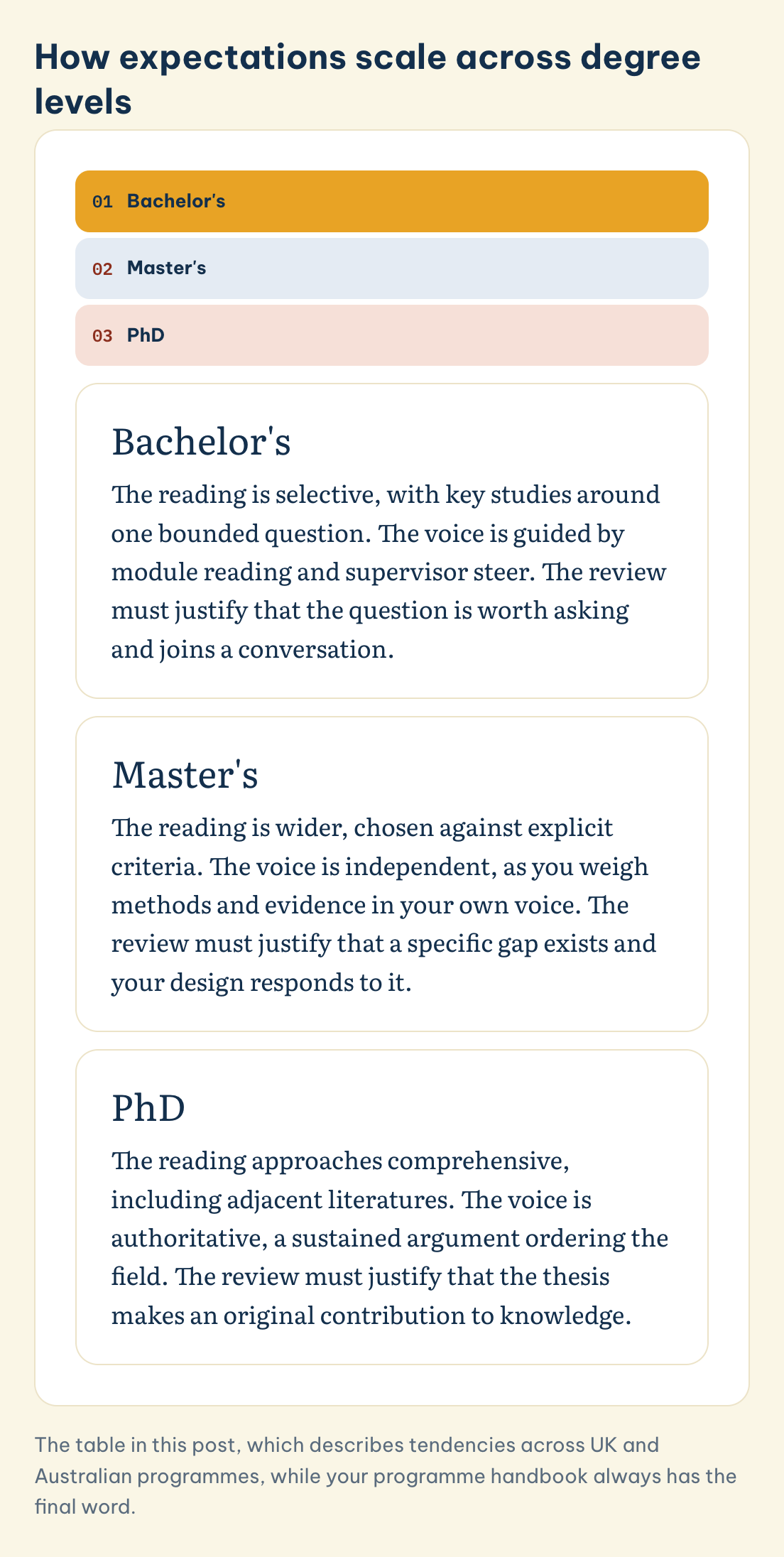
| Level | Scope of reading | Voice and judgment | What the review must justify |
|---|---|---|---|
| Bachelor's | Selective: key studies around one bounded question | Guided by module reading and supervisor steer | The question is worth asking and joins a conversation |
| Master's | Wider, chosen against explicit criteria | Independent: you weigh methods and evidence in your own voice | A specific gap exists and your design responds to it |
| PhD | Approaching comprehensive, including adjacent literatures | Authoritative: a sustained argument ordering the field | The thesis makes an original contribution to knowledge |
The practical implication sits in the last column: a review that feels weak usually needs a clearer case to argue, not more sources.
◆ Part 4 / 9 · Structure
How do you structure a literature review?
Direct answer: University of Kent (2025) frames a review as argument writing, so it needs a beginning, a middle and an end. RMIT University Learning Lab supplies the outer two, an opening covering context and scope, and a conclusion that restates the aim and points forward to the study to come. The middle holds the organising decision, thematic, chronological or theoretical.
The beginning, middle and end of a literature review
Tap a part to see what it holds.
Step 1 of 3
Introduction
It gives an overview of the context and says what the review will cover.
Step 2 of 3
Middle
This is where the organising decision lives: thematic, chronological or theoretical. Thematic organisation is the usual recommendation because it forces sources into contact.
Step 3 of 3
Conclusion
It restates the review's aim and points forward to the study to come.
Save this figure
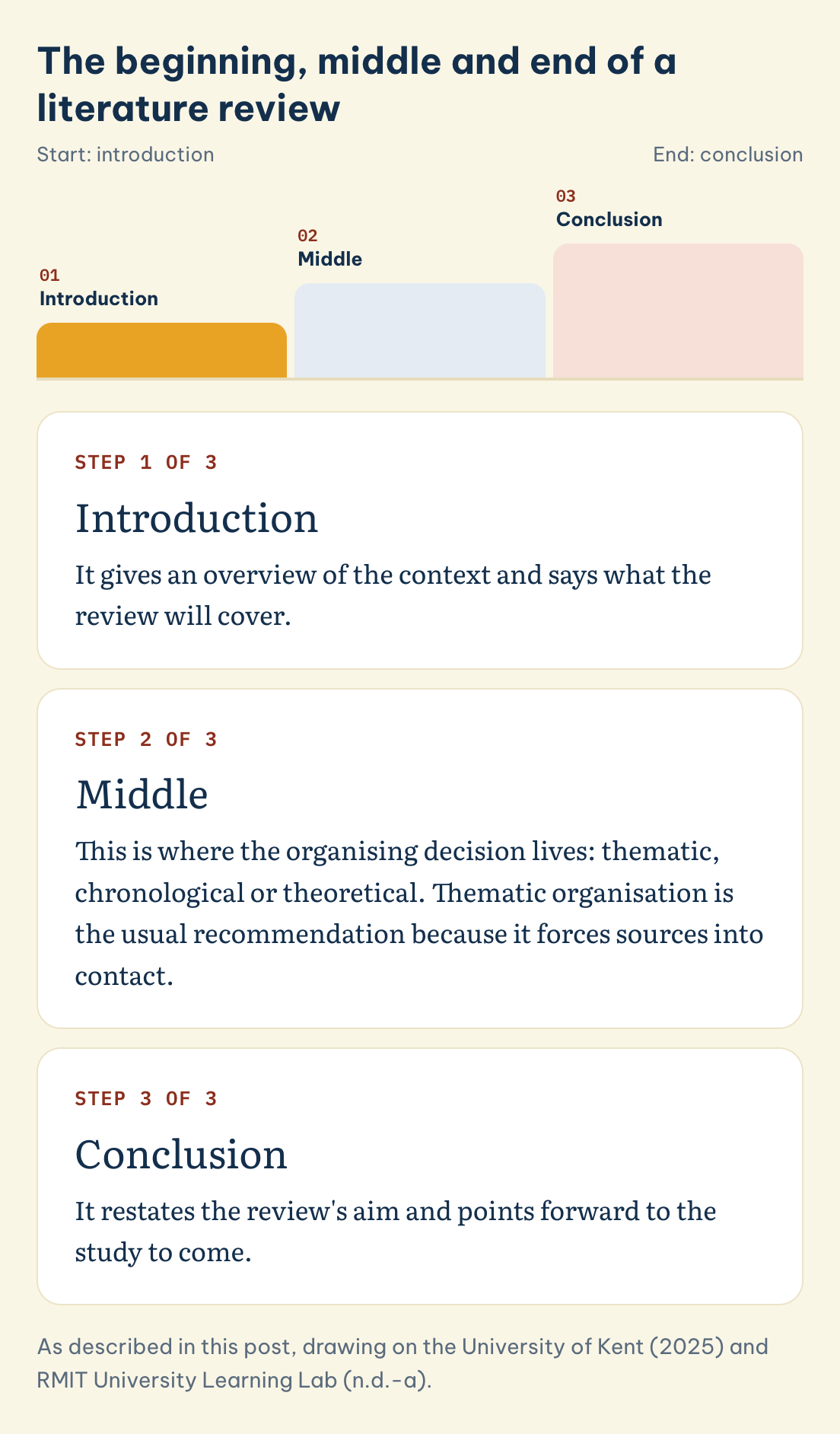
A literature review needs a beginning, a middle and an end, like any argument (University of Kent, 2025). The introduction gives an overview of the context and says what the review will cover; the conclusion restates the review's aim and points forward to the study to come (RMIT University Learning Lab, n.d.-a). The middle is where the organising decision lives.
Before working through that structure, it helps to name which type of review this guide teaches: a narrative (traditional) literature review, which synthesises existing work without a standardised search protocol, and the most common form at master's and doctoral review-chapter level alike (NPS Dudley Knox Library, n.d.). It differs from a systematic review, which uses a transparent, reproducible method to answer a narrow research question, typically reported against the PRISMA checklist and taking up to two years to complete (Page et al., 2021; University of Waikato Library, n.d.). If your module guide or supervisor specifically requires a systematic, scoping or integrative review, follow that type's own method requirements rather than the structure in this guide.
Thematic, chronological and theoretical patterns
RMIT University Learning Lab (n.d.-a) names three recognised ways to organise the middle: thematically, around key topics and debates; chronologically, following how the field developed; and theoretically, grouped by the frameworks researchers apply. UNSW Sydney (n.d.) adds the inverted pyramid, narrowing from the broad field to your question, and a classic-studies pattern for fields anchored by landmark works. Thematic organisation is the usual recommendation because it forces sources into contact; whichever you choose, the structure should be yours, not borrowed from the first source you read.
How long should it be, and how many sources?
There is no fixed answer: both scale with the word limit, the level of the degree and the conventions of the discipline. A review embedded in a taught assignment is selective by design; a standalone or doctoral review moves toward comprehensive coverage. The ceiling itself varies by institution rather than by rule of thumb: Cambridge and the University of Manchester both cap the finished PhD thesis at 80,000 words of main text (University of Cambridge, n.d.; University of Manchester, 2026), and the literature review typically claims one chapter inside that budget, not a fixed share of it. Rather than chasing a number, set inclusion criteria and confirm expectations with your supervisor or module guide.
◆ Part 5 / 9 · Screening sources
How do you find, screen and evaluate sources?
Direct answer: Deciding what deserves your reading time is where reviews are won. The Open University's PROMPT framework screens sources on Presentation, Relevance, Objectivity, Method, Provenance and Timeliness. Set your inclusion criteria early and in writing. Most theses run a narrative review; a systematic one is reported against the 27-item PRISMA checklist (Page et al., 2021).
PROMPT criteria
6
make up the Open University's framework for screening sources
PRISMA items
27
is the length of the checklist a systematic review is reported against, while most theses run a narrative review
The PROMPT framework for screening sources
Tap a criterion to see what to weigh.
Criterion 1 / 6
Presentation
Weigh how the source is presented.
Criterion 2 / 6
Relevance
Weigh how relevant it is.
Criterion 3 / 6
Objectivity
Weigh how objective its account is.
Criterion 4 / 6
Method
Weigh whether its method supports its claims.
Criterion 5 / 6
Provenance
Weigh where it comes from.
Criterion 6 / 6
Timeliness
Weigh how timely it remains.
Save this figure
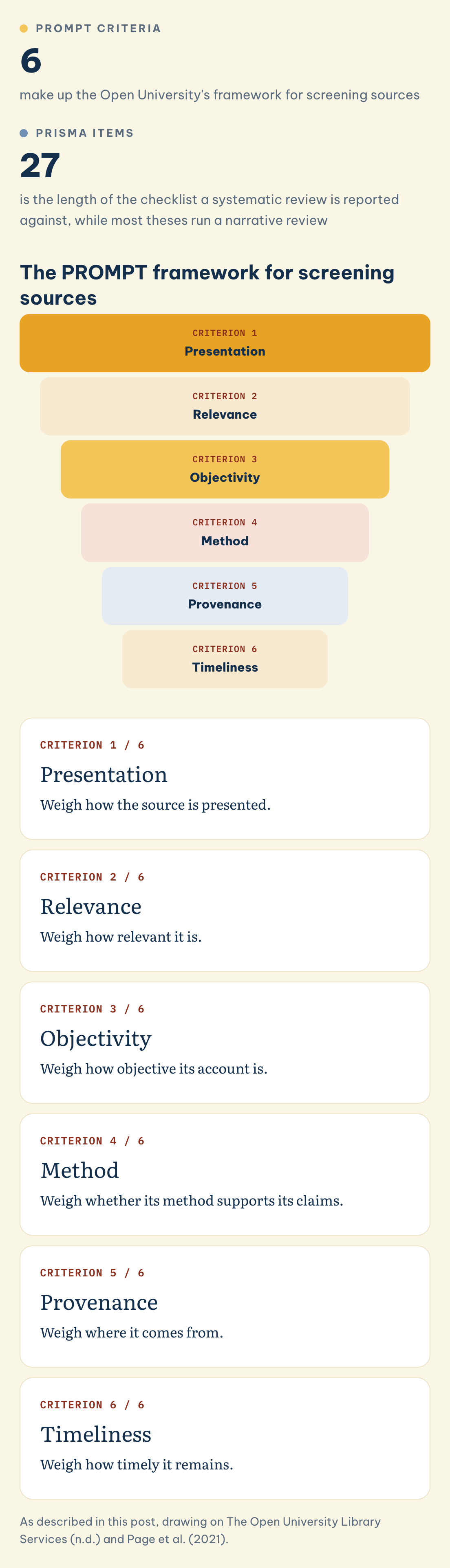
Deciding what deserves your reading time is where reviews are won. The Open University Library Services (n.d.) offers the PROMPT framework for this screening step, an acronym for Presentation, Relevance, Objectivity, Method, Provenance and Timeliness: weigh each source on how it is presented, how relevant it is, how objective its account is, whether its method supports its claims, where it comes from, and how timely it remains. Alongside that, set your own inclusion and exclusion criteria early and in writing, so your selectivity is defensible rather than accidental. Most theses and dissertations run a narrative review rather than a systematic one; if your field expects the latter, with a reproducible search protocol reported against the 27-item PRISMA checklist (Page et al., 2021), confirm that with your supervisor before you start screening rather than after. If AI tools sit anywhere in your workflow, the guide to using AI ethically in a literature review sets out where legitimate use ends; the APA 7th referencing guide covers keeping citations accurate from the first source.
◆ Part 6 / 9 · Synthesis
How do you synthesise sources instead of walking through them one by one?
Direct answer: University of Westminster Library (2026) defines synthesis as extracting content from different sources to create a new structure, unlike summary or paraphrase, which keep the source's structure. A walked-through paragraph keeps the shape of one source per sentence; a synthesised paragraph has a structure existing in no single source, the same skill University of Kent (2025) names.
The University of Westminster Library (2026) defines the chapter's core skill precisely: "With synthesis you extract content from different sources to create an original text. While paraphrase and summary maintain the structure of the given source(s), with synthesis you create a new structure." The working method is to summarise and synthesise in your own words what is important or controversial about each source (University of Kent, 2025).
The difference shows at paragraph level. A walked-through paragraph reads: one study found this, a second found that, a third found something else; each sentence keeps the shape of one source, and the sources never touch. A synthesised paragraph reads: most studies agree on the headline effect, and the disagreements track differences in method. That paragraph has a structure existing in no single source, and the new structure is your contribution. It is also where your voice enters: a successful review includes the voice of the writer, not only the authors reviewed (RMIT University Learning Lab, n.d.-b).
◆ Part 7 / 9 · The research gap
How do you identify and frame the research gap?
Direct answer: The gap is the review's destination, the first job Monash University Library assigns it. Strong gaps take recognisable shapes, an unexamined context, a methodological limitation, an unresolved contradiction, or an untested assumption, rather than a bare absence. Alvesson and Sandberg (2011) call questioning an assumption problematization, and it produces sharper research questions than pointing to unreached ground.
The gap is the review's destination: the first job Monash University Library (n.d.) assigns the review is to locate the gaps in existing research and justify the study that follows. Strong gaps come in recognisable shapes: an unexamined population or context, a methodological limitation running through the studies, an unresolved contradiction, or an assumption every study makes but none has tested. A bare absence is weaker; "no one has studied this in my country" only becomes an argument once you show why existing findings should not transfer there.
Frame the gap with restraint, because "never claim more than the evidence will support" (University of Kent, 2025). Alvesson and Sandberg (2011) call the strongest version of this move problematization: questioning an assumption a field has taken for granted, rather than only pointing to where research has not yet reached, and it tends to produce sharper research questions than gap-spotting alone. Once stated, the gap has to convert into something researchable; the guide to research questions and objectives covers that conversion.
◆ Part 8 / 9 · At doctoral level
For PhD candidates and Vietnamese researchers: what changes at doctoral level
Direct answer: The review's jobs do not change at doctoral level, but the stakes rise: the gap must justify an original contribution to knowledge. In the UK the viva voce runs 1 to 3 hours before internal and external examiners; Australian programmes route the thesis to 2 or 3 external examiners. Boote and Beile (2005) read the chapter as evidence of judgment.
At doctoral level the review's jobs do not change, but the stakes rise: the gap must justify an original contribution to knowledge, and the review becomes a chapter-length argument. In the UK, the finished thesis is defended at a viva voce that most commonly runs 1 to 3 hours in front of an internal and an external examiner, and the literature review is a frequent focus of the opening questions because it signals whether the candidate understands the field's boundaries. Australian programmes typically route the thesis to 2 or 3 external examiners for written reports instead of an oral defence, but on both sides the review chapter is read as evidence of judgment, not as a record of reading done. Boote and Beile (2005) make the case, still cited two decades later, that a doctoral literature review is what separates a scholar from someone who has merely completed a research task, which is why examiners read this chapter as evidence of judgment rather than as a summary of reading done. That argument starts inside the proposal; the PhD research proposal guide shows how the proposal's short review grows into the thesis chapter.
Two patterns recur in MAAS mentoring work with Vietnamese doctoral candidates. The first is the reading log: a draft in which every paragraph begins with a new author's name and reports what that author found. One supervisor returned such a chapter calling it a reading log, not a review; regrouping the same sources around themes turned the draft around without a single new source. The second is the thin gap. A draft claiming only that little research existed on the topic in Vietnam was reframed: the existing models assumed the reliable infrastructure of high-income economies, which rural Vietnamese provinces do not have. Challenging an assumption, rather than pointing at an empty space, justified a genuinely new study design.
Writing the review in your own academic voice as an ESL writer
Kwan's (2006) analysis of 20 doctoral theses in applied linguistics found the strongest review chapters moved through a shared underlying arc, establishing the field, narrowing to the specific topic, and justifying the study, a structural pattern that has nothing to do with which language the writer's first one is. Writing in a second language raises an honest worry: if the sources say it better than you can, why not let them speak? The answer is that the chapter is assessed on your judgment, and judgment is only visible in your own sentences; a successful review includes the writer's own voice alongside the sources' (RMIT University Learning Lab, n.d.-b). That voice is built deliberately: paraphrase ideas into your own argument structure rather than stitching quotations together, choose reporting verbs that carry your stance, and keep a personal bank of evaluative sentence patterns from papers in your field, adapting their frames without copying their content. Writing in your own voice from the first draft has a second benefit: it lowers the risk that a detector misreads careful ESL prose as machine-written, a false positive that falls hardest on non-native writers.
◆ Part 9 / 9 · Common mistakes
Common mistakes that weaken a literature review
Direct answer: Most weak reviews fail for a small, repeatable set of reasons rather than a lack of reading, the pattern Randolph (2009) built a self-evaluation framework around. Mistakes include writing author-by-author islands instead of the concept-centric structure Webster and Watson (2002) recommend, including every source regardless of relevance, overclaiming the gap, quoting too much, and leaving your own voice out.
Randolph (2009) built one of the more widely used self-evaluation frameworks for a dissertation-level review around exactly this kind of mistake list, on the reasoning that most weak reviews fail for a small, repeatable set of reasons rather than for lack of reading.
- Writing author-by-author islands. Compare and contrast the ideas of authors rather than writing one paragraph about one study, then another about the next (RMIT University Learning Lab, n.d.-a); structure by theme instead. Webster and Watson (2002) named this failure mode an author-centric review and contrasted it with the concept-centric organisation this guide recommends.
- Including everything you read. Sources that shaped your thinking but do not serve the argument belong in your notes, the selectivity principle behind the PROMPT screening framework (The Open University Library Services, n.d.).
- Overclaiming the gap. An inflated gap invites the examiner to deflate it (University of Kent, 2025), which is why Alvesson and Sandberg (2011) favour naming a specific assumption over declaring a whole area unstudied.
- Quoting too much and too long. Heavy quoting hands the chapter's structure back to the sources (University of Kent, 2025), the opposite of the concept-centric synthesis Webster and Watson (2002) recommend.
- Leaving your own voice out. A review with no evaluative voice reads as a report (RMIT University Learning Lab, n.d.-b).
Beyond your library's own guide, the book-length and journal-length treatments worth keeping on your desk through the whole project are Hart (1998) on mapping the field, Webster and Watson (2002) on concept-centric structure, Randolph (2009) on the self-evaluation checklist, and Ridley (2025) for a full step-by-step walkthrough.
Frequently asked questions
What is a literature review?
A survey and critical analysis of what has been written on a particular topic, theory, question or method (University of Queensland Library, n.d.). It is both a research process and the written product presenting your argument about the field (University of Southampton Library, 2026), the same process-and-product framing Hart (1998) used to distinguish a review from a mere summary.
How is a literature review different from an annotated bibliography?
An annotated bibliography evaluates each source separately, entry by entry. A literature review collates, links and evaluates sources around themes, so studies appear in conversation (Sheffield Hallam University Library, n.d.).
How many types of literature review are there?
The most common type, and the one most master's theses and PhD dissertations use, is the narrative (traditional) literature review, which synthesises existing work without requiring a standardised search protocol (NPS Dudley Knox Library, n.d.; University of Waikato Library, n.d.). Beyond that sit the systematic review, which uses a transparent, reproducible method to answer a narrow research question (Page et al., 2021), the scoping review, which maps the breadth of knowledge in an emerging area, and the integrative review, which synthesises quantitative, qualitative and theoretical literature together (University of Waikato Library, n.d.). Unless your module guide or supervisor specifically asks for one of those, a narrative review is what most master's review chapters expect.
What is the difference between summarising and synthesising sources?
Summary keeps the structure of the source; synthesis extracts content from several sources to create an original text with a new structure (University of Westminster Library, 2026). You sum up in your own words what is important or controversial about each source, then connect those judgments (University of Kent, 2025), the same skill Randolph (2009) places at the centre of a strong dissertation review.
Should a literature review be organised by theme, by date, or by theory?
The recognised patterns are thematic, chronological and theoretical (RMIT University Learning Lab, n.d.-a); UNSW adds inverted-pyramid and classic-studies patterns (UNSW Sydney, n.d.). Whichever you choose, compare and contrast ideas across sources rather than writing one paragraph per study, the concept-centric approach Webster and Watson (2002) contrast with an author-centric review (RMIT University Learning Lab, n.d.-a).
How many sources does a literature review need?
There is no fixed number: the count scales with the word limit, the level and the discipline. Shorter embedded reviews are selective, standalone and doctoral reviews aim for fuller coverage within whatever ceiling the university sets on the whole thesis (University of Cambridge, n.d.; University of Manchester, 2026), and your supervisor or module guide sets the real expectation.
How is a PhD literature review different from a master's one?
The purpose is shared: situating the work, locating gaps and justifying the study (Monash University Library, n.d.). At doctoral level, coverage moves from selective toward comprehensive, and the review must sustain an original argument that justifies a contribution to knowledge, the standard Boote and Beile (2005) set when they argued the chapter is what separates a scholar from someone who has merely completed a research task.
Do I include my own opinion in a literature review?
Yes, as evaluative judgment rather than personal feeling. A successful review includes the voice of the person writing it, not just the authors reviewed (RMIT University Learning Lab, n.d.-b), the exact quality Boote and Beile (2005) and Kwan (2006) both use to separate a strong doctoral chapter from a weak one, expressed by weighing evidence in measured academic language.
WHEN YOU WANT AN EXPERIENCED READER ON YOUR REVIEW CHAPTER
A review improves fastest when an experienced reader asks what an examiner would ask: where is the argument, which sources are doing work, does the gap follow. Working with a MAAS academic mentor across each thesis phase gives you structured feedback on your own draft, with the mentor questioning your source-selection criteria, testing how well the synthesis holds together, and probing how the gap is framed, while the reading, the judgments and the writing remain your own throughout.
Explore academic mentoring at MAAS
References
- Alvesson, M., & Sandberg, J. (2011). Generating research questions through problematization. Academy of Management Review, 36(2), 247–271. https://doi.org/10.5465/amr.2009.0188
- Boote, D. N., & Beile, P. (2005). Scholars before researchers: On the centrality of the dissertation literature review in research preparation. Educational Researcher, 34(6), 3–15. https://doi.org/10.3102/0013189X034006003
- Hart, C. (1998). Doing a literature review: Releasing the social science research imagination. Sage Publications.
- Kwan, B. S. C. (2006). The schematic structure of literature reviews in doctoral theses of applied linguistics. English for Specific Purposes, 25(1), 30–55. https://doi.org/10.1016/j.esp.2005.06.001
- Monash University Library. (n.d.). Literature reviews - Researching for your literature review. Retrieved July 2, 2026, from https://guides.lib.monash.edu/researching-for-your-literature-review/literature-review
- NPS Dudley Knox Library. (n.d.). Types of literature reviews. Retrieved September 16, 2026, from https://libguides.nps.edu/literature-review/lrtypes
- The Open University Library Services. (n.d.). Advanced evaluation using PROMPT. Retrieved July 2, 2026, from https://www.open.ac.uk/libraryservices/documents/advanced-evaluation-using-prompt.pdf
- Page, M. J., McKenzie, J. E., Bossuyt, P. M., Boutron, I., Hoffmann, T. C., Mulrow, C. D. et al. (2021). The PRISMA 2020 statement: An updated guideline for reporting systematic reviews. BMJ, 372, Article n71. https://doi.org/10.1136/bmj.n71
- Randolph, J. J. (2009). A guide to writing the dissertation literature review. Practical Assessment, Research & Evaluation, 14, Article 13. https://scholarworks.umass.edu/pare/vol14/iss1/13
- Ridley, D. (2025). The literature review: A step-by-step guide for students (3rd ed.). SAGE Publications.
- RMIT University Learning Lab. (n.d.-a). Structuring a literature review. Retrieved July 2, 2026, from https://learninglab.rmit.edu.au/assessments/literature-reviews/literature-review-structure/
- RMIT University Learning Lab. (n.d.-b). Your voice. Retrieved July 2, 2026, from https://learninglab.rmit.edu.au/assessments/literature-reviews/your-voice/index.html
- Sheffield Hallam University Library. (n.d.). Types of review - Literature reviews. Retrieved July 3, 2026, from https://libguides.shu.ac.uk/literaturereviews/types
- University of Cambridge. (n.d.). Word limits and requirements of your Degree Committee. Cambridge Students. Retrieved August 21, 2026, from https://www.cambridgestudents.cam.ac.uk/your-course/research-students-pgr/postgraduate-exam-information/writing-submitting-and-examination/phd/word-limits
- University of Kent. (2025). Writing a literature review. Retrieved July 2, 2026, from https://student.kent.ac.uk/studies/literature-reviews/writing-a-literature-review
- University of Manchester. (2026). Presentation of theses policy. Retrieved August 21, 2026, from https://documents.manchester.ac.uk/display.aspx?DocID=7420
- University of Queensland Library. (n.d.). Introduction - Literature reviews. Retrieved July 2, 2026, from https://guides.library.uq.edu.au/research-techniques/literature-reviews
- University of Southampton Library. (2026). Literature reviews: Writing. Retrieved July 2, 2026, from https://library.soton.ac.uk/literature_reviews
- University of Waikato Library. (n.d.). Literature reviews: Systematic & narrative - Which type of review do I need? Retrieved September 16, 2026, from https://libraryguides.waikato.ac.nz/c.php?g=979384&p=7131542
- University of Westminster Library. (2026). Literature reviews: Synthesis. Retrieved July 2, 2026, from https://libguides.westminster.ac.uk/literature-reviews/synthesis
- Webster, J., & Watson, R. T. (2002). Analyzing the past to prepare for the future: Writing a literature review. MIS Quarterly, 26(2), xiii–xxiii.
- UNSW Sydney. (n.d.). How to write a literature review. Retrieved July 2, 2026, from https://www.unsw.edu.au/student/managing-your-studies/academic-skills-support/toolkit/honours-postgraduate/literature-review
A free 20-minute consultation with a MAAS mentor, to talk through your review chapter.
Book Free Discovery ▸