
◆ Thesis and dissertation
How do you write a theoretical framework? A worked example
To write a theoretical framework, define each core concept from scholarly sources, survey the theories your field already uses, justify the theory you choose over its alternatives, and check that the choice stays aligned with your research objectives and methods. The framework itself is the part of your thesis or dissertation that names your key concepts, proposes the relationships between them, and identifies the established theories you will use to interpret your findings.
This guide walks through each of those 4 moves in order, with a worked example, the marking logic examiners tend to apply, and the 5 mistakes that most often weaken the section. Every claim below traces to one of 22 sources, each a university library guide, a peer-reviewed methods paper, or one named UK module handbook, and the full list sits at the end so you can check the original guidance yourself.

◆ Part 1 / 7 · Purpose
What a theoretical framework is and what it does for your study
Direct answer: A theoretical framework is the lens through which a study frames its problem, selects methods, and interprets results. In a 12,000-word master's dissertation it usually occupies part of Chapter 2, not a chapter of its own. It sets out your key concepts, their definitions, and the established theories your research draws on, grounding later chapters.
A theoretical framework is the foundation, or lens, through which a research study frames its problem, selects its methods, and interprets its results. That definition comes from National University's library guidance, and Sacred Heart University Library (2026) describes the same section in more operational terms: it introduces and describes the theory that explains why the research problem exists, and it consists of the key concepts of your research, their definitions, and the existing theories your study draws on, all grounded in what you found in the literature. Concordia University Chicago Library states that "A theoretical framework consists of concepts and, together with their definitions and reference to relevant scholarly literature, existing theory that is used for your particular study" (Concordia University Chicago Library, n.d.).
The word "lens" is doing real work in that definition. Two researchers can study the same classroom, the same supply chain, or the same patient group and reach different, equally defensible conclusions, because they read the data through different theories. A study of why staff resist a new system reads one way through the Technology Acceptance Model (Davis, 1989), where the question becomes perceived usefulness and perceived ease of use, the 2 constructs Davis names, and another way through the Theory of Planned Behaviour (Ajzen, 1991), where the question becomes attitudes, subjective norms and perceived behavioural control, the 3 constructs Ajzen names. The framework is where you tell the reader, before any data appears, which lens you are holding and why.
What the framework actually does
According to National University's guide, a theoretical framework grounds the study in established knowledge, defines its boundaries, and directs the research questions, the literature review, and the choice of methods. In practice that means the section earns its place by making later chapters easier to defend: when a reader asks why you measured one variable rather than another, or why you interpreted a finding one way rather than another, the honest answer should already be sitting in the framework, 2 chapters earlier. A peer-reviewed introduction to frameworks written for new education researchers by Luft, Jeong, Idsardi and Gardner (2022) adds a test of direction: a theoretical framework explains a phenomenon through a particular lens, challenging and extending existing knowledge, rather than sitting as a neutral summary of what other people have written.
The toolbox picture
In its research-projects guide, Sheffield Hallam University Library (n.d.) offers a picture that many students find clarifying. The theories, concepts, and assumptions you adopt work like a set of tools chosen for a particular job, while the methodology is closer to the instruction manual that explains how those tools will be used. In that picture, choosing SERVQUAL (Parasuraman et al., 1988) is picking up a tool, and deciding to run it as a 22-item questionnaire across 2 service encounters is reading the manual. The image is useful because it separates 2 chapters that often blur together in early drafts, since the framework establishes what you will think with while Chapter 3, the methodology, explains what you will actually do.
◆ Part 2 / 7 · Two types
Theoretical vs conceptual framework: which one your project needs
Direct answer: A theoretical framework interprets your study through one or more established, named theories; a conceptual framework is a structure you build yourself, usually a diagram of variables and expected relationships for one specific problem. Check which one your programme handbook asks for before you write, because the terms are often wrongly used as synonyms.
Two frameworks, side by side
Each row compares what the two terms usually mean.
Theoretical framework
Conceptual framework
Interprets the study through one or more established, named theories
A structure the researcher builds, usually a diagram of variables and expected relationships for one specific problem
More abstract and general, often associated with quantitative and deductive designs
Problem-specific, and commonly presented as a single diagram
PhD dissertations typically require one built on established scholarship
Applied doctoral projects may use either type, depending on the problem
Save this figure
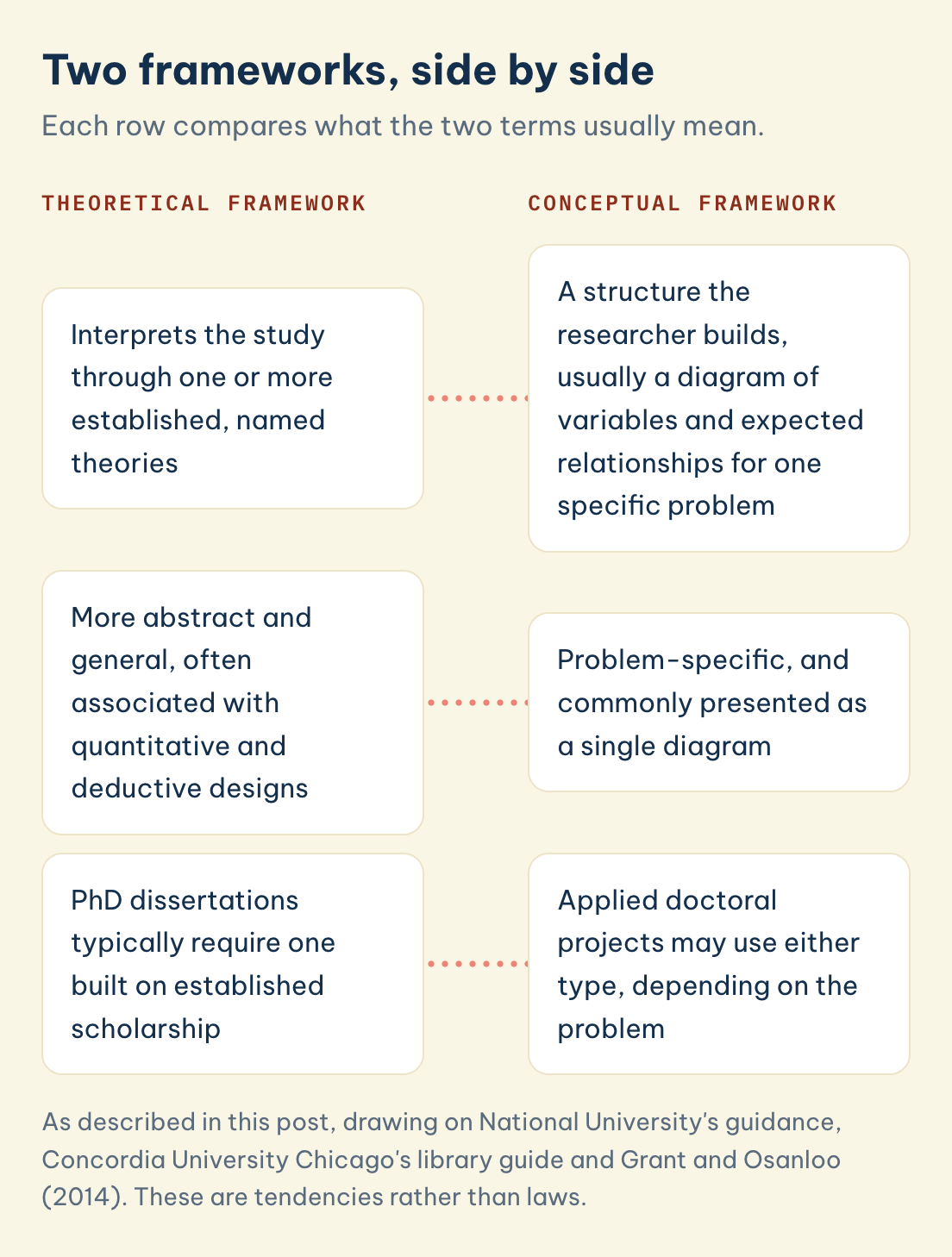
A theoretical framework interprets your study through one or more established, named theories, while a conceptual framework is a structure the researcher builds, usually a diagram of variables and expected relationships tailored to one specific problem. National University's guidance and the Grant and Osanloo (2014) paper both observe that the two terms are frequently, and incorrectly, used as if they were synonyms, so it is worth pinning down which one your programme handbook actually asks for before you write a word. For a fuller side-by-side comparison, see conceptual vs theoretical framework, and for building the diagram-based version, see how to write a conceptual framework.
The house-blueprint analogy
In a peer-reviewed guide for doctoral students published in the Administrative Issues Journal, Grant and Osanloo (2014) reach for a building metaphor. They are explicit about which framework the metaphor belongs to: "We believe the blueprint is an appropriate analogy of the theoretical framework of the dissertation" (Grant & Osanloo, 2014, p. 12). The blueprint is the established design produced before construction begins, and it is what permits the foundation to be poured and dictates the floor plan. Note what the metaphor does not do. Grant and Osanloo do not hand the conceptual framework a second building part. They define it separately, as the researcher's understanding of how the research problem will best be explored and how the variables in the study relate (Grant & Osanloo, 2014, p. 16). Read carelessly, this passage is where students pick up the belief that the conceptual framework is the blueprint, which reverses what the paper says.
PhD dissertation vs applied project
National University's guidance draws a practical line between degree types. PhD dissertations, which run to 80,000 or 100,000 words and are expected to extend or generate theory, typically require a theoretical framework built on established scholarship, while applied doctoral projects may use either a theoretical or a conceptual framework depending on the problem. The same guidance, echoed by Concordia University Chicago's library guide, describes theoretical frameworks as more abstract and general, often associated with quantitative and deductive designs, whereas conceptual frameworks tend to be problem-specific and are commonly presented as a single diagram. These are tendencies rather than laws, and your supervisor's reading of your project should carry more weight than any general rule, but the pattern explains why a supervisor who writes "this reads like a conceptual framework" on your draft is usually asking for more engagement with named, established theory, meaning theory with an author and a year attached.
◆ Part 3 / 7 · Placement
Where the framework sits in your dissertation
Direct answer: In most dissertations the theoretical framework sits inside the literature review chapter, though some institutions place it in the introduction or give it its own chapter when the study draws on many complex theories. Confirm your own programme's structure, since placement conventions vary by university rather than following a single universal rule.
Chapter 2 allocation
3,500
words of a 12,000-word dissertation, roughly, in Northumbria University Business School's LD7201 handbook
Share of the whole
29%
close to 29% of the whole document, one UK university's handbook, not a universal standard
Chapter 2 against the whole dissertation
Chapter 2, Background Research and Literature Review, is where the framework material belongs in this handbook.
Save this figure
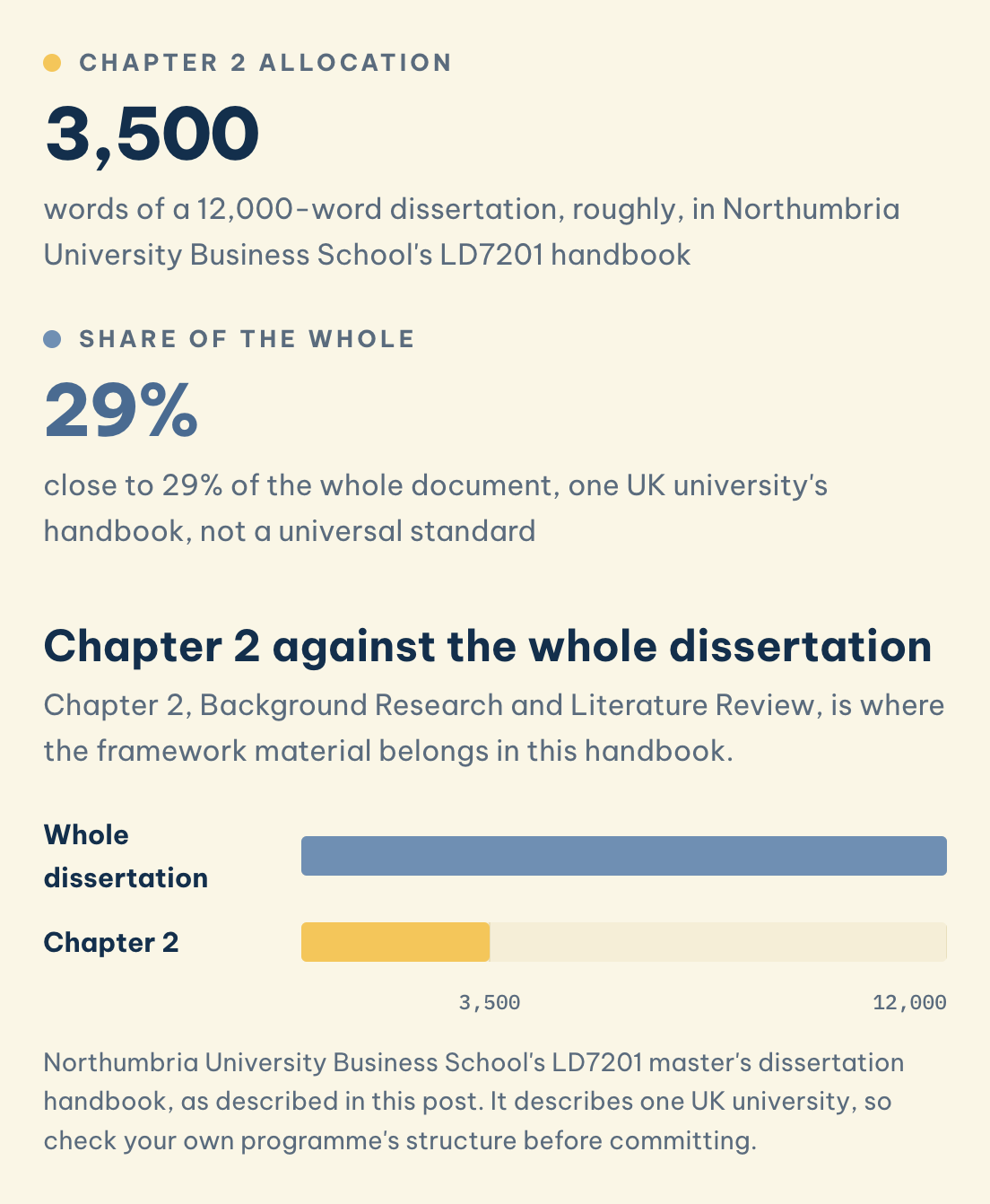
In most dissertations the theoretical framework lives inside the literature review chapter, though placement varies by institution: the Lee University Library (n.d.) research guide, for example, places the framework in Chapter 1, before the literature review, and some programmes give it a chapter of its own when the research draws on 3 or more complex theories that would crowd the review. As one concrete illustration, Northumbria University Business School's LD7201 master's dissertation handbook structures a 12,000-word dissertation so that Chapter 2, Background Research and Literature Review, runs to roughly 3,500 words, close to 29% of the whole document, and the framework material belongs inside that chapter rather than standing alone. Chapter 3 on methodology and Chapter 4 on findings then carry the remaining word budget. That figure describes one UK university's handbook, not a universal standard, so treat it as a sense of scale and check your own programme's structure before committing.
Placement also has a forward and a backward direction. The introduction chapter should point toward the framework by naming the problem and the key concepts, and the analysis chapters should reach back to it when findings are interpreted. If you want chapter-by-chapter guidance across the whole document, the MAAS guide to writing a dissertation maps the full structure in one place.
◆ Part 4 / 7 · Four steps
How to write a theoretical framework in four steps
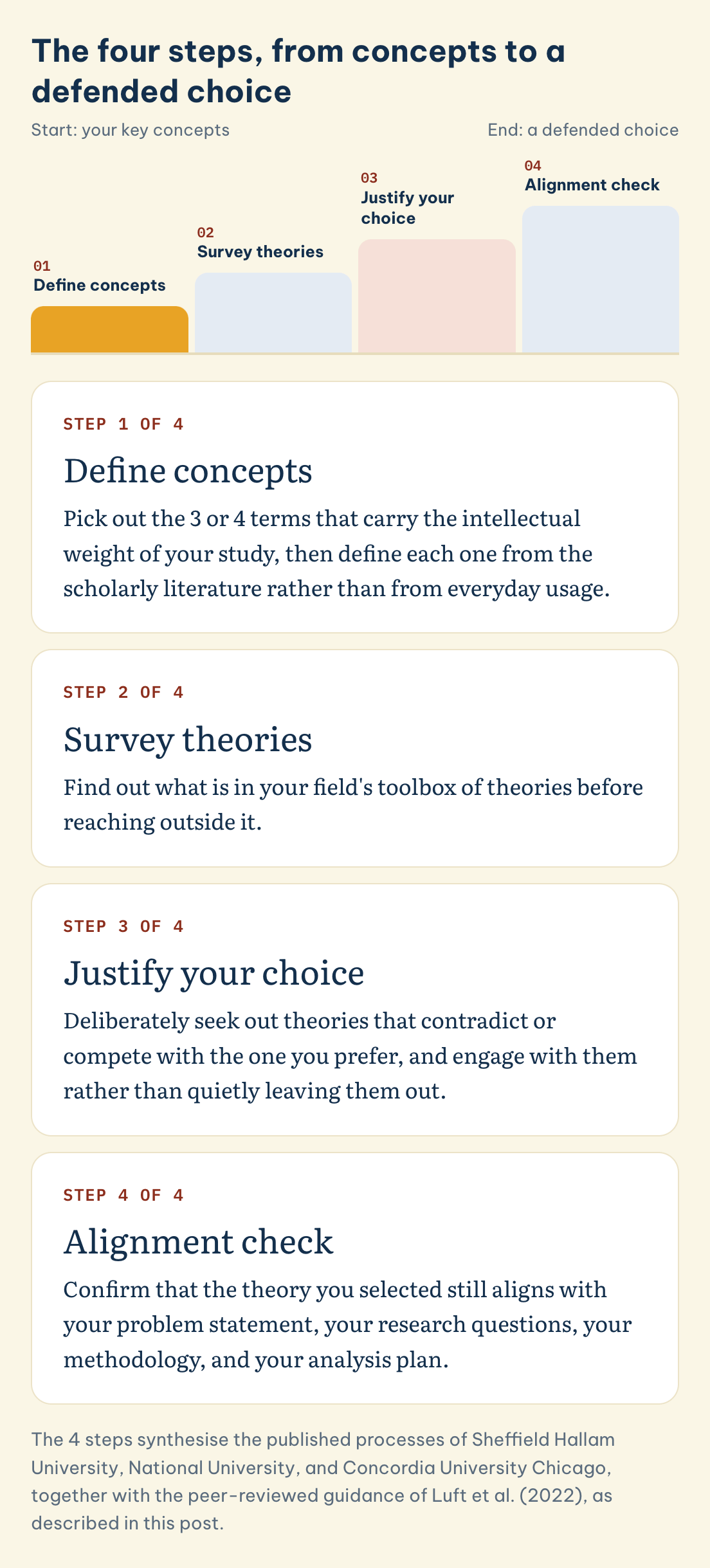
Direct answer: Write a theoretical framework in 4 steps: define your key concepts from scholarly sources, survey the theories your field already uses, justify your chosen theory against its alternatives, and run an alignment check against your problem statement, research questions, and methods. The steps move from concepts, to candidate theories, to a defended choice.
The 4 steps below synthesize the published processes of Sheffield Hallam University, National University, and Concordia University Chicago, together with the peer-reviewed guidance of Luft et al. (2022). The sources describe the sequence in slightly different ways, but they converge on the same underlying movement: from concepts, to candidate theories, to a defended choice, to an alignment check.
Step 1: define your key concepts from scholarly sources
The University of Southern California Libraries (2026) describe a framework as consisting of concepts, together with their definitions and reference to relevant scholarly literature, so start where your problem statement and research questions already are. Pick out the 3 or 4 terms that carry the intellectual weight of your study, then define each one from the scholarly literature rather than from everyday usage. The step matters because different authors often define the same term in meaningfully different ways across 40 or 50 years of literature, so a complete definition compares the competing versions and states, with reasons, which one your study adopts. Satisfaction alone carries at least 3 rival definitions, since Oliver (1980) frames it as the gap between expectation and performance while service-quality work in the SERVQUAL tradition frames it as a judgement across several dimensions at once.
Step 2: survey the theories your field already uses
Sheffield Hallam's guide describes each discipline as having something like a standard toolbox of theories that researchers in that field reach for, and your job at this stage is to find out what is in your field's toolbox before reaching outside it. Naming the tools makes the point concrete. A study of technology uptake will almost certainly meet the Technology Acceptance Model, published by Davis (1989) in MIS Quarterly, and the Theory of Planned Behaviour, published by Ajzen (1991) in Organizational Behavior and Human Decision Processes. A service-quality study will meet SERVQUAL and its 5 dimensions, introduced by Parasuraman et al. (1988) in the Journal of Retailing. A satisfaction study will meet the expectancy-disconfirmation model, set out by Oliver (1980) in the Journal of Marketing Research. A qualitative study analysing interview data will meet the 6-phase approach to thematic analysis published by Braun and Clarke (2006) in Qualitative Research in Psychology.
Those 5 are among the most heavily cited frameworks in business and social science, and the oldest of them, Oliver (1980), has been in circulation for more than 45 years while the youngest, Braun and Clarke (2006), is approaching 20. That longevity matters for a different reason than prestige: a theory used across many studies comes with a body of published measures, so you inherit instruments that other researchers have already tested rather than building your own from nothing. SERVQUAL arrives with its 22 items and 5 dimensions already worded, and the Theory of Planned Behaviour arrives with 3 predictor constructs already defined.
Other disciplines have their own defaults. Education research reaches for Bloom's taxonomy (Bloom, 1956) and for Vygotsky's zone of proximal development (Vygotsky, 1978), first published in English by Harvard University Press. Strategy research reaches for the resource-based view set out by Barney (1991) in the Journal of Management and Porter's 5 forces (Porter, 1979), published in Harvard Business Review. Organisational research reaches for Hofstede's cultural dimensions (Hofstede, 1980) and Tuckman's 4 group stages (Tuckman, 1965), published in Psychological Bulletin. Read 3 or 4 recent empirical papers on your topic and note which framework each one adopts. Where the same theory appears in 3 of those 4 papers, you have found your field's default, and departing from it becomes a decision you must justify in Step 3 rather than an oversight the examiner will catch.
Step 3: justify your choice against the alternatives
National University's process includes a step that weaker frameworks almost always skip: deliberately seek out theories that contradict or compete with the one you prefer, and engage with them rather than quietly leaving them out. For a technology study that means naming the Unified Theory of Acceptance and Use of Technology alongside the Technology Acceptance Model, not only the one you intend to keep. Sheffield Hallam's guidance points the same way, asking you to give reasons for the selection and to note the limitations of the theory you choose. Choosing the theory everyone in your department already uses can feel like the safe move, and familiarity does reduce the risk of misapplying a framework you only half understand. The difficulty is that a choice which is never weighed against an alternative gives the reader no way to tell whether it was reasoned or simply inherited, and it is the weighing, visible on the page, that turns a description into an argument. In practice 2 or 3 paragraphs of comparison are enough to show it happened.
Step 4: run the alignment check
National University's 8-step process ends with verification: confirm that the theory you selected still aligns with your problem statement, your research questions, your methodology, and your analysis plan, because drafts drift and a framework chosen in month 2 may no longer fit the study you are actually running in month 6. Concordia University Chicago Library (n.d.) frames the same check at the level of mechanics: the chosen theory should be able to explain the relationships between your variables, and its assumptions should be discussed openly rather than imported silently.
The four steps, from concepts to a defended choice
Tap a step to see what it asks of you.
Step 1 of 4
Define concepts
Pick out the 3 or 4 terms that carry the intellectual weight of your study, then define each one from the scholarly literature rather than from everyday usage.
Step 2 of 4
Survey theories
Find out what is in your field's toolbox of theories before reaching outside it.
Step 3 of 4
Justify your choice
Deliberately seek out theories that contradict or compete with the one you prefer, and engage with them rather than quietly leaving them out.
Step 4 of 4
Alignment check
Confirm that the theory you selected still aligns with your problem statement, your research questions, your methodology, and your analysis plan.
Save this figure
These four steps are also where most candidates discover they are doing this alone. Academic Mentoring pairs you with a senior expert in your discipline who reads each draft of the framework and presses on the reasoning, while you stay the one writing it.
◆ Part 5 / 7 · Example
A worked example: three definitions of customer satisfaction
Direct answer: A strong framework does not just announce a definition; it presents several authors' competing definitions of a key concept, weighs them, and adopts the one that best fits the study's context, stating why. It then sketches the expected relationships in a simple model and ties the chosen theory back to the research objectives.
Definitions compared
3
definitions of customer satisfaction, from 3 different authors
Boxes in the model
4 or 5
usually joined by labelled arrows in the simple visual model
The three beats of the worked example
Tap a beat to see what it does.
Beat 1 / 3
Competing definitions
Present 3 different authors' definitions of customer satisfaction and weigh them against each other.
Beat 2 / 3
The definition you adopt
Adopt the definition that best fits the study's online context, stating the reason for the fit.
Beat 3 / 3
Why it serves the objectives
Sketch the expected relationships in a simple visual model and connect the chosen theory back to the study's objectives.
Save this figure
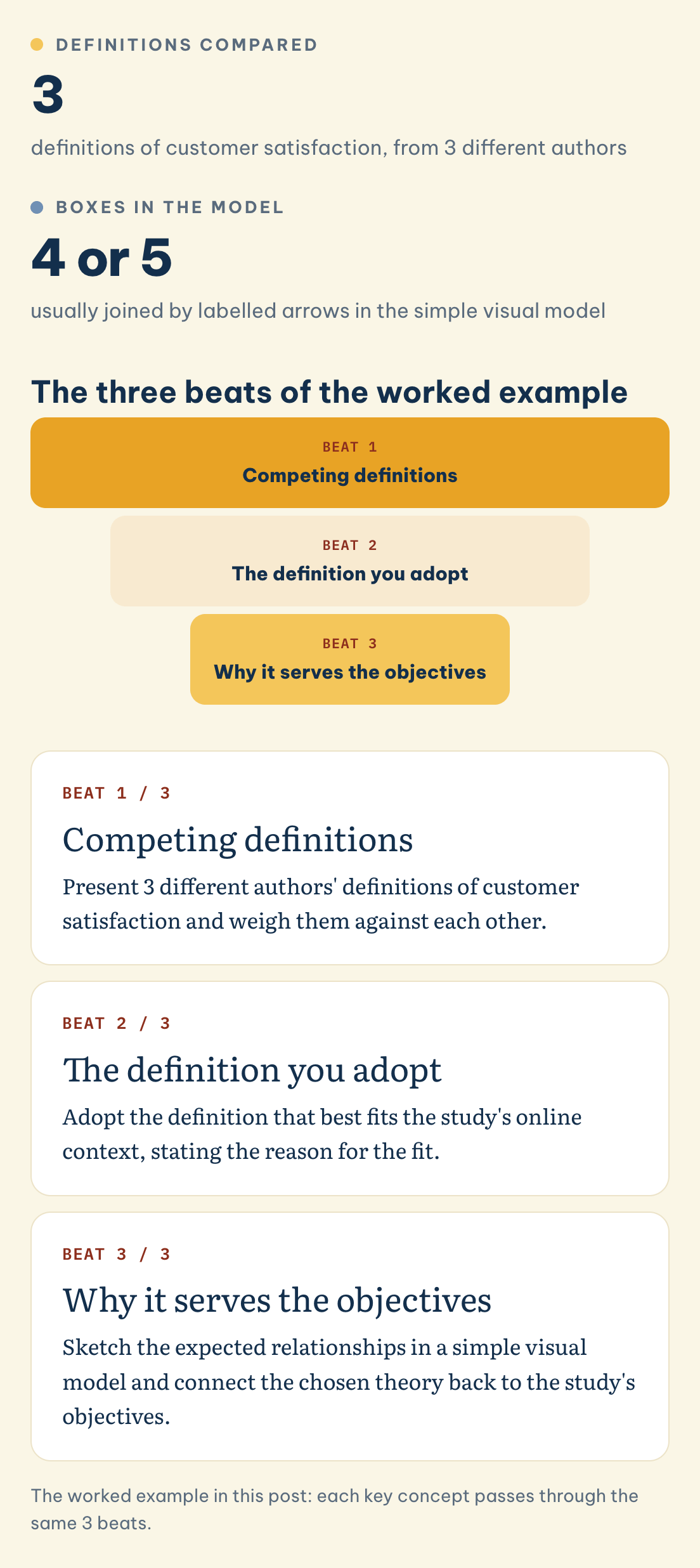
A worked example shows what the finished movement looks like at small scale. In a study of customer satisfaction at an online business, a strong framework does not simply announce a definition; it presents 3 different authors' definitions of customer satisfaction, weighs them against each other, and adopts the one that best fits the study's online context, stating the reason for the fit. It then sketches the expected relationships in a simple visual model, usually 4 or 5 boxes joined by labelled arrows, and connects the chosen theory back to the study's objectives, so the reader can see exactly how the lens will be used on the data to come.
The example is worth imitating for its shape rather than its topic. Even in a short framework, each key concept passes through the same 3 beats: here are the competing definitions, here is the one this study adopts, and here is why that choice serves these particular research objectives. A framework built from such units is difficult to dismiss as decorative, because every paragraph ends by doing work for the study.
◆ Part 6 / 7 · Examiners
How examiners read this section
Direct answer: Examiners judge a theoretical framework mainly on whether the choice of theory is defended, not merely described. UK marking language separates analysing, critically evaluating, and justifying, and the section is read against all three at once, so the gap between a good and a top band is usually whether it answers "why this theory and not another".
What separates a strong theoretical framework from a weak one, in most marking schemes, is whether the choice of theory is defended rather than merely described. UK assessment language signals this expectation directly. The University of Portsmouth (n.d.) study-skills guidance on task words distinguishes 3 verbs that mark this section. Analysing means breaking a topic into its parts and examining how they relate. Critically evaluating means weighing the arguments and evidence for and against before reaching a position. Justifying means supporting a decision with reasons and evidence. A framework section is usually being read against all 3 at once.
Northumbria's LD7201 marking descriptors, again offered as one university's illustration rather than a national rule, show how fine the line can be. Work in the 60 to 69 band is characterised as showing "good explanation but lacking in full justification", while the 70 to 79 band asks for "clear justification" of the choices made, with limitations noted. The 10 marks between those 2 bands are the difference between a Merit and a Distinction on most UK master's scales. The gap between those two descriptions is not more reading or more theories; it is whether the section answers the question "why this theory and not another". The same expectation follows you into the next chapter, where methods face an identical test; the guide to writing a methodology covers how that argument continues.
◆ Part 7 / 7 · Mistakes
Common mistakes that weaken a theoretical framework
Direct answer: 5 failures account for most weak frameworks: confusing theoretical with conceptual, listing theories without choosing one, choosing a theory the methods cannot test, defining concepts in your own words rather than from sources, and never revisiting the framework in the discussion chapter.
- Using "theoretical" and "conceptual" interchangeably. Grant and Osanloo (2014) and National University both note the terms are often confused; and if your handbook asks for one while you deliver the other, the mismatch is visible to a marker within the first 2 pages, before the content is even judged.
- Presenting a summary as a framework. Luft and colleagues (2022) are explicit that a framework explains a phenomenon through a particular lens, and the same distinction between surveying sources and arguing with them is the core of writing a real literature review. A framework that only reports what others said has not yet started its job.
- Naming a theory without defending it. National University's process asks you to seek out contradicting theories precisely because a choice with no visible alternatives reads as an assumption, and assumptions attract questions in a viva that typically runs 60 to 90 minutes.
- Never reconnecting the framework to the study. The alignment check in Step 4 is not a one-time event; if Chapter 4 and Chapter 5 never return to the framework, the reader is entitled to wonder whether it shaped the study at all.
- Leaning on textbooks instead of journals. Northumbria University's handbook guidance expects the literature underpinning Chapter 2 to draw on journal research and to evaluate it, rather than restating textbook summaries; textbook-heavy sourcing tends to cap how seriously the framework can engage with current debates.
Frequently asked questions
How many paragraphs should a theoretical framework have?
None of the sources in the reference list prescribes a paragraph count, so the safer unit is length and structure. In a master's dissertation the framework usually takes 1,500 to 2,000 words inside Chapter 2, and a practical way to organise it is one block per step of the 4-step method above: your 3 or 4 key concepts defined from scholarly sources, the theories your field already uses, the 2 or 3 theories you actually think with and why you chose them over alternatives, and a closing alignment check against your research questions and methods. Your programme handbook has the final say on length.
What is a theoretical framework in a thesis or dissertation?
A theoretical framework is the foundation, or lens, through which a study is designed and its findings are interpreted, as National University's library guidance defines it. It names the established theories the researcher will think with, defines the study's key concepts, and sets the boundaries of what the research will and will not explain. In a master's dissertation that work usually takes 1,500 to 2,000 words inside Chapter 2.
What is the difference between a theoretical framework and a literature review?
A literature review surveys and evaluates the existing research on a topic, while the theoretical framework selectively presents the specific concepts and theories the study will actually use. Luft and colleagues (2022) draw the line by function, since a framework explains a phenomenon through a particular lens, so a section that only summarises other people's work is a review fragment, and not yet a framework. The literature review may cover 40 or 60 sources, while the framework carries only the 2 or 3 the study actually thinks with.
What is the difference between a theoretical and a conceptual framework?
A theoretical framework applies established, named theory as the study's lens, while a conceptual framework is a researcher-built structure, often a diagram, showing the expected relationships between the variables of one specific problem. Grant and Osanloo (2014) and National University both caution that the terms are frequently used interchangeably even though they refer to different things.
How long should a theoretical framework be?
None of the 22 university guides and peer-reviewed sources in the reference list below fixes a required length, and placement conventions vary by institution: the framework usually sits inside the literature review unless the study involves many complex theories, in which case it can take its own chapter. As one illustration of scale, Northumbria University's LD7201 handbook allocates roughly 3,500 words of a 12,000-word dissertation to the whole of Chapter 2, which houses the framework material; your own programme's handbook is the figure that matters.
How do I choose the right theory for my research?
Follow the survey-then-defend sequence: search the literature using your key variables to find the theories your field already applies, as National University's 8-step process describes, then give reasons for your selection and note its limitations, as Sheffield Hallam's toolbox guidance asks. The decisive move is engaging with alternatives, including theories that contradict your choice, so the final selection reads as reasoned rather than inherited. Naming 2 rejected theories is usually enough.
Where in the dissertation does the theoretical framework go?
Usually inside the literature review chapter, though some institutions place it differently: The Lee University guide, for example, puts the framework in Chapter 1, and a separate chapter is reserved for studies that draw on many complex theories. In Northumbria's LD7201 structure, for example, the framework material lives inside Chapter 2, Background Research and Literature Review, rather than standing alone, though other universities structure the document differently.
WHEN YOU WANT A SECOND PAIR OF EYES ON CHAPTER TWO
Choosing between theories is easier to reason through out loud, with someone who has read many of these chapters and knows where examiners push back. MAAS academic mentoring pairs you with a postgraduate-qualified mentor who works alongside you across all 5 chapters, from settling the 2 or 3 research questions to pressure-testing why this theory and not another, so the framework you submit has already survived a sceptical reader before it reaches the University marking panel. Mentors question, advise, and give structured feedback; the reading, the decisions, and the writing remain your own.
Explore academic mentoring at MAAS
Related guides
- Free course: Academic writing essentials for postgraduate students: three short lessons on theoretical frameworks, the viva and APA 7th referencing, published free on the OpenLearn Create platform of The Open University
References
- Ajzen, I. (1991). The theory of planned behavior. Organizational Behavior and Human Decision Processes, 50(2), 179–211. https://doi.org/10.1016/0749-5978(91)90020-T
- Barney, J. (1991). Firm resources and sustained competitive advantage. Journal of Management, 17(1), 99–120. https://doi.org/10.1177/014920639101700108
- Bloom, B. S. (1956). Taxonomy of educational objectives: The classification of educational goals, handbook I: Cognitive domain. David McKay.
- Braun, V., & Clarke, V. (2006). Using thematic analysis in psychology. Qualitative Research in Psychology, 3(2), 77–101. https://doi.org/10.1191/1478088706qp063oa
- Concordia University Chicago Library. (n.d.). Theoretical frameworks. Retrieved July 2, 2026, from https://libguides.cuchicago.edu/research_center/theoretical_frameworks
- Davis, F. D. (1989). Perceived usefulness, perceived ease of use, and user acceptance of information technology. MIS Quarterly, 13(3), 319–340. https://doi.org/10.2307/249008
- Grant, C., & Osanloo, A. (2014). Understanding, selecting, and integrating a theoretical framework in dissertation research: Creating the blueprint for your "house". Administrative Issues Journal, 4(2), 12–26. https://doi.org/10.5929/2014.4.2.9
- Hofstede, G. (1980). Culture's consequences: International differences in work-related values. Sage Publications.
- Lee University Library. (n.d.). Theoretical framework: Developing your research study. Retrieved July 2, 2026, from https://leeuniversity.libguides.com/research_study_guide/theoretical_framework
- Luft, J. A., Jeong, S., Idsardi, R., & Gardner, G. (2022). Literature reviews, theoretical frameworks, and conceptual frameworks: An introduction for new biology education researchers. CBE—Life Sciences Education, 21(3), Article rm33. https://doi.org/10.1187/cbe.21-05-0134
- National University Library. (n.d.-a). Theoretical framework. Retrieved July 2, 2026, from https://resources.nu.edu/researchtools/theoreticalframework
- National University Library. (n.d.-b). Theoretical vs conceptual framework. Retrieved July 2, 2026, from https://resources.nu.edu/c.php?g=1446805&p=10752288
- Northumbria University Business School. LD7201 Master's Dissertation module handbook, held on file by MAAS (chapter structure, word allocation, and marking descriptors cited above as one UK university's illustration, not a universal standard).
- Oliver, R. L. (1980). A cognitive model of the antecedents and consequences of satisfaction decisions. Journal of Marketing Research, 17(4), 460–469. https://doi.org/10.1177/002224378001700405
- Parasuraman, A., Zeithaml, V. A., & Berry, L. L. (1988). SERVQUAL: A multiple-item scale for measuring consumer perceptions of service quality. Journal of Retailing, 64(1), 12–40.
- Porter, M. E. (1979). How competitive forces shape strategy. Harvard Business Review, 57(2), 137–145.
- Sacred Heart University Library. (2026, March 9). Theoretical framework: Organizing academic research papers. Retrieved July 2, 2026, from https://library.sacredheart.edu/c.php?g=29803&p=185919
- Sheffield Hallam University Library. (n.d.). Doing a research project: The theoretical framework. Retrieved July 2, 2026, from https://libguides.shu.ac.uk/researchprojects/theoretical-framework
- Tuckman, B. W. (1965). Developmental sequence in small groups. Psychological Bulletin, 63(6), 384–399. https://doi.org/10.1037/h0022100
- University of Portsmouth. (n.d.). Essays: Task words. Retrieved July 2, 2026, from https://www.port.ac.uk/student-life/help-and-advice/study-skills/written-assignments/essays-task-words
- University of Southern California Libraries. (2026, June 24). Theoretical framework: Organizing your social sciences research paper. Retrieved July 2, 2026, from https://libguides.usc.edu/writingguide/theoreticalframework
- Vygotsky, L. S. (1978). Mind in society: The development of higher psychological processes. Harvard University Press.
Open licence. This lesson is released under Creative Commons Attribution 4.0 International (CC BY 4.0). You may share, translate and adapt it for any purpose, including commercially, provided you give appropriate credit to MAAS Education Technology JSC and link back to this page. The citable open-access version, with a permanent DOI, is deposited at Zenodo.
A free 20-minute discovery call with a MAAS expert, to talk through your own topic and your supervisor's expectations.
Book Free Discovery ▸