
◆ Thesis mentoring
Conceptual vs theoretical framework: what is the difference?
The difference between a conceptual and a theoretical framework is that one applies a named theory and the other maps your own concepts. The terms are used interchangeably so often that confusing them is the most common framework problem Vietnamese postgraduates bring to MAAS mentors. This guide answers the seven questions students ask most.

◆ Question 1 / 7 · The difference
What is the difference between a conceptual framework and a theoretical framework?
Direct answer: A theoretical framework is an established, named theory you select from the literature and apply. A conceptual framework is the system of concepts and relationships you construct to answer one research question. The theoretical framework is something you find and adopt, while the conceptual framework is something you design, drawing on one or more theories, findings, and your own assumptions.
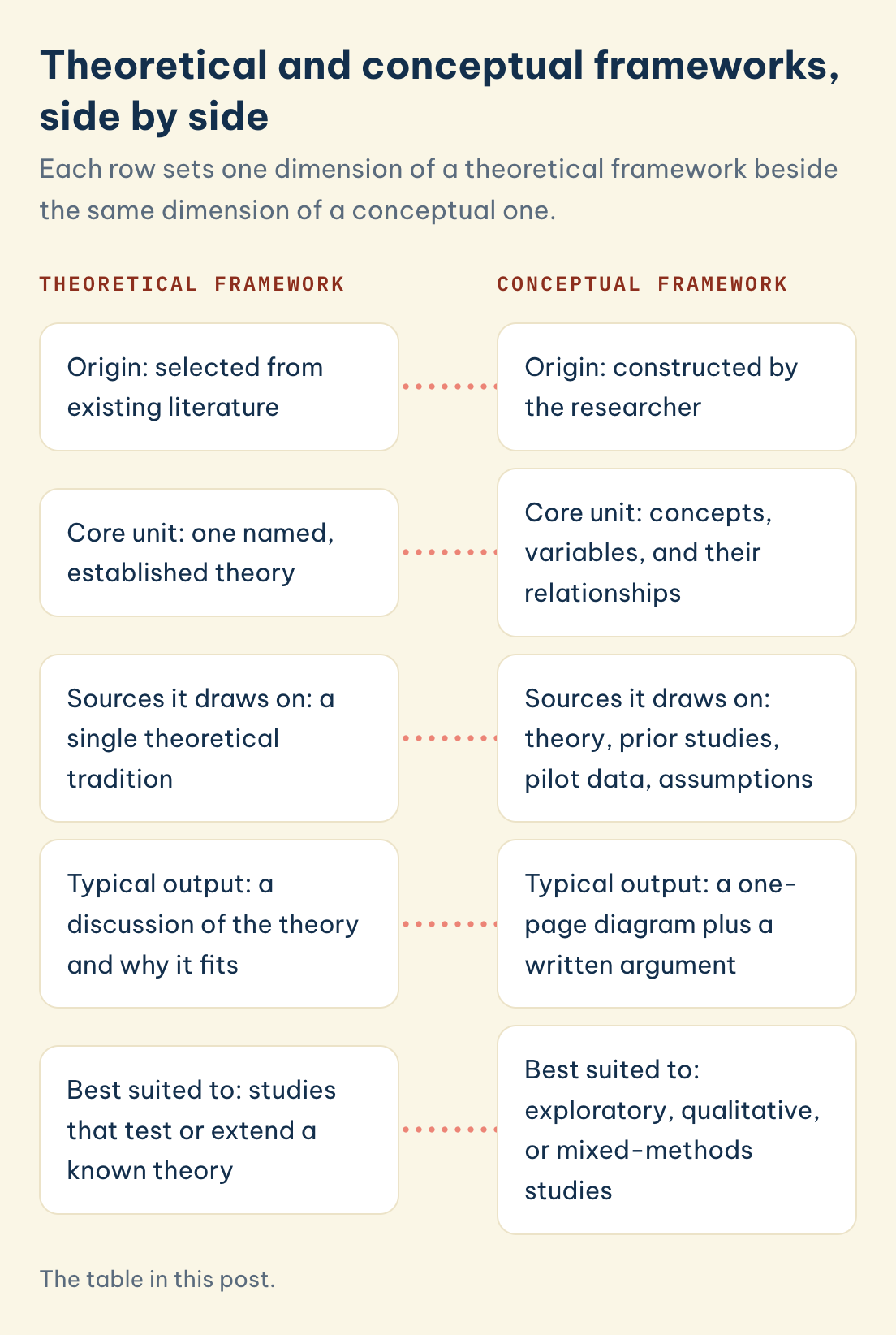
Theoretical and conceptual frameworks, side by side
Each row sets one dimension of a theoretical framework beside the same dimension of a conceptual one.
Theoretical framework
Conceptual framework
Origin: selected from existing literature
Origin: constructed by the researcher
Core unit: one named, established theory
Core unit: concepts, variables, and their relationships
Sources it draws on: a single theoretical tradition
Sources it draws on: theory, prior studies, pilot data, assumptions
Typical output: a discussion of the theory and why it fits
Typical output: a one-page diagram plus a written argument
Best suited to: studies that test or extend a known theory
Best suited to: exploratory, qualitative, or mixed-methods studies
Save this figure
Evidence: Varpio et al. (2020) draw the distinction precisely: a theoretical framework applies a formal, named theory as the lens for the whole study, whereas a conceptual framework is the researcher's justification assembled from multiple sources of knowledge. The same authors note why students keep mixing the two up: "However, all too often, these words are used interchangeably or without a clear understanding of the differences between these concepts" (Varpio et al., 2020, p. 989). Grant and Osanloo (2014) are quoted often here, though their house metaphor covers only the theoretical framework: "We believe the blueprint is an appropriate analogy of the theoretical framework of the dissertation" (Grant & Osanloo, 2014, p. 12). Their conceptual framework is defined separately, as the researcher's understanding of how the problem will best be explored and how the variables in the study relate (Grant & Osanloo, 2014, p. 16).
Example: A Vietnamese Education Master's candidate at the University of Melbourne had drafted a theoretical framework around Vygotsky's sociocultural theory, yet her supervisor still asked for a conceptual framework. Her MAAS mentor showed the split: Vygotsky supplied the lens, while the conceptual framework was the diagram linking teacher scaffolding, peer interaction, and language gains in her classroom, same theory, different job.
| Dimension | Theoretical framework | Conceptual framework |
|---|---|---|
| Origin | Selected from existing literature | Constructed by the researcher |
| Core unit | One named, established theory | Concepts, variables, and their relationships |
| Sources it draws on | A single theoretical tradition | Theory, prior studies, pilot data, assumptions |
| Typical output | A discussion of the theory and why it fits | A one-page diagram plus a written argument |
| Best suited to | Studies that test or extend a known theory | Exploratory, qualitative, or mixed-methods studies |
◆ Question 2 / 7 · Which one you need
When do you need a theoretical framework, a conceptual framework, or both?
Direct answer: Use a theoretical framework when one established theory clearly maps onto your problem and you intend to test, apply, or extend it. Use a conceptual framework when no single theory fully fits, when your study is exploratory or mixed-methods, or when you combine ideas from more than one tradition. Many dissertations need both: a theoretical section that names the lens, and a conceptual diagram that operationalises it. Always check your programme's house style first, because some departments use the two labels for the same thing.
Evidence: Jabareen (2009) argues that conceptual frameworks are the appropriate tool for qualitative and interdisciplinary research, where understanding matters more than prediction from one theory. Varpio et al. (2020) note that quantitative, hypothesis-testing studies typically lead with a theoretical framework, while interpretive studies more often build a conceptual one.
Example: A Vietnamese Public Health candidate at UNSW studied vaccine hesitancy among migrant communities, where no single theory covered the cultural, informational, and access factors involved. Her MAAS mentor steered her toward a conceptual framework combining the Health Belief Model with trust and access constructs from migration studies, a single theory would have left half her findings unexplained.
◆ Question 3 / 7 · Choosing
How do you choose between them for your dissertation?
Direct answer: Start from your research question, not a preference for one label. Ask three things: does one established theory already explain the relationships I care about; is my aim to test that theory or to explore something it does not cover; and how many traditions does my question span?
If one theory fits and you are testing it, lead with a theoretical framework. If your question reaches across theories or into territory no theory maps, build a conceptual framework and when in doubt, name the theory you rely on and build a model showing how its concepts apply to your case.
Evidence: Ravitch and Riggan (2017) position the conceptual framework as the argument for why your study matters and why your methods will answer your question, a job a borrowed theory alone cannot do, and one that should be driven by the research problem rather than by convention.
Example: A Vietnamese Finance candidate at Monash assumed she needed only a theoretical framework because agency theory was central to her topic, until her MAAS Senior Financial Strategist mentor noted her question also pulled in behavioural and institutional factors agency theory ignores. They kept agency theory as the named lens and added a conceptual framework integrating the extra constructs, matching her mixed-methods design exactly.
◆ Question 4 / 7 · From theory to model
How do you move from a theoretical framework to a conceptual framework?
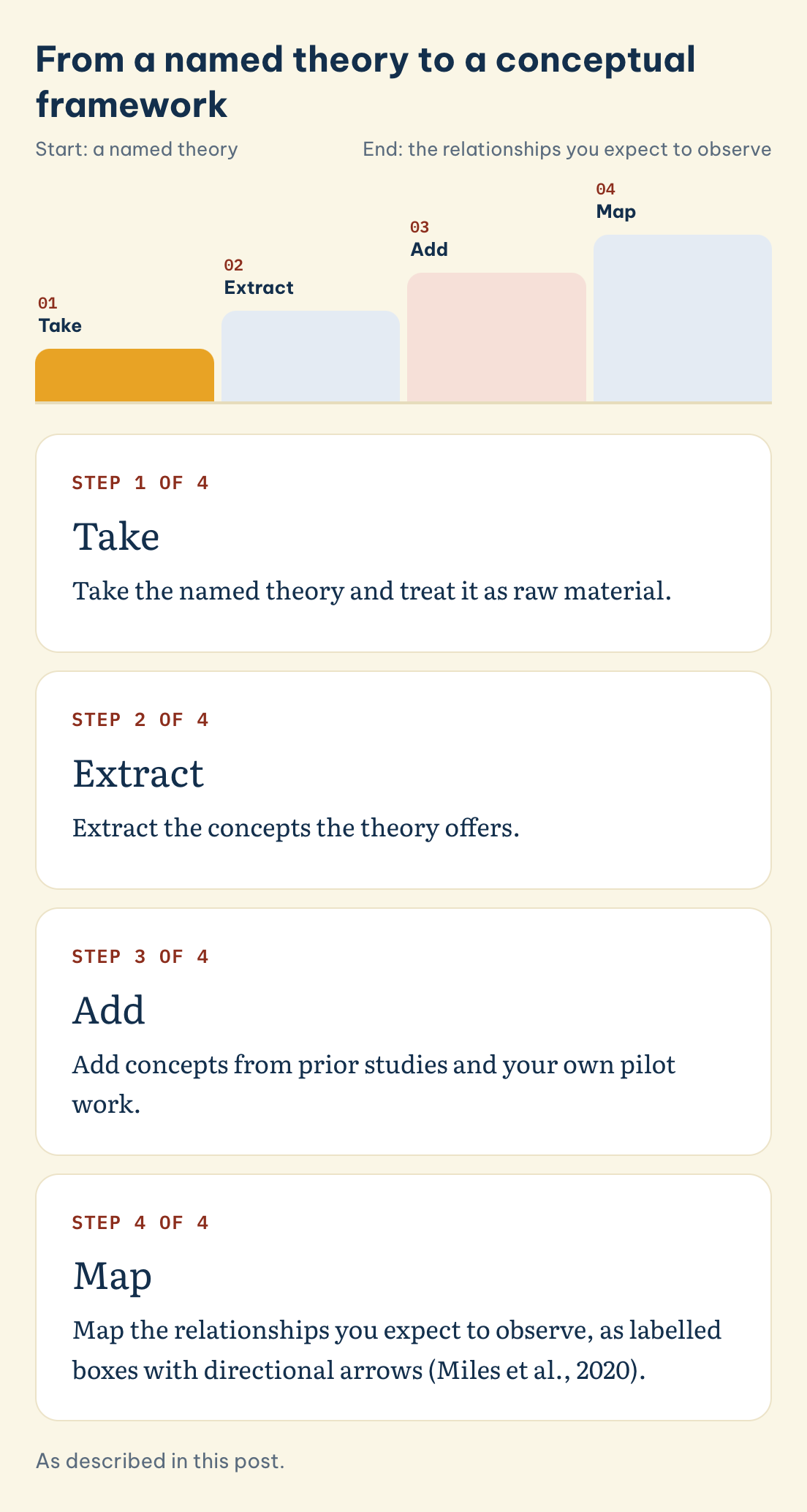
Direct answer: Treat the theory as raw material and the conceptual framework as the structure you build from it. Take the named theory, extract the concepts it offers, add concepts from prior studies and your own pilot work, then map the relationships you expect to observe. The theoretical framework tells you which concepts are theoretically important; the conceptual framework commits you to which of those you will actually study.
From a named theory to a conceptual framework
Tap a step to see what you do. The post describes them in this order.
Step 1 of 4
Take
Take the named theory and treat it as raw material.
Step 2 of 4
Extract
Extract the concepts the theory offers.
Step 3 of 4
Add
Add concepts from prior studies and your own pilot work.
Step 4 of 4
Map
Map the relationships you expect to observe, as labelled boxes with directional arrows (Miles et al., 2020).
Save this figure
Evidence: Maxwell (2013) names four sources every conceptual framework draws on, existing theory and research, experiential knowledge, pilot findings, and thought experiments so the formal theory is only one input. Miles et al. (2020) recommend mapping the concepts as labelled boxes with directional arrows so the relationships become explicit.
Example: A Vietnamese AI Master's candidate at the University of Edinburgh started from a fairness-in-machine-learning theory but could not see how it became a dissertation. Her MAAS Principal AI Architect mentor had her list the theory's concepts, drop the two she could not measure, and add a context concept from prior work, the result was a study she could actually run.
◆ Question 5 / 7 · How each is laid out
How are the two frameworks structured differently in your dissertation?
Direct answer: A theoretical framework is usually written as prose: you introduce the theory, explain its key tenets, justify why it fits, and cite its originators. A conceptual framework is usually a short argument plus a one-page diagram: each concept a labelled box, each relationship a labelled directional arrow, inputs on the left and outcomes on the right. Both belong in the early chapters, alongside the literature review and before the methodology chapter they are meant to shape.
Evidence: Grant and Osanloo (2014) argue that the framework a study commits to should govern the methodology, analysis, and interpretation chapters, so it needs a visual structure later chapters can reference. Miles et al. (2020) treat the visual map as a core analytic tool, not decoration, drawing forces a commitment to specific relationships.
Example: A Vietnamese Business candidate at the University of Manchester wrote three pages of theory but no diagram, so her examiner could not see how it applied. Her MAAS Executive Business Strategist mentor had her keep the theory section and add a five-box conceptual diagram where every arrow traced back to resource-based theory or her pilot interviews. The verdict changed from "abstract" to "clear and defensible."
◆ Question 6 / 7 · How they are assessed
How do supervisors and examiners assess each framework?
Direct answer: For a theoretical framework, examiners check that the theory is established, correctly represented, cited to its originators, and genuinely fits the problem. For a conceptual framework, they check that every concept has a source, every relationship is justified, the model is focused enough to investigate, and that it reappears in the analysis and discussion chapters. The fastest way to lose marks on either is incoherence: a theory named but never used, or a diagram drawn but never revisited after Chapter 2.
Evidence: Ravitch and Riggan (2017) note that the most common weakness in student conceptual frameworks is treating them as a one-time chapter rather than a guiding logic the whole dissertation should reflect.
Example: A Vietnamese DBA candidate at the University of Sunderland presented a strong conceptual framework in Chapter 2, then never mentioned it again. Her MAAS mentor had her add one paragraph at the start of the analysis chapter and one in the discussion, each pointing back to specific arrows, just the connective tissue, and the revised thesis was accepted with minor corrections.
◆ Question 7 / 7 · Mistakes to avoid
What mistakes do students make confusing the two?
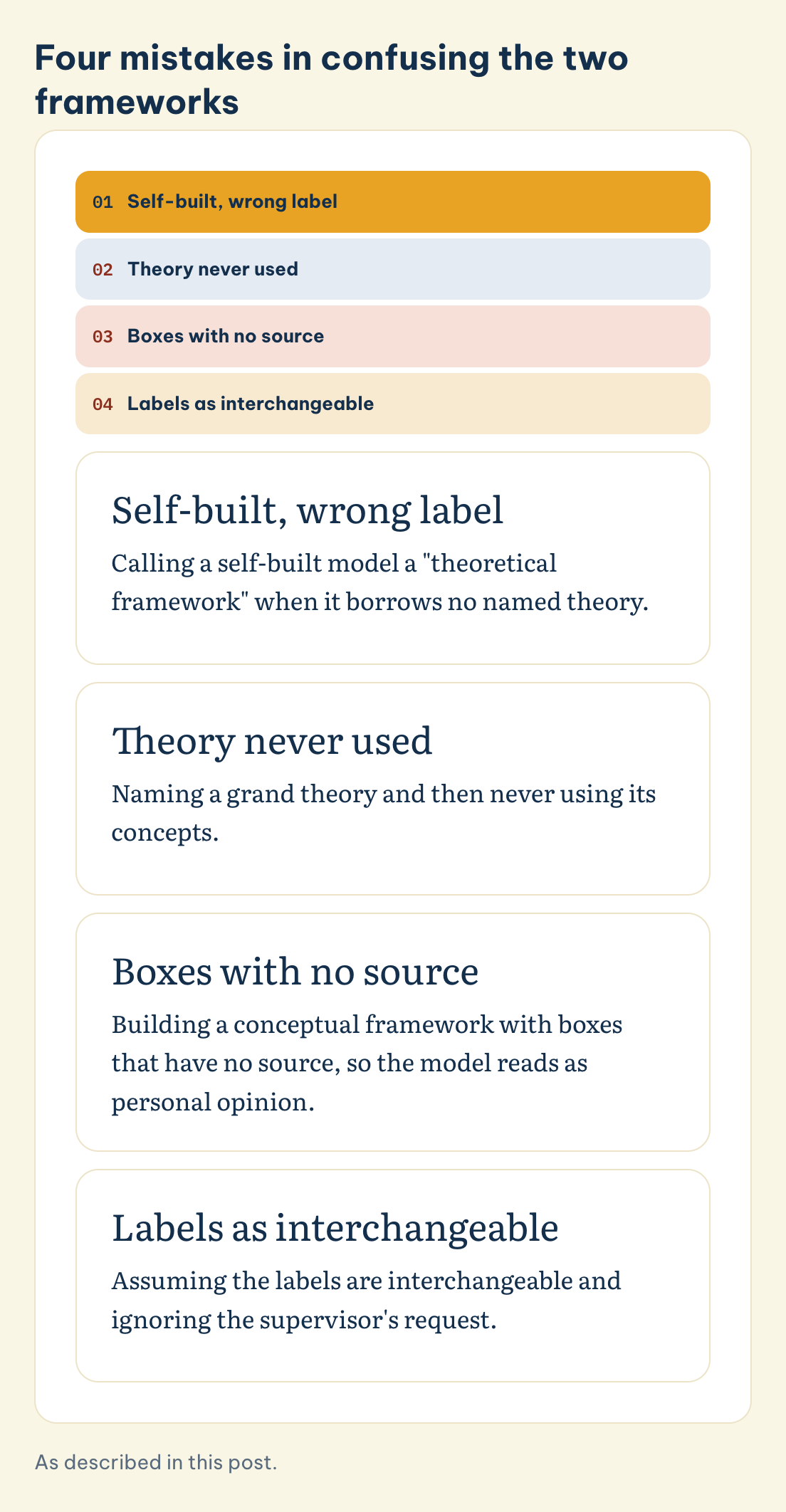
Direct answer: Four mistakes dominate. First, calling a self-built model a "theoretical framework" when it borrows no named theory. Second, naming a grand theory and then never using its concepts. Third, building a conceptual framework with boxes that have no source, so the model reads as personal opinion. Fourth, assuming the labels are interchangeable and ignoring the supervisor's request. Fix all four by being literal: if you adopted a theory, say so and use it; if you built a model, source every part of it.
Four mistakes in confusing the two frameworks
Tap a mistake to see what it looks like.
Self-built, wrong label
Calling a self-built model a "theoretical framework" when it borrows no named theory.
Theory never used
Naming a grand theory and then never using its concepts.
Boxes with no source
Building a conceptual framework with boxes that have no source, so the model reads as personal opinion.
Labels as interchangeable
Assuming the labels are interchangeable and ignoring the supervisor's request.
Save this figure
Evidence: Varpio et al. (2020) attribute much of the confusion to interchangeable, imprecise use of "theory," "theoretical framework," and "conceptual framework" across fields, and call for authors to state explicitly which they are using and why. Maxwell (2013) warns specifically against frameworks built only from existing theory while ignoring the researcher's own experiential knowledge and pilot data.
Example: A Vietnamese Education candidate at UCL labelled her four-box diagram a theoretical framework, although it borrowed no named theory. Her MAAS mentor relabelled it a conceptual framework and added a brief theoretical section naming the learning theory it drew on, the terminology now matched the content, and the examiner's first-round confusion disappeared.
Frequently asked questions
Can a dissertation have both a conceptual and a theoretical framework?
Yes, and many strong dissertations do. The theoretical framework names the established theory you work from; the conceptual framework shows how the concepts in your study connect, often operationalising that theory. Present the theory first, then the conceptual model that applies it.
Is the conceptual framework just the theoretical framework with a diagram?
No. A conceptual framework can include a theory but is broader; it integrates prior studies, pilot data, and your own assumptions into a model built for one question. The diagram only summarises that argument.
Which one comes first in the writing process?
Usually the theoretical framework, because you need to know which theory you are drawing on before you can build a model from it. In practice the two develop together as your research question sharpens.
Do quantitative studies use conceptual frameworks too?
Yes. In quantitative dissertations the conceptual framework's arrows typically become testable hypotheses and its boxes become measured variables, while a theoretical framework supplies the theory being tested.
What if my supervisor uses the two terms interchangeably?
Follow your department's house style for labelling, but keep the logic clear: state which named theory you rely on and show how its concepts apply to your study. Content matters more than the label.
How can I tell quickly whether my framework is conceptual or theoretical?
Ask whether you adopted a named theory or built the model yourself. A diagram you assembled from several sources that borrows no single named theory is a conceptual framework, so calling it a theoretical framework is the most common mislabel. If you do rely on a named theory, add a short section that names it, then show the model that applies it.
Can MAAS help me decide which framework I need?
Yes. MAAS Academic Mentoring and the Dissertation Mentoring resource hub include structured coaching on framework choice, naming your theory, mapping your concepts, and aligning both with your methodology phase by phase, with feedback from postgraduate-qualified mentors.
Where this guidance comes from
The distinction argued above rests on six sources spanning 2009 to 2020, not one house style. Varpio et al. (2020) and Jabareen (2009) both appeared in methods journals eleven years apart, Academic Medicine and the International Journal of Qualitative Methods respectively, and Grant and Osanloo (2014) appeared in the Administrative Issues Journal. Ravitch and Riggan (2017), Maxwell (2013), and Miles et al. (2020) are full-length research-design texts rather than journal articles, which is why their guidance below is broader than a single argument.
How MAAS mentors support framework decisions
With the support of MAAS experts you work through the choice as a coaching conversation, not a hand-off, testing whether one theory fits, building a defensible conceptual model when it does not, and checking that both reappear in your methodology and discussion. Our network is 100+ experts strong, 23% of them PhD-qualified. Every engagement runs phase by phase: you write, your expert guides and reviews, and a recording of each session is sent to you afterwards. You keep full authorship throughout.
Ready to settle which framework your dissertation needs? Book a free 20-minute consultation, bring your research question and we will match you to a mentor in your discipline within 48 hours when our network already covers that field. If it does not, MAAS opens a dedicated recruitment round for your case, which usually takes about two weeks.
Related resources
- Conceptual framework guide: building the model once you need one
- Theoretical framework guide: the named-theory chapter it operationalises
- Research questions and objectives guide: the question your framework answers
- Methodology guide: where arrows become hypotheses and measures
- Academic Mentoring service: 1:1 coaching with postgraduate-qualified mentors
- Meet our expert mentors: the credentials behind MAAS advisory
References
- Grant, C., & Osanloo, A. (2014). Understanding, selecting, and integrating a theoretical framework in dissertation research: Creating the blueprint for your "house". Administrative Issues Journal: Connecting Education, Practice, and Research, 4(2), 12–26. https://doi.org/10.5929/2014.4.2.9
- Jabareen, Y. (2009). Building a conceptual framework: Philosophy, definitions, and procedure. International Journal of Qualitative Methods, 8(4), 49–62. https://doi.org/10.1177/160940690900800406
- Maxwell, J. A. (2013). Qualitative research design: An interactive approach (3rd ed.). SAGE Publications.
- Miles, M. B., Huberman, A. M., & Saldaña, J. (2020). Qualitative data analysis: A methods sourcebook (4th ed.). SAGE Publications.
- Ravitch, S. M., & Riggan, M. (2017). Reason & rigor: How conceptual frameworks guide research (2nd ed.). SAGE Publications.
- Varpio, L., Paradis, E., Uijtdehaage, S., & Young, M. (2020). The distinctions between theory, theoretical framework, and conceptual framework. Academic Medicine, 95(7), 989–994. https://doi.org/10.1097/ACM.0000000000003075
This article is part of the MAAS Journal series for Vietnamese international postgraduate students. MAAS Academic Mentoring is an advisory partner; we coach students through a phase-by-phase delivery model with developmental feedback from postgraduate-qualified mentors. We do not write, submit, or guarantee grades on a student's behalf.
A free 20-minute consultation with MAAS Academic Mentoring, to talk through which framework your dissertation needs.
Book Free Discovery ▸