
◆ Thesis mentoring
How do you write a dissertation methodology chapter examiners believe?
◆ Watch the 60-second guide
A dissertation methodology reports what you did and why each choice answers your research question, in enough detail for others to repeat the study. Write it in the past tense, as a record of decisions already made: design, participants or sources, data collection, analysis, ethics, and the limitations you accepted.
The main claims below trace to university library guides, a peer-reviewed methods paper and methods textbooks; the full source list sits at the end.
◆ Section 1 / 10 · What it does
What a methodology chapter does (and how it differs from methods)
Direct answer: A methodology chapter reports what you did and why each choice answers your research question (University of Southampton Library, n.d.). Write it in the past tense across 6 parts: design, participants, data collection, analysis, ethics and limitations, in enough detail for another researcher to follow.
The methodology chapter outlines the methods you used and records the decisions and challenges met while carrying the research out (University of Southampton Library, n.d.). Methods and methodology are not synonyms: methods are the techniques you used and the specific steps you took, while methodology also covers the philosophical underpinning that shapes the whole research process (University of Southampton Library, n.d.), described by Dawson as the philosophy or general principle guiding the research (Dawson, 2009, as cited in University of Sunderland Library, n.d.). A chapter that lists techniques without that layer of reasoning is a methods report, not yet a methodology. For where the chapter sits in the whole document, see the full chapter-by-chapter dissertation guide. In a journal article the same material appears as a methods section, covered in methods section of a research paper.
What examiners check before they read a word
Examiners look first for one relationship: whether each methodological choice demonstrably relates to your research question, and what it means for the reliability and validity of your findings (University of Southampton Library, n.d.). Your theoretical framework informs both which methods suit the study and how results will be interpreted, so the reasoning built in the theoretical framework should still be visible here (Monash University, n.d.). Two cautions temper any template: the detail and emphasis expected differ by discipline (Monash University, n.d.), and your department's handbook always takes precedence over generic advice (University of Sunderland Library, n.d.).
◆ Section 2 / 10 · The shape
The shape of the chapter: introduction, body, conclusion
Direct answer: The chapter has its own three-part shape, introduction, body and conclusion. The introduction restates the research problem and the questions the methods answer. The body works through the subheadings O'Siochru suggests, design, participants, materials, procedure and ethics (O'Siochru, 2022, as cited in University of Sunderland Library, n.d.).
The three-part shape of a methodology chapter
Tap a part to see what it does.
Part 1 of 3
Introduction
Restate the research problem and the questions the methods answer.
Part 2 of 3
Body
Work through the subheadings O'Siochru suggests: design, participants, materials, procedure and ethics.
Part 3 of 3
Conclusion
End the chapter the way you opened it, facing the research question.
Save this figure
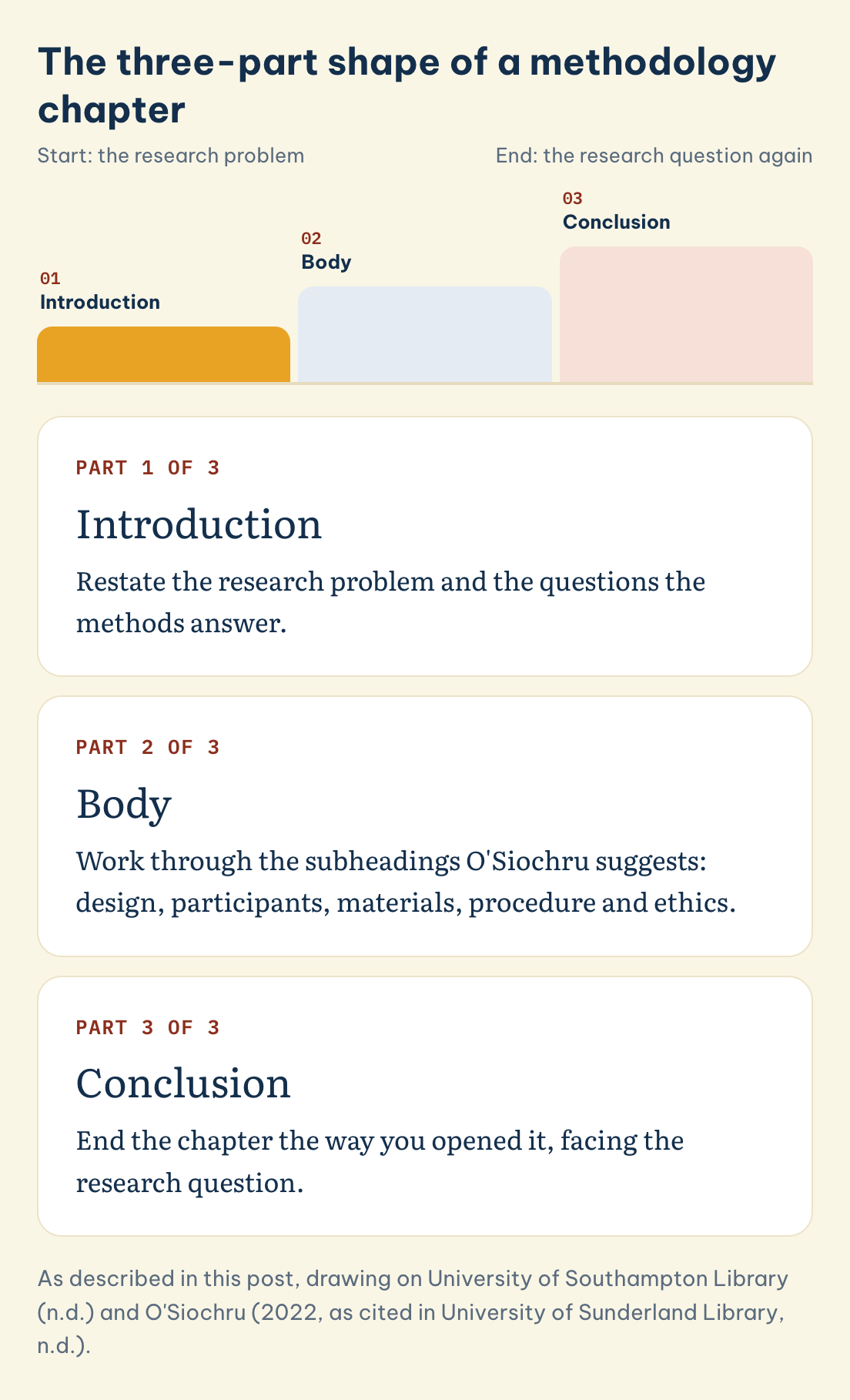
Internally, the chapter has a three-part structure of its own: introduction, body and conclusion. Open by restating the research problem and the questions the methods were built to answer (University of Southampton Library, n.d.); the guide to research questions and objectives helps if those questions still need settling. For the body, O'Siochru (2022, as cited in University of Sunderland Library, n.d.) suggests subheadings most projects can adapt: design, participants, materials, procedure and ethics. UK courses often teach the layered research onion model, running from research philosophy inward to techniques; not every layer applies to every project (University of Southampton Library, n.d.).
◆ Section 3 / 10 · Choosing a design
Choosing your design: quantitative, qualitative or mixed methods
Direct answer: Creswell and Creswell (2023) group research designs into three families: quantitative, qualitative and mixed methods. University of Westminster's guidance treats these as trade-offs rather than rankings: quantitative work measures and compares numerically, qualitative work explores depth and meaning, and mixed methods combine both at the cost of extra design and analysis work.
Research designs are conventionally grouped into qualitative, quantitative and mixed methods approaches (Creswell & Creswell, 2023). University guidance presents these as trade-offs rather than rankings: quantitative approaches deal in numerical measurement and comparison, qualitative approaches in depth and meaning, and mixed methods designs combine the two at the cost of extra design and analysis work (University of Westminster, n.d.-c). Kothari (2004) treats the qualitative and quantitative divide as one of several basic types of research, alongside descriptive versus analytical, applied versus fundamental, and conceptual versus empirical. The question is which family your research question needs. Once you choose a qualitative design, qualitative data analysis software describes the tools used to analyse the data.
Data collection methods and their trade-offs
Interviews range from structured, through semi-structured, to unstructured formats, each fixing how far the conversation may move from your script (University of Westminster, n.d.-c). Focus groups let participants respond to each other, which can surface views no individual would volunteer alone and can equally let the group steer or silence individual voices (University of Westminster, n.d.-c). Experiments carry their own discipline of language: results support or fail to support a hypothesis, never prove it, and a claim of proof is a misunderstanding markers notice (University of Westminster, n.d.-c).
Primary data, secondary data and desk-based dissertations
A second axis runs across all designs: whether your data is primary, collected first-hand for this study, or secondary, gathered by someone else and reused (University of Westminster, n.d.-c). Desk-based dissertations built entirely on secondary sources still need this chapter, although it might not stand alone: you still have to explain how you approached the research, including how and why you selected and analysed the texts you used (University of Southampton Library, n.d.).
◆ Section 4 / 10 · Justifying choices
Justify each choice against the research question
Direct answer: For each choice, University of Westminster's guidance asks you to state why the method fits your question and weigh its benefits against its limitations. Busse and August (2020) call this justification the hallmark of a strong methods account, and its absence one of the pitfalls to avoid; Monash University's guidance asks the same from the examiner's side.
Four moves that justify each significant choice
Tap a move to see what it asks you to do.
Why it fits
State why the method fits your research question.
Benefits and limits
Weigh its benefits against its limitations and say how you mitigated them.
Alternatives
Acknowledge the alternatives you considered and why you set them aside.
Citations
Support the choice with citations to methods literature.
Save this figure
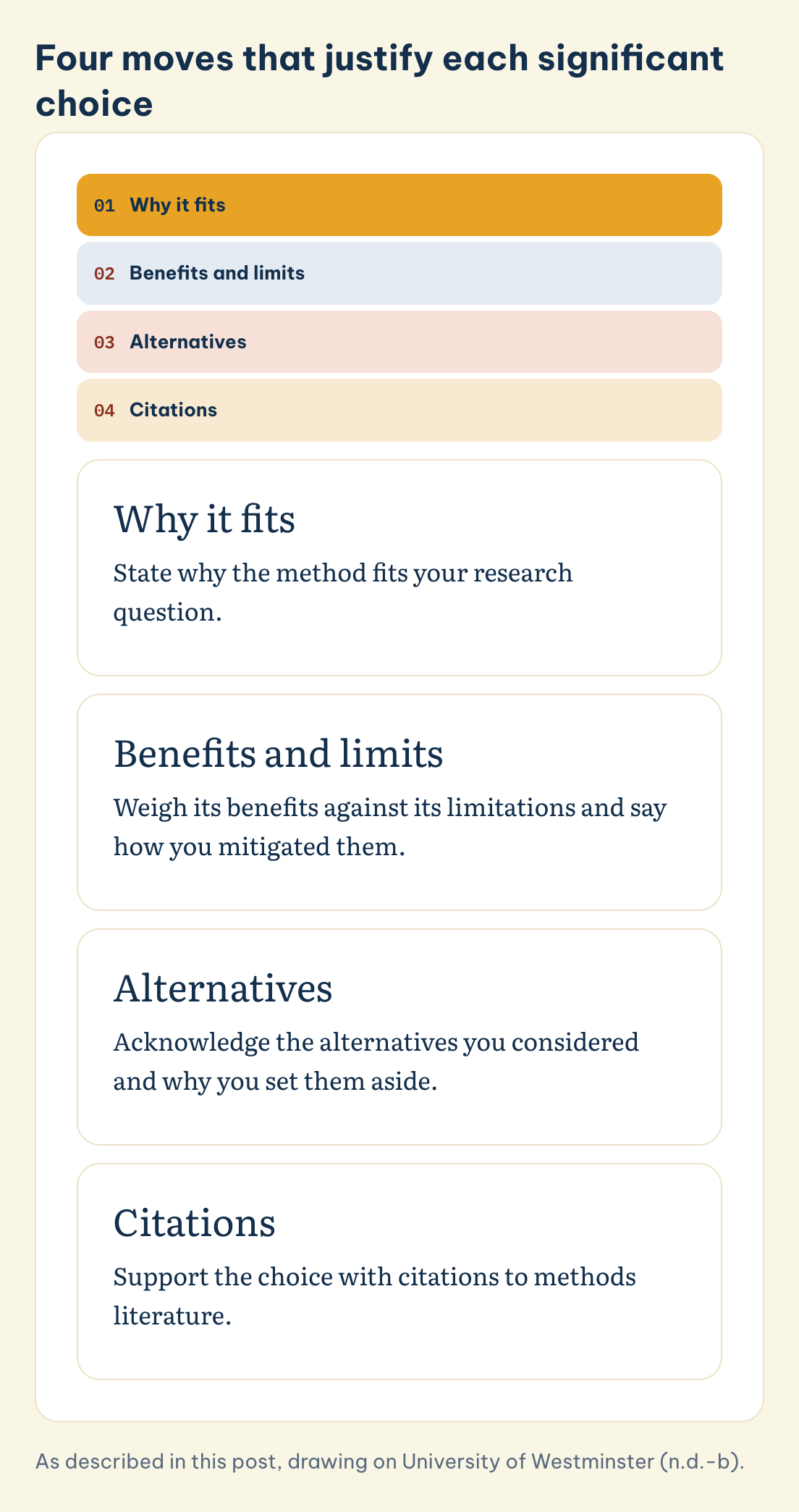
For each significant choice, the guidance converges on four moves. State why the method fits your research question, weigh its benefits against its limitations and say how you mitigated them, acknowledge the alternatives you considered and why you set them aside, and support the choice with citations to methods literature (University of Westminster, n.d.-b). Busse and August (2020) identify justification of the chosen procedures as the hallmark of a strong methods account and its absence as one of the pitfalls to avoid in methods writing. Monash University's guidance asks the same from the examiner's side: every choice justified, not merely announced (Monash University, n.d.). A reader who can see why you rejected the obvious alternative trusts the option you kept.
◆ Section 5 / 10 · The detail test
Write for replication: the detail test
Direct answer: The standard is not a word count but a reader: could another researcher replicate your study from this chapter alone. Busse and August (2020) list the contents that standard requires, setting, design, recruitment, variables, analysis and ethics, the coverage APA Style's reporting standards also specify. Move full questionnaires into the appendices, and cover every aim your dissertation reports.
What a stranger must be able to reconstruct, subsection by subsection
Each row sets a subsection beside what a reader must be able to rebuild from it.
Subsection
What a stranger must be able to reconstruct from it
Design
The overall approach and the reasoning connecting it to the research question.
Participants or sources
Who or what was studied, and how they were found and selected.
Materials
The exact instruments used, with full questionnaires or interview guides in the appendices.
Procedure
What happened, in what order, where and when, including collection logistics.
Analysis
How raw data became findings: tests, coding frames or analytic steps, named precisely.
Ethics
The approval obtained and how consent, confidentiality and storage were handled.
Save this figure
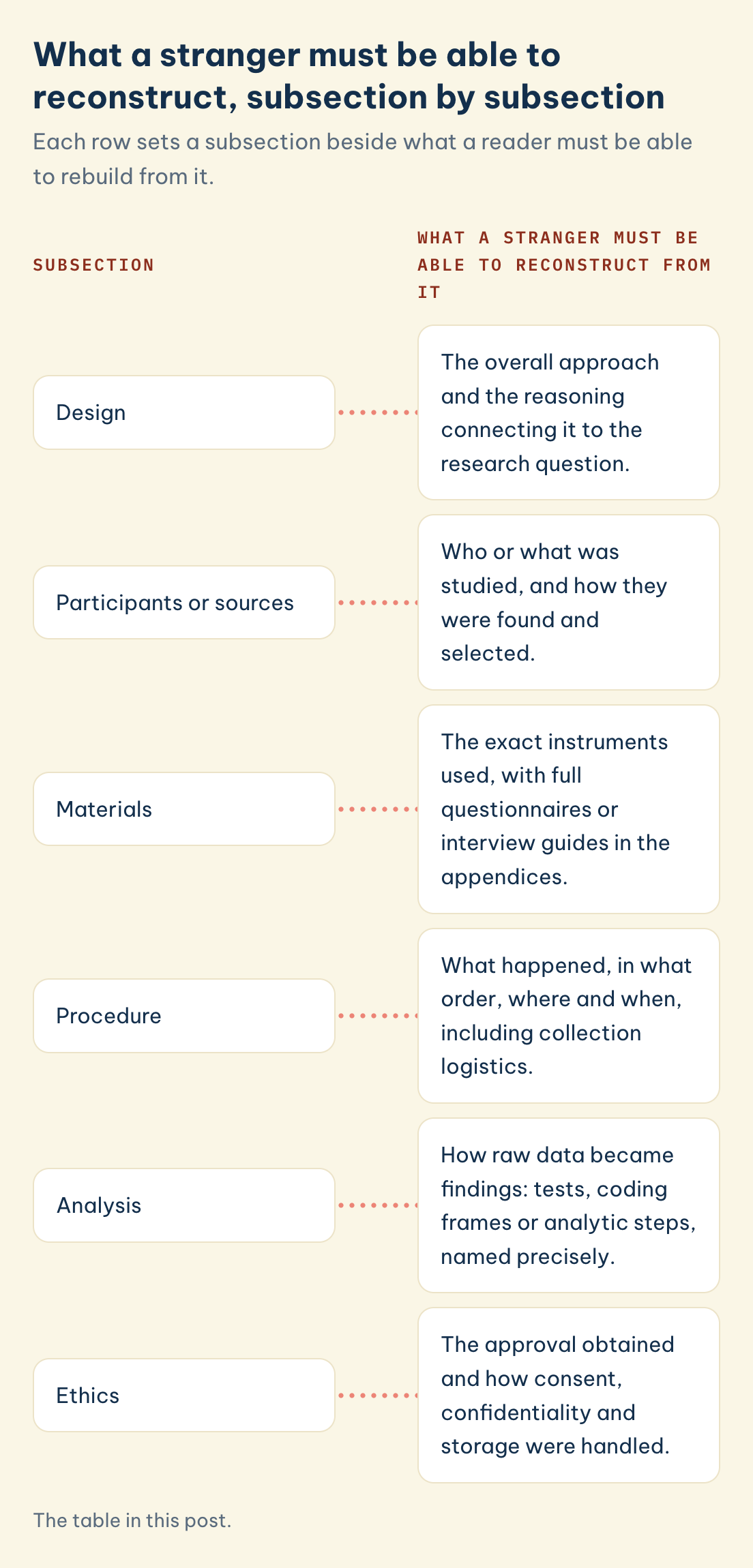
The most useful standard for how much to write is not a number; it is a reader. Ask whether another researcher, working only from your chapter, could replicate or adapt your study, moving supplementary material such as full questionnaires into the appendices (University of Southampton Library, n.d.). For data collection, record the practical decisions that shaped the data, including how participants were recruited and the logistics of when, where and how collection happened (University of Southampton Library, n.d.). Westminster's version is procedural: document your steps in enough detail that someone else could carry them out (University of Westminster, n.d.-c).
Busse and August (2020) turn the standard into contents: a complete methods account covers the study setting, the design, how participants were recruited, the variables measured, how the data were analysed, and the ethics approval under which it happened. They add a completeness test: your methods must cover every aim your dissertation reports on, because an aim with no corresponding method is a promise the chapter never keeps (Busse & August, 2020). Formal reporting standards, such as the APA Style journal article reporting standards, specify what a full method account includes (American Psychological Association, n.d.).
The table below turns the standard into a working check.
| Subsection | What a stranger must be able to reconstruct from it |
|---|---|
| Design | The overall approach and the reasoning connecting it to the research question |
| Participants or sources | Who or what was studied, and how they were found and selected |
| Materials | The exact instruments used, with full questionnaires or interview guides in the appendices |
| Procedure | What happened, in what order, where and when, including collection logistics |
| Analysis | How raw data became findings: tests, coding frames or analytic steps, named precisely |
| Ethics | The approval obtained and how consent, confidentiality and storage were handled |
Length varies by programme; check your handbook's word allocation rather than a generic figure.
◆ Section 6 / 10 · Validity and reliability
Validity and reliability in plain terms
Direct answer: University of Southampton Library frames validity as whether the study measures what it claims: internal validity is whether the findings reflect the relationship studied, external validity is how far findings generalise beyond the sample. Reliability concerns consistency in how instruments were designed, so repeating the procedure produces comparable results. You need not claim perfection, only show where your study stands.
Validity concerns whether the study measures what it claims to measure. Internal validity is about whether the findings reflect the relationship under study rather than some other factor, while external validity is about how far the findings generalise beyond the sample studied (University of Southampton Library, n.d.). Reliability is about consistency, in the design of your instruments and in how they were implemented, so that repeating the procedure would produce comparable results (University of Southampton Library, n.d.). The library's own guide puts it this way: "Reliability refers to the consistency with which you designed and implemented your research instrument(s)" (University of Southampton Library, n.d.). You do not need to claim perfection under either heading; you need to show where your study stands. A related design decision is how many participants you need, covered in sample size calculation.
◆ Section 7 / 10 · Ethics
Ethics: consent, confidentiality, storage
Direct answer: Research ethics covers the standards of behaviour guiding conduct toward the people your study touches (Saunders et al., 2015, as cited in University of Westminster, n.d.-a). University of Southampton Library reduces reporting to four questions covering consent, withdrawal, confidentiality and data storage.
Research ethics is about the rights of the people your study touches. The term refers to the standards of behaviour that guide your conduct in relation to the rights of those who become the subject of your work or are affected by it (Saunders et al., 2015, as cited in University of Westminster, n.d.-a). Southampton's guidance reduces the reporting to four questions: how participants gave informed consent, how they could withdraw, how confidentiality was protected, and how the data was stored (University of Southampton Library, n.d.). Name any formal ethics approval, since it belongs to the complete account of the method (Busse & August, 2020).
◆ Section 8 / 10 · Limitations
Limitations and delimitations without apologising
Direct answer: A delimitation is a boundary you chose on purpose; a limitation is a constraint outside your control affecting generalisability, validity or reliability, the distinction University of Westminster's guidance draws. Never omit limitations: University of Westminster's guidance reads discussing them openly as a sign of strength. Frame each one by time, scope or access, state its effect plainly, and close constructively.
The two terms are easy to conflate. A delimitation is a boundary you chose on purpose, defining what the study includes and excludes by design; a limitation is a constraint outside your control that affects the generalisability, validity or reliability of the findings (University of Westminster, n.d.-b). The instinct to hide limitations is understandable; nobody wants to hand an examiner a list of faults in their own work. The marking culture runs the other way: limitations should never be omitted, and discussing them openly is read as a sign of strength, because it shows you understand your study well enough to see its edges (University of Southampton Library, n.d.; University of Westminster, n.d.-b). Frame each limitation in terms of time, scope or access, state plainly how it affected the study, and close constructively on what the study still achieves within those constraints (University of Southampton Library, n.d.).
◆ Section 9 / 10 · Tense and voice
Tense, voice and the mistakes that cost trust
Direct answer: Write the chapter in the past tense, since University of Southampton Library treats the study as already conducted. Voice is a discipline decision: pick third or first person and hold it consistently. Two mistakes cost trust, reviewing other studies' methods, and reporting an aim the methods never address, the gap Busse and August (2020) say the completeness check catches.
Write the chapter in the past tense. By the time anyone reads it, the study has been conducted and the decisions implemented, so the chapter reports completed actions rather than intentions (University of Southampton Library, n.d.). Voice is a discipline decision rather than a universal rule: third person is the more widely accepted default, some fields accept the first person, and the requirement is to pick one, hold it consistently, and check your supervisor's guidance and published articles in your field (University of Southampton Library, n.d.).
Two structural mistakes recur. The first is turning the chapter into a review of other studies' methods: reason about your own procedures rather than surveying the field's, since that survey belongs in the literature review (University of Southampton Library, n.d.). The second is incomplete coverage, where the dissertation reports on an aim the methods never address; the completeness check above exists to catch that gap before an examiner does (Busse & August, 2020).
◆ Section 10 / 10 · Closing
How to close the chapter
Direct answer: Close by facing the research question again. University of Westminster's guidance suggests summarising how the methods fit the study's aims, arguing why the approach works despite the limitations acknowledged, noting how the design could improve in future work, and handing over cleanly to the results. This is where the plan you proposed meets what the study actually did.
End the chapter the way you opened it, facing the research question. Westminster's guidance suggests a conclusion that summarises how the methods fit the study's aims, argues why the approach works despite the limitations you acknowledged, notes how the design could be improved in future work, and hands over cleanly to the results (University of Westminster, n.d.-b). The methodology is also where the plan you proposed meets what the study actually did. A chapter that ends this way leaves the examiner holding your reasoning, not just your procedures.
Frequently asked questions
What should a dissertation methodology include?
A methodology chapter reports what you did and why each choice answers your research question (University of Southampton Library, n.d.). Write it in the past tense across 6 parts: design, participants, data collection, analysis, ethics and limitations, in enough detail for another researcher to follow.
What is the difference between methods and methodology in a dissertation?
Methods are the techniques used and the specific steps taken in the research; methodology also covers the philosophical underpinning that shapes the whole research process (University of Southampton Library, n.d.).
Should a dissertation methodology be written in the past or present tense?
Past tense: the study has already been conducted and the methodological decisions implemented, so the chapter reports them as completed actions (University of Southampton Library, n.d.).
Can I write my methodology in the first person?
It depends on your discipline: third person is more commonly accepted, but some fields accept first person; pick one, stay consistent, and check your supervisor's guidance and published articles in your field (University of Southampton Library, n.d.).
What is the difference between a limitation and a delimitation?
A delimitation is your intentional choice about the boundary of the study, covering what it includes and excludes; a limitation is a constraint outside your control that affects generalisability, validity or reliability (University of Westminster, n.d.-b).
Does a desk-based (secondary research) dissertation need a methodology chapter?
Yes, although it might not form a standalone chapter: you still need to explain how you approached the research phase, including how and why you selected and analysed the texts you used (University of Southampton Library, n.d.).
How do I justify my choice of research method?
State why the method suits your research question, weigh its benefits against its limitations and how you mitigated them, acknowledge the alternatives you considered and rejected, and cite sources supporting the choice (University of Westminster, n.d.-b; Busse & August, 2020).
How much detail should the methodology chapter include?
Enough that another researcher could replicate or adapt your study, covering every aim your dissertation reports, while supplementary material goes to the appendices; check your programme handbook for the word allocation (University of Southampton Library, n.d.; Busse & August, 2020).
WHEN YOU WANT A METHODOLOGIST'S EYES ON CHAPTER THREE
An examiner's questions are the ones any second reader asks naturally: why this design, why these participants, what about the obvious alternative. MAAS academic mentoring pairs you with a postgraduate-qualified mentor who reviews your design reasoning and drafts with you, chapter by chapter, so the methodology you submit has already survived a sceptical reader. Mentors question, advise and give structured feedback on your reasoning; the decisions, the research and the writing remain entirely your own throughout.
A free 20-minute consultation is the easiest way to start if you want to talk through chapter three before you draft it.
Explore academic mentoring at MAAS
References
American Psychological Association. (n.d.). APA Style journal article reporting standards (APA Style JARS). APA Style. Retrieved July 2, 2026, from https://apastyle.apa.org/jars
Busse, C., & August, E. (2020). How to write and publish a research paper for a peer-reviewed journal. Journal of Cancer Education, 36(5), 909–913. https://doi.org/10.1007/s13187-020-01751-z
Creswell, J. W., & Creswell, J. D. (2023). Research design: Qualitative, quantitative, and mixed methods approaches (6th ed.). SAGE Publications.
Kothari, C. R. (2004). Research methodology: Methods and techniques (2nd rev. ed.). New Age International.
Monash University. (n.d.). Methods thesis chapter. Student Academic Success. Retrieved July 2, 2026, from https://www.monash.edu/student-academic-success/excel-at-writing/how-to-write/thesis-chapter/methods-thesis-chapter
University of Southampton Library. (n.d.). Methodology. Writing the Dissertation, Guides for Success. Retrieved July 2, 2026, from https://library.soton.ac.uk/writing_the_dissertation/methodology
University of Sunderland Library. (n.d.). Writing your dissertation: Methods/methodology. Study Skills. Retrieved July 2, 2026, from https://libraryguides.sunderland.ac.uk/Dissertations/Method
University of Westminster. (n.d.-a). Ethics. Dissertations 4: Methodology. Retrieved July 2, 2026, from https://libguides.westminster.ac.uk/methodology-for-dissertations/ethics
University of Westminster. (n.d.-b). Methodology. Dissertations 4: Methodology. Retrieved July 2, 2026, from https://libguides.westminster.ac.uk/methodology-for-dissertations/methodology
University of Westminster. (n.d.-c). Methods. Dissertations 4: Methodology. Retrieved July 2, 2026, from https://libguides.westminster.ac.uk/methodology-for-dissertations/methods
A free 20-minute consultation with MAAS Academic Mentoring, to talk through chapter three before you draft it.
Book Free Discovery ▸