
◆ Thesis and dissertation
How do you write research questions and objectives for a dissertation?
How to write research questions and objectives matters because they are the first thing an examiner reads closely and the standard against which everything else in your dissertation is judged. Get them right and the rest of the project has a spine; get them vague and every later chapter wobbles. This guide answers the seven questions Vietnamese postgraduates ask MAAS mentors most when they sit down to write them.

◆ Question 1 / 7 · Three layers
What is the difference between a research aim, research questions, and objectives?
Direct answer: The aim is the single overarching purpose of your study, one sentence on what you want to achieve. Research questions are the specific questions your study will answer to reach that aim. Objectives are the concrete steps you will take to answer them. A common error is writing three near-identical sentences and labelling them aim, question, and objective.
Evidence: Bryman (2016) treats the research question as the central organising device of a social-science dissertation, distinct from the broad aim and from the operational objectives. UK and Australian dissertation rubrics typically ask for an explicit aim, two to four research questions, and a matching set of objectives and assess whether they are aligned.
Example: A Vietnamese Management Master's candidate at the University of Leeds submitted an aim, two questions, and two objectives that all said essentially "to explore employee motivation in Vietnamese SMEs." Her MAAS Executive Business Strategist mentor separated the layers: the aim stayed broad, the questions became specific ("Which non-financial factors do employees rank highest?"), and the objectives became actions ("Survey 120 employees; run a thematic analysis of 15 interviews"). The chapter immediately read as a designed study rather than a restated topic.
◆ Question 2 / 7 · How many
How many research questions should a dissertation have?
Direct answer: Two to four for a Master's dissertation; three to six for a PhD. Fewer than two usually means the question is too broad to structure a whole project around; more than four at Master's level almost always means at least one question is doing no real work. Each question should earn its place by requiring its own data or its own analysis. If two questions would be answered by the same table of results, they are one question.
Master's dissertation
2 to 4
research questions
PhD
3 to 6
research questions
How many research questions
The range of research questions for each level, drawn on one scale from 0 to 6.
Evidence: White (2009) argues that a well-constructed dissertation usually rests on one main question with a small number of subsidiary questions, and warns that proliferating questions is a sign of an unfocused design. Based on MAAS mentors' observation, Master's dissertations scoped to two to three tightly-focused questions tend to read with a clearer sense of focus than those with five or more.
Example: A Vietnamese Public Health candidate at UNSW arrived with seven research questions. Her MAAS Senior Educational Scientist mentor mapped each one to the data she planned to collect and found that four of them shared the same dataset and analysis. They merged the project down to three questions, each tied to a distinct method. The proposal became clear and free of redundant questions before submission.
◆ Question 3 / 7 · Strong question
What makes a strong research question?
Direct answer: A strong research question is focused, researchable within your time and resources, clearly connected to existing literature, and able to generate a non-obvious answer. It is narrow enough to answer in a single dissertation, specific about who and what it covers, and open enough that the answer is not already known.
Two checklists help: FINER (Feasible, Interesting, Novel, Ethical, Relevant) for whether the question is worth asking, and a simple test, if you can answer it with a quick web search or a yes/no, it is not a research question.
Evidence: Hulley et al. (2013) set out the FINER criteria as the standard test for a viable research question, and the framework is now taught across health, social science, and business research-methods modules. Sandberg and Alvesson found that "the most common way across paradigmatic camps is to spot various ‘gaps’ in the literature and, based on that, to formulate specific research questions" (Sandberg & Alvesson, 2011). They add that the strongest questions instead come from problematising those assumptions in the literature, not merely spotting a gap.
Example: A Vietnamese Finance candidate at Monash proposed "What affects stock prices?", unanswerable in one dissertation. Her MAAS Senior Financial Strategist mentor ran it through FINER: not feasible, not novel, not specific. They narrowed it to "How did ESG disclosure announcements affect the share prices of VN30 firms between 2020 and 2024?", feasible, specific, and tied to a clear dataset. The whole methodology fell out of the sharpened question.
◆ Question 4 / 7 · Narrowing
How do you turn a broad topic into a focused research question?
Direct answer: Narrow along four dimensions in order: population (who specifically), context (where and when), concept (what exactly you are studying), and relationship (what link you are testing or exploring). Start with your broad interest, then make each dimension concrete. "Social media and students" becomes "How does daily Instagram use relate to academic procrastination among Vietnamese undergraduates in Australia?" Each added specification removes ambiguity and moves you closer to a question you can actually answer.
Four dimensions that narrow a topic
Tap a dimension to see what to make concrete.
Dimension 1 of 4
Population
Say who specifically the study is about.
Dimension 2 of 4
Context
Say where and when the study takes place.
Dimension 3 of 4
Concept
Say what exactly you are studying.
Dimension 4 of 4
Relationship
Say what link you are testing or exploring.
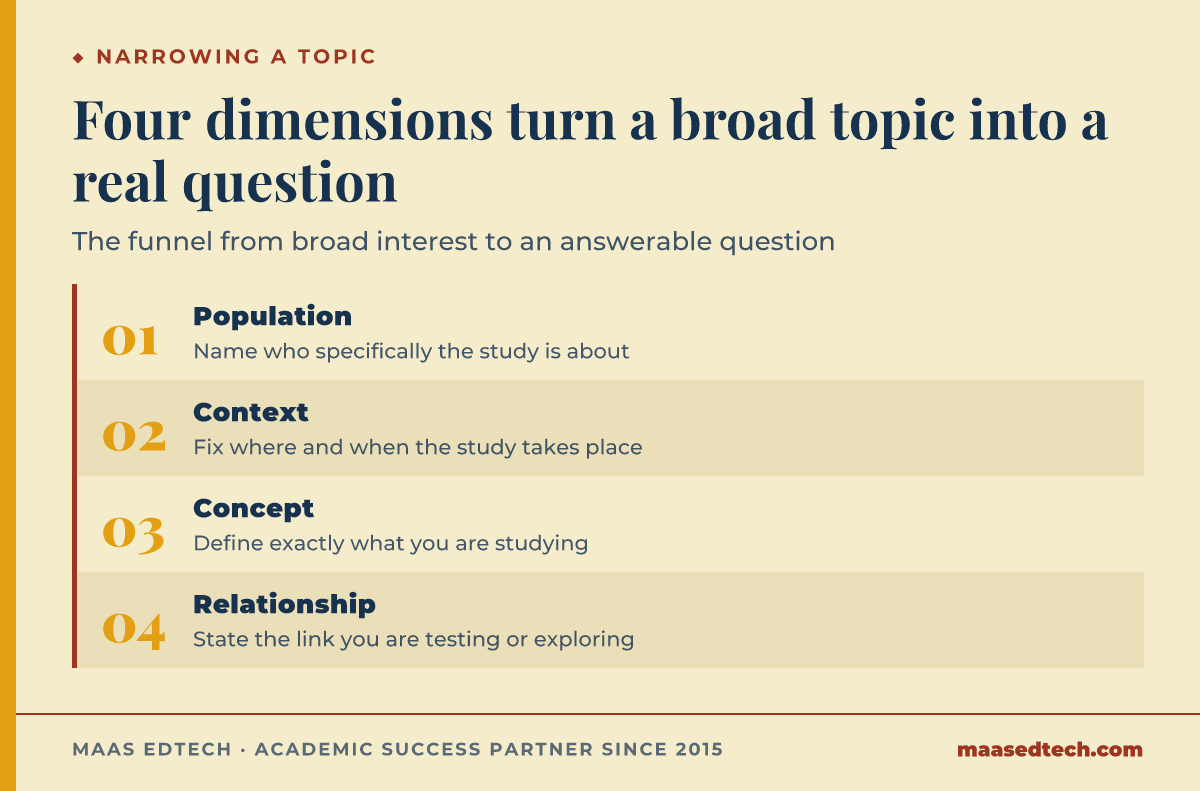
Evidence: Bryman (2016) and White (2009) both describe research-question development as a funnelling process from broad interest to specific, answerable question. Most UK research-methods modules teach a population–context–concept narrowing sequence as the standard technique.
Example: A Vietnamese Education candidate at UCL began with "online learning." Her MAAS mentor walked her through the four dimensions: population (lower-secondary EFL learners), context (Vietnamese public schools, post-2021 period), concept (synchronous vs asynchronous delivery), relationship (effect on speaking confidence). The final question was specific enough to name exactly who, where, and what relationship was being studied, with no ambiguity left.
◆ Question 5 / 7 · Objectives
How do you write research objectives that match your questions?
Direct answer: Write one objective per research question, phrased as an action using a precise verb, identify, measure, compare, evaluate, analyse, not vague verbs like understand or explore. Each objective should be specific enough that you and your examiner can tell when it has been achieved. The SMART test, a later, widely used version of Doran's (1981) framework (Specific, Measurable, Achievable, Relevant, Time-bound), is a useful filter for objectives even though it was designed for management goals. If an objective cannot be checked off as done, rewrite it until it can.
Evidence: The SMART framework originates with Doran (1981) and is now widely applied to research objectives in postgraduate methods training. Creswell and Creswell (2018) stress that objectives should map one-to-one onto research questions, giving the reader an unbroken chain from purpose to action.
Example: A Vietnamese Business candidate at the University of Manchester wrote objectives beginning "to understand" and "to explore." Her MAAS Executive Business Strategist mentor replaced them with "to measure the correlation between X and Y" and "to compare responses across three firm sizes." Suddenly the methodology chapter knew exactly what instruments it needed, and the examiner could see precisely what the study promised to deliver.
◆ Question 6 / 7 · Methodology
How do you align research questions with your methodology?
Direct answer: The wording of your question dictates your method. Questions that ask "how many," "to what extent," or "is there a relationship" point to quantitative methods. Questions that ask "how," "why," or "in what ways" point to qualitative methods. Mixed questions point to mixed methods.
How the wording of a question points to a method
Each row pairs a kind of question with the kind of method it points to.
If the question asks
It points to
"How many," "to what extent," or "is there a relationship"
Quantitative methods
"How," "why," or "in what ways"
Qualitative methods
A mixed question
Mixed methods
Before you finalise a question, check that you can actually collect and analyse the data it implies, a beautifully worded question you cannot answer with available data is worse than a plainer one you can. This alignment is the bridge from your questions to your methodology chapter.
Evidence: Creswell and Creswell (2018) base their entire research-design framework on matching question type to method: descriptive and relational questions to quantitative designs, exploratory and process questions to qualitative designs. Examiners in the UK and Australia routinely check this alignment as a coherence criterion.
Example: A Vietnamese AI Master's candidate at the University of Edinburgh asked "Why do users distrust automated decisions?" but planned a survey with closed questions. Her MAAS Principal AI Architect mentor flagged the mismatch: a "why" question needs qualitative depth. They either had to reword the question to "What factors are associated with distrust?" or switch to interviews. She chose interviews; question and method aligned, and the findings were rich enough to answer the original question in full.
◆ Question 7 / 7 · Mistakes
What are the most common mistakes in research questions and objectives?
Direct answer: Five recurring mistakes. First, a question too broad to answer in one dissertation. Second, a question with a built-in yes/no answer that closes off analysis. Third, objectives that merely restate the questions in different words. Fourth, vague verbs (understand, explore) that cannot be checked. Fifth, questions and objectives that drift apart from the methodology as the project evolves and are never updated. Fix the last one by treating your questions as a living anchor, revisit them whenever your design changes, and make sure every later chapter still serves them.
Evidence: White (2009) identifies over-broad questions and unfocused proliferation as the two most common failings in student research design. In MAAS mentors' review experience, misaligned question–objective–method chains are one of the reasons proposals are returned for revision.
Example: A Vietnamese DBA candidate at the University of Sunderland had strong questions but objectives that simply repeated them. Her MAAS Executive Business Strategist mentor rewrote the objectives as distinct actions and added one sentence linking each to a method. No new research was needed, just alignment. The revised proposal became coherent, and the same clarity carried through every later chapter.
Frequently asked questions
Should research questions come before or after the literature review?
They develop together. An initial question guides your reading; the literature review then sharpens or reshapes the question as you find what has and has not been studied. Most students refine their questions two or three times before finalising them.
Can I change my research questions partway through?
Yes, and many students do but tell your supervisor, and update your objectives and methodology to match. Unannounced drift between your stated questions and what you actually did is one of the easiest things for an examiner to catch.
Do qualitative dissertations need research questions or hypotheses?
Qualitative dissertations use research questions, not hypotheses. Hypotheses are for quantitative studies that test a predicted relationship. If your question asks "how" or "why," you want research questions; if it predicts a measurable relationship, you may add hypotheses.
How specific should a research question be?
Specific enough to name the population, context, and concept, but not so narrow that the answer is trivial. A good test: a knowledgeable reader should not be able to guess the answer in advance, but should be able to see exactly what data would answer it.
What is the difference between objectives and hypotheses?
Objectives are the actions you will take ("to compare X across two groups"); hypotheses are the predicted outcomes you will test ("Group A will score higher than Group B"). A quantitative dissertation often has both; a qualitative one usually has objectives only.
Can MAAS help me frame my research questions?
Yes. MAAS Academic Mentoring and the Dissertation Mentoring resource hub include structured coaching on question framing, narrowing your topic, applying FINER and SMART, and aligning questions, objectives, and method phase by phase. You write every word yourself, and the mentor guides direction and reviews each deliverable.
Related resources
- How do you identify a research gap?: the absence your research question is designed to fill
- How do you write a PhD research proposal?: where your research question anchors the whole proposal
- Literature review guide for PhD students: the reading that sharpens your questions
- Theoretical framework guide: the lens your questions are interpreted through
- Conceptual framework guide: turning your questions into a model of expected relationships
- How do you write the recommendations section?: the closing move your questions must trace back to
- Methodology guide: where your questions become a research design
- Dissertation Mentoring resource hub: advisory from mentors holding a doctorate or a master's degree across proposal, framework, methodology, drafting, and viva
- Academic Mentoring service: 1:1 coaching with mentors holding a doctorate or a master's with supervisory experience
Ready to sharpen your research questions? Book a free 15-minute consultation and bring your research topic.
References
- Bryman, A. (2016). Social research methods (5th ed.). Oxford University Press.
- Creswell, J. W., & Creswell, J. D. (2018). Research design: Qualitative, quantitative, and mixed methods approaches (5th ed.). SAGE Publications.
- Doran, G. T. (1981). There's a S.M.A.R.T. way to write management's goals and objectives. Management Review, 70(11), 35–36.
- Hulley, S. B., Cummings, S. R., Browner, W. S., Grady, D. G., & Newman, T. B. (2013). Designing clinical research (4th ed.). Lippincott Williams & Wilkins.
- Sandberg, J., & Alvesson, M. (2011). Ways of constructing research questions: Gap-spotting or problematization? Organization, 18(1), 23–44. https://doi.org/10.1177/1350508410372151
- White, P. (2009). Developing research questions: A guide for social scientists. Palgrave Macmillan.
This article is part of the MAAS Journal series for Vietnamese international postgraduate students. MAAS Academic Mentoring is an advisory partner; we coach students through a phase-by-phase delivery model with developmental feedback from mentors holding a doctorate or a master's with supervisory experience. We do not write, submit, or guarantee grades on a student's behalf.
A free 15-minute discovery call with a MAAS expert, to talk through your own topic and research questions.
Book Free Discovery ▸