
Where to look 01
Limitations and future research
Read the "Limitations" and "Future research" sections of recent papers, where authors point to areas needing further work.
◆ Publishing advisory
A research gap is a specific, unresolved question your field has not yet answered, and finding a genuine one is the foundation of any publishable study. For Vietnamese researchers preparing a first Scopus paper or thesis, a well-defined gap is what separates a manuscript an editor takes seriously from one that reads as a summary of what others have already done.
Identifying a research gap is a skill you can learn, not a flash of inspiration you wait for. This guide answers the seven questions Vietnamese postgraduate researchers ask MAAS mentors most often when finding an original contribution.

◆ Part 1 / 9 · What a gap is
Direct answer: A research gap is a specific question, population, method, or context that existing studies have not adequately addressed, the elements Robinson et al. (2011) use to specify a gap concretely. It is not simply a topic nobody has written about, but a meaningful absence in knowledge whose answer would change how researchers think or act.
Evidence: Elsevier's Researcher Academy defines research gaps as unexplored or underexplored areas in existing knowledge, missing data in specific populations, underused methods, inconsistent results, or emerging areas that lack thorough investigation (Elsevier, n.d.). A gap only counts when the literature itself shows the absence; a topic you simply have not read about is a reading gap, not a research gap.
Example: A MAAS Publishing Advisory client in public health proposed "studying mental health in students" as her gap. Her mentor pushed for precision until it became "the absence of validated Vietnamese-language anxiety screening tools for first-year university students", a defensible gap an editor could see at a glance.
◆ Part 2 / 9 · Types of gap
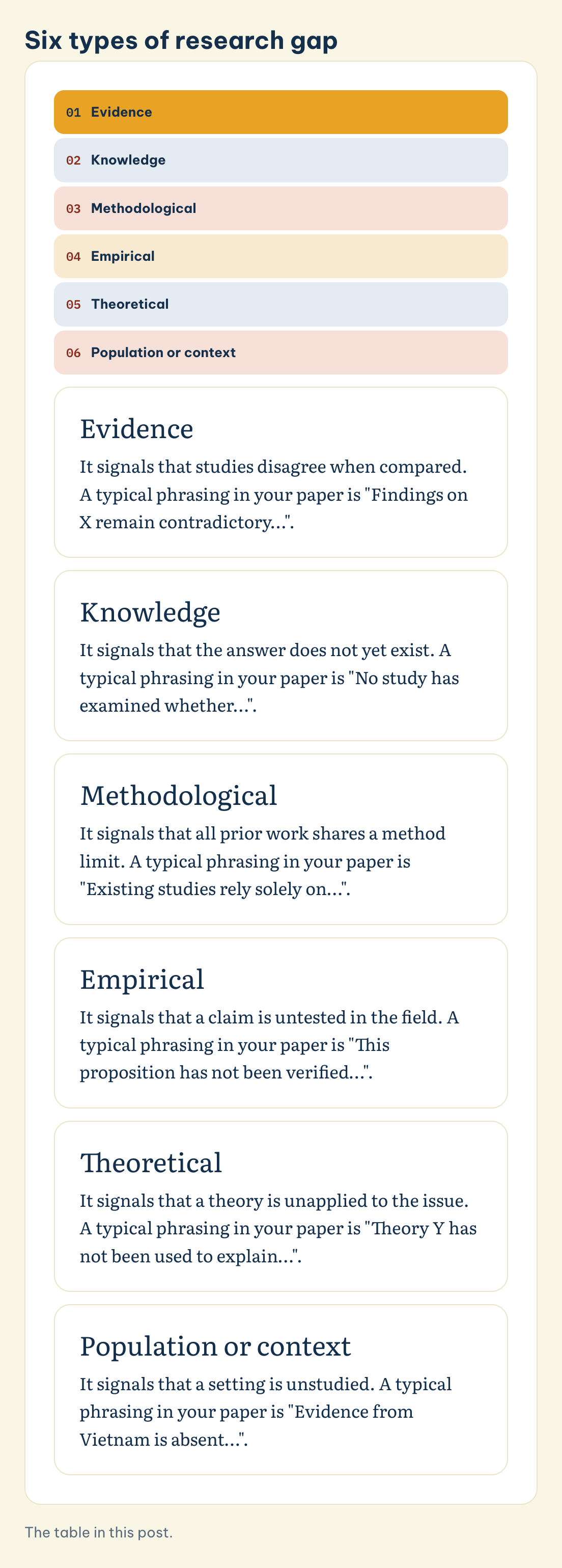
Direct answer: Most gaps fall into a small number of recognisable types (Müller-Bloch & Kranz, 2015): evidence gaps (findings conflict when compared), knowledge gaps (the answer simply does not exist yet), methodological gaps (existing studies share a limiting method), empirical gaps (a proposition has not been tested in the field), theoretical gaps (a theory has not been applied to an issue), and population or context gaps (no one has studied your setting). Naming the type sharpens your argument.
Six types of research gap
Tap a type to see what it signals and how it is usually phrased.
Evidence
It signals that studies disagree when compared. A typical phrasing in your paper is "Findings on X remain contradictory…".
Knowledge
It signals that the answer does not yet exist. A typical phrasing in your paper is "No study has examined whether…".
Methodological
It signals that all prior work shares a method limit. A typical phrasing in your paper is "Existing studies rely solely on…".
Empirical
It signals that a claim is untested in the field. A typical phrasing in your paper is "This proposition has not been verified…".
Theoretical
It signals that a theory is unapplied to the issue. A typical phrasing in your paper is "Theory Y has not been used to explain…".
Population or context
It signals that a setting is unstudied. A typical phrasing in your paper is "Evidence from Vietnam is absent…".
Evidence: Müller-Bloch and Kranz (2015) derived six gap types, evidence, knowledge, methodological, empirical, theoretical, and practical-knowledge-conflict, by analysing 40 literature reviews, giving authors a vocabulary for stating gaps rigorously rather than vaguely. A parallel taxonomy from Miles (2017) names seven research gaps rather than six, splitting what Müller-Bloch and Kranz treat as a single methodological category into two narrower ones. The exact count matters less than the discipline it forces: test your own gap against a full checklist of types rather than settling for the first label that seems to fit. In systematic-review settings, Robinson et al. (2011) classify why a gap exists: insufficient information, biased information, inconsistency, or "not the right information."
Example: A Vietnamese marketing doctoral candidate believed her gap was a missing topic. Using the typology above, her MAAS mentor reframed it as a methodological gap: every prior study used surveys, while her qualitative, interview-based design could surface mechanisms surveys had missed. Editors found that framing far more compelling than "no one has studied this."
| Gap type | What it signals | Typical phrasing in your paper |
|---|---|---|
| Evidence | Studies disagree when compared | "Findings on X remain contradictory…" |
| Knowledge | The answer does not yet exist | "No study has examined whether…" |
| Methodological | All prior work shares a method limit | "Existing studies rely solely on…" |
| Empirical | A claim is untested in the field | "This proposition has not been verified…" |
| Theoretical | A theory is unapplied to the issue | "Theory Y has not been used to explain…" |
| Population/context | A setting is unstudied | "Evidence from Vietnam is absent…" |
◆ Part 3 / 9 · Finding a gap
Direct answer: Work systematically, the way a formal review protocol does (Tranfield et al., 2003): choose a focused topic, search with consistent keywords, read recent reviews to map what is settled, then read primary studies closely for what they could not do. The gap emerges from the pattern across many papers, not from any single article. Track every candidate gap in a structured note so you can compare them later.
Evidence: Both Elsevier (n.d.) and Springer Nature (n.d.) describe the same disciplined sequence, refine the topic, search broadly, then read systematic reviews first because they map trends and paradigm shifts across an entire field before you commit time to primary papers. A literature review, done well, is itself the method for surfacing gaps (Webster & Watson, 2002).
Reviews themselves come in more forms than most researchers realise, and the type you are reading changes how much weight its stated gaps deserve. Grant and Booth (2009) catalogued 14 distinct review types and their associated methodologies, from narrative reviews through to full systematic reviews and meta-analyses, precisely because researchers kept using the single term "literature review" for methodologically different exercises. A rapid review's stated limitations have not been argued with the same rigour as a systematic review's, so know which one you are reading before you build a gap on top of it. If the review you are reading is a meta-analysis, how to conduct a meta-analysis shows how one is put together. For the review that your gap argument sits inside, see how to write an undergraduate literature review.
Example: A MAAS-coached lecturer spent 2 weeks reading randomly and felt overwhelmed. Her mentor restructured the search into one keyword set, ten recent reviews, and a one-row-per-study tracking table. Within days the same literature revealed three candidate gaps, because she was now reading for absence rather than content.
◆ Part 4 / 9 · Where gaps hide
Direct answer: The fastest gaps to find are the ones authors hand you, in exactly the section PRISMA's reporting standard now requires every systematic review to include (Page et al., 2021). Read the "Limitations" and "Future research" sections of recent papers, the closing paragraphs of systematic reviews, and the discussion sections where authors concede what they could not explain. These are gaps already validated by experts in your field, far safer than ones you guess at alone.
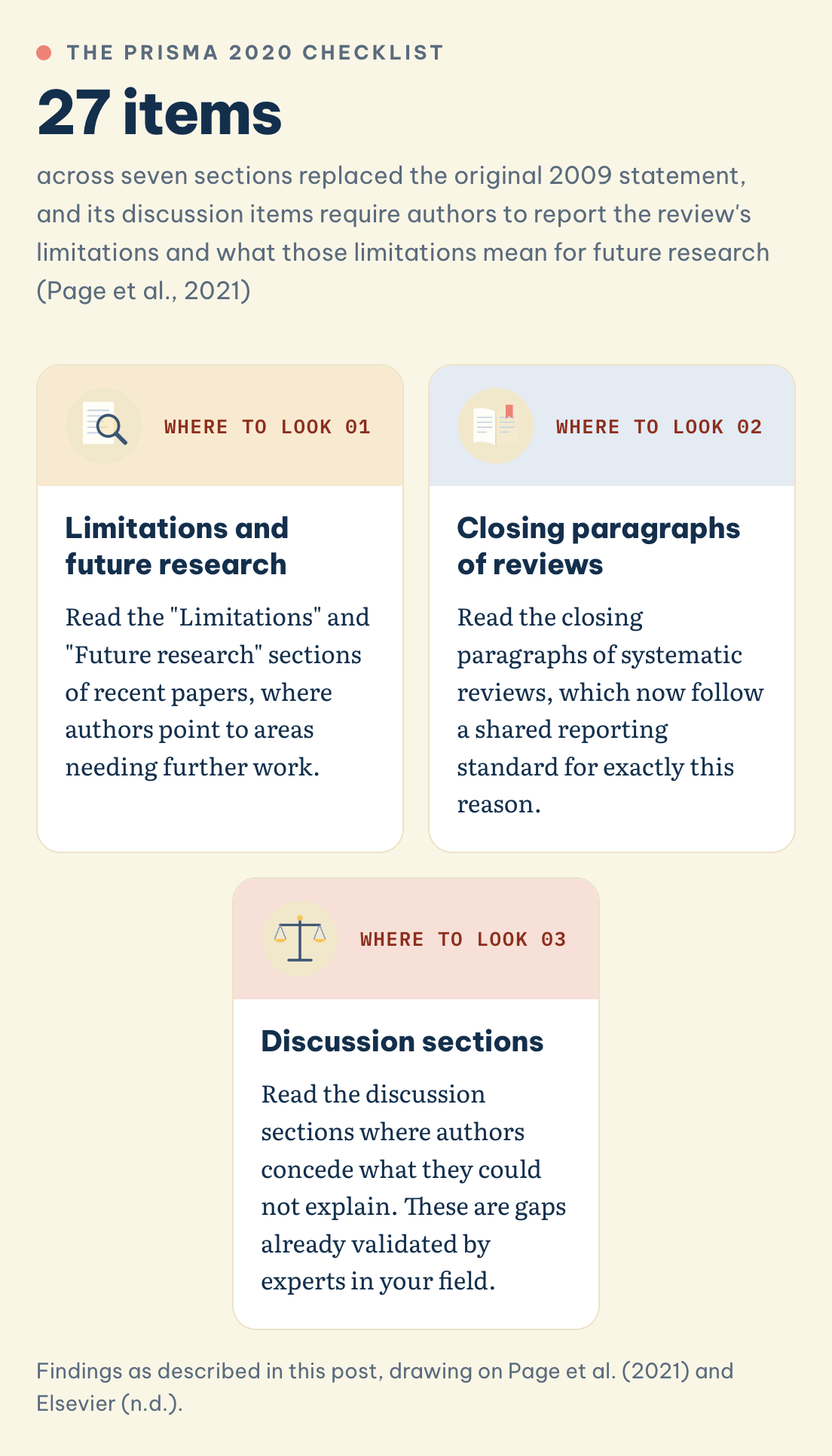
The PRISMA 2020 checklist
27 items
across seven sections replaced the original 2009 statement, and its discussion items require authors to report the review's limitations and what those limitations mean for future research (Page et al., 2021)
Read the "Limitations" and "Future research" sections of recent papers, where authors point to areas needing further work.
Read the closing paragraphs of systematic reviews, which now follow a shared reporting standard for exactly this reason.
Read the discussion sections where authors concede what they could not explain. These are gaps already validated by experts in your field.
Evidence: Elsevier (n.d.) explicitly directs authors to the limitations and future-directions sections, where researchers point directly to areas needing further work. The Cochrane Handbook instructs systematic reviewers to write structured "implications for research," distinguishing how future research should be done from what should be studied (Higgins et al. 2023), a ready-made source of well-specified gaps. Systematic reviews now follow a shared reporting standard for exactly this reason: PRISMA 2020 replaced the original 2009 statement with a 27-item checklist across seven sections, and its discussion items explicitly require authors to report the review's limitations and what those limitations mean for future research (Page et al., 2021). That single requirement is why a well-reported systematic review is one of the fastest places to find a gap someone else has already named for you.
Example: A Vietnamese researcher in education read the future-research paragraph of three recent reviews and noticed all three called for longitudinal data in Southeast Asian contexts. That single recurring recommendation became the spine of her proposal, a gap three sets of experts had already endorsed in print.
◆ Part 5 / 9 · In a thesis
Direct answer: A thesis research gap names one precise absence in the literature and why it matters. Strong examples are narrow: a missing screening tool for one student group, or a methodological gap where every earlier study relied on a single design, so an interview-based approach adds something new.
Three cases from this guide show the pattern. A public health student narrowed "mental health in students" to validated Vietnamese-language anxiety screening tools for first-year undergraduates, a knowledge gap. A marketing doctoral candidate noticed that all prior work used surveys, a methodological gap. An education researcher found that three recent reviews each called for longitudinal data in Southeast Asia, a context gap. Each works because it names a population, method or setting instead of a broad topic. In your thesis, state the gap in the phrasing from the table of gap types above, then show in the literature review that the absence is real. Screening large result sets is one place software is used, and AI tools for systematic review covers it.
◆ Part 6 / 9 · Real or trivial
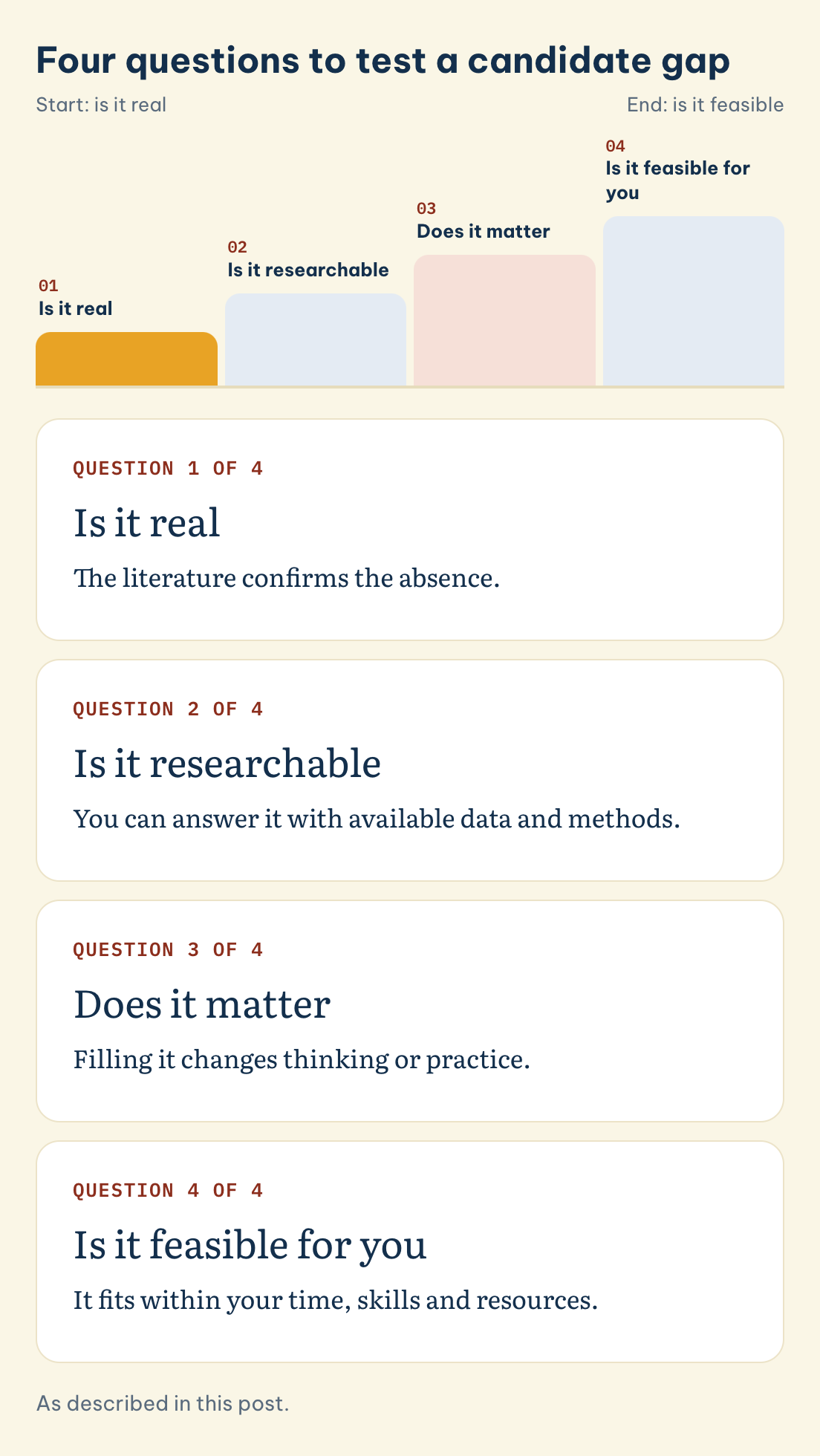
Direct answer: Test every candidate gap against four questions: Is it real (the literature confirms the absence)? Is it researchable (you can answer it with available data and methods)? Does it matter (filling it changes thinking or practice)? And is it feasible for you (within your time, skills, and resources)? A gap that fails any one of these is not yet a project.
Four questions to test a candidate gap
Tap a question to see what to check. A gap that fails any one of them is not yet a project.
Question 1 of 4
Is it real
The literature confirms the absence.
Question 2 of 4
Is it researchable
You can answer it with available data and methods.
Question 3 of 4
Does it matter
Filling it changes thinking or practice.
Question 4 of 4
Is it feasible for you
It fits within your time, skills and resources.
Evidence: Robinson et al. (2011) characterise gaps using PICOS-style elements, population, intervention, comparison, outcomes, setting, precisely so that a gap is specified concretely enough to act on rather than left abstract. A gap you cannot frame in those concrete terms is usually too vague to defend in front of reviewers. Sandberg and Alvesson (2011) add a useful test of ambition on top of that. Reviewing 52 published articles in organisation studies, they found that most researchers construct their research question through gap-spotting, pointing to what existing literature has not yet covered, rather than through the harder move of problematisation, questioning an assumption the existing literature itself rests on. A defensible gap-spotting question clears the bar for a publishable paper. Naming the assumption a whole line of research has taken for granted, when you can defend it, clears a higher one.
Example: A doctoral candidate in finance had a genuinely unstudied question that required proprietary trading data she could never obtain. Her MAAS mentor flagged it as real and important but not feasible, and helped her pivot to an adjacent gap answerable with public market data. Feasibility, not novelty alone, decided the project.
◆ Part 7 / 9 · Gap to question
Direct answer: Convert the gap into a precise gap statement and then a research question, the same two-step move the Cochrane Handbook's EPICOT format formalises (Higgins et al. 2023). The statement names what is missing and why it matters; the question makes it answerable. Move from "little is known about X" to "this study examines whether A affects B among C in Vietnam," so the gap, the question, and your eventual method line up cleanly.
Evidence: Springer Nature (n.d.) states that "research gaps are unexplored or underexplored areas in existing knowledge that can guide you in shaping original, relevant, and impactful research" (Springer Nature, n.d.), meaning the gap must connect directly to the question it generates. The EPICOT format recommended in the Cochrane Handbook (Higgins et al. 2023) shows how a well-formed research recommendation already contains the seeds of a testable question.
Example: A MAAS client wrote "more research is needed on digital banking." Her mentor walked her through the conversion: gap statement (no study tests trust as a mediator for older Vietnamese users), then research question (does perceived trust mediate digital-banking adoption among users over 50 in Vietnam?). That question practically wrote her methodology section.
◆ Part 8 / 9 · Scopus submission
Direct answer: A clearly stated gap is what editors and reviewers scan for first, the same signal Webster and Watson (2002) identify as a literature review's real job. It justifies why your study deserves journal space, frames your contribution in one sentence, and signals that you understand the conversation your paper is joining. A submission without a visible gap reads as descriptive, and descriptive papers are the ones most often desk-rejected.
Evidence: Editors apply scope and contribution filters before peer review, so a paper that cannot articulate its gap struggles at the desk stage regardless of data quality. Webster and Watson (2002) argue that a literature review's job is to expose the gap that motivates the study, the same logic an editor applies when judging originality.
Example: A Vietnamese researcher's first submission was returned with "unclear contribution." Working with a MAAS mentor through a phase-by-phase model, she rewrote her introduction around a single, evidence-backed gap statement and the matching research question. The resubmission cleared desk review, same study, a visible gap.
◆ Part 9 / 9 · Putting it together
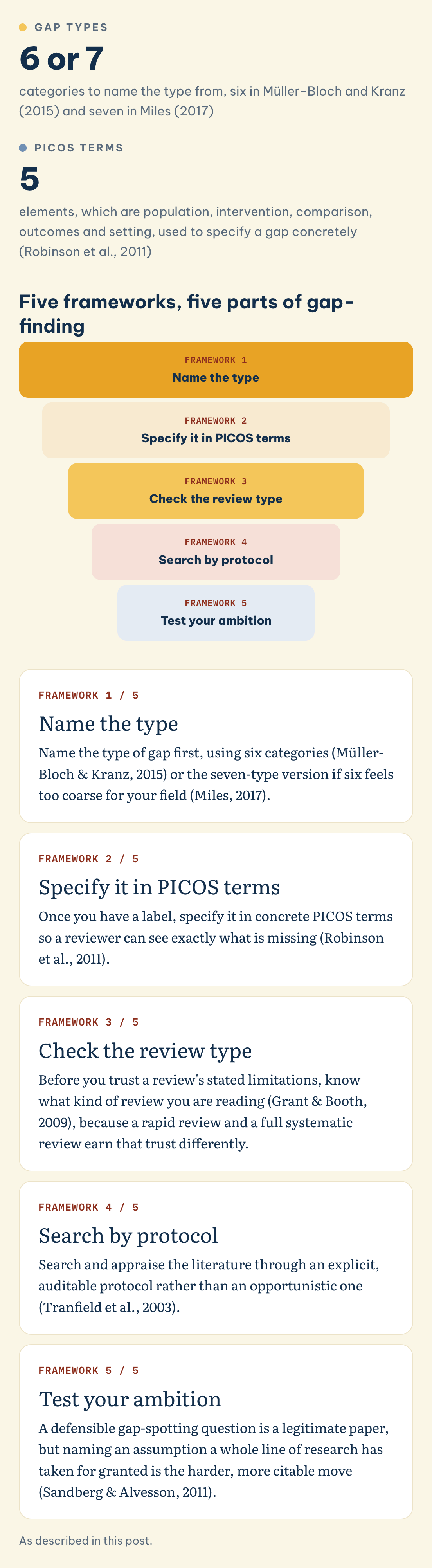
Direct answer: Each framework handles one part of gap-finding: name the type (six or seven categories), specify it in PICOS terms, check what kind of review you are reading before trusting its stated limitations, search through an explicit protocol, and finally test your ambition, a defensible gap-spotting question or the harder move of naming an unquestioned assumption.
Gap types
6 or 7
categories to name the type from, six in Müller-Bloch and Kranz (2015) and seven in Miles (2017)
PICOS terms
5
elements, which are population, intervention, comparison, outcomes and setting, used to specify a gap concretely (Robinson et al., 2011)
Five frameworks, five parts of gap-finding
Tap a framework to see which part of the problem it handles.
Framework 1 / 5
Name the type
Name the type of gap first, using six categories (Müller-Bloch & Kranz, 2015) or the seven-type version if six feels too coarse for your field (Miles, 2017).
Framework 2 / 5
Specify it in PICOS terms
Once you have a label, specify it in concrete PICOS terms so a reviewer can see exactly what is missing (Robinson et al., 2011).
Framework 3 / 5
Check the review type
Before you trust a review's stated limitations, know what kind of review you are reading (Grant & Booth, 2009), because a rapid review and a full systematic review earn that trust differently.
Framework 4 / 5
Search by protocol
Search and appraise the literature through an explicit, auditable protocol rather than an opportunistic one (Tranfield et al., 2003).
Framework 5 / 5
Test your ambition
A defensible gap-spotting question is a legitimate paper, but naming an assumption a whole line of research has taken for granted is the harder, more citable move (Sandberg & Alvesson, 2011).
Each framework above answers a different part of the same problem, and none of them replaces the others. Name the type of gap first, using six categories (Müller-Bloch & Kranz, 2015) or the seven-type version if six feels too coarse for your field (Miles, 2017). Once you have a label, specify it in concrete PICOS terms so a reviewer can see exactly what is missing (Robinson et al., 2011). Before you trust a review's stated limitations, know what kind of review you are reading (Grant & Booth, 2009), because a rapid review and a full systematic review earn that trust differently. Search and appraise the literature through an explicit, auditable protocol rather than an opportunistic one, the approach management researchers in particular have converged on (Tranfield et al., 2003). Finally, test your own ambition: a defensible gap-spotting question is a legitimate paper, but naming an assumption a whole line of research has taken for granted is the harder, more citable move (Sandberg & Alvesson, 2011).
For a focused researcher reading recent reviews and primary studies systematically, a defensible gap usually emerges within 2 to 4 weeks. Rushing this stage is the most common cause of an unfocused study, so the time invested early saves months later.
No, and the Cochrane Handbook's EPICOT format keeps the two deliberately separate (Higgins et al. 2023). The gap is the absence in knowledge; the research question is the answerable question you design to fill it. You identify the gap first, then convert it into a precise, testable question that drives your methodology.
AI can help you summarise and cluster literature, but you must verify every source and every claim it produces, and follow your institution's and target journal's disclosure rules. Treat AI as a search assistant whose output you check, never as the source of truth for what the literature does or does not contain.
That is good news caught early. Refine the gap using the type checklist above (Müller-Bloch & Kranz, 2015), a different population, method, context, or unresolved inconsistency often remains. A gap that survives a thorough search is far stronger than one you never tested against the literature.
No, but reading existing systematic reviews is the fastest route, because their authors have already mapped the field and written explicit future-research recommendations you can build on, provided you first confirm the review really is systematic and not a narrower type dressed up in the name (Grant & Booth, 2009).
Yes. MAAS Publishing Advisory coaches Vietnamese researchers through gap analysis, mapping the literature, classifying the gap type, and converting it into a research question, using a phase-by-phase model with postgraduate-qualified mentors. Book a consultation through our contact page.
Identifying the right research gap is the highest-leverage step in the research process, and far easier with an adviser who has published in Scopus journals. MAAS Publishing Advisory opens with a kick-off in which the adviser appraises your idea or manuscript and gives a frank read on how far it can go at the journal you are aiming for, then uses its second phase to lock the research question and a gap that reviewers accept as a real one. Advisers hold multiple Q1 or Q2 papers under their own name, and 23% of MAAS experts hold a PhD. MAAS matches you within 48 hours when our network already covers that field. If it does not, MAAS opens a dedicated recruitment round for your case, which usually takes about two weeks. Talk it through first in a free 20-minute consultation. You stay the author, every step.
Book a Publishing Advisory consultation with MAAS Academic Mentoring →
This article is part of the MAAS Journal series for Vietnamese international postgraduate students and researchers. MAAS Publishing Advisory is an advisory partner; we coach authors through a phase-by-phase delivery model with developmental feedback from postgraduate-qualified, Scopus-published mentors. We do not write, submit, or guarantee acceptance of work on an author's behalf.
A free 20-minute consultation with a MAAS publishing mentor, to talk through your own gap and the research question it should lead to.
Book Free Discovery ▸