
◆ Publishing advisory
How do you design a PRISMA systematic review in health sciences?
A PRISMA systematic review answers one focused health-sciences question by finding, appraising, and synthesising every relevant study with a reproducible method. For Vietnamese researchers and students building a first publication, it is one of the most achievable routes into a Scopus-indexed journal but only when the method is rigorous from the protocol stage, not improvised along the way.
This guide answers the seven questions Vietnamese researchers ask MAAS publishing mentors most often before starting a health-sciences systematic review.

◆ Question 1 / 7 · Systematic or literature review
What is a systematic review, and how is it different from a literature review?
Direct answer: A systematic review uses an explicit, pre-defined method to identify, select, appraise, and synthesise all studies that answer one focused question, so another researcher could repeat it and reach the same result. A narrative literature review summarises sources selectively; a systematic review is reproducible and transparent by design.
Evidence: The Cochrane Handbook for Systematic Reviews of Interventions defines the method precisely: "a systematic review attempts to collate all the empirical evidence that fits pre-specified eligibility criteria in order to answer a specific research question" (Cochrane, n.d.). It sets the methodological standard, requiring a clearly defined question, a pre-specified protocol, and systematic methods for searching and appraisal. Reporting then follows the PRISMA 2020 guideline, which treats the protocol and its registration as essential elements of a complete report (PRISMA, n.d.). For a side-by-side comparison of the two review types and when a dissertation needs each, see our guide to literature review vs systematic review.
Example: A Vietnamese student new to research wanted a systematic review for a scholarship application but was summarising papers she happened to find. Her MAAS mentor showed her the difference: they rebuilt the work around one focused question and a documented protocol, turning a narrative summary into a method a journal could take seriously.
◆ Question 2 / 7 · Framing with PICO
How do you frame the research question with PICO?
Direct answer: Use a structured framework, most often PICO (Population, Intervention, Comparison, Outcome), to turn a broad topic into one answerable question. PICO forces you to define exactly who you are studying, what is being done, against what alternative, and what you measure, which then drives every later step.
Evidence: The Cochrane Handbook specifies PICO as the model for developing a review question so the relevant components are well defined, and the framework directly informs the search terms alongside Medical Subject Headings (MeSH) (Cochrane, n.d.). A clear question is the single biggest predictor of a feasible review.
Example: A MAAS-coached author began with "AI in diagnosis", far too broad for a review. Her mentor used PICO to narrow it to a specific population, imaging modality, and outcome, producing a question precise enough to scope a realistic search and timeline.
◆ Question 3 / 7 · Registering a protocol
Why must you register a protocol before you start?
Direct answer: Write a full protocol and register it, usually on PROSPERO for health-related reviews, before you begin screening studies. Registration time-stamps your method, prevents you from quietly changing the question to fit the results, and is increasingly expected by journals and reviewers.
Evidence: PROSPERO requires a completed protocol and a 22-field registration form submitted before data extraction begins, and issues a unique identification number that links your registration to the eventual publication (University of York, Centre for Reviews and Dissemination, n.d.). PRISMA 2020 lists the registration number as a required reporting element (PRISMA, n.d.).
Example: A Vietnamese researcher wanted to start screening immediately to save time. Her MAAS mentor explained that an unregistered review is easy for reviewers to distrust, helped her finalise the protocol, and registered it on PROSPERO first, a delay of days that protected months of work.
◆ Question 4 / 7 · The search strategy
How do you build and document a search strategy?
Direct answer: Search several databases systematically using terms built from your PICO question and controlled vocabulary like MeSH, and record every step so the search can be reproduced. Document the databases, dates, full search strings, and the number of records at each stage in a PRISMA flow diagram.
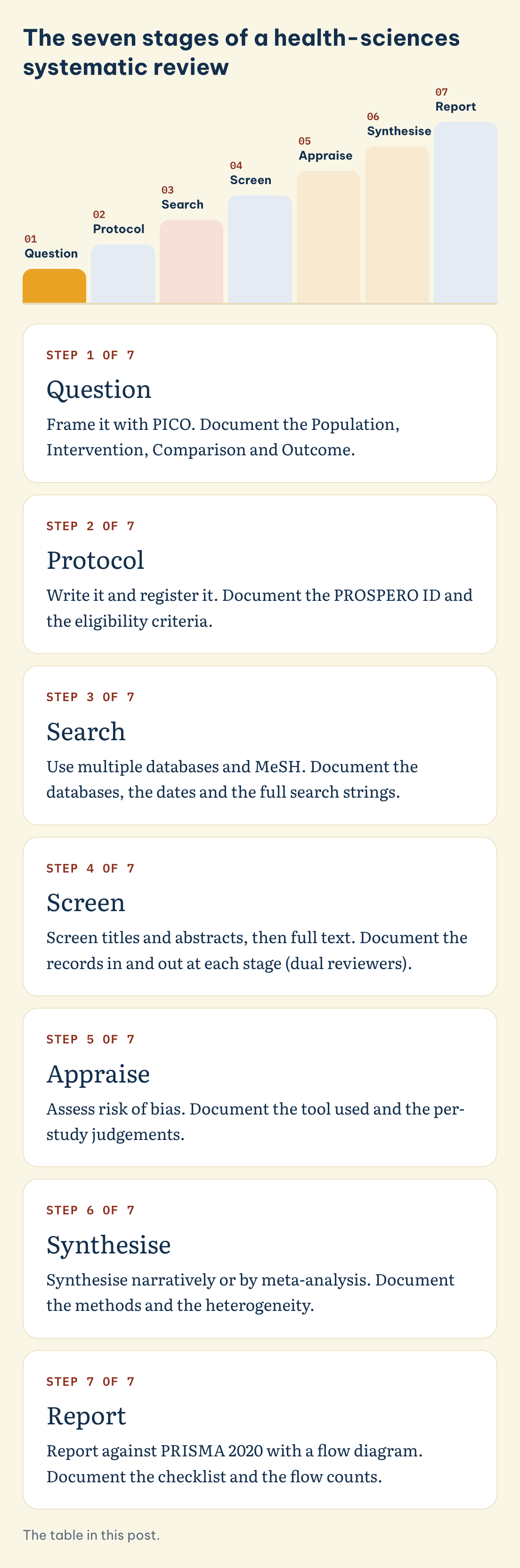
The seven stages of a health-sciences systematic review
Tap a stage to see what you do and what to document, in the order the post gives them.
Step 1 of 7
Question
Frame it with PICO. Document the Population, Intervention, Comparison and Outcome.
Step 2 of 7
Protocol
Write it and register it. Document the PROSPERO ID and the eligibility criteria.
Step 3 of 7
Search
Use multiple databases and MeSH. Document the databases, the dates and the full search strings.
Step 4 of 7
Screen
Screen titles and abstracts, then full text. Document the records in and out at each stage (dual reviewers).
Step 5 of 7
Appraise
Assess risk of bias. Document the tool used and the per-study judgements.
Step 6 of 7
Synthesise
Synthesise narratively or by meta-analysis. Document the methods and the heterogeneity.
Step 7 of 7
Report
Report against PRISMA 2020 with a flow diagram. Document the checklist and the flow counts.
Save this figure
Evidence: Guidance generally recommends building the search around the Population, Intervention, and study design, while leaving Comparison and Outcome out of the search string because including them can lower recall and miss relevant studies (Eriksen & Frandsen, 2018). PRISMA 2020 then requires transparent reporting of the full search and the study-selection flow.
| Stage | What you do | What to document |
|---|---|---|
| 1. Question | Frame with PICO | Population, Intervention, Comparison, Outcome |
| 2. Protocol | Write + register | PROSPERO ID, eligibility criteria |
| 3. Search | Multiple databases + MeSH | Databases, dates, full search strings |
| 4. Screen | Title/abstract, then full text | Records in/out at each stage (dual reviewers) |
| 5. Appraise | Risk-of-bias assessment | Tool used, per-study judgements |
| 6. Synthesise | Narrative or meta-analysis | Methods, heterogeneity |
| 7. Report | PRISMA 2020 + flow diagram | Checklist, flow counts |
Example: A MAAS mentor reviewing a candidate's draft found a single-database search with no recorded strings. They rebuilt it across the standard health databases, saved every search string, and produced a PRISMA flow diagram, work that turned an unverifiable search into a defensible one.
◆ Question 5 / 7 · Screening and appraisal
How do you screen, extract, and appraise studies rigorously?
Direct answer: Screen and extract data in duplicate, two reviewers working independently with a consensus process and assess each included study with a recognised risk-of-bias tool. Doing this alone, or skipping appraisal, is one of the clearest signals of a weak review.
Evidence: Methodological standards call for independent, duplicate screening and extraction with a defined consensus process, and for appraising methodological quality using validated instruments; AMSTAR-2, for example, is widely used to appraise the quality of systematic reviews from conception to interpretation (AMSTAR, n.d.; Cochrane, n.d.). Choosing an appropriate risk-of-bias tool for the included study designs matters, because different tools can yield different judgements.
Example: A Vietnamese first-time author had screened everything solo. Her MAAS mentor arranged a second independent screener for a sample, documented the agreement and consensus process, and added a risk-of-bias assessment, changes that lifted the review toward the standard reviewers expect.
◆ Question 6 / 7 · Mistakes that get a review rejected
What mistakes get a systematic review rejected?
Direct answer: The most damaging mistakes are starting without a registered protocol, a thin or undocumented search, single-reviewer screening, missing risk-of-bias appraisal, statistical errors in pooling results, and reporting that does not follow PRISMA. Each one tells a reviewer the review may not be reproducible or reliable.
Evidence: Statistical errors in synthesis are common enough to warrant dedicated tutorials for authors (Kanellopoulou et al. 2025), and incomplete reporting against PRISMA 2020 is a recurring reason reviews are sent back. A registered protocol and transparent methods directly address the trust questions reviewers raise first.
Example: A MAAS Publishing Advisory client had a finished review with promising findings but no protocol registration and a meta-analysis that ignored heterogeneity. Her mentor flagged both during a Final-stage check, helped her correct the synthesis and document the deviation, and the resubmission read as far more credible.
◆ Question 7 / 7 · Vietnamese and ESL researchers
How can Vietnamese and ESL researchers run a rigorous review?
Direct answer: Treat method and reporting as the priority, not speed. Follow a registered protocol, use PRISMA 2020 as a checklist from the outset, write in clear and concise English, and get developmental feedback from a mentor who has appraised reviews before. For first-timers and undergraduates, structured guidance is what makes a publishable review realistic.
Evidence: Vietnam's research strategy targets a 15–20% annual increase in WoS/Scopus/Q1 output, and well-conducted systematic reviews are an accessible, high-value contribution for early-career researchers. Adhering to reporting guidelines measurably improves manuscript quality and reviewer reception.
Example: A MAAS mentor guided a Vietnamese undergraduate through a phase-by-phase model: an outline mapped to PRISMA, a draft built on a registered protocol and duplicate screening, and a final language and reporting polish. The student stayed the author throughout, with the mentor advising at each stage rather than producing the review.
Frequently asked questions
Do I always need to register on PROSPERO?
For health-related systematic reviews it is strongly recommended and increasingly expected. Registration before screening protects the integrity of your method. If a review falls outside PROSPERO's scope, other registries or protocol-publication options exist, check your target journal's requirements.
Can a systematic review be my first publication?
Yes. A well-scoped systematic review is one of the most realistic first publications because it does not require primary data collection. Its quality depends on method and reporting rigour, which a mentor can help you build from the start.
What is the difference between a systematic review and a meta-analysis?
A systematic review is the full method of finding and appraising studies; a meta-analysis is an optional statistical step that pools results numerically. You can have a systematic review without a meta-analysis, but a sound meta-analysis always sits inside a systematic review.
How many databases should I search?
Search several complementary databases rather than one, and record each search fully. The exact set depends on your topic, but relying on a single database is a common reason searches are judged incomplete.
Do I need two reviewers?
Best practice is independent, duplicate screening and data extraction with a consensus process. If a second reviewer is hard to arrange, document how you handled screening transparently but solo screening weakens the review.
Can MAAS help me design and publish a systematic review?
Yes. MAAS Publishing Advisory coaches Vietnamese researchers through question framing, protocol registration, search strategy, appraisal, and PRISMA reporting using a phase-by-phase model. Book a consultation through our contact page.
Ready to build a publishable systematic review?
A systematic review lives or dies on method and reporting, and both are far easier to get right with an adviser who has taken papers of their own through peer review. MAAS Publishing Advisory reviews your manuscript section by section in a set order, starting with the abstract, tables and figures, then methods and results, then introduction and discussion, before a final read of the whole paper, and MAAS keeps every unpublished file confidential. Advisers hold multiple Q1 or Q2 papers under their own name, and 23% of MAAS experts hold a PhD. Your first conversation is a free 20-minute consultation. MAAS matches you within 48 hours when our network already covers that field. If it does not, MAAS opens a dedicated recruitment round for your case, which usually takes about two weeks. We coach; you stay the author, every step.
Book a Publishing Advisory consultation with MAAS Academic Mentoring →
Related guides
- How do you publish a medical imaging AI study in a Q1 journal?: applying the same rigor when your study uses AI methods
- How do you make an AI health study reproducible for a Q1 journal?: the reproducibility standard for AI-driven health reviews
- How do you choose the right Scopus journal for your paper?: finding the right home once your review is written
- How do you avoid predatory journals when publishing your research?: verifying a target journal is legitimate before you submit
- How do you choose the right statistical test for a Q1 publication?: matching the test to your data once the study is designed
- How do you run a meta-analysis as a first-time researcher?: pooling study results once your review is complete
- How do you use AI to screen studies for a systematic review?: screening titles and abstracts transparently, within journal and integrity guidelines
- Publishing Advisory service: full service tiers for Scopus Q1/Q2 support
- Data & Coding Projects service: statistical analysis support in SPSS, R, and Python
- Meet the MAAS experts: the postgraduate-qualified mentors behind our publishing advisory
References
- AMSTAR. (n.d.). AMSTAR 2: A critical appraisal tool for systematic reviews. Retrieved June 8, 2026, from https://amstar.ca/Amstar-2.php
- Cochrane. (n.d.). Cochrane handbook for systematic reviews of interventions. Retrieved June 8, 2026, from https://www.cochrane.org/authors/handbooks-and-manuals/handbook
- Eriksen, M. B., & Frandsen, T. F. (2018). The impact of patient, intervention, comparison, outcome (PICO) as a search strategy tool on literature search quality: A systematic review. Journal of the Medical Library Association, 106(4), 420–431. https://doi.org/10.5195/jmla.2018.345
- Kanellopoulou, A., Dwan, K., & Richardson, R. (2025). Common statistical errors in systematic reviews: A tutorial. Cochrane Evidence Synthesis and Methods, 3(2), Article e70013. https://doi.org/10.1002/cesm.70013
- PRISMA. (n.d.). PRISMA 2020 statement. Retrieved June 8, 2026, from https://www.prisma-statement.org/prisma-2020
- University of York, Centre for Reviews and Dissemination. (n.d.). PROSPERO: International prospective register of systematic reviews. Retrieved June 8, 2026, from https://www.crd.york.ac.uk/prospero/
This article is part of the MAAS Journal series for Vietnamese international postgraduate students and researchers. MAAS Publishing Advisory is an advisory partner; we coach authors through a phase-by-phase delivery model with developmental feedback from postgraduate-qualified, Scopus-published mentors. We do not write, submit, or guarantee acceptance of work on an author's behalf.
A free 20-minute consultation with MAAS Publishing Advisory, to talk through your review question, protocol and search strategy.
Book Free Discovery ▸