
Choosing the right statistical test means matching one method to your research question, your data type, and your study design before you run any analysis. Picking the test after seeing the results, or copying whatever a similar paper used, is one of the fastest ways for Vietnamese researchers to lose credibility with Q1 reviewers, who read the methods section first.
This guide answers the seven questions Vietnamese researchers and students ask MAAS publishing mentors most often when they reach the analysis stage of a Scopus-targeted study.
Author: MAAS Quantitative Methods Publishing Desk
Last updated: 2026-06-06
Category: research-methods

What does "choosing the right statistical test" actually mean?
Direct answer: Choosing the right statistical test means selecting the one test whose assumptions fit your data and whose logic answers your research question, defined before you collect or analyse data, not after. The choice flows from three things: the question you are asking, the type of your variables, and the design that produced the numbers.
Evidence: Guidance for biomedical authors stresses that the test must follow from the hypothesis and data structure, and that the statistical approach should be pre-specified rather than chosen to fit the result (Marusteri & Bacarea, 2010). The SAMPL guidelines for reporting statistics in biomedical journals, developed by Lang and Altman, ask authors to state the purpose of each test and the assumptions behind it (Lang & Altman, 2015). Structured statistical reporting checklists are not a new idea: the CONSORT statement for randomised trials set an early precedent in 1996, and SAMPL carried the same logic into the wider biomedical literature roughly 20 years later.
Example: A Vietnamese first-time author came to a MAAS mentor with results already run, asking which test "looked best." Her mentor walked it back to the research question and the data design first, then matched a single appropriate test, turning a fishing exercise into a defensible analysis plan a reviewer could trust.
How do you classify your data and design before choosing a test?
Direct answer: Before any test, answer four questions: what type are your variables (nominal, ordinal, or continuous), how many groups are you comparing, are the groups independent or paired, and are you comparing differences or measuring association? Those four answers point to a small set of candidate tests.
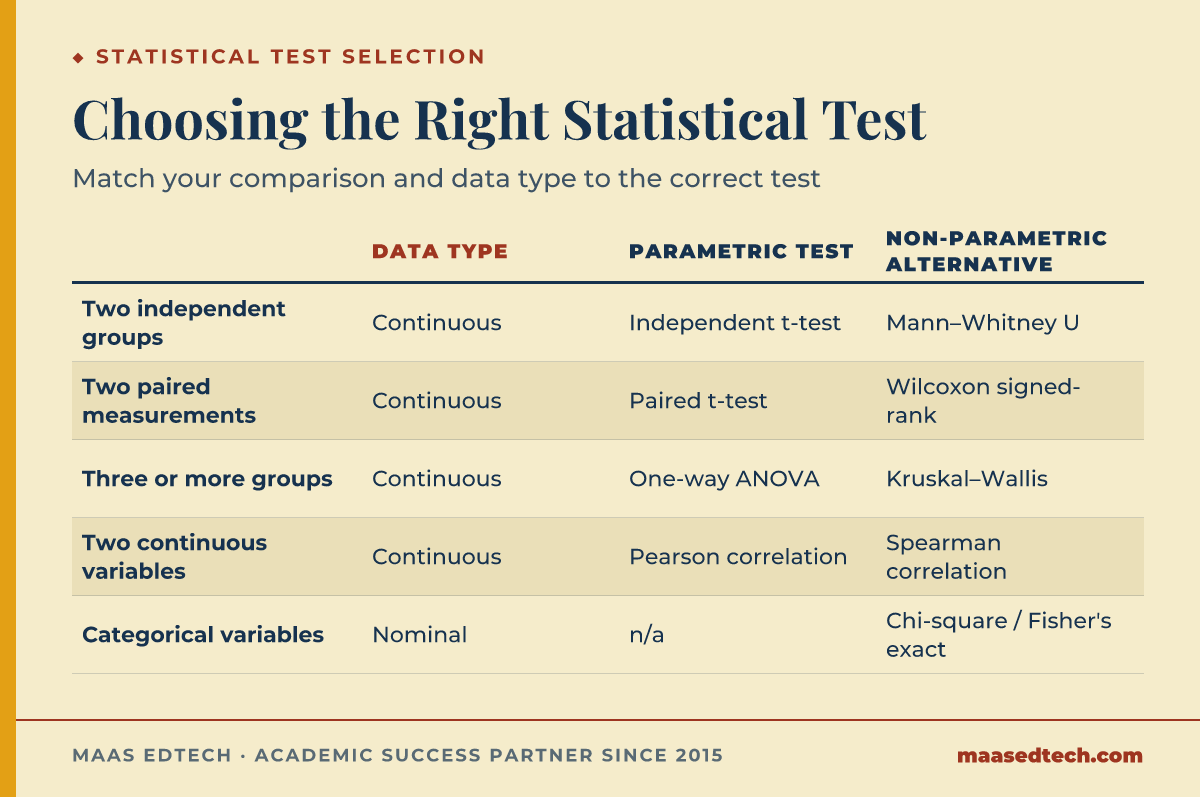
Evidence: University statistics services frame test selection around variable type, the number of groups or levels, and whether samples are paired or independent (University of York, n.d.; UCLA Statistical Consulting Group, n.d.). Applied-statistics textbooks aimed at postgraduate researchers list the same four questions as the standard starting point for choosing a test (Field, 2013). Choosing a paired test when samples are independent or the reverse, is a common and avoidable error (Marusteri & Bacarea, 2010).
| Your comparison | Data type | Common parametric test | Non-parametric alternative |
|---|---|---|---|
| Two independent groups | Continuous | Independent t-test | Mann–Whitney U |
| Two paired measurements | Continuous | Paired t-test | Wilcoxon signed-rank |
| Three or more groups | Continuous | One-way ANOVA | Kruskal–Wallis |
| Association between two continuous variables | Continuous | Pearson correlation | Spearman correlation |
| Association between categorical variables | Nominal | n/a | Chi-square / Fisher's exact |
Example: A MAAS-coached student studying a before-and-after intervention had planned an independent t-test. Her mentor showed that because the same subjects were measured twice, a paired test was correct, a single reclassification that changed the entire analysis and its reported result.
When should you use a parametric versus a non-parametric test?
Direct answer: Use a parametric test when your continuous data reasonably meet its assumptions, chiefly approximate normality and equal variance, because parametric tests are more powerful when those conditions hold. Switch to a non-parametric alternative when data are ordinal, badly skewed, contain extreme outliers, or come from a very small sample.
Evidence: When assumptions are met, parametric tests are generally more powerful and more likely to detect a real effect. However, with larger samples the Central Limit Theorem allows parametric tests to perform well even when the underlying data are not perfectly normal, so sample size is part of the decision, not just the histogram (Marusteri & Bacarea, 2010).
Example: A Vietnamese researcher with a 14-participant pilot insisted on a t-test because "everyone uses it." Her MAAS mentor explained that at that sample size, with visible skew, a Mann–Whitney U test was the safer, more honest choice and reviewers would respect the caution rather than penalise it.
How do you check the assumptions a test requires?
Direct answer: Every parametric test carries assumptions you must check and report: independence of observations, approximate normality (often of residuals, not raw data), and homogeneity of variance between groups. Inspect distributions visually, use formal tests where appropriate, and decide in advance what you will do if an assumption fails.
Evidence: SAMPL implementation research found that analysis of the assumptions necessary for a test, and consideration of the impact of outliers, are among the most frequently missing elements in published statistics, assumption checks were absent in a large share of articles reviewed (Ordak, 2025). Reviewers increasingly expect these checks to be stated explicitly. In practice, that usually means running a Shapiro-Wilk test for normality alongside a Levene test for equal variance, then reporting both results next to the primary statistic rather than leaving the reader to assume they were checked.
Example: A MAAS Publishing Advisory client had run an ANOVA without mentioning any assumption check. During a Final-stage review, her mentor added a normality and variance check, documented one mild violation, and noted the robustness of the chosen test, a short paragraph that pre-empted an obvious reviewer question.
Why do p-values alone fail Q1 reviewers, and what should you report instead?
Direct answer: A p-value tells you only how compatible your data are with a null hypothesis; it does not measure the size or importance of an effect. Q1 reviewers expect effect sizes and confidence intervals alongside p-values, so readers can judge practical significance, not just statistical significance.
Evidence: The American Statistical Association's 2016 statement on p-values, built around 6 core principles, warns that statistical significance should not by itself drive scientific conclusions and that p-values are widely misused (Wasserstein & Lazar, 2016). One of those principles states it directly: "Scientific conclusions and business or policy decisions should not be based only on whether a p-value passes a specific threshold" (Wasserstein & Lazar, 2016, p. 131). Reporting effect sizes with confidence intervals communicates both the strength of evidence and the precision of the estimate, which a bare p-value cannot (Lakens, 2013). Cohen's (1988) benchmarks treat a standardized mean difference of 0.2 to 0.8 as small to large, so "p < 0.05" alone cannot tell a reviewer which end of that range the true effect sits at.
Example: A Vietnamese author reported a string of "p < 0.05" results with no effect sizes. Her MAAS mentor helped her add effect sizes and 95% confidence intervals throughout, reframing the discussion around how large and how precise each effect was, exactly the lens a Q1 reviewer applies.
What statistical mistakes get a paper rejected at Q1?
Direct answer: The recurring rejection triggers are: choosing the test after seeing the data, confusing paired and independent designs, ignoring assumption checks, running many comparisons without correction, reporting post-hoc power, and describing methods too vaguely to reproduce. Each signals to a reviewer that the analysis may not be reliable.
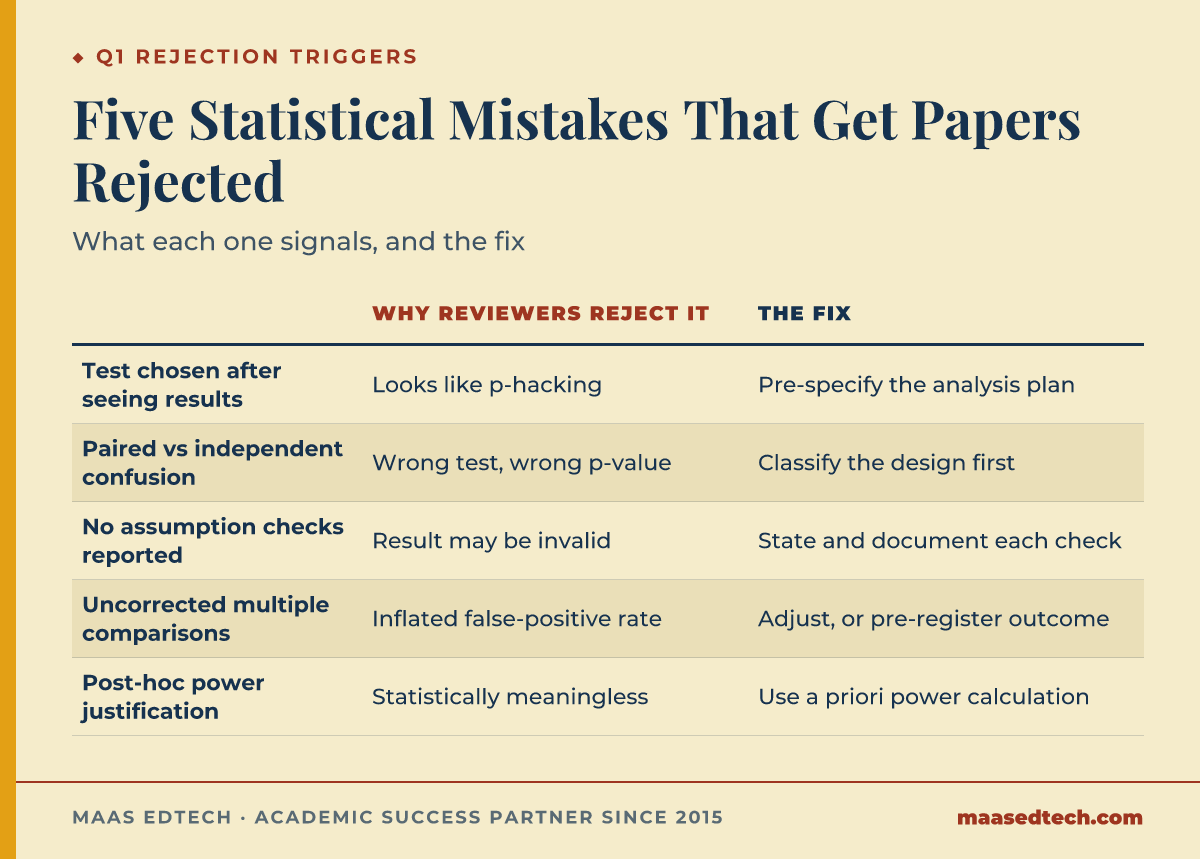
Evidence: Post-hoc power calculations have no value once a study has concluded; sample size justification should be done a priori (Hickey et al. 2018). Most quantitative journals still expect that a priori calculation to target 80% power at a 5% significance level (α = 0.05), the field's long-standing default before any data are collected. A Bonferroni correction divides that significance threshold by the number of tests run, so with 12 comparisons the working threshold falls from 5% to about 0.4%, which is why uncorrected multiple testing inflates false positives so quickly. SAMPL guidelines call for a clear statement of each test's purpose, its assumptions, and effect sizes, deficiencies in exactly these areas are the most commonly flagged (Ordak, 2025).
| Mistake | Why reviewers reject it | The fix |
|---|---|---|
| Test chosen after seeing results | Looks like p-hacking | Pre-specify the analysis plan |
| Paired vs independent confusion | Wrong test, wrong p-value | Classify the design first |
| No assumption checks reported | Result may be invalid | State and document each check |
| Uncorrected multiple comparisons | Inflated false-positive rate | Adjust, or pre-register the primary outcome |
| Post-hoc power "justification" | Statistically meaningless | Use a priori power calculation |
Example: A MAAS client's manuscript ran twelve uncorrected comparisons and justified the sample with post-hoc power. Her mentor flagged both before submission, helped her define one primary outcome and an a priori rationale, and the revised methods read as far more disciplined.
How can Vietnamese and ESL researchers get the statistics right?
Direct answer: Decide the analysis before you collect data, write a short statistical analysis plan, and use a reporting checklist such as SAMPL as you draft the methods. Then get developmental feedback from a mentor who has reviewed quantitative papers, so problems surface before submission rather than in a reviewer's report.
Evidence: Vietnam's national research strategy targets a 15–20% annual increase in WoS/Scopus/Q1 output, and well-reported statistics are a low-cost way to lift a manuscript above the rejection threshold. Following established reporting guidance measurably improves how reviewers receive a paper (Lang & Altman, 2015).
Example: A MAAS mentor guided a Vietnamese postgraduate through the Outline → Draft → Final model: an outline that fixed the analysis plan and chosen tests, a draft that documented assumptions and effect sizes, and a final language and reporting polish against SAMPL. The student stayed the author throughout, with the mentor advising at each stage rather than running the analysis for her.
Frequently asked questions
Do I need to test for normality before every analysis?
Check normality whenever you plan a parametric test, but interpret it sensibly. With small samples, formal normality tests have low power; with large samples they flag trivial deviations. Combine a visual check of the distribution with the test and your knowledge of the data, then decide.
Should I use a parametric or non-parametric test for a small sample?
For very small samples with skew or outliers, a non-parametric test is usually the safer choice because it makes fewer assumptions. If a small sample is approximately normal, a parametric test can still be appropriate but report the limitation honestly rather than hiding it.
Should I report exact p-values or just "p < 0.05"?
Report exact p-values (for example, p = 0.03) rather than only a threshold, and always pair them with an effect size and confidence interval. Thresholds alone hide how strong or weak the evidence actually is, which reviewers increasingly penalise.
Do I really need an a priori sample size calculation?
For most quantitative Q1 studies, yes. An a priori calculation based on the expected effect size, your chosen significance level, and target power justifies your sample before data collection. Post-hoc power calculated after the study has no statistical value.
Which software should I use for Q1 statistics?
SPSS, R, and Stata are all accepted in Q1 journals; what matters is that the test is correct, the assumptions are checked, and the procedure is reported clearly enough to reproduce. State the software and version in your methods section.
What does "Q1" actually mean for a journal?
"Q1" is a Scopus quartile ranking, not a quality label a journal gives itself. A title that sits in the top 25% of its subject category by SCImago Journal Rank (SJR) or CiteScore percentile is Q1, the next 25% is Q2, and so on down to Q4. Most Vietnamese universities and funding bodies that reward "WoS/Scopus" output specifically require Q1 or Q2 placement, not just any indexed journal, which is why the statistics have to withstand a reviewer pool used to seeing the strongest submissions in the field.
Can MAAS help me choose and report the right statistical test?
Yes. MAAS Publishing Advisory coaches Vietnamese researchers through analysis planning, test selection, assumption checks, and statistical reporting using a phase-by-phase model, with feedback from PhD-level mentors. Book a consultation through our contact page.
Ready to get your statistics Q1-ready?
The right statistical test is decided before you analyse, not after, and it is far easier to get right with an adviser who has taken quantitative papers of their own through peer review. In MAAS Publishing Advisory, the methodology phase covers designing the method, choosing the tooling, whether SPSS, R or Python, and working through data cleaning and analysis, and the later section-by-section review reads your methods and results together. Advisers hold multiple Q1 or Q2 papers under their own name, and 23% of MAAS experts hold a PhD. A free 15-minute consultation comes first. MAAS then matches you within 48 hours when our network already covers that field. If it does not, MAAS opens a dedicated recruitment round for your case, which usually takes about two weeks. You stay the author, every step.
Book a Publishing Advisory consultation with MAAS Academic Mentoring →
Related guides
- How do you calculate the sample size for a research study?: power your study before you pick the test
- How do you report effect sizes and confidence intervals?: report the magnitude once the test is chosen
- How do you design a systematic review in the health sciences?: the method that frames where your statistics fit
- How do you publish a medical imaging AI study in a Q1 journal?: statistical rigour when your study uses AI methods
- How do you write the discussion section of a research paper?: interpreting your statistical results once they are in
- How do you choose the right Scopus journal for your paper?: finding the right home once your analysis is sound
- Publishing Advisory service: full service tiers for Scopus Q1/Q2 support
- Data & Coding Projects service: statistical analysis support in SPSS, R, and Python
- Meet the MAAS experts: the PhD-level mentors behind our publishing advisory
References
- Cohen, J. (1988). Statistical power analysis for the behavioral sciences (2nd ed.). Lawrence Erlbaum Associates.
- Field, A. (2013). Discovering statistics using IBM SPSS statistics (4th ed.). Sage.
- Hickey, G. L., Grant, S. W., Dunning, J., & Siepe, M. (2018). Statistical primer: Sample size and power calculations, why, when and how? European Journal of Cardio-Thoracic Surgery, 54(1), 4–9. https://doi.org/10.1093/ejcts/ezy169
- Lakens, D. (2013). Calculating and reporting effect sizes to facilitate cumulative science: A practical primer for t-tests and ANOVAs. Frontiers in Psychology, 4, Article 863. https://doi.org/10.3389/fpsyg.2013.00863
- Lang, T. A., & Altman, D. G. (2015). Basic statistical reporting for articles published in biomedical journals: The "Statistical Analyses and Methods in the Published Literature" or the SAMPL guidelines. International Journal of Nursing Studies, 52(1), 5–9. https://doi.org/10.1016/j.ijnurstu.2014.09.006
- Marusteri, M., & Bacarea, V. (2010). Comparing groups for statistical differences: How to choose the right statistical test? Biochemia Medica, 20(1), 15–32. https://doi.org/10.11613/BM.2010.004
- Ordak, M. (2025). Implementation of SAMPL guidelines: Recommendations for improving statistical reporting in biomedical journals. Clinical Medicine, 25(3), Article 100304. https://doi.org/10.1016/j.clinme.2025.100304
- UCLA Statistical Consulting Group. (n.d.). Choosing the correct statistical test. Retrieved June 8, 2026, from https://stats.oarc.ucla.edu/other/mult-pkg/whatstat/
- University of York. (n.d.). Which statistical test? Maths Skills Centre. Retrieved June 8, 2026, from https://subjectguides.york.ac.uk/maths-skills-centre/which-statistical-test
- Wasserstein, R. L., & Lazar, N. A. (2016). The ASA statement on p-values: Context, process, and purpose. The American Statistician, 70(2), 129–133. https://doi.org/10.1080/00031305.2016.1154108
This article is part of the MAAS Journal series for Vietnamese international postgraduate students and researchers. MAAS Publishing Advisory is an advisory partner; we coach authors through a phase-by-phase delivery model with developmental feedback from PhD-level, Scopus-published mentors. We do not write, submit, or guarantee acceptance of work on an author's behalf.