
Choosing a Scopus journal means matching your paper to a journal by scope, citation fit, and realistic acceptance odds before you ever submit. For Vietnamese researchers, this single decision often matters more than the writing itself: the right journal turns a strong manuscript into a published Q1 or Q2 paper, while the wrong one wastes 4 to 12 months in review only to end in rejection.
Journal selection is a strategy problem, not a guessing game. This guide answers the seven questions Vietnamese postgraduate researchers ask MAAS publishing mentors most often before their first submission.
Author: MAAS Editorial Team · Reviewed by a MAAS subject mentor
Last updated: 2026-06-02
Category: research-methods

What does "choosing the right Scopus journal" actually mean?
Direct answer: Choosing the right Scopus journal means selecting a journal where your topic fits the stated scope, your references overlap with the journal's own citation network, and your manuscript has a realistic chance of acceptance given its quartile. A good fit is the intersection of all three, not simply the highest-ranked journal you can find.
Evidence: Elsevier's own author guidance (Elsevier, n.d.) lists "relevance to the journal's aims and scope" as the most common reason for desk rejection before peer review even begins. Scopus indexes journals by quartile (Q1 = top 25% by citation impact in a subject category, Q2 = next 25%), and a journal's scope statement on its homepage is the first filter every editor applies.
Example: A MAAS Publishing Advisory client in education research had drafted a strong empirical paper and wanted to submit to a flagship Q1 journal. Her mentor checked the journal's last two issues, found it had shifted toward theoretical rather than empirical work, and steered her to a Q2 journal publishing similar methods. She received a major revision on the first round and acceptance after the second.
How do you match your paper to a journal's scope?
Direct answer: Read the journal's "Aims and Scope" page, then read the titles and abstracts of the most recent two issues. If three or more recent articles could sit naturally beside yours, same subfield, comparable method, similar contribution type, the scope fits. If you cannot find a single close neighbour, the scope does not fit, no matter how prestigious the journal.
Evidence: Editors describe scope-checking as their fastest filter. Springer Nature (Springer Nature, n.d.) and Wiley author resources both recommend examining recent issues rather than relying on the journal title alone, because journals drift in focus over time and a title can be misleading. Elsevier states that "Carefully read the journal's aims and scope statement, browse recent issues to understand typical content themes and review author guidelines for specific requirements" (Elsevier, n.d.).
Example: A Vietnamese doctoral candidate in marketing assumed a journal with "consumer" in its title would suit her behavioural study. Her MAAS mentor showed her the last issue was almost entirely quantitative modelling, while her work was qualitative. They found a better-fit journal whose recent issues featured interpretive consumer research, and her paper landed within scope on the first try.
What is journal quartile (Q1, Q2, Q3, Q4) and which should you target?
Direct answer: Quartile ranks a journal within its subject category by citation impact: Q1 is the top quarter, Q4 the bottom. For Vietnamese promotion and PhD requirements, Q1 and Q2 usually carry the recognised weight, so target the highest quartile where your paper is genuinely competitive, not the highest quartile that exists. A realistic Q2 acceptance beats an unrealistic Q1 rejection.
Evidence: Vietnam's Ministry of Education and Training recognises Scopus and Web of Science-indexed publications in its academic-title criteria, and many Vietnamese universities track Q1/Q2 output as a primary research KPI. Quartile data is published openly through Scimago Lab's Scimago Journal Rank (Scimago Lab, n.d.), which lets you verify a journal's current quartile by subject category and year.
Example: A MAAS-coached lecturer needed one more Q-ranked publication for Associate Professor candidacy. Rather than gamble 8 months on a borderline Q1, her mentor mapped a primary Q2 target plus a Q1 "stretch" and a Q3 fallback. She submitted to the Q2 first, was accepted in 9 months, and met the MOET requirement on schedule.
How do you build a tiered shortlist instead of betting on one journal?
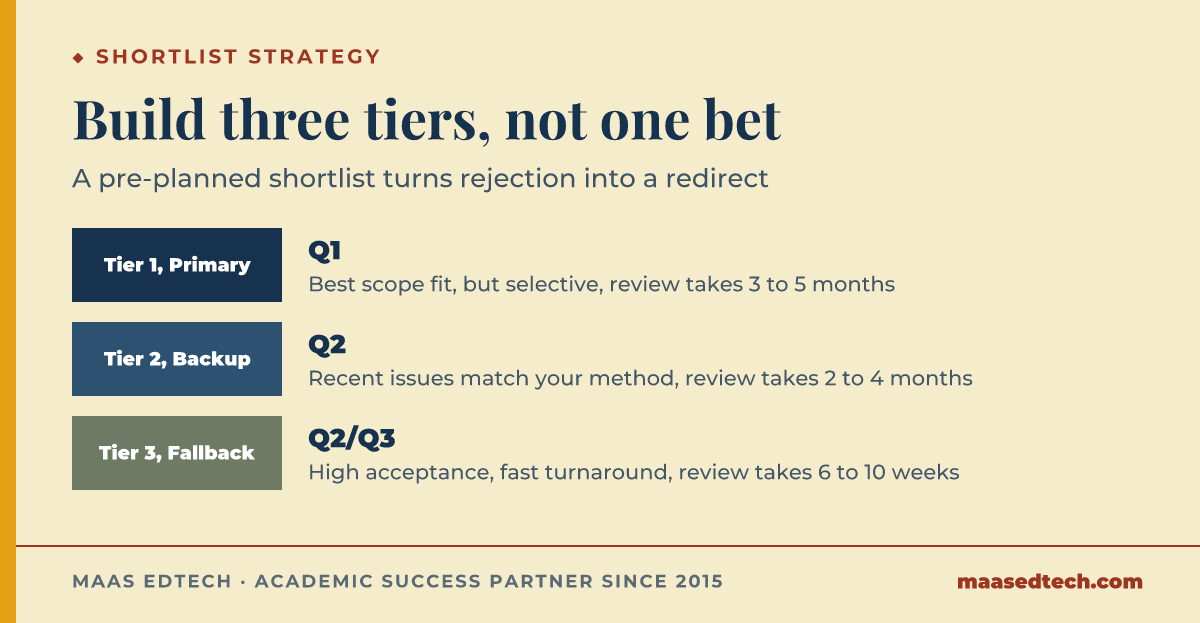
Direct answer: Build a three-journal shortlist in descending quartile: a primary target where you are competitive, a backup one tier down, and a fallback that is a safe bet. Decide the full sequence before you submit, so a rejection becomes an immediate redirect rather than a month of fresh deliberation under stress.
Evidence: Because journals review exclusively (you may submit to only one at a time), a pre-planned sequence is the only way to keep momentum. MAAS publishing advisors maintain an internal database of over 600 Scopus-indexed journals annotated with acceptance rate, average review time, fee structure, and recent editorial focus, exactly the data needed to rank a shortlist realistically.
Example: The table below shows how a MAAS mentor structured a shortlist for a Vietnamese finance researcher, balancing ambition against turnaround time.
| Tier | Role | Quartile | Why it was chosen | Typical review time |
|---|---|---|---|---|
| 1 | Primary | Q1 | Best scope fit, but selective | 3–5 months |
| 2 | Backup | Q2 | Recent issues match her method | 2–4 months |
| 3 | Fallback | Q2/Q3 | High acceptance, fast turnaround | 6–10 weeks |
She was rejected by the Q1 on scope, moved the same week to the Q2 backup using the comments she had received, and was accepted after one revision.
How do you check citation fit and avoid the wrong journal?
Direct answer: Look at your own reference list. If you are citing several papers from a journal, that journal is a strong candidate, your work is already in conversation with it. If none of your references come from a journal you are considering, that mismatch is a warning sign the editor will notice. Citation overlap is the most reliable, least subjective fit signal you have.
Evidence: Citation-network alignment is one of the three filters MAAS journal matching uses, alongside scope and acceptance probability. Editors look for whether a submission engages the conversation their journal hosts; a reference list disconnected from the journal's own output signals a poor fit regardless of topic.
Example: A doctoral candidate in public health had six references from one Q2 journal but had planned to submit elsewhere. Her MAAS mentor flagged the overlap, she switched her primary target to that journal, and her introduction, already built on its papers, needed almost no reframing. The submission read as a natural fit and cleared desk review immediately.
How do you avoid predatory journals while chasing Scopus indexing?
Direct answer: Verify a journal three ways before trusting it: confirm it is currently indexed in Scopus (check the Scopus source list, not the journal's own claim), check it against the journal's real publisher and, for open-access titles, the Directory of Open Access Journals (Directory of Open Access Journals, n.d.), and be sceptical of any journal promising guaranteed acceptance, payment for fast-track publication, or unrealistically short review times. Real Scopus journals never guarantee acceptance, and the Committee on Publication Ethics publishes core practices that legitimate journals are expected to follow, including transparent peer review and a documented process for handling misconduct complaints (Committee on Publication Ethics, n.d.), a useful checklist against which to test an unfamiliar title.
Evidence: Vietnam has a documented problem with predatory journals falsely claiming ISI or Scopus status, which has prompted universities to scrutinise where staff publish. Scopus periodically discontinues journals that fail quality checks, so a journal indexed 2 years ago may not be indexed now, always verify against the current Scopus source list and a journal's standing on Scimago.
Example: A Vietnamese researcher received a flattering email inviting her to publish in a "Scopus-indexed" journal within 3 weeks for a fee. Her MAAS mentor checked the Scopus source list, found the title had been discontinued for quality reasons, and redirected her to a legitimately indexed Q2 journal. Avoiding that trap protected both her money and her institutional record.
How do reviewing time and fees factor into the decision for Vietnamese researchers?
Direct answer: Weigh three practical costs alongside prestige: review time (does the journal's turnaround fit your promotion or graduation deadline?), article processing charges (open-access fees can run into thousands of dollars), and language expectations (some journals request evidence of professional language editing). For deadline-driven Vietnamese candidates, a faster Q2 is often a smarter choice than a slow Q1.
Evidence: Open-access article processing charges vary widely by publisher, and subscription journals may carry no author fee at all, a material difference on a Vietnamese academic budget. Review times are often stated in a journal's author metrics or can be estimated from MAAS's annotated journal database, which tracks average decision times.
Example: A MAAS client in a joint Vietnam–UK programme had a hard funding deadline 9 months away. Her mentor ruled out a prestigious Q1 with a typical review time of 10 months and selected a Q2 with a documented first-decision time of 3 months and no processing fee. She was published comfortably before her deadline, a journal chosen for fit and timing, not name alone.
Frequently asked questions
Is a Q1 journal always better than a Q2 journal?
No. Q1 signals higher citation impact, but a Q2 where your paper genuinely fits is a far better choice than a Q1 where it does not. Most Vietnamese promotion and PhD criteria recognise both Q1 and Q2.
How do I confirm a journal is really indexed in Scopus?
Check the official Scopus source list and the journal's current quartile on Scimago Journal Rank (SJR). Never rely on the journal's own website claim alone, because Scopus discontinues titles that fail quality checks.
Can I submit my paper to several journals at once?
No. Academic journals require exclusive submission; you may submit to only one journal at a time. That is exactly why a pre-planned, tiered shortlist matters.
What is the single biggest journal-selection mistake?
Targeting a journal by prestige instead of scope fit. A paper outside a journal's stated scope is usually desk-rejected before peer review, costing months for nothing.
How long does journal selection take to do properly?
For a focused researcher with a finished manuscript, building a verified three-journal shortlist typically takes a few days of checking scope, citation fit, indexing, and turnaround, far cheaper than months lost to a wrong submission.
Can MAAS help me choose the right Scopus journal?
Yes. MAAS Publishing Advisory coaches Vietnamese researchers through journal matching, scope analysis, citation-fit checking, quartile strategy, and predatory-journal screening, using a phase-by-phase model. Book a consultation through our contact page.
What are the key numbers for choosing a Scopus journal?
Q1 covers the top 25% of journals by citation impact in a subject category, Q2 the next 25%. A wrong-fit submission typically wastes 4 to 12 months before ending in rejection, while MAAS's annotated shortlist database tracks over 600 Scopus-indexed journals across acceptance rate, review time and fee structure.
Ready to choose a journal with confidence?
Picking the right Scopus journal is the highest-leverage decision in the whole publication process, and it is far easier with an adviser who has published in journals in your field. MAAS Publishing Advisory narrows the field to a shortlist of 3–5 journals ranked by impact factor, scope, acceptance rate and review timeline, and the adviser doing that work holds multiple Q1 or Q2 papers under their own name, with 23% of MAAS experts holding a PhD. Book the free 15-minute consultation first. MAAS matches you within 48 hours when our network already covers that field. If it does not, MAAS opens a dedicated recruitment round for your case, which usually takes about two weeks. We advise on the choice, and you stay the author and the one who submits.
Book a Publishing Advisory consultation with MAAS Academic Mentoring →
Related guides
- How long does a first Scopus paper take, and when should you start?: the realistic end-to-end timeline your journal choice feeds into
- What is the difference between a Q1 and a Q2 journal?: how quartiles work and which to target for your paper
- How does a Vietnamese researcher get published in a Scopus Q1 or Q2 journal?: the full publication journey this decision sits inside
- How do you respond to reviewer comments on a Scopus journal submission?: the next stage after your journal accepts your paper for review
- How do you write a cover letter to a journal editor?: the letter that frames your chosen journal fit before the editor reads your paper
- How do you avoid predatory journals when publishing your research?: the verification step that confirms your shortlisted journal is legitimate
- What happens in each stage of a Scopus publication project?: the method MAAS uses across journal selection and revision
- Publishing Advisory service: full service tiers for Scopus Q1/Q2 support
- Scopus Publishing resource hub: journal-matching checklists and shortlist templates
References
- Committee on Publication Ethics. (n.d.). Guidance for authors. Retrieved June 8, 2026, from https://publicationethics.org/guidance
- Directory of Open Access Journals. (n.d.). DOAJ: Directory of Open Access Journals. Retrieved June 8, 2026, from https://doaj.org/
- Elsevier. (n.d.). Journal selection. Retrieved August 22, 2026, from https://www.elsevier.com/publishing/publish-in-a-journal/journal-selection
- Elsevier. (n.d.). Scopus sources. Scopus. Retrieved June 8, 2026, from https://www.scopus.com/sources
- Scimago Lab. (n.d.). Scimago Journal & Country Rank. Retrieved June 8, 2026, from https://www.scimagojr.com/
- Springer Nature. (n.d.). How to choose a journal. Retrieved June 8, 2026, from https://www.springernature.com/gp/authors/campaigns/choosing-a-journal
This article is part of the MAAS Journal series for Vietnamese international postgraduate students and researchers. MAAS Publishing Advisory is an advisory partner; we coach authors through a phase-by-phase delivery model with developmental feedback from PhD-level, Scopus-published mentors. We do not write, submit, or guarantee acceptance of work on an author's behalf.