
◆ Publishing advisory
How does a Vietnamese researcher publish in Scopus Q1 and Q2 journals?
Publishing in Scopus Q1 or Q2 journals is the single hardest milestone for a Vietnamese researcher's first international submission and the one with the highest career payoff. Selective titles such as The Social Science Journal, in the top quartile on both Impact Factor and CiteScore, accept about 5% of submissions (Taylor & Francis, n.d.). Most failures happen in the first 72 hours, before the manuscript reaches peer review. This guide is MAAS Publishing Advisory's playbook for that first submission.
Most rejections are not failures of research quality; they are failures of journal fit, manuscript structuring, or reviewer-response strategy. Vietnamese researchers have produced extraordinary output growth (the country's Scopus business publications rose from 140 to 1,316 between 2016 and 2020, lifting the country from 63rd to 25th in the world on that measure; Hồ, 2021), but most first-time international submissions still get desk-rejected within a week. This guide answers the seven questions Vietnamese postgraduates ask MAAS Publishing Advisory mentors most often, and ends with six FAQs covering the moments before submission.

◆ Question 1 / 7 · What the quartiles mean
What do Scopus Q1, Q2, Q3, and Q4 actually mean and which quartile should a Vietnamese first-author target?
Direct answer: Quartiles divide journals in a Scopus subject category into four equal groups based on the SCImago Journal Rank (SJR), with Q1 the top group and Q4 the bottom. For a Vietnamese researcher's first submission, MAAS recommends a strong Q2 over a borderline Q1: the rejection cycle is shorter, feedback is comparable, and the paper still counts under Vietnam's doctoral requirements.
Evidence: The SCImago Journal Rank averages weighted citations a journal received over the previous three years, where citations from more prestigious journals count more heavily. Quartiles are recalculated once a year (usually April–May). Vietnam's Ministry of Education and Training (MOET) regulated doctoral publication requirements under Circular 08/2017/TT-BGDĐT, which required at least two articles in ISI- or Scopus-indexed journals before defending. That circular was superseded by Circular 18/2021/TT-BGDĐT, effective 15 August 2021, which removed the nationwide mandatory international-publication requirement and now also accepts qualifying domestic-journal publications or monographs (Bộ Giáo dục và Đào tạo, 2021). In practice, many Vietnamese universities (VNU, HCMUT, VinUniversity) still set their own internal thresholds that count Q1 and Q2 papers more heavily for promotion and scholarship eligibility, so a candidate's real publication bar depends on their institution, not only on the national floor.
Example: A MAAS Publishing Advisory student in 2025 targeted a Q1 management journal as her first submission. Desk rejection in 6 days, no reviewer feedback. The mentor reassessed her manuscript against three Q2 candidates in the same subject category, recommended the one with the closest topical alignment to recent issues, and the student submitted there. Outcome: minor revisions after 4 months of peer review, then accepted. Same paper. Different journal fit.
◆ Question 2 / 7 · Choosing the journal
How do you choose the right Scopus Q1 or Q2 journal, before drafting a single section?
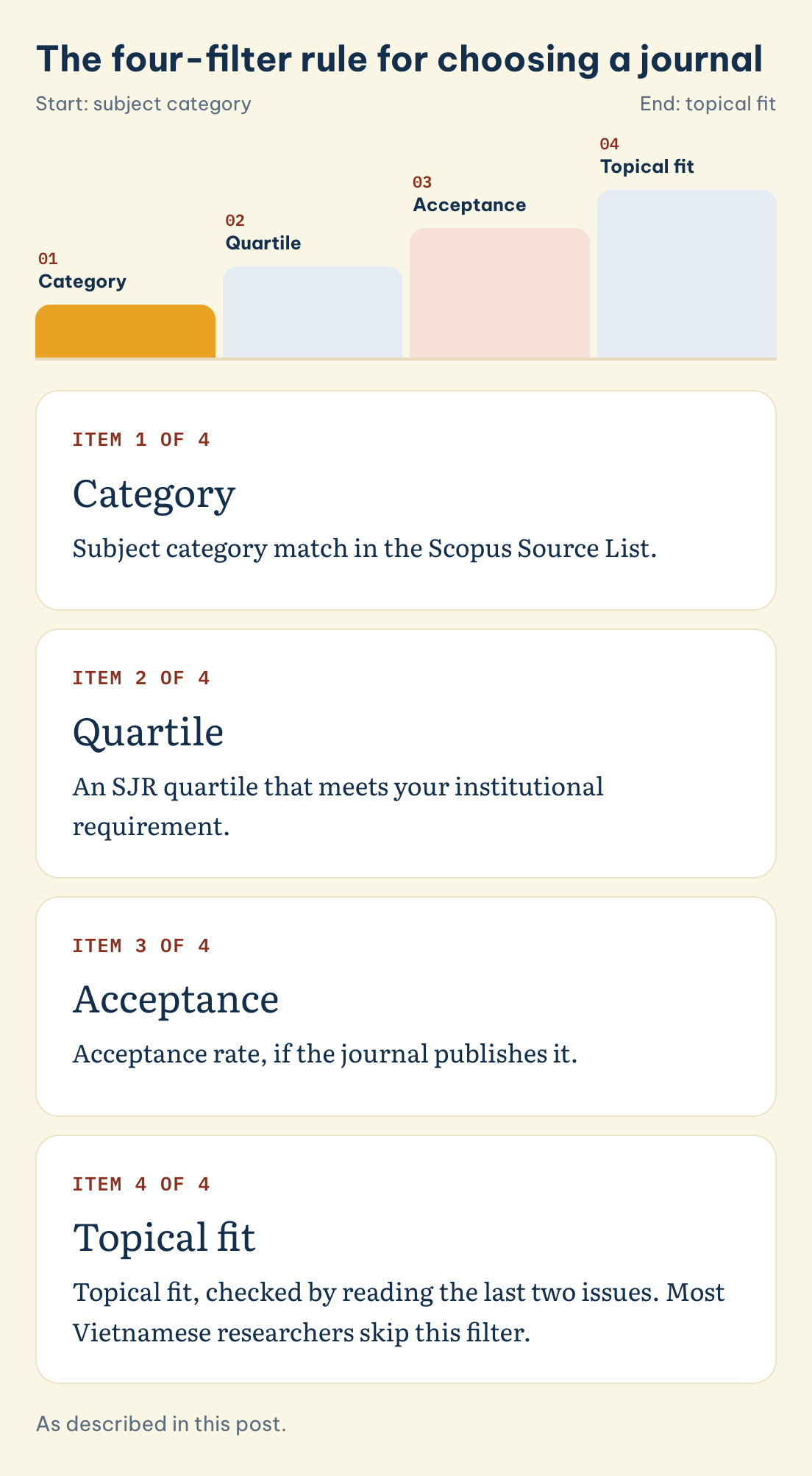
Direct answer: Journal fit is decided BEFORE drafting, not after. Use a four-filter rule: (1) subject category match in the Scopus Source List, (2) SJR quartile that meets your institutional requirement, (3) acceptance rate if the journal publishes it, (4) topical fit by reading the last two issues. Most Vietnamese researchers skip filter (4) and write a manuscript that is academically sound but topically off and they pay for it in desk rejection.
The four-filter rule for choosing a journal
Tap a filter to see what it checks.
Item 1 of 4
Category
Subject category match in the Scopus Source List.
Item 2 of 4
Quartile
An SJR quartile that meets your institutional requirement.
Item 3 of 4
Acceptance
Acceptance rate, if the journal publishes it.
Item 4 of 4
Topical fit
Topical fit, checked by reading the last two issues. Most Vietnamese researchers skip this filter.
Save this figure
Evidence: Editor surveys consistently identify poor journal fit as the single largest cause of desk rejection. Desk rejection rates vary widely between broad-scope journals and elite, single-discipline venues. The Journal of International Business Studies (JIBS) reports 65% desk rejection (Beugelsdijk & Bird, 2025), and at Science about 83% of submissions never reach formal peer review (Zhang et al., 2026). The Springer Nature author guide on common rejection reasons puts "out of scope" at the top of its list of editorial rejection reasons, ahead of poor English and methodology weaknesses (Springer Nature, n.d.). Use the Scopus Source List filter, JournalGuide, or Elsevier Journal Finder to scope candidate journals.
Example: A MAAS publishing advisory mentor walked a Vietnamese DBA candidate through a 4-filter spreadsheet, 47 candidate journals narrowed to 3 in under 90 minutes. Filter (4) eliminated 28 journals that had not published in her sub-topic in the previous two years. The 3 survivors all had editorial board members publishing in the same theme. She submitted to the top-ranked of the 3; the manuscript went to peer review on attempt 1.
◆ Question 3 / 7 · Structuring the manuscript
How should a Vietnamese researcher structure a Scopus Q1/Q2 manuscript differently from a Vietnamese-language journal article?
Direct answer: International journals expect IMRaD strict (Introduction, Methods, Results, Discussion). No narrative preface. No acknowledgement of supervisor in the opening section. No "the author would like to thank…" before the abstract. The structural conventions that work in Vietnamese-language journals (V-journals like Tạp chí Khoa học) often get an international manuscript desk-rejected for structural mismatch.
Evidence: The Springer Nature common rejection reasons list places "structure does not match journal expectations" alongside scope mismatch as a primary desk-rejection cause (Springer Nature, n.d.). How to Write & Publish a Scientific Paper (Day & Gastel, 2022), now in its 9th edition, remains the canonical reference for IMRaD structuring across natural and social sciences. Most Q1 journals enforce IMRaD by editorial template, and reviewers are instructed to flag structural deviation. The Springer Nature author guide explicitly notes that reviewers form their first impression from the abstract and introduction, so a non-IMRaD opening quickly signals "not journal-ready" (Springer Nature, n.d.).
Example: A MAAS coachee submitted a manuscript to a Q2 Asia studies journal with a 600-word narrative opening that introduced her field site, the Vietnamese context, and her motivation. Desk rejection citing "structure does not match journal expectations." The mentor rewrote the opening into a 200-word IMRaD-compliant introduction stating problem, gap, contribution, and method. Same manuscript content. Resubmitted to the same journal one month later. Survived to peer review, accepted with revisions.
◆ Question 4 / 7 · The first 72 hours
Why do so many first manuscripts from Southeast Asian first-authors get desk-rejected and how do you survive the first 72 hours?
Direct answer: Across major journals, desk rejection within the first week is common, and it is especially likely at the most selective venues, as the JIBS and Science figures cited above illustrate. For Southeast Asian first-authors, poor journal fit, inadequate English at the abstract and introduction level, and scope mismatch with the journal's current editorial direction are among the most common causes of rejection. The first 72 hours are decisive because editors triage submissions by scanning the title, abstract, and first paragraph of the introduction.
Evidence: Desk-rejected authors frequently receive little or no reviewer feedback, which leaves them unable to diagnose what to fix before resubmitting elsewhere. Editage Insights' review of common desk rejection causes ranks poor journal fit, insufficient novelty, and weak language and presentation among the top reasons, ahead of methodology weaknesses (Sindhuja, n.d.). The same review explains why editors move so fast on a scope mismatch: desk rejection "protects the time of volunteer peer reviewers by removing manuscripts that clearly do not meet a journal's basic standards, scope, or format requirements before those reviewers ever see the paper" (Sindhuja, n.d.). MAAS Publishing Advisory recommends three pre-submission checks regardless of venue: a journal-fit memo, a native-speaker English review of the abstract, and a final scan of the journal's last two issues to ensure topical alignment.
Example: One MAAS student received 3 consecutive desk rejections in 5 months from three different journals. After a 90-minute journal-fit audit and a cover-letter rewrite by the MAAS mentor, the next submission survived to peer review on attempt 1. The manuscript itself had not changed substantially, what changed was the submission package and the journal choice.
◆ Question 5 / 7 · The cover letter
What does a Q1/Q2-grade cover letter for a Vietnamese first-author look like?
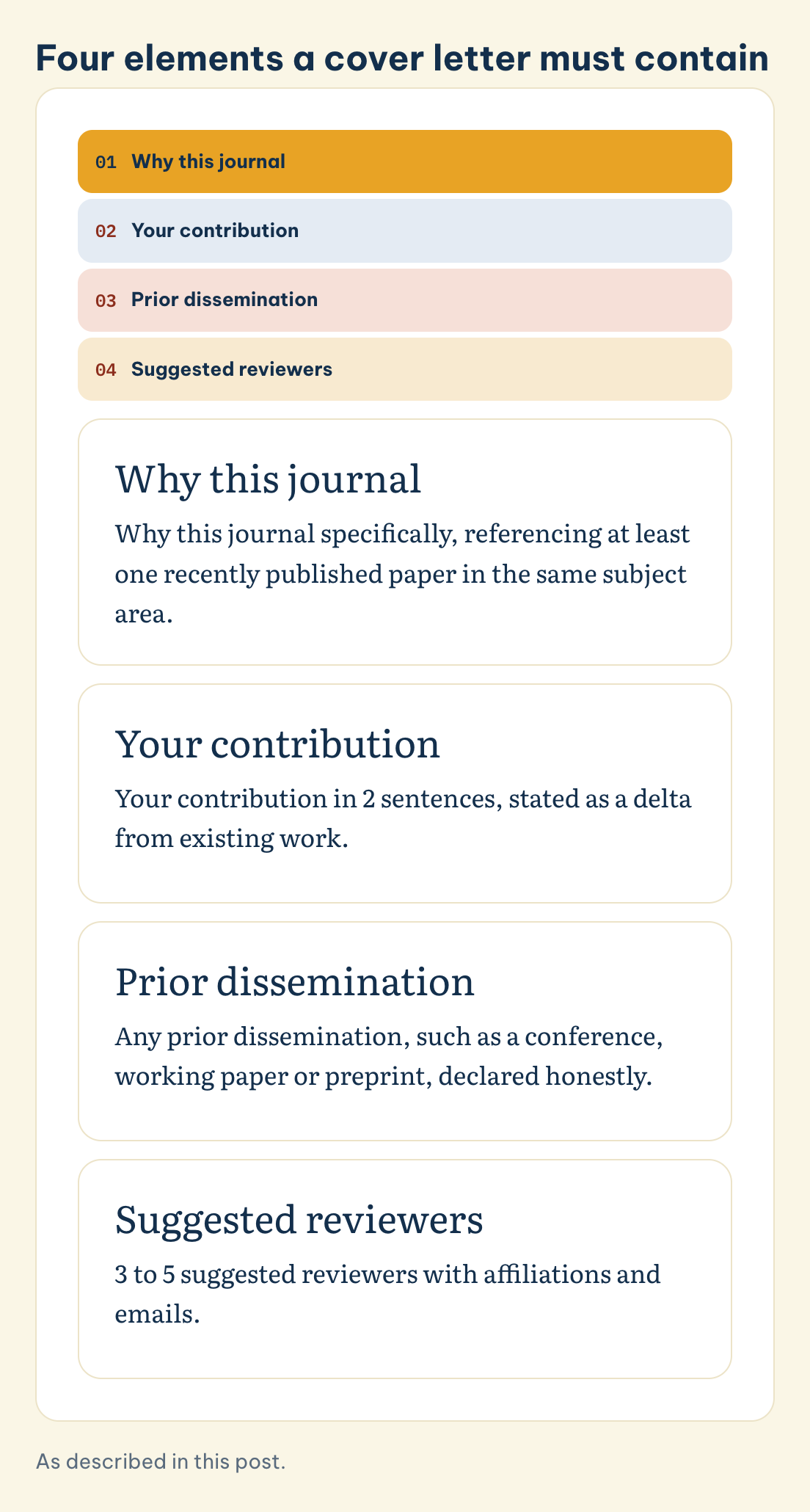
Direct answer: A cover letter is a 250–350-word document that signals fit, not a courtesy note. It must contain four elements: (1) why this journal specifically, referencing at least one recently published paper in the same subject area, (2) your contribution in 2 sentences stated as a delta from existing work, (3) any prior dissemination (conference, working paper, preprint) declared honestly, (4) 3–5 suggested reviewers with affiliations and emails. Vietnamese authors most often skip elements (1) and (4), both are signal-rich for editors.
Four elements a cover letter must contain
Tap an element to see what it asks for.
Why this journal
Why this journal specifically, referencing at least one recently published paper in the same subject area.
Your contribution
Your contribution in 2 sentences, stated as a delta from existing work.
Prior dissemination
Any prior dissemination, such as a conference, working paper or preprint, declared honestly.
Suggested reviewers
3 to 5 suggested reviewers with affiliations and emails.
Save this figure
Evidence: Springer Nature, Elsevier, and Wiley all publish author cover-letter templates. The Springer Nature author guide explicitly notes that suggesting reviewers is not optional, editors use the suggested reviewer list to triage submissions, and a complete list demonstrates that the author has read the field . The Nature Computational Science editorial on responding to peer review extends this logic to the cover letter: the editor's first decision is whether the manuscript belongs in the journal's reviewer pool, and a thoughtful suggested-reviewer list is a primary signal (Nature Computational Science, 2025).
Example: Template structure: paragraph 1 names the journal and cites one recent paper. Paragraph 2 states the contribution as a delta ("Whereas X (2023) established A, this manuscript shows B under condition C"). Paragraph 3 declares prior dissemination (or states no prior dissemination explicitly). Paragraph 4 lists suggested reviewers with one-line justifications. MAAS mentor reviews the cover letter in 30 minutes before submission, and reviewer-list errors are the most common fix.
◆ Question 6 / 7 · Major Revisions
How do you respond to "Major Revisions" from a Scopus Q1/Q2 reviewer?
Direct answer: A Major Revisions response letter is its own document, typically 8–12 pages for a Q1 submission. Three rules: (1) copy the reviewer's full text into the response, do not paraphrase, (2) respond point-by-point, every comment, even the ones you disagree with, (3) flag changes by line number and indicate where in the revised manuscript each change appears. The response letter is read more closely than the revised manuscript itself.
Evidence: Nature Computational Science (2025) lays out the canonical structure: open with a one-paragraph summary of major concerns and changes, then go point-by-point, copying the full reviewer text without selecting. Springer Nature's official guide adds two practical instructions: visualise changes in the manuscript (track changes or coloured text), and address disagreements respectfully but persuasively with citation-backed reasoning . Writing Your Journal Article in Twelve Weeks (Belcher, 2019) provides a chapter-length template for the response letter that MAAS Publishing Advisory mentors use as a baseline.
Example: A MAAS student received 41 reviewer comments on a Q1 management submission. The mentor drafted an 11-page point-by-point response with three sections: (1) summary of major changes (1 page), (2) reviewer 1 point-by-point (5 pages), (3) reviewer 2 point-by-point (5 pages). Where the student disagreed with a methodological critique, the response cited two newer empirical papers supporting her choice. Accepted at the next round.
◆ Question 7 / 7 · How long it takes
How long does the Scopus Q1/Q2 publication cycle actually take and what should a Vietnamese PhD candidate plan around?
Direct answer: From submission to publication, the timeline for a Q1 or Q2 social-science manuscript typically runs well over a year once resubmission rounds are included, and it varies substantially by field, journal, and how many revision rounds a manuscript needs. Build in at least 2 reviewer rounds and a multi-week revision window for each. A realistic planning horizon for a Vietnamese PhD candidate targeting a Q1 publication before viva is closer to two years from manuscript draft than to a few months.
Evidence: Elsevier and Springer Nature both publish median submission-to-first-decision metrics on individual journal pages, and these vary widely: some journals decide within weeks, others take several months, so authors should check the specific target journal's own reported metrics rather than assume a publisher-wide average. Acceptance-to-publication typically adds further weeks depending on whether the journal publishes online-first.
Example: MAAS Publishing Advisory plans backwards from the viva date. If a Vietnamese candidate defends in May 2027 and needs a Q1 publication on the CV, the manuscript must enter the submission queue by November 2025 at the latest and a phase-by-phase cycle (a separate MAAS methodology guide explains this) typically adds 14–20 weeks before submission. Working backwards, the manuscript outline ideally starts in mid-2025.
Frequently asked questions
Is paying for Scopus Q1/Q2 publication legitimate?
No, reputable Q1 and Q2 journals never charge a "publication fee" beyond standard Article Processing Charges (APCs) on Open Access tracks, and APCs are paid only after peer-reviewed acceptance. Any pre-acceptance offer to "guarantee Scopus publication" is predatory. Always verify the journal in the official Scopus Source List and cross-check Beall's List archive for predatory flags.
Do MAAS Publishing Advisory mentors write the manuscript for the student?
No. MAAS Publishing Advisory works on a phase-by-phase partnership model. The student remains the first author and writes the manuscript. Mentors review structure, argument, methodology fit, journal selection, cover letter, and reviewer-response strategy. The student's authorship is the centre of the engagement.
Which Scopus subject category is most accessible for Vietnamese first-authors?
Education, Business & Management, and Social Sciences subject categories typically show higher relative acceptance rates than Engineering or Medicine but quality bars remain high. Vietnamese researchers have made the largest gains in economics and business journals, where Scopus-indexed publications by Vietnamese authors grew nearly tenfold between 2016 and 2020.
Can I use AI tools like ChatGPT to draft a Scopus Q1 submission?
Cautiously. Most Q1 journals now require explicit disclosure of AI use. AI is widely accepted for grammar polish, citation formatting, and language editing. Under the Committee on Publication Ethics (COPE) position on authorship and AI tools, an AI tool can never be listed as an author, and any use of AI beyond basic editing must be disclosed in the manuscript, with the human authors remaining fully accountable for the accuracy of the content (COPE, 2024). The safe rule: disclose any AI use, and keep human authorship over substance.
What if my paper gets rejected after peer review?
Use the reviewer feedback as a free advisory report. Rewrite according to the critiques, then submit to a Q2 in the same subject category. Most MAAS-supported manuscripts find their journal within 2 submissions. Do not resubmit to the same journal without a structural change, editors record prior submissions.
Does a Scopus Q1 publication guarantee a Vietnamese scholarship?
It significantly increases competitiveness for VinIF (Vingroup Innovation Foundation) and most internal university scholarships. Project 911, MOET's earlier PhD-training scholarship scheme, wound down well short of its targets before Circular 08/2017/TT-BGDĐT even took effect and is not a current funding source. MOET's current doctoral training regulation, Circular 18/2021/TT-BGDĐT, no longer mandates ISI/Scopus publication for doctoral defence nationwide, but individual universities and funders set their own thresholds, and many still weight Q1/Q2 publications heavily (Bộ Giáo dục và Đào tạo, 2021). Always check the specific funder's requirements before assuming Q1 counts equally to Q2.
Ready to map your Scopus Q1 or Q2 submission strategy?
MAAS Publishing Advisory pairs Vietnamese researchers with a discipline-matched mentor for journal selection, IMRaD structuring, cover-letter review, and point-by-point reviewer-response coaching. The phase-by-phase method is documented in a companion guide. Every manuscript stays the student's own work.
Book a Publishing Advisory consultation →
References
- Belcher, W. L. (2019). Writing your journal article in twelve weeks: A guide to academic publishing success (2nd ed.). University of Chicago Press.
- Beugelsdijk, S., & Bird, A. (2025). How to avoid a desk reject: Do's and don'ts. Journal of International Business Studies, 56(3), 301–310. https://doi.org/10.1057/s41267-024-00712-8
- Bộ Giáo dục và Đào tạo [Vietnam Ministry of Education and Training]. (2021). Thông tư số 18/2021/TT-BGDĐT ban hành Quy chế tuyển sinh và đào tạo trình độ tiến sĩ [Circular No. 18/2021/TT-BGDĐT promulgating the regulation on doctoral admission and training]. https://congbao.chinhphu.vn/van-ban/thong-tu-so-18-2021-tt-bgddt-33987.htm
- Committee on Publication Ethics [COPE]. (2024). Authorship and AI tools [Position statement]. https://doi.org/10.24318/cCVRZBms
- Day, R. A., & Gastel, B. (2022). How to write and publish a scientific paper (9th ed.). Greenwood.
- Hồ, M. T. (2021, July 16). Nghiên cứu KHXH&NV ở Việt Nam tăng trưởng thế nào trong 5 năm qua? [How has social science and humanities research in Vietnam grown over the past five years?]. VietNamNet. https://vietnamnet.vn/nghien-cuu-khxhnv-o-viet-nam-tang-truong-the-nao-trong-5-nam-qua-756677.html
- Nature Computational Science. (2025). How to respond to reviewers [Editorial]. Nature Computational Science. https://doi.org/10.1038/s43588-025-00931-5
- Sindhuja, A. (n.d.). Top causes of desk rejection: How to avoid rejection without peer review. Editage Insights. Retrieved August 11, 2026, from https://www.editage.com/insights/top-5-reasons-for-desk-rejection-and-simple-solutions-for-authors
- Springer Nature. (n.d.). Common reasons for rejection. Retrieved August 11, 2026, from https://www.springer.com/gp/authors-editors/journal-author/common-reasons-for-rejection/1376
- Taylor & Francis. (n.d.). Learn about The Social Science Journal. Retrieved August 11, 2026, from https://www.tandfonline.com/journals/ussj20/about-this-journal
- Zhang, S., LaBerge, N., McElhiney, Q., Larremore, D. B., & Clauset, A. (2026). Editorial and peer review dynamics at elite general science journals. Science Advances, 12(29), Article eaec0494. https://doi.org/10.1126/sciadv.aec0494
Related guides
- How do you publish your first international paper as a Vietnamese researcher?: the first-paper journey stage by stage, from readiness check to acceptance
- How do you choose the right Scopus journal for your paper?: the journal-matching decision that comes before you submit
- What happens in each stage of a Scopus publication project?: the methodology MAAS uses with every Publishing Advisory student
- How do you respond to reviewer comments on a Scopus journal submission?: turning a "major revision" decision into an acceptance
- How do you write a cover letter to a journal editor?: the one-page letter that frames fit and ethics at submission
- How do you prepare for a viva voce defence when English is your second language?: viva coaching for Vietnamese PhD candidates
- How do you design a systematic review in the health sciences?: a data-light route to a first Scopus publication
- How do you publish a medical imaging AI study in a Q1 journal?: rigor and reporting standards for AI-driven research
- Publishing Advisory service: full service tiers and pricing
- Scopus Publishing resource hub: additional templates and checklists
A free 20-minute consultation with a MAAS publishing adviser, to talk through your Q1 or Q2 submission plan.
Book Free Discovery ▸