
Publishing your first international paper as a Vietnamese researcher means moving one finished study through journal matching, peer review, and revision. The process is longer than most first-time authors expect, typically 9 to 18 months end to end but every stage follows learnable rules, and none requires a native English speaker or a famous co-author.
This guide answers the seven questions Vietnamese first-time authors ask MAAS publishing mentors most often, the full journey from finished research to a Scopus-indexed publication with your name on it.
Author: MAAS Researcher Development Desk
Last updated: 2026-06-08
Category: student-success
What does publishing your first international paper actually involve?
Direct answer: It involves five staged decisions: confirming your study makes a publishable contribution, choosing a realistic target journal, preparing a manuscript in the journal's exact format, passing peer review through one or more revision rounds, and completing post-acceptance production. Each stage has its own gatekeeper, and each can be planned in advance.
Evidence: Elsevier's Researcher Academy describes publication as a structured cycle, from finding the right journal through submission, review, and revision and notes that rejection rates at many journals are high precisely because authors skip the early matching stages (Elsevier, n.d.-b). Vietnam's national context raises the stakes: the country's 2025–2030 basic-science program targets a 15–20% annual increase in WoS/Scopus Q1–Q2 publications, and a benchmark of at least 1.5 international publications per PhD graduate per year by 2030 (Vietnam.vn, 2025).
Example: A MAAS Publishing Advisory client, a lecturer at a southern Vietnamese university with zero international publications, mapped the full pipeline with her mentor in a single session: contribution statement in week 1, three-journal shortlist by week 3, submission in month 4, acceptance in month 13. Seeing all five stages on one page replaced anxiety with a schedule.
How do you decide whether your research is ready for an international journal?
Direct answer: Your study is ready when you can state, in two sentences, what it adds to the international literature and who will cite it. Readiness is about contribution, not perfection: a modest, clearly framed finding in a Q2 journal beats an overstated claim that reviewers will dismantle.
Evidence: Elsevier's step-by-step author guidance puts "determine whether you are ready to publish" before any writing advice, and treats the contribution question, what is new, why it matters, who needs it, as the first filter editors apply (Elsevier, n.d.-b). COPE's guidance for authors adds the integrity dimension: the work must be original, not sliced into redundant fragments, and free of duplicate submission (Committee on Publication Ethics, n.d.).
Example: A Hanoi doctoral candidate in economics brought her mentor a dataset she considered "too local" for international journals. Her MAAS mentor reframed the contribution: Vietnam's export-manufacturing transition was exactly the empirical setting international development journals lacked. The "local" weakness became the selling point of the introduction, and the paper cleared desk review at a Q2 journal on its first submission.
How do you choose the right journal for a first international submission?
Direct answer: Build a three-journal shortlist where your references already live: a realistic primary target, a backup one tier down, and a fast-turnaround fallback. For a first paper, weight acceptance probability and review speed over prestige, a published Q2 article builds the track record that makes your next Q1 attempt credible.
Evidence: Quartile data is openly verifiable on Scimago Journal Rank (Scimago Lab, n.d.), which ranks the journals in each subject category into four quartiles by citation-weighted score, Q1 the top 25% of titles and Q4 the bottom 25%, and the current Scopus source list confirms whether a journal is still indexed, a critical check, since Scopus periodically discontinues titles, and Vietnamese researchers have been warned about journals falsely claiming indexation. Citation overlap between your reference list and the journal's recent issues remains the most reliable fit signal.
Example: The table below shows the staged plan a MAAS mentor built with a first-time author in public health, balancing ambition against her graduation deadline.
| Stage | What you decide | Typical duration | First-timer trap to avoid |
|---|---|---|---|
| Readiness check | Contribution statement, integrity check | 1–2 weeks | Submitting before the claim is clear |
| Journal shortlist | 3 tiers by scope + citation fit | 2–3 weeks | Targeting prestige over fit |
| Manuscript preparation | Format to the exact journal guide | 4–8 weeks | Ignoring the author guidelines |
| Peer review + revision | Respond to every comment | 3–8 months | Treating major revision as rejection |
| Production + indexing | Proofs, copyright, indexing | 1–3 months | Relaxing before final checks |
She submitted to her Q2 primary, received a major revision, and was accepted 11 months after the first mentoring session.
How do you write the manuscript when English is your second language?
Direct answer: Structure first, sentences second. Reviewers reject ESL manuscripts mainly for unclear logic and poor organisation, not imperfect grammar so build the argument skeleton (IMRaD, one message per paragraph, signposted transitions) before polishing language, and use the journal's own recent articles as sentence-level models.
Evidence: Springer Nature runs a free, self-paced course on writing in English that takes about 30 minutes to complete, and its guidance for non-native English authors stresses clarity of structure over native-like style, and its widely used handbook for ESL research writing, based on analysis of over 1,000 manuscripts and reviewer reports, found that papers by non-native researchers are most often rejected for problems of structure and content presentation, with English usage compounding rather than causing the rejection (Springer Nature, n.d.; Wallwork, 2016).
Example: A Vietnamese master's graduate working on her first solo paper sent her MAAS mentor a draft she had polished for grammar three times. The mentor's feedback ignored grammar entirely: the results section buried the key finding in paragraph six. They rebuilt the section around one figure and one claim using the Outline → Draft → Final method, and the next reviewer round praised the paper's "clear narrative", from an author who had never written in English professionally.
How do you handle authorship and integrity rules on a first paper?
Direct answer: Agree authorship before drafting, using the ICMJE's four criteria: substantial contribution, drafting or critical revision, final approval, and accountability. Disclose any AI assistance according to the journal's policy, keep your data trail auditable, and never let a supervisor or colleague be added or dropped without discussion. Note too that many journals now run detection software, and AI screening can flag honest, self-written text, especially from non-native authors, so keep the drafts and notes that show the argument is yours.
Evidence: The ICMJE recommendations are explicit on this point: "All those designated as authors should meet all four criteria for authorship, and all who meet the four criteria should be identified as authors" (ICMJE, n.d.). Guest and gift authorship both violate that standard. COPE guidance extends this to disclosure: undeclared text recycling, image manipulation, or undisclosed use of generative AI in manuscript preparation are treated as integrity breaches by member journals (Committee on Publication Ethics, n.d.).
Example: A first-time author in pharmacy research was pressured to add two senior names who had not touched the study. Her MAAS mentor walked her through the ICMJE criteria and helped her draft a respectful email proposing an acknowledgement instead. The journal's submission form, which required a contribution statement per author, backed her position, and the paper went out with three authors who each met all four criteria.
What should you expect during peer review and how do you respond?
Direct answer: Expect three to eight months and at least one revision round; outright first-round acceptance is rare in any field. Treat a major revision as a conditional yes: respond to every single comment in a point-by-point table, revise the manuscript visibly, and stay polite even when a reviewer is wrong.
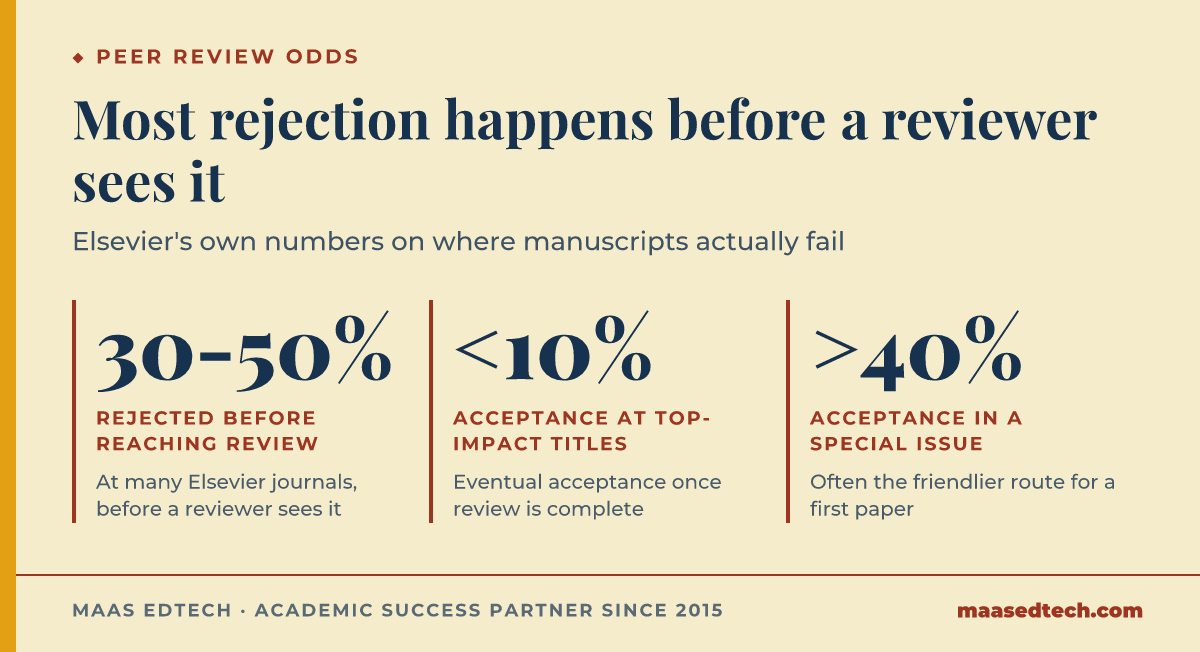
Evidence: Elsevier's own guidance puts the odds in context: between 30% and 50% of articles submitted to its journals are rejected before they even reach peer review, and at the highest-impact titles the eventual acceptance rate can fall under 10%, while a special issue or special-topic section often accepts more than 40% (Elsevier, n.d.-a). Against that backdrop, almost no manuscript that does reach review is accepted without revision, and a careful, complete response letter is the single strongest predictor of a smooth second round (Elsevier, n.d.-b). Reviewer comments on ESL submissions disproportionately request clarification rather than new experiments, which means many "major" revisions for Vietnamese first-time authors are fixable with rewriting, not new data.
Example: A MAAS client received 31 reviewer comments on her first international submission and read the decision as a rejection. Her mentor re-read the letter with her: 24 comments asked for clarification, 5 for added literature, 2 for a robustness check she could run in a week. They built a response table over two sessions, resubmitted in 6 weeks, and the paper was accepted with minor revisions on the next round.
How long does the journey take, and how do you plan around Vietnamese deadlines?
Direct answer: Budget 9 to 18 months from finished study to indexed publication, then work backwards from your real deadline, PhD defence, scholarship application, or professorship dossier. If the deadline is inside 12 months, choose a faster Q2 journal deliberately rather than gambling on a slow Q1.
Evidence: With Vietnamese PhD programs increasingly requiring Scopus or WoS-indexed publication before graduation, and the national 2030 benchmark of 1.5 international publications per PhD graduate per year, timing has become a graduation-critical variable, not a nice-to-have (Vietnam.vn, 2025). Review and production times are estimable in advance: many journals publish average first-decision times, and quartile-by-category data on Scimago lets you compare realistic options.
Example: A doctoral candidate needed one indexed publication 14 months before her defence. Her MAAS mentor ruled out two prestigious journals whose first decisions took 10 months, selected a Q2 title with a documented 3 month turnaround, and front-loaded manuscript formatting in parallel with the readiness check. The acceptance email arrived 4 months before her paperwork deadline.
Frequently asked questions
Do I need a native English speaker as co-author to publish internationally?
No. Journals evaluate the contribution and the clarity of the writing, not the passport of the authors. Structure and logic matter far more than native-like style, and language polishing is a normal, declared part of manuscript preparation.
Should my first international paper target Q1 or Q2?
For most first-time authors, a well-matched Q2 is the smarter target: acceptance odds are higher, review is often faster, and a published Q2 paper builds the track record for a later Q1 attempt. Vietnamese promotion and graduation criteria typically recognise both.
How much does it cost to publish in a Scopus-indexed journal?
Subscription journals usually charge authors nothing. Open-access journals charge article processing fees that vary widely by publisher. Any journal demanding payment for acceptance itself, or promising publication within days, is a predatory red flag.
Can I write the paper in Vietnamese first and translate it?
It usually costs more time than it saves. Argument structure differs between Vietnamese and English academic prose, so translated drafts often need full restructuring. Drafting directly in English from a detailed bilingual outline works better for most researchers.
What is the most common first-paper mistake?
Submitting to a journal chosen by prestige rather than fit, with a manuscript that ignores the author guidelines. Elsevier-affiliated guidance reports that roughly one paper in five fails to follow the target journal's format requirements, an avoidable reason to start peer review on the back foot (Elsevier, n.d.-a).
Can MAAS help me publish my first international paper?
Yes. MAAS Publishing Advisory mentors Vietnamese researchers through the full first-paper journey, readiness assessment, journal shortlisting, manuscript framing, and peer-review response, using a phase-by-phase model. You remain the author at every step. Book a consultation through our contact page.
Ready to start your first-paper journey with a mentor beside you?
Your first international paper is the hardest one you will ever publish, because every stage is unfamiliar and the cost of each mistake is measured in months. MAAS Publishing Advisory works with advisers who each hold multiple Q1 or Q2 papers under their own name, and 23% of MAAS experts hold a PhD. MAAS matches you with a discipline-matched adviser within 48 hours when our network already covers that field. If it does not, MAAS opens a dedicated recruitment round for your case, which usually takes about two weeks. Whether a journal accepts the paper is the editor's decision, so that is not something MAAS promises. The first consultation is free and lasts 15 minutes, and the project kick-off that opens your plan is also free and does not count as a paid session.
Book a Publishing Advisory consultation with MAAS →
Related guides
- How does a Vietnamese researcher get published in a Scopus Q1 or Q2 journal?: the full publication landscape this first-paper journey sits inside
- How do you choose the right Scopus journal for your paper?: the journal-matching stage in depth
- How do you respond to reviewer comments on a Scopus journal submission?: the peer-review stage in depth
- How do you write a literature review for a PhD as a Vietnamese student?: building the literature base your paper stands on
- How long does a first Scopus paper take, and when should you start?: the backward-planned calendar for this journey
- Publishing Advisory service: mentoring tiers for first-time and returning authors
- Scopus Publishing resource hub: checklists and shortlist templates
- Meet the MAAS expert network: the PhD-level mentors behind this series
References
- Committee on Publication Ethics. (n.d.). Guidance for authors. Retrieved June 8, 2026, from https://publicationethics.org/guidance
- Elsevier. (n.d.-a). 7 steps to publishing in a scientific journal. Retrieved June 8, 2026, from https://www.elsevier.com/en-in/connect/7-steps-to-publishing-in-a-scientific-journal
- Elsevier. (n.d.-b). Step-by-step guide to publishing your research. Researcher Academy. Retrieved June 8, 2026, from https://researcheracademy.elsevier.com/publication-process/fundamentals-publishing/step-step-guide-publishing-research
- International Committee of Medical Journal Editors [ICMJE]. (n.d.). Defining the role of authors and contributors. Retrieved June 8, 2026, from https://www.icmje.org/recommendations/browse/roles-and-responsibilities/defining-the-role-of-authors-and-contributors.html
- Scimago Lab. (n.d.). Scimago Journal & Country Rank. Retrieved June 8, 2026, from https://www.scimagojr.com/
- Springer Nature. (n.d.). Writing in English. Retrieved June 8, 2026, from https://www.springernature.com/gp/authors/campaigns/writing-in-english
- Vietnam.vn. (2025). Vietnam aims to have multiple world-class research centers by 2030. https://www.vietnam.vn/en/viet-nam-dat-muc-tieu-co-nhieu-trung-tam-nghien-cuu-tam-the-gioi-vao-nam-2030
- Wallwork, A. (2016). English for writing research papers (2nd ed.). Springer. https://doi.org/10.1007/978-3-319-26094-5
This article is part of the MAAS Journal series for Vietnamese international postgraduate students and researchers. MAAS Publishing Advisory is an advisory partner; we coach authors through a phase-by-phase delivery model with developmental feedback from PhD-level, Scopus-published mentors. We do not write, submit, or guarantee acceptance of work on an author's behalf.