
◆ Publishing advisory
How do you respond to reviewer comments on a Scopus journal submission?
Responding to reviewer comments on a Scopus submission means answering every point in a structured letter, fixing what you agree with and defending the rest. Do it with evidence and courtesy. For Vietnamese researchers, the revision stage, not the first draft, is where most publications are won or lost, because a "major revision" decision is an invitation, not a rejection.
Reviewers are busy academics doing unpaid work; a clear, complete, respectful response makes their job easy and signals you are a serious author. This guide answers the seven questions Vietnamese researchers ask MAAS publishing mentors most often after the first decision email arrives.

◆ Question 1 / 7 · Decision and comments
What do the editor's decision and reviewer comments actually mean?
Direct answer: A Scopus journal decision is usually one of four outcomes: accept (rare on first submission), minor revision, major revision, or reject. "Major revision" is good news; it means the editor sees publishable value and will read your paper again. Only "reject" closes the door, and even then the comments help you improve the paper for the next journal.
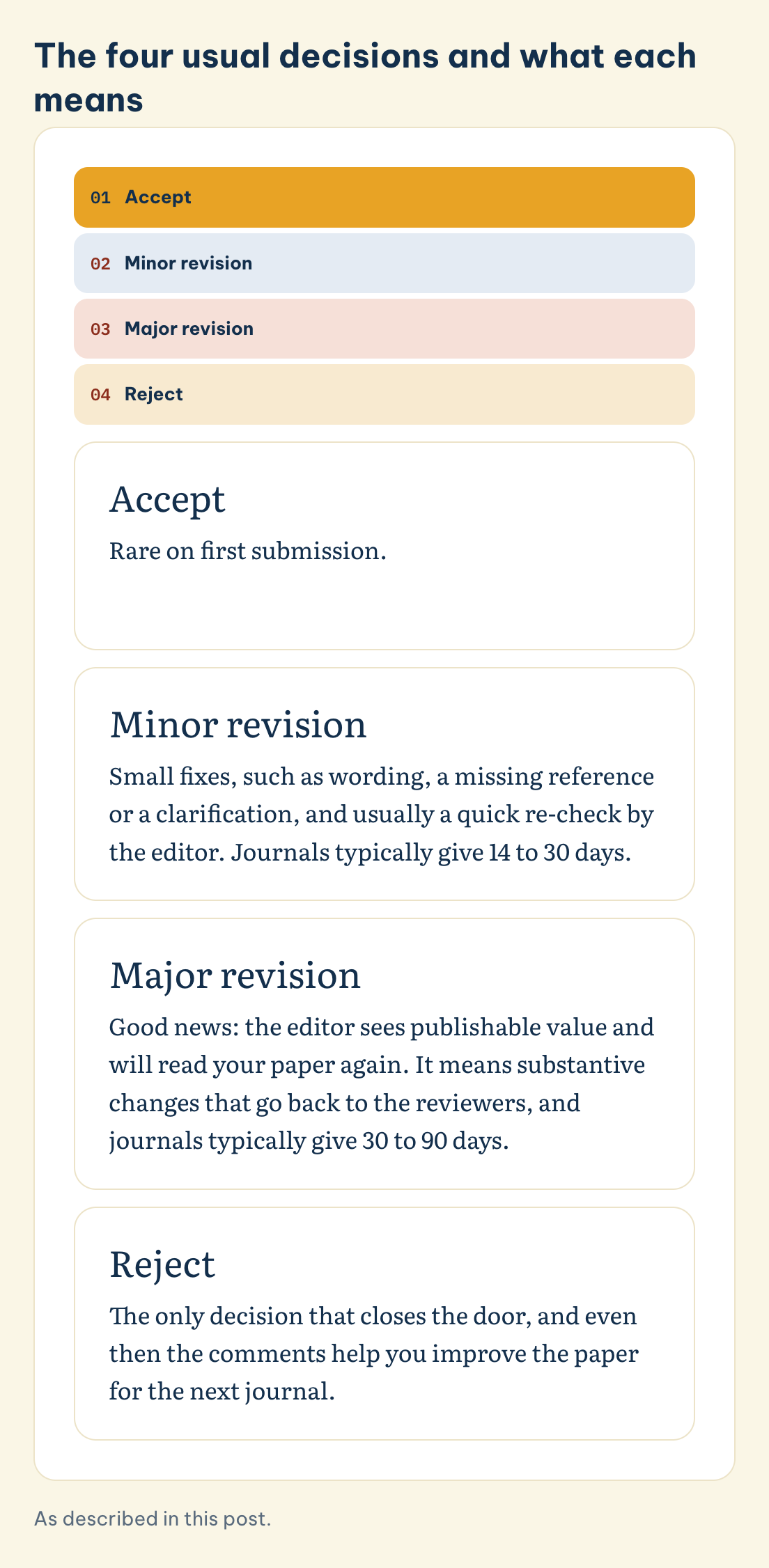
The four usual decisions and what each means
Tap a decision to see what it means for your paper.
Accept
Rare on first submission.
Minor revision
Small fixes, such as wording, a missing reference or a clarification, and usually a quick re-check by the editor. Journals typically give 14 to 30 days.
Major revision
Good news: the editor sees publishable value and will read your paper again. It means substantive changes that go back to the reviewers, and journals typically give 30 to 90 days.
Reject
The only decision that closes the door, and even then the comments help you improve the paper for the next journal.
Save this figure
Evidence: Elsevier and Springer Nature author guidance (Elsevier, n.d.; Springer Nature, n.d.), echoed by the Committee on Publication Ethics (Committee on Publication Ethics, n.d.), both report that first-round acceptance is uncommon and that the large majority of eventually published papers go through at least one major-revision cycle. Wiley's author resources describe major revision as "conditional interest", the journal is signalling intent to publish if concerns are resolved. Elsevier frames the whole exercise plainly: "Peer review is designed to ensure the quality and integrity of the scholarly record" (Elsevier, n.d.), which is why a well-argued response, not a defensive one, is what moves a paper from major revision to acceptance.
Example: A MAAS Publishing Advisory client received a Q2 education journal decision with eleven reviewer comments spanning 4 pages and panicked, reading it as rejection. The decision word was actually "major revision." After a structured response and 3 weeks of revisions, the paper was accepted, the comments had been a roadmap to acceptance, not a verdict against it.
◆ Question 2 / 7 · The response letter
How do you write a response-to-reviewers letter?
Direct answer: Write a point-by-point response that copies each reviewer comment verbatim, then answers it directly underneath. State what you changed, where (page and line number), and quote the new text. Open with a short thank-you to the editor and reviewers. The golden rule: every single comment gets a visible response, even if your answer is "we have made this change as suggested."
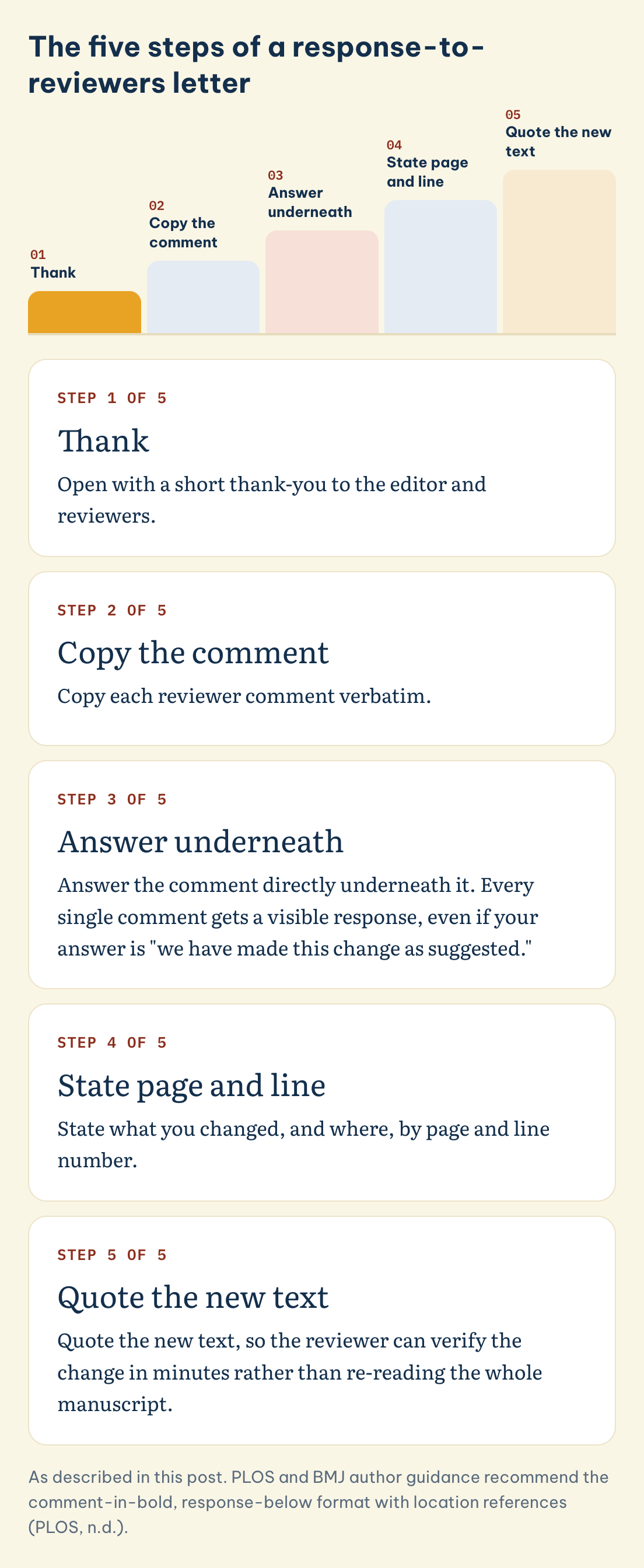
The five steps of a response-to-reviewers letter
Tap a step to see what it holds.
Step 1 of 5
Thank
Open with a short thank-you to the editor and reviewers.
Step 2 of 5
Copy the comment
Copy each reviewer comment verbatim.
Step 3 of 5
Answer underneath
Answer the comment directly underneath it. Every single comment gets a visible response, even if your answer is "we have made this change as suggested."
Step 4 of 5
State page and line
State what you changed, and where, by page and line number.
Step 5 of 5
Quote the new text
Quote the new text, so the reviewer can verify the change in minutes rather than re-reading the whole manuscript.
Save this figure
Evidence: The Committee on Publication Ethics (COPE) and most Scopus journal author instructions explicitly require a response document that addresses all comments. PLOS and BMJ author guidance (PLOS, n.d.) recommend the comment-in-bold / response-below format with location references, because it lets reviewers verify changes in minutes rather than re-reading the whole manuscript. Some smaller Scopus-indexed journals run on Open Journal Systems (OJS) rather than Editorial Manager or ScholarOne, but the expectation is the same: an uploaded response file, not just inline comments. Health and life-sciences journals that follow International Committee of Medical Journal Editors (ICMJE) recommendations expect the same structure.
Example: A MAAS-coached author structured her letter as: "Reviewer 1, Comment 3: [pasted comment]. Response: We agree. We have added a limitations paragraph (p. 14, lines 312–325): '[new text]'." Reviewer 1 returned the second round with a single line, "All my concerns have been addressed", because the letter made verification effortless.
◆ Question 3 / 7 · When you disagree
How do you respond to a reviewer comment you disagree with?
Direct answer: You can disagree, politely, with evidence, exactly the stance PLOS and BMJ author guidance recommends. Never ignore a comment or dismiss it. Acknowledge the reviewer's point, explain your reasoning with a citation or data, and offer a compromise where possible (for example, adding a sentence acknowledging the alternative view rather than changing your method). Editors respect a well-argued, courteous defence far more than silent compliance or defensiveness.
Evidence: Noble's (2017) "Ten simple rules for writing a response to reviewers" and the widely shared Nature career guidance on responding to reviewers both stress that reviewers are not always right, and that a reasoned rebuttal, "We respectfully retain our approach because…", is a normal and accepted part of peer review when supported by evidence.
Example: A reviewer asked a MAAS client to drop her qualitative interviews because the sample was "too small." She declined, but did so well: she cited the saturation literature, clarified that the study was interpretive rather than generalising, and added two sentences to the methodology explaining this. The editor sided with her and the section stayed.
◆ Question 4 / 7 · Deadlines
How long do you have to respond, and how fast should you?
Direct answer: Journals typically give 30 to 90 days for a major revision and 14 to 30 days for a minor one, stated in the decision email. Do not rush a major revision to look fast, a thorough, complete response matters more than speed. If you need more time, email the editor and ask; extensions are routinely granted when requested before the deadline.
Evidence: Editorial Manager and ScholarOne (the two systems most Scopus journals use) display the revision deadline on the author dashboard, and Elsevier's author FAQ confirms that authors may request deadline extensions through the system or by emailing the handling editor. Björk and Solomon (2013) documented in the Journal of Informetrics how widely review-to-decision delays vary across journals and disciplines, which is why the same "major revision" label can carry very different deadlines from one Scopus journal to the next.
Example: A MAAS Publishing Advisory client in a joint Vietnam–UK programme was given 60 days, needed to re-run an analysis, and emailed the editor for 2 extra weeks. The editor granted it the same day. The paper was accepted; the brief delay had no effect on the outcome.
◆ Question 5 / 7 · Contradictory comments
What do you do when two reviewers give contradictory comments?
Direct answer: When reviewers disagree, you do not have to satisfy both, address each comment, explain the conflict to the editor, and state which path you took and why. The editor is the final arbiter, so make their decision easy by flagging the contradiction explicitly in your response letter and justifying your choice.
Evidence: Committee on Publication Ethics guidance on conflicting reviews advises authors to respond to both reviewers transparently and to let the editor adjudicate, rather than attempting an impossible compromise. Most journal author guides, including Elsevier and Springer Nature, echo this: the editor weighs the reviews, not the author.
Example: One MAAS client had Reviewer 1 demand more theory and Reviewer 2 demand the theory be cut. She added a focused half-page expanding the most relevant concept, then wrote: "We note Reviewers 1 and 2 differ here; we have taken a middle path by deepening the core construct while removing the two peripheral models Reviewer 2 found distracting." The editor accepted the resolution.
◆ Question 6 / 7 · Harsh reviews
How do you recover from a harsh review or a "reject and resubmit"?
Direct answer: Treat a harsh review as free expert consulting, not a personal attack. Wait a day before reacting, separate the tone from the substance, and extract the actionable points, the same order of operations the Nature and Science Careers columns recommend. A "reject and resubmit" is closer to a major revision than a true rejection, the journal is willing to see the paper again if you rebuild it. Even a flat reject gives you comments that strengthen the next submission.
Evidence: The Nature and Science Careers columns on rejection consistently report that most published researchers have papers rejected multiple times, and that resilience plus systematic revision, not first-attempt brilliance, predicts eventual publication. Lee, Sugimoto, Zhang, and Cronin (2013) survey the role subjective bias plays in peer review, part of why the same paper can be rejected at one journal and accepted with minor changes at another. Scopus indexing rewards persistence across submission cycles.
Example: A MAAS-coached Vietnamese researcher had a Q1 submission rejected with blunt comments about her framing. Rather than abandon it, she used the comments to reframe the contribution, targeted a better-fit Q2 journal, and was accepted 4 months later. The "rejection" had effectively peer-reviewed her paper for free before the successful submission.
◆ Question 7 / 7 · Language criticism
Do reviewer comments differ for Vietnamese or ESL authors, and how do you handle language criticism?
Direct answer: Yes, ESL authors more often receive comments about "language," "clarity," or "readability," and these are fixable, not disqualifying. When a reviewer flags English quality, respond by having the manuscript professionally edited or reviewed, then state in your letter that the text has been language-edited. Never argue about language; just fix it and say so.
Evidence: Studies in Journal of English for Academic Purposes and surveys by editing services such as Editage report that ESL authors disproportionately receive language-related revision requests, and that a documented language edit before resubmission measurably improves acceptance odds. Many Scopus journals explicitly accept a statement that the paper was edited by a fluent academic reader. Hyland (2016) pushes back on the common assumption that non-native English is itself the barrier, arguing in Journal of Second Language Writing that publishing success tracks genre knowledge and disciplinary community membership at least as much as raw fluency.
Example: A MAAS Publishing Advisory client received "the English needs significant improvement" from Reviewer 2. Through a phase-by-phase model, a MAAS mentor did a developmental language and structure review with her; her response letter noted the manuscript had been thoroughly language-edited. Reviewer 2's second-round comment was simply "much improved." The science had never been the problem, only the presentation.
Frequently asked questions
Is "major revision" a rejection?
No. Per Elsevier and Springer Nature author guidance, major revision means the journal is interested and will reconsider the paper after you address the comments. It is one of the most common routes to publication in Scopus Q1 and Q2 journals.
Do I have to respond to every single comment?
Yes. Per COPE and PLOS guidance, every reviewer and editor comment needs a visible response in your letter, even if it is just "Done, see p. 7." Skipping comments is the fastest way to a second rejection.
Can I disagree with a reviewer?
Yes, politely and with evidence. As Wiley's author resources note, acknowledge the point, give your reasoning with a citation, and offer a small compromise. Editors respect a well-argued defence.
What is the difference between minor and major revision?
Per Committee on Publication Ethics guidance, minor revision means small fixes (wording, a missing reference, a clarification) and usually a quick re-check by the editor. Major revision means substantive changes that go back to the reviewers.
How do I handle a comment about my English?
Have the paper language-edited or reviewed, then state in your response that this has been done. Research published in the Journal of English for Academic Purposes treats this as a presentation fix, not a judgement of the underlying research.
Can MAAS help me respond to reviewer comments?
Yes. MAAS Publishing Advisory coaches Vietnamese researchers through the full revision cycle, interpreting the decision, drafting the response letter, and refining the manuscript, using a phase-by-phase model. Book a consultation through our contact page.
Ready to turn "major revision" into "accepted"?
The decision email is not the end of the process; it is the part where most Scopus papers are actually earned. With a mentor who has sat on both sides of peer review, a daunting list of reviewer comments becomes a clear, answerable checklist.
Book a Publishing Advisory consultation with MAAS Academic Mentoring →
Related guides
- How do you respond to a major revision from a Scopus journal?: planning and managing the whole major-revision cycle
- How does a Vietnamese researcher get published in a Scopus Q1 or Q2 journal?: the full publication journey before revisions
- How do you write a cover letter to a journal editor?: the submission letter that opened the door to this review
- What happens in each stage of a Scopus publication project?: the method MAAS uses through every revision round
- Publishing Advisory service: full service tiers for Scopus Q1/Q2 support
- Scopus Publishing resource hub: response-letter templates and revision checklists
References
- Björk, B.-C., & Solomon, D. (2013). The publishing delay in scholarly peer-reviewed journals. Journal of Informetrics, 7(4), 914–923. https://doi.org/10.1016/j.joi.2013.09.001
- Committee on Publication Ethics. (n.d.). Guidance for authors. Retrieved June 8, 2026, from https://publicationethics.org/guidance
- Elsevier. (n.d.). Publish in a journal: navigate the peer review and resubmission process. Retrieved August 22, 2026, from https://www.elsevier.com/researcher/author/submit-your-paper
- Hyland, K. (2016). Academic publishing and the myth of linguistic injustice. Journal of Second Language Writing, 31, 58–69. https://doi.org/10.1016/j.jslw.2016.01.005
- Lee, C. J., Sugimoto, C. R., Zhang, G., & Cronin, B. (2013). Bias in peer review. Journal of the American Society for Information Science and Technology, 64(1), 2–17. https://doi.org/10.1002/asi.22784
- Noble, W. S. (2017). Ten simple rules for writing a response to reviewers. PLOS Computational Biology, 13(10), Article e1005730. https://doi.org/10.1371/journal.pcbi.1005730
- PLOS. (n.d.). Revising your manuscript and responding to reviewers. Retrieved June 8, 2026, from https://plos.org/resource/revise-your-manuscript/
- Springer Nature. (n.d.). Responding to reviewers. Retrieved June 8, 2026, from https://www.springernature.com/gp/authors
This article is part of the MAAS Journal series for Vietnamese international postgraduate students and researchers. MAAS Publishing Advisory is an advisory partner; we coach authors through a phase-by-phase delivery model with developmental feedback from PhD-level, Scopus-published mentors. We do not write, submit, or guarantee acceptance of work on an author's behalf.
A free 20-minute consultation with a MAAS publishing mentor, to talk through your decision email and your reviewer comments.
Book Free Discovery ▸