
How many working sessions does it actually take to move a study from an idea to a paper published in a Scopus-indexed journal, the database Elsevier launched in 2004 alongside Web of Science, the index tracing back to the Science Citation Index Eugene Garfield founded in 1964? The question sounds administrative, but it is the one that separates researchers who finish from researchers who stall, because most first-time authors have no idea where the real workload sits.
This guide walks the 5 phases in order, says what each one produces, and is honest about which parts of the timeline nobody controls.
Author: MAAS Editorial Team
Last updated: 2026-08-14
Category: research-methods

How is a publication project divided, and how many sessions does each phase take?
Direct answer: 5 phases, 10 work items. On the international route the full arc runs about 26 sessions, dropping to 21 when the study involves no experimental programming. A domestic Vietnamese-language journal route compresses to 8 work items and roughly 13 sessions.
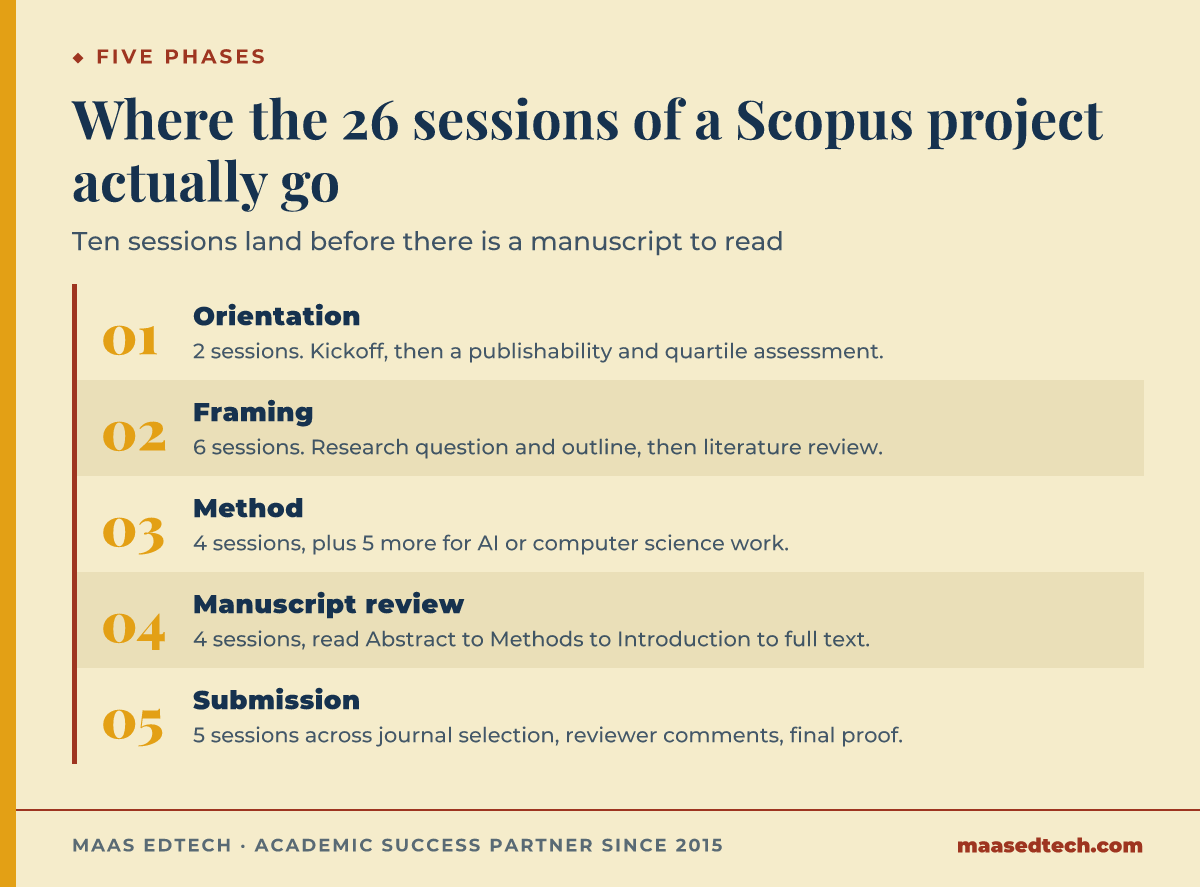
| Phase | Work item | Sessions |
|---|---|---|
| 1 · Orientation | Project kickoff | 1 |
| 1 · Orientation | Topic direction and publishability assessment | 1 |
| 2 · Framing | Research question and outline | 3 |
| 2 · Framing | Literature review and gap analysis | 3 |
| 3 · Method | Methodology and data analysis | 4 |
| 3 · Method | Experimental design and programming (AI / computer science only) | 5 |
| 4 · Manuscript review | Section-by-section review | 4 |
| 5 · Submission | Journal selection, submission package, submission | 2 |
| 5 · Submission | Working through reviewer comments | 2 |
| 5 · Submission | Final manuscript after acceptance | 1 |
Read the distribution rather than the total. 10 of the sessions land in phases 2 and 3, before there is a manuscript to read. 5 land in phase 5, after the manuscript leaves your hands. The writing itself is not a phase; it happens between sessions, and the sessions exist to make sure what you write is defensible when it arrives at an editor's desk.
Why do the first two sessions decide whether the project is viable at all?
Direct answer: Phase 1 asks whether the study, as currently designed, can reach a Scopus-indexed journal at all and if so, which quartile is realistic. Q1 means the top quartile of journals in a subject category, the percentile ranking published in Clarivate's Journal Citation Reports (JCR), in Elsevier's CiteScore tables, or as SCImago Journal Rank (SJR) percentiles.
Elsevier's own journal-selection guidance (Elsevier, n.d.) tells authors to weigh aims and scope, audience and indexing before impact metrics, which is the same order of questions phase 1 works through, and the 2 to 3 sessions it takes are far cheaper than the 4 to 12 months a wrong-fit submission burns before rejection. That verdict is cheaper to hear in session 2 than in month 8.
The kickoff session establishes what exists: data collected or not, ethics approval in place or pending against the kind of core practices the Committee on Publication Ethics (COPE, n.d.) publishes, co-authors agreed, deadline fixed by a graduation date or a funding milestone. The second session assesses publishability. A study can be methodologically sound and still be unpublishable in a Q1 outlet because its contribution is incremental, its sample is too narrow for the journals in that subject category, or its design cannot answer the question it poses.
The uncomfortable outcome of phase 1 is sometimes a recommendation to re-scope the study or aim at Q2, the 25% to 50% band, rather than Q1. Researchers who skip this assessment tend to discover the same verdict 18 months later, in a desk rejection letter, having spent the intervening year writing.
What does the framing phase produce, and why does it take six sessions?
Direct answer: Phase 2 produces two documents, a research question with a structural outline, and a literature review that names a specific gap. 6 sessions is the realistic cost of getting both to a state a reviewer will accept.
3 sessions go to the research question and outline. The work here is narrowing: a question that can be answered with the data you have, phrased tightly enough that the outline follows from it rather than being imposed on it. The other 3 go to the literature review and gap analysis, searched across Scopus and Google Scholar together rather than either alone, and, where the field calls for it, a subject-specific index such as PubMed or IEEE Xplore. A gap is not an absence of publications on your topic. It is a specific unresolved disagreement, an untested boundary condition, or a population where an established finding has never been checked. Reviewers read the gap statement as a claim, and they check it.
The framing phase is where the most rework happens, and where rework is cheapest. Restructuring an argument at outline stage costs a session. Restructuring it after 8,000 words exist costs weeks, and authors resist it precisely because the words already exist.
Where does the methodology phase absorb the most time?
Direct answer: 4 sessions on methodology and data analysis for most disciplines, plus 5 more on experimental design and programming when the study is in AI or computer science, the single largest block in the whole roadmap.
Methodology sessions cover design justification, sampling, instrument validity, analysis strategy, and the assumptions the chosen tests carry, checked against the relevant reporting standard published by the EQUATOR Network, PRISMA 2020 for reviews or the CONSORT 2010 statement for trials. The output is not a completed analysis. It is an analysis you can defend when a reviewer asks why you used this approach rather than an obvious alternative, the kind of question Annesley (2011) frames as the most common first-round challenge.
For AI and computer science studies the additional block covers experiment design, implementation, and reproducibility of results. This is why the same roadmap runs 26 sessions in one discipline and 21 in another. Transparent reporting of how models were trained and validated, the same standard platforms like Papers With Code encourage authors to publish alongside their code, has become a routine reviewer demand in these fields, and a study that cannot supply it will not survive review however strong its headline accuracy.
Why is the manuscript reviewed section by section rather than front to back?
Direct answer: Phase 4 reviews the manuscript in the order Abstract → Methods → Introduction → full text, the reverse of the IMRAD order most journals require in the final version, because each of those sections constrains the next and reading them in narrative order hides the mismatches.
The abstract comes first because it forces a single paragraph, typically 150 to 250 words, that states the contribution. If that paragraph is vague, no amount of editing further down will fix it. Methods come second because they are the section reviewers check hardest for reproducibility, and because what the methods actually support determines what the introduction is allowed to promise. The introduction is written third, once the contribution and the evidence are both settled, so that the framing matches the study rather than the study straining to meet the framing. Only then is the full text read end to end for coherence, alongside formatting to the target journal's requirements.
4 sessions cover this. It is the shortest of the substantive phases, and it is short because phases 2 and 3 did the structural work already.
What happens after submission, and what is outside anyone's control?
Direct answer: 5 sessions sit after the manuscript is finished, 2 for journal selection and the submission package, 2 for working through reviewer comments, and 1 for the final manuscript after acceptance. What no session can influence is the editorial decision itself.
Journal selection is a matching exercise: scope fit, citation fit, Scopus CiteScore percentile, and realistic acceptance odds, decided before submission rather than after a rejection, and cross-checked against the Directory of Open Access Journals (DOAJ) inclusion criteria and a predatory-journal screen such as Cabells' Predatory Reports. The submission package around it, cover letter, suggested reviewers, ethics and data statements, author contributions, is where avoidable delays cluster, because an incomplete package is returned before it reaches an editor.
The reviewer-response sessions produce a point-by-point response letter alongside the revised manuscript, following the same logic Annesley (2011) and Noble (2017), writing in PLOS Computational Biology, both set out for responding to reviewers. Structured, complete responses that address every comment, including the ones you disagree with, are consistently associated with better revision outcomes. Disagreeing is allowed; ignoring is not.
The final session handles proofs and any post-acceptance corrections, the same category of obligation the Committee on Publication Ethics sets out in its core-practices guidance. It exists because acceptance is not the end of the author's obligations, and because errors introduced at proof stage are expensive to correct once a DOI is live and the paper starts accruing citations in Scopus and Google Scholar.
One boundary should be stated plainly. MAAS Publishing Advisory commits to the scope of work and the seniority of the mentor, not to a journal accepting your paper. That decision belongs to an editor and to peer reviewers, and no advisory service is in a position to promise it.
How long does the whole arc take in calendar time?
Direct answer: 4 to 10 months on the international route and 2 to 4 months domestically, and those figures cover your work, not the journal's. Peer review adds its own clock on top.
The two timelines are frequently confused. The session roadmap measures the work you and your mentor do. Peer review measures what happens after the manuscript leaves you, and it typically runs 2 to 4 months to a first decision, with wide variance by field and journal (Huisman & Smits, 2017), figures broadly consistent with the crowd-sourced review-time data SciRev (n.d.) collects directly from authors. Björk and Solomon (2013) trace that delay largely to reviewer turnaround rather than editorial processing; publishers such as Springer Nature (n.d.) describe a broadly similar window for their own editorial processing after submission, and are explicit about what that window is for: "reviewers will assess the technical soundness and scientific validity of your methods, analysis and interpretation, all of which must be appropriate, properly conducted, ethically robust and fully supported by the data" (Springer Nature, n.d.). International submissions commonly go through 2 to 3 review rounds, each adding a further 2 to 4 months. From submission to publication, 4 to 12 months is a normal range, and longer is not unusual.
Planning against a graduation date therefore means counting backwards from the journal's clock, not from your own. A researcher who needs a publication in hand by a fixed date and starts 12 months out is working to a tight schedule, not a comfortable one.
Frequently asked questions
Can I join partway through if I have already written a draft?
Yes, and it is common. The first session becomes a retrospective check on the 6-session phase 2 and 3 work described above: whether the research question, the gap statement, and the methodology in the existing draft hold up. Where they do, the project resumes at phase 4. Where they do not, the honest recommendation is to fix the framing before polishing prose that argues for a claim the evidence does not support.
Does this roadmap work for a literature review or a conceptual paper?
Yes, with phase 3 reshaped. In a systematic review the methodology sessions cover the protocol, search strategy, inclusion criteria, and screening procedure, typically documented in a PRISMA 2020 flow diagram, all of which must be fixed before screening begins. Conceptual papers replace data analysis with the development and defence of the theoretical contribution, still cross-checked against the same Web of Science and Scopus coverage used for an empirical study.
Is the session count fixed?
No. 26 is the standard international route; 21 applies where there is no experimental programming; 13 is the domestic route. The actual number is set at kickoff against the state of your study, and a project arriving with clean data and ethics approval already in place needs fewer sessions than one starting from a research idea.
What happens if the paper is rejected?
Rejection re-enters the roadmap at phase 5, targeting the next journal identified during selection from the same shortlist built against Scopus and Web of Science coverage. Reviewer comments from a rejection are usable material for the next submission, in the same spirit as the reviewer-response practice Noble (2017) sets out, which is why the response sessions matter even when the decision is negative.
Who is listed as an author?
You are. Authorship follows the criteria your target journal applies, most commonly the International Committee of Medical Journal Editors (ICMJE, n.d.) framework, which for most international journals means substantial contribution to the work, involvement in drafting or revising it, and accountability for the result. A mentor advising on method or structure does not meet those criteria and is not an author, a distinction the Committee on Publication Ethics (COPE, n.d.) treats as a core research-integrity issue rather than a formality.
Plan your publication project with a mentor
MAAS Publishing Advisory offers a free consultation where a mentor reviews your study or draft, gives a realistic quartile assessment, and maps which of the 5 phases your project actually starts at.
Book a Publishing Advisory consultation →
Related guides
- How does a Vietnamese researcher get published in a Scopus Q1 or Q2 journal?, the broader Q1/Q2 playbook this roadmap sits inside
- How do you choose the right Scopus journal for your paper?, the matching exercise inside phase 5
- How long does peer review take for a Scopus journal?, the journal's clock, in detail
- How do you respond to a major revision from a Scopus journal?, the revision round, step by step
- Publishing Advisory service, how the advisory engagement is scoped
- Scopus Publishing resource hub, templates, checklists, and reading lists
References
- Annesley, T. M. (2011). Top 10 tips for responding to reviewer and editor comments. Clinical Chemistry, 57(4), 551–554. https://doi.org/10.1373/clinchem.2011.162388
- Björk, B.-C., & Solomon, D. (2013). The publishing delay in scholarly peer-reviewed journals. Journal of Informetrics, 7(4), 914–923. https://doi.org/10.1016/j.joi.2013.09.001
- Committee on Publication Ethics [COPE]. (n.d.). Core practices. Retrieved August 14, 2026, from https://publicationethics.org/core-practices
- Elsevier. (n.d.). Journal selection. Retrieved August 22, 2026, from https://www.elsevier.com/publishing/publish-in-a-journal/journal-selection
- Huisman, J., & Smits, J. (2017). Duration and quality of the peer review process: The author's perspective. Scientometrics, 113(2), 633–650. https://doi.org/10.1007/s11192-017-2310-5
- International Committee of Medical Journal Editors [ICMJE]. (n.d.). Defining the role of authors and contributors. Retrieved August 14, 2026, from https://www.icmje.org/recommendations/browse/roles-and-responsibilities/defining-the-role-of-authors-and-contributors.html
- Noble, W. S. (2017). Ten simple rules for writing a response to reviewers. PLOS Computational Biology, 13(10), Article e1005730. https://doi.org/10.1371/journal.pcbi.1005730
- SciRev. (n.d.). Duration of the first review round. Retrieved August 14, 2026, from https://scirev.org/analyses/first-round/
- Springer Nature. (n.d.). Editorial process after submission. Retrieved August 14, 2026, from https://support.springernature.com/en/support/solutions/articles/6000251301-editorial-process-after-submission