
◆ Thesis and dissertation
How do you prepare for a viva voce if English is a second language?
◆ Watch the 60-second guide
The viva voce is the part of postgraduate research Vietnamese students worry about most, and the part that gets the least time in actual training. A Vietnamese candidate in Manchester or Sydney typically spends 3 to 5 years writing in a second language, but only a few hours rehearsing how to defend it out loud. This guide is MAAS's playbook for mock vivas: seven questions students ask most often, plus six FAQs from the night before defence.
◆ Question 1 / 7 · What a viva is
What is a viva voce defence and why does it sometimes carry more weight than the written thesis?
Direct answer: A viva voce ("by living voice") is an oral examination of your thesis by two or more academic examiners. In the UK and most European universities it is mandatory and binding, a doctorate cannot be awarded until you defend in person. Outcomes are tiered across five recommendations: pass with no corrections, minor corrections, major corrections, re-submission, or fail.
Evidence: Analysis of 26,076 PhD candidates across 14 UK universities (2006–2017) found that 96% of candidates passed their viva. Among those who passed, only about 5% needed no amendments, 79% received minor corrections and 16% major corrections. Only 3.3% failed outright, and of those, around 97% were offered an MPhil instead of being awarded nothing. Translation: the viva itself is rarely where doctorates die, but it is almost always where the category of pass gets decided.
Example: A MAAS student in 2024 submitted a Distinction-grade thesis at a Russell Group university and walked into the viva expecting "minor corrections" as a worst case. The external examiner pushed hard on one chapter where the methodology had not been justified clearly enough. Outcome: minor corrections, but with six weeks of rewrite work. The thesis was strong; the defence of one chapter was not.
Before any of that, there is a calendar. In Vietnam the stages between submitting the thesis and receiving the degree each carry a ceiling set by regulation, and our guide to the timeline from thesis submission to the award sets out what those ceilings are and what starts them running.
◆ Question 2 / 7 · UK, Australia, Vietnam
How is the viva different in the UK, Australia, and Vietnam?
Direct answer: The format is genuinely different across the three systems, and Vietnamese students often only realise this in the final term. In the UK, the viva is closed-door, mandatory, and usually run by two examiners (one internal, one external), lasting 1.5 to 3 hours.
In Australia, an oral defence is less common, historically Australian PhDs were examined by written reports from external reviewers alone, although universities like the University of South Australia made the oral defence compulsory from 2016 onwards. In Vietnam, defence is typically open and public, with a panel of 5 to 7 reviewers and an audience.
Evidence: Research on the Australian system, the University of Newcastle's (n.d.) cross-national viva study, Australia, confirms that the viva remains optional or partial at most Australian universities, and Thesis Whisperer (Inger Mewburn's widely-cited blog) notes that the Australian PhD examination process "mirrors the journal review and publication process rather than that of the more usual international research degree examination". The implication for Vietnamese students is operational: if you are in an Australian programme that does not require an oral defence, your written thesis carries 100% of the weight, and there is no second chance to clarify a weak chapter.
Example: A Vietnamese student who finished her Masters by Research at Macquarie University was offered a transferable credit pathway into a Vietnamese PhD programme. She assumed defence in Vietnam would feel similar to the practice viva she had done with her Australian supervisor. It did not. The public format, the questions from non-specialist panel members, and the bilingual switching between Vietnamese and English questions caught her off guard. MAAS coaching for Vietnamese students who plan a return-defence now includes a public-format rehearsal explicitly.
◆ Question 3 / 7 · The first 10 minutes
What questions do examiners ask in the first 10 minutes?
Direct answer: Three opening questions account for roughly 80% of viva starts: "Could you summarise your thesis in 5 minutes?", "Why did you choose this topic?", and "What is your contribution to knowledge?". If you have a polished, drilled answer for these three questions, you will get through the first 10 minutes and the first 10 minutes set the tone for the next two hours.
Evidence: Higher-education guidance from Times Higher Education (n.d.) and DiscoverPhDs (n.d.) both identify the five-minute thesis summary as the single most common opener in UK PhD vivas. The examiners are not trying to catch you out; they are listening for clarity, confidence, and whether you can articulate your core contribution in your own words, without reading from the thesis. That ability to speak your work fluently is also the surest answer to any doubt about authorship, including the kind that AI-detection false positives can raise for ESL writers. A strong answer names the topic, the method, the key finding, and its significance in under 300 words.
Example: In a MAAS mock viva session, a student initially took 11 minutes to deliver his "5-minute summary". The mentor stopped him, broke the summary into four blocks (problem, method, finding, significance), and gave a 90-second budget for each. By the third rehearsal he was hitting 4 minutes 30 seconds and the language was tighter. On defence day his real opener landed at 4 minutes 50 seconds and the external examiner thanked him for being "refreshingly direct".
◆ Question 4 / 7 · A question you missed
How should ESL candidates handle a question they don't immediately understand?
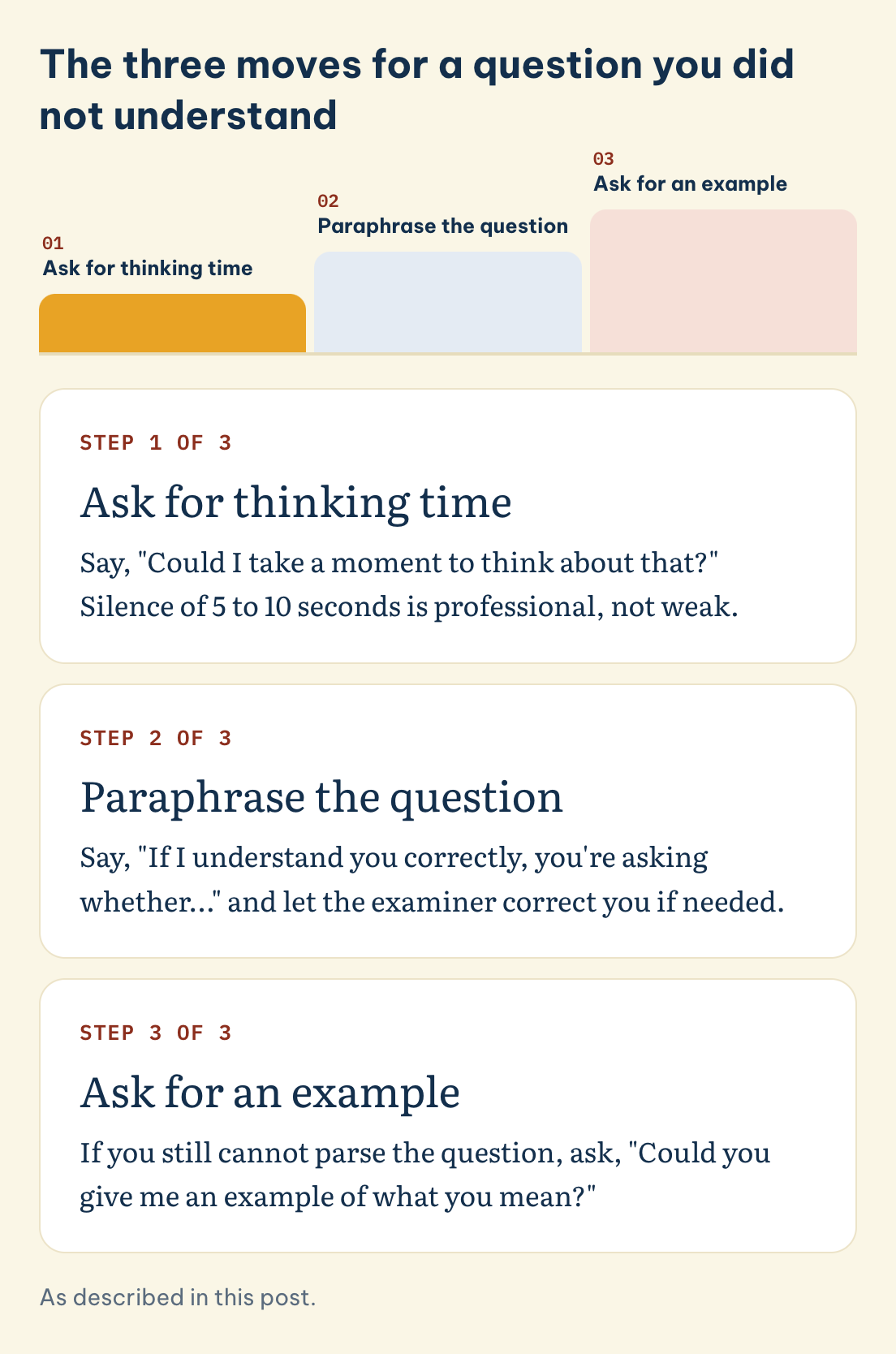
Direct answer: There are three moves to learn, in this order. First: ask for thinking time, "Could I take a moment to think about that?", silence of 5 to 10 seconds is professional, not weak. Second: paraphrase the question back, "If I understand you correctly, you're asking whether…" and let the examiner correct you if needed. Third, if you still cannot parse the question: "Could you give me an example of what you mean?". None of these moves cost you marks. All three buy you control.
The three moves for a question you did not understand
Tap a move to see what to say and why it works, in the order the post gives them.
Step 1 of 3
Ask for thinking time
Say, "Could I take a moment to think about that?" Silence of 5 to 10 seconds is professional, not weak.
Step 2 of 3
Paraphrase the question
Say, "If I understand you correctly, you're asking whether…" and let the examiner correct you if needed.
Step 3 of 3
Ask for an example
If you still cannot parse the question, ask, "Could you give me an example of what you mean?"
Save this figure
Evidence: Doctoral examination research (Tinkler & Jackson's The Doctoral Examination Process) and Vitae's (n.d.) official viva resources both confirm that examiners expect candidates to paraphrase difficult questions. The Vitae guidance is explicit: if you don't understand a question, asking for it to be repeated or rephrased is not a sign of weakness, it is a sign of careful engagement. MAAS observation across more than 40 mock viva sessions: candidates who use the paraphrase move score noticeably higher because they stop guessing.
Example: A MAAS coachee in 2025 panicked during a mock viva, stayed silent for 30 seconds, then guessed at what the examiner had asked and answered the wrong question. We coached her through the three-move drill (think, paraphrase, ask for example) and rehearsed it on 20 ambiguous test questions. In her real defence two weeks later, when the external asked a question she did not fully catch the first time, she used move two and bought herself the time and clarity to answer well. Outcome: pass with minor corrections.
◆ Question 5 / 7 · Answer length
How long should each viva answer be, and when is silence the right move?
Direct answer: Use a length budget. Factual or definitional questions: 60 to 90 seconds. Critical-analysis questions ("Why did you choose X over Y?"): 2 to 3 minutes. Yes/no or clarification questions: 30 seconds. A 3- to 5-second pause before you answer reads as professional and considered. A pause longer than 15 seconds reads as panic, exit it with the paraphrase move from the previous section.
Evidence: Research on viva dynamics by Tinkler and Jackson (2004) and follow-up work by Trafford and Leshem (2008) in Stepping Stones to Achieving Your Doctorate consistently find that the most common mistake first-time candidates make is over-answering, talking past the point of value and inviting follow-up challenges. Examiners report that they form their judgment on the first 60 to 90 seconds of any answer; everything after that is the candidate either reinforcing or unwinding the case.
Example: A MAAS coachee, a perfectionist by temperament, used to talk for 4 minutes on every question, including yes/no ones. We taught him a hand-on-thigh tactile signal: tap your thigh once when 90 seconds passes, twice when 2 minutes pass, and stop talking on the second tap unless you have a concrete point left. In the real defence he closed three answers cleanly at 90 seconds and the examiners moved on without follow-up, a sign the answer had landed.
◆ Question 6 / 7 · Practising the viva
What is the best way to practise a viva when your supervisor is not a native English speaker?
Direct answer: Build a three-part drill. Part one: a mock viva with two examiners independent of your supervisor, one in-field, one out-of-field so you experience the cross-disciplinary push-back that real examiners use. Part two: self-record yourself answering 20 test questions, then listen back to flag filler words ("um", "you know", "actually") and overlong answers. Part three: a 60-minute session with a native-English peer from outside your field, who has to be able to understand your contribution from your spoken explanation alone.
Evidence: Vitae's Researcher Development Framework lists "Communication and dissemination", including public engagement and impact, as a core doctoral competency, and explicitly recommends cross-disciplinary practice with non-specialists. MAAS internal data from over 60 mock viva sessions with Vietnamese candidates shows that the single highest-value improvement comes from the out-of-field examiner role, because it forces the candidate to strip jargon and explain assumptions in plain English.
Example: A MAAS student whose supervisor was a Vietnamese academic working at a UK university, both spoke English as a second language, had practised the viva exclusively in their shared technical vocabulary. In her first MAAS mock viva the out-of-field mentor (an applied mathematician sitting in on an educational-policy viva) asked, "Can you explain what 'curricular alignment' actually means in a sentence I could tell my parents?" The candidate froze. We then ran a 90-minute crossfire drill. By the real defence she was opening every technical answer with one plain-English sentence before the specialist detail.
◆ Question 7 / 7 · A hostile examiner
How do you handle a hostile examiner or one who keeps pushing back on your methodology?
Direct answer: A hostile examiner is not the same as an unfair examiner. Three rules. First: concede minor points early, "That is a fair point, and in a revised version I would tighten the wording in section 3.4." Second: hold the line on main findings, but back the hold with evidence, "I weighed that option, and chose X because the literature I cite in chapter 2 supports it; here is why I think the trade-off was the right one." Third: never argue. The closing move on any contested exchange is always a version of "I appreciate that perspective, and here is how I weighed it", then stop talking.
Evidence: Trafford and Leshem's work on examiner dynamics, plus the Vitae guidance on "After your viva", both emphasise that examiners expect push-back as a normal part of the viva and that they read concession-and-defence as a marker of doctoral maturity. Writing for doctoral candidates preparing for a US-style defence, The Thesis Whisperer notes that a tough panel is not the same as a hostile one, "remember that they are also upholding the high research standards of the university and their part in it" (The Thesis Whisperer, 2018). The danger zone is not push-back itself; it is the candidate either capitulating on every point (which looks like the thesis was not theirs) or refusing all push-back (which looks defensive and unscholarly).
Example: A MAAS coachee defending a mixed-methods thesis met an external examiner who challenged her sample size in the quantitative phase. She conceded the sample-size limitation, then held the line on the mixed-methods rationale itself, citing the specific theoretical justification from chapter 3. The examiner moved on. Outcome: minor corrections, with the sample-size limitation added to the "future research" section as a developmental note, not a fatal flaw.
Frequently asked questions
What is a viva voce?
A viva voce, literally "by living voice", is the oral part of postgraduate assessment, in which two or more academic examiners question you on your thesis. Where it is compulsory and binding, as in the UK and most European universities, nobody receives the doctorate without defending in person. In an analysis of 26,076 UK PhD candidates, 96% passed, so the viva mostly decides which category of pass you receive, from no corrections to major corrections.
Should I memorise my thesis word-for-word before the viva?
No. Memorise the structure, your single-sentence contribution, your top three limitations, and your top five references. Word-for-word memorisation produces a robotic delivery that collapses the moment an examiner asks an off-script question.
Can I bring notes into the viva?
Yes, at almost all UK and Australian universities. You can bring an annotated copy of your thesis (with tab markers on key chapters), a one-page summary sheet, and a list of your main references. Laptops are generally not allowed unless pre-approved with the chair.
What should I wear to a viva voce?
Business casual or smart casual at most UK and Australian universities, a shirt with a blazer, no tie required. A full suit is overkill and can read as anxious. For an open Vietnamese defence, dress more formally: áo dài or a suit is appropriate to the public-format expectation.
What does "pass with minor corrections" actually mean as an outcome?
It means the thesis is accepted in principle but you must make small textual revisions, typos, references, rephrasing of a few paragraphs, occasionally a tightened argument in one section, typically within one to three months. Your examiners then re-check the changes by email and no second oral defence is required. This is the most common UK viva outcome (around 79% of passes).
How do I prepare in the final 48 hours before the viva?
Stop reading new material. Re-read your abstract and conclusion once. List your top five contributions and top three limitations on a single page. Sleep at least eight hours. On defence day eat lightly, arrive 30 minutes early, use the bathroom before you go in, and put your phone on aeroplane mode.
Can MAAS coach me through a mock viva voce?
Yes. MAAS Academic Mentoring offers a 90-minute mock viva with two mentors, one in-field, one out-of-field, followed by a written feedback report and a 30-minute follow-up to rehearse the weakest answers. The session is designed to mirror the cross-disciplinary push-back of a real UK or Australian viva, with explicit support for ESL candidates on paraphrasing, length-budgeting, and concession-and-defence tactics. Book a consultation through our contact page.
Ready to defend with confidence?
Vietnamese postgraduates who walk into a viva having only practised with their own supervisor are walking in undertrained, not because their supervisor is bad, but because a viva is a cross-examination by people you have not been talking to for three years. The drill matters. The drill is what MAAS coaches.
If you have a viva scheduled in the next 6 to 12 weeks, the highest-leverage hour you can spend is a structured mock with feedback. Book a mock viva consultation with MAAS Academic Mentoring →
Related guides
Free course: Academic writing essentials for postgraduate students: three short lessons on theoretical frameworks, the viva and APA 7th referencing, published free on the OpenLearn Create platform of The Open University
What goes on each slide of a thesis defence deck?: the slide by slide spine four departmental guides publish
Why do committees fail or ask for major revisions at a thesis defence?: the failure modes to fix before you defend
Methodology guide: the chapter examiners challenge most often in the viva
Theoretical framework guide: defend your theoretical choices under cross-examination
Literature review guide for PhD students: defend the gap and sources your review argued
How do UK and Australian dissertation rubrics actually differ?: why the UK requires a viva while Australia examines on the thesis alone
How do you choose a dissertation topic that won't run out of literature?: scoping a topic you can sustain to the viva
Dissertation Mentoring: phase-by-phase coaching
Academic Mentoring service: 1:1 mentor matching for viva prep
Presentation & Design Support service: slide decks and speaker scripts coached for your viva defense
References
- DiscoverPhDs. (n.d.). PhD failure rate. Retrieved June 8, 2026, from https://www.discoverphds.com/advice/doing/phd-failure-rate
- The Thesis Whisperer. (2018, June 13). The dreaded doctoral defense. https://thesiswhisperer.com/2018/06/13/the-dreaded-doctoral-defense/
- Times Higher Education. (n.d.). How to answer viva questions. Retrieved June 8, 2026, from https://www.timeshighereducation.com/campus/how-answer-viva-questions
- Tinkler, P., & Jackson, C. (2004). The doctoral examination process: A handbook for students, examiners and supervisors. Open University Press.
- Trafford, V., & Leshem, S. (2008). Stepping stones to achieving your doctorate. Open University Press.
- University of Newcastle. (n.d.). Cross-national viva study. Retrieved June 8, 2026, from https://www.newcastle.edu.au/research/centre/sorti/research/cross-national-viva-study
- Vitae. (n.d.). The viva and after your viva. Retrieved June 8, 2026, from https://vitae.ac.uk/resource/working-in-research/doctoral-research/the-viva/
This article is part of the MAAS Journal series for Vietnamese international postgraduate students. MAAS Academic Mentoring is an advisory partner; we coach students through a phase-by-phase delivery model with developmental feedback from PhD-level mentors. We do not write theses on students' behalf, and our mock vivas are designed to strengthen the student's own defence.
Open licence. This lesson is released under Creative Commons Attribution 4.0 International (CC BY 4.0). You may share, translate and adapt it for any purpose, including commercially, provided you give appropriate credit to MAAS Education Technology JSC and link back to this page. The citable open-access version, with a permanent DOI, is deposited at Zenodo.
A free 20-minute consultation with MAAS Academic Mentoring, to talk through how you would rehearse your viva.
Book Free Discovery ▸