
◆ Thesis mentoring
How do you choose a dissertation topic that won't run out of literature?
The dissertation topic that stalls at month six is almost never the one that was too hard; it is the one that was the wrong size, chosen before anyone checked how much literature and data existed to support it. A topic too narrow leaves nothing to review; a topic too broad leaves you unable to finish. The way to avoid both is to test a topic's literature base and practicality before you commit, not after 3 chapters in.
This guide shows you how to scope a topic's literature in an afternoon, how to tell whether it is too narrow or too broad, and how to check that it is genuinely doable within your timeframe so the topic you choose at the proposal stage is one you can still write in month six.
◆ Question 1 / 7 · Why it runs out
Why do dissertations run out of literature at month six?
Direct answer: Usually because the topic was chosen for its appeal rather than tested for its feasibility. Students commit to an idea, start writing, and only discover months later that too few sources exist for a literature review, or that the needed data cannot be reached. The problem is not the writing, but a topic selected before its practicality was checked.
Evidence: Keshavarz and Shekari (2020), writing in Library & Information Science Research and surveying 391 postgraduates, found that "research operability", whether the study can actually be carried out, was the single strongest factor in successful topic selection, followed by the availability of information resources. Luse et al. (2012) name this pattern directly: "When setting out to develop a research project, many doctoral students begin by jumping straight to a solution to a problem before they have given the problem adequate thought or sometimes before they even have a well-defined problem at all" (Luse et al., 2012, p. 144). A topic that fails on operability or literature availability does not announce itself early; it surfaces at month six, when the review will not build.
Example: A MAAS-mentored student chose a highly specific topic she was passionate about, wrote a proposal, and stalled at month five because only four relevant studies existed. Her mentor had her run a scoping search first for her next attempt, which revealed the gap before she committed and she chose a nearby topic with a workable literature base instead.
◆ Question 2 / 7 · What "enough" means
What does "enough literature" actually mean?
Direct answer: Confirmed against databases such as Scopus, Web of Science, or ProQuest Dissertations, enough literature is a base you can review and a live debate you can enter, not so little that you have nothing to build on, and not so much that the field is saturated and your contribution disappears. You are looking for an active conversation with room in it for your voice.
Evidence: Booth et al. (2025), in a guide published by SAGE, frame a key early decision as "deciding how much literature to include," which presupposes there is a workable volume in the first place. A topic with a handful of sources cannot sustain the critical synthesis a dissertation requires, while one with tens of thousands signals a field so worked over that carving out a defensible gap becomes its own project. The sweet spot is a topic with a solid body of recent work and an unresolved question inside it. Ravitch and Riggan (2017), in a book published by SAGE, add that the conceptual framework you bring to a topic, the assumptions and prior knowledge that shape which gap looks worth occupying, should guide that choice as much as the raw volume of literature does. Creswell and Creswell (2018) suggest a practical way to see that volume at a glance, the literature map, a visual summary of the research already done on a topic that shows quickly whether a field is crowded or nearly empty.
Example: A student comparing two topics ran a quick search on each: one returned six results, the other returned several hundred with a clear cluster of recent debate. Her mentor helped her see that the second was not "more crowded" but "more alive", enough to review, with an open question she could occupy.
◆ Question 3 / 7 · Scoping the literature
How do you scope a topic's literature before committing?
Direct answer: Run a scoping search, a deliberate trial search of the main databases, before you write a word of your proposal. The goal is not to read everything, but to gauge three things quickly: roughly how much exists, how recent it is, and whether there is an obvious unresolved question. An afternoon of scoping saves a term of stalling.
Evidence: Booth et al. (2025) set out "defining your scope" and "searching the literature and assessing the evidence" as distinct, early steps in any systematic approach, precisely so that the size of the literature is known before the project is designed around it. A structured reporting standard such as PRISMA is built on the same logic: search first, across databases such as Scopus, Web of Science, or Google Scholar, and only then design the project around what actually exists. Keshavarz and Shekari (2020) reinforce that information resources are a leading determinant of a topic's viability, which makes checking them a proposal-stage task, not a later discovery.
Example: A MAAS-mentored student spent one afternoon searching her library's databases, ProQuest Dissertations, the British Library's EThOS service, and Google Scholar for three candidate topics. She recorded the number of relevant results and the newest publication year for each, and chose the topic with a strong recent base and a visible debate, a decision made on evidence rather than instinct.
◆ Question 4 / 7 · Too narrow
How do you tell if a topic is too narrow?
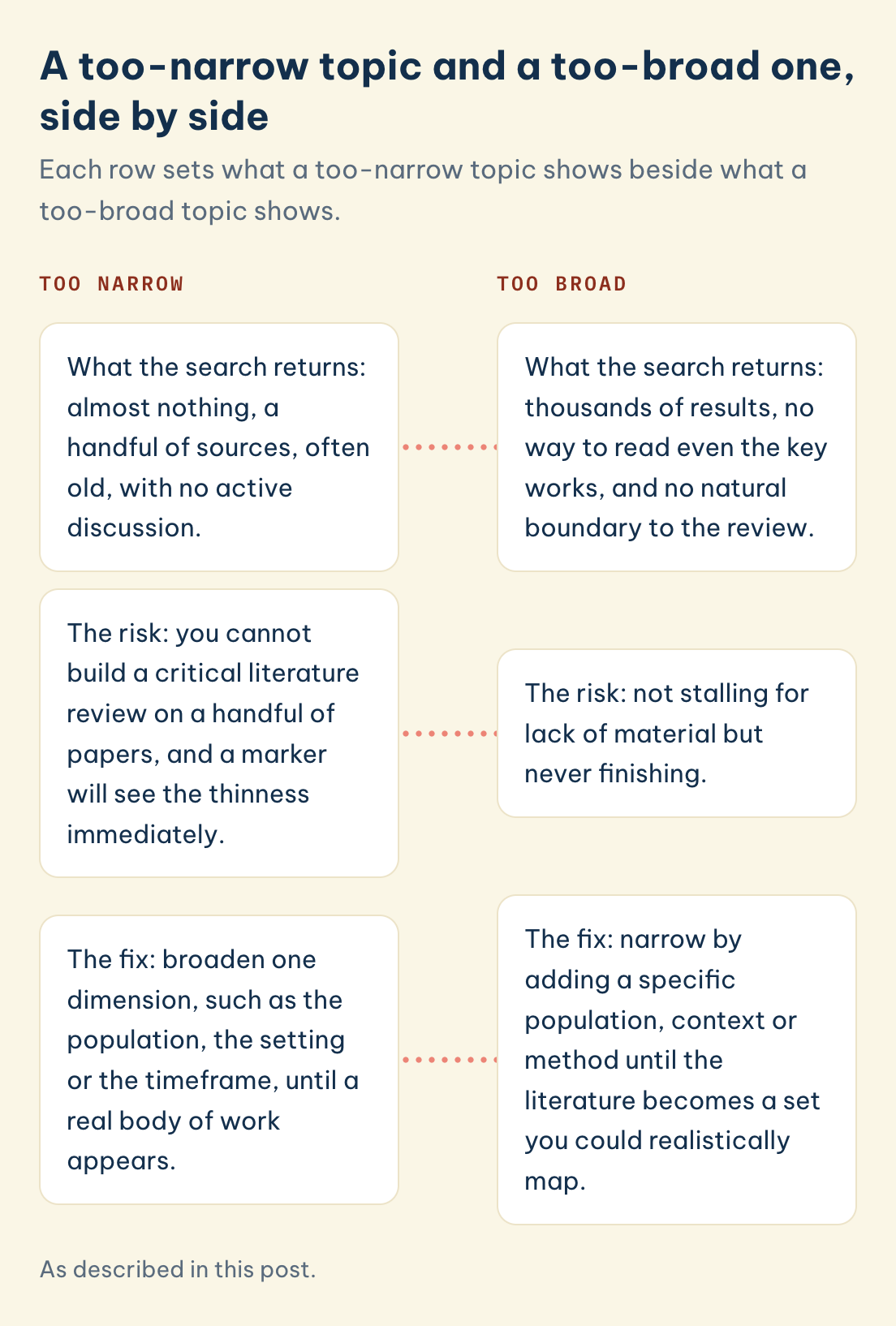
Direct answer: A too-narrow topic returns almost nothing when you scope it, a handful of sources, often old, with no active discussion. You cannot build a critical literature review on four papers, and a marker will see the thinness immediately. The fix is to broaden one dimension: widen the population, the setting, or the timeframe until a real body of work appears.
A too-narrow topic and a too-broad one, side by side
Each row sets what a too-narrow topic shows beside what a too-broad topic shows.
Too narrow
Too broad
What the search returns: almost nothing, a handful of sources, often old, with no active discussion.
What the search returns: thousands of results, no way to read even the key works, and no natural boundary to the review.
The risk: you cannot build a critical literature review on a handful of papers, and a marker will see the thinness immediately.
The risk: not stalling for lack of material but never finishing.
The fix: broaden one dimension, such as the population, the setting or the timeframe, until a real body of work appears.
The fix: narrow by adding a specific population, context or method until the literature becomes a set you could realistically map.
Save this figure
Evidence: Keshavarz and Shekari (2020) would class a topic this thin as failing on operability too, since there is no literature base to design a defensible study around. Luse et al. (2012), writing in the International Journal of Doctoral Studies, warn that over-narrowing can leave research "merely a description of small-scale or inconsequential phenomena," disconnected from any wider scholarly conversation. Booth et al. (2025) treat scope as adjustable by design, which means a topic returning too little literature is not a dead end but a signal to loosen one constraint.
Example: A student's original topic, a single policy in one small district in 1 year, returned 3 sources. Her mentor helped her broaden it to the same policy across a region over 5 years, and the literature base grew from three papers to a reviewable body without losing her core interest.
◆ Question 5 / 7 · Too broad
How do you tell if a topic is too broad?
Direct answer: A too-broad topic drowns you: thousands of results, no way to read even the key works, and no natural boundary to the review. The risk here is not stalling for lack of material but never finishing. The fix is to narrow by adding a specific population, context, or method until the literature becomes a set you could realistically map.
Evidence: Booth et al. (2025) emphasise that deciding how much literature to include is a scoping decision, and an unbounded topic makes that decision impossible. Luse et al. (2012) would recognise the same signal from the opposite direction: unmanageable breadth is still an operability failure, not just a literature problem. Keshavarz and Shekari (2020) identify operability as the top selection factor, and a topic no one could finish in the available time fails operability regardless of how interesting it is.
Example: A student who wanted to study "social media and mental health" found the field unmanageable. Her mentor guided her to narrow it to one platform, one age group, and one outcome measured over a defined period, the same interest, now a finishable project with a mappable literature.
◆ Question 6 / 7 · Beyond literature
What makes a topic "operable" beyond the literature?
Direct answer: A topic can have ideal literature and still fail if you cannot actually do the study. Operability also depends on access to data, the methods and skills the topic demands, ethical approval where people are involved, and whether all of it fits your timeframe. Check these at the proposal stage, because none of them is easy to fix later.
Evidence: Keshavarz and Shekari (2020) place research operability above every other factor in topic selection, defining it through practical constraints such as data access and feasibility rather than intellectual appeal alone. Luse et al. (2012) similarly stress readiness, being mentally and practically prepared to execute, before a topic is locked in. Creswell and Creswell (2018) add that a mixed-methods design carries its own operability cost, since it demands competence in two methodological traditions rather than one, and Davis's (1989) technology acceptance model is a reminder that a method you find awkward to use rarely gets used well. Booth et al. (2025) would frame this as a scoping constraint too: an operable topic is one whose demands on data, method, and time were sized before the proposal was written. If your design leans qualitative, methods such as Braun and Clarke's (2006) six-phase thematic analysis, published in Qualitative Research in Psychology, take real time to learn well, and that learning curve belongs inside the same feasibility check. A topic is only as good as your ability to carry it out.
Example: A student's literature-rich topic required interviews with a hard-to-reach professional group. Her mentor flagged the access problem before she committed, and she adjusted the design to a survey of a reachable population, keeping the question, changing the method to one she could actually complete.
◆ Question 7 / 7 · Locking it in
How do you lock in a topic you can sustain to submission?
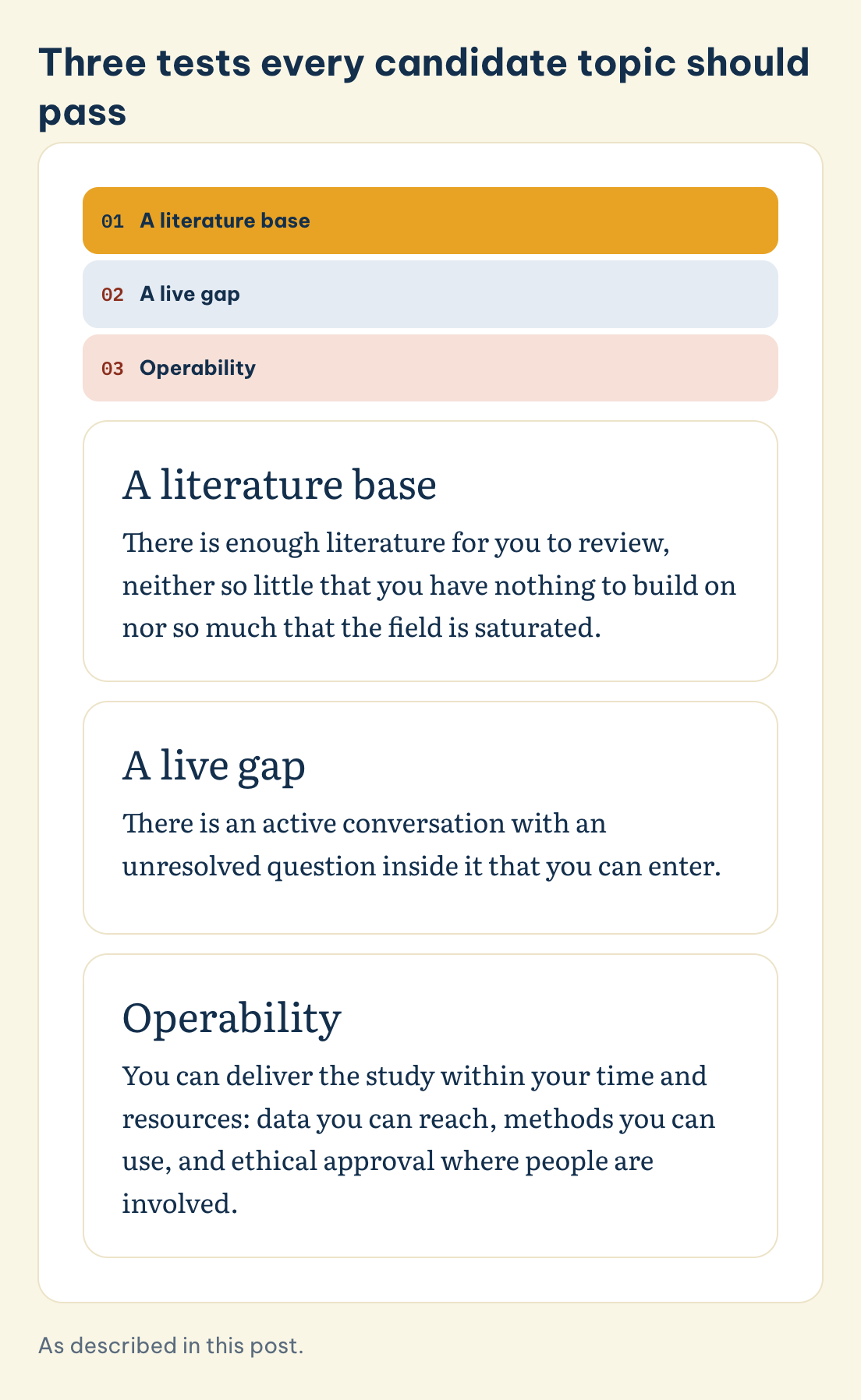
Direct answer: Put each candidate topic through three tests before you decide: a literature base you can review, a live gap you can enter, and operability you can deliver within your time and resources. A topic that passes all three, confirmed with your supervisor, is one you can still be writing confidently in month six.
Three tests every candidate topic should pass
Tap a test to see what it asks of the topic.
A literature base
There is enough literature for you to review, neither so little that you have nothing to build on nor so much that the field is saturated.
A live gap
There is an active conversation with an unresolved question inside it that you can enter.
Operability
You can deliver the study within your time and resources: data you can reach, methods you can use, and ethical approval where people are involved.
Save this figure
Evidence: The combined guidance of Keshavarz and Shekari (2020), Booth et al. (2025), and Luse et al. (2012) points to the same conclusion: viable topics are chosen against explicit criteria, resources, scope, and operability, rather than by enthusiasm alone. Confirming the choice with a supervisor adds the disciplinary judgement that turns a plausible topic into an approved one.
Example: A MAAS-mentored student scored three shortlisted topics against the three tests, took the strongest to her supervisor with the scoping evidence attached, and had it approved in one meeting. She reached month six with a full literature base and a clear question, the stall that had ended her first attempt never came.
Frequently asked questions
How much literature is "enough" for a dissertation topic?
Enough to build a critical review and to show a live, unresolved debate, typically a solid body of recent work rather than a handful of old papers. Too few sources cannot sustain a review; a saturated field makes finding a gap its own struggle.
How do I check if there is enough literature before I commit?
Run a scoping search across your library's databases, Web of Science, ERIC if your field is education, and Google Scholar for each candidate topic, and note roughly how many relevant results appear and how recent they are. An afternoon of scoping tells you whether a topic is viable.
What do I do if my topic is too narrow?
Broaden one dimension, the population, the setting, or the timeframe, until a reviewable body of literature appears, without abandoning your core interest.
What do I do if my topic is too broad?
Narrow it by adding a specific population, context, or method so the literature becomes a set you could realistically map and the study becomes finishable in your timeframe.
Is interesting literature enough to choose a topic?
No. A topic must also be operable, data you can access, methods you can use, ethics you can clear, and a scope that fits your time. Operability is consistently the strongest predictor of a topic you can complete.
Can MAAS help me choose a feasible dissertation topic?
Yes. MAAS Academic Mentoring helps you scope candidate topics across Scopus, Web of Science, and ProQuest Dissertations, test their literature base and operability, and refine the one you take to your supervisor, through a phase-by-phase model. Book a consultation through our contact page.
Ready to choose a topic you can finish?
The topics that stall are the ones chosen before anyone checked the literature and the practicality; the topics that finish are chosen against evidence. A mentor who has guided dissertations at your level can help you test your options against the literature and lock in a question you can sustain all the way to submission.
MAAS Academic Mentoring pairs you with a mentor with a doctorate, or with a master's degree and supervisory experience, within 48 hours when our network already covers that field, or in about 2 weeks if MAAS has to recruit for it. In Phase 1 of the journey, usually about 2 sessions, the mentor tests how feasible your data really is and helps you settle a main topic direction, a fallback option and a preliminary research question. Your first consultation lasts 20 minutes and is free. We coach; you stay the author, with a MAAS expert alongside you.
Book a dissertation topic consultation with MAAS →
Related guides
- How do you identify a research gap for your dissertation?: finding the unresolved question inside a viable literature base
- How do you write research questions and objectives?: turning a scoped topic into an answerable question
- How do you write a literature review for a PhD as a Vietnamese student?: building the review your topic must support
- How do you write a PhD research proposal?: the document your chosen topic anchors
- How do you decode common supervisor feedback codes?: acting on the feedback your proposal attracts
- Dissertation mentoring resource hub: scoping templates and proposal checklists
Tools & resources
- Google Scholar, a fast first pass for gauging the volume and recency of literature on a topic: https://scholar.google.com/
- Scopus source and document search, for checking indexed coverage of your field: https://www.scopus.com/
References
- Braun, V., & Clarke, V. (2006). Using thematic analysis in psychology. Qualitative Research in Psychology, 3(2), 77–101. https://doi.org/10.1191/1478088706qp063oa
- Creswell, J. W., & Creswell, J. D. (2018). Research design: Qualitative, quantitative, and mixed methods approaches (5th ed.). SAGE Publications.
- Davis, F. D. (1989). Perceived usefulness, perceived ease of use, and user acceptance of information technology. MIS Quarterly, 13(3), 319–340. https://doi.org/10.2307/249008
- Ravitch, S. M., & Riggan, M. (2017). Reason & rigor: How conceptual frameworks guide research (2nd ed.). SAGE.
- Booth, A., Sutton, A., Clowes, M., & Martyn-St James, M. (2025). Systematic approaches to a successful literature review (4th ed.). SAGE.
- Keshavarz, H., & Shekari, M. R. (2020). Factors affecting topic selection for theses and dissertations in library and information science: A national scale study. Library & Information Science Research, 42(4), Article 101052. https://doi.org/10.1016/j.lisr.2020.101052
- Luse, A., Mennecke, B. E., & Townsend, A. M. (2012). Selecting a research topic: A framework for doctoral students. International Journal of Doctoral Studies, 7, 143–152. https://doi.org/10.28945/1572
This article is part of the MAAS Journal series for Vietnamese international postgraduate students. MAAS Academic Mentoring is an advisory partner; we coach students on scoping and designing research through a phase-by-phase delivery model. We do not write, submit, or guarantee the outcome of any student's work.
A free 20-minute consultation with MAAS Academic Mentoring, to talk through the topics on your shortlist.
Book Free Discovery ▸