
◆ Thesis and dissertation
What do common feedback codes from supervisors mean?
Feedback codes from a supervisor often arrive as a handful of compressed phrases in the margin, "tighten this," "engage more critically," "needs more synthesis," "so what?" and the hardest part is rarely the grammar. It is working out what each code is actually asking you to change. For a Vietnamese student writing in a second language, these codes can feel deliberately opaque, yet almost every one maps onto a specific, learnable action once you know how to read it.
This guide translates the most common feedback codes into concrete revisions, explains why they are written so briefly in the first place, and shows how to turn a page of margin notes into a genuine improvement in your next mark rather than a source of quiet panic.

◆ Question 1 / 7 · Why codes
Why is supervisor feedback written in codes at all?
Direct answer: Not to confuse you. Markers mark 40 or 60 scripts in 2 to 3 weeks, spending 20 to 30 minutes on a 5,000 word chapter, so a phrase like "develop this" stands in for a longer instruction. Sadler (1989) argues a student can only close the gap a comment describes by building their own capacity to judge quality.
Evidence: Derham et al. (2021), writing in Assessment & Evaluation in Higher Education, analysing 2,101 in-text comments on 60 essays, found that most comments target the task rather than the underlying reasoning, and that lower-graded work attracts more corrective and interrogative annotations, the very "Why?" and "Evidence?" codes students find hardest to act on. Ryan et al. (2022) showed that students make sense of feedback most easily when comments are clear and specific, and struggle most when comments are brief, carry several intentions at once, or are softened to protect feelings. In other words, the codes are hard to decode precisely when they are shortest.
Example: A MAAS-mentored student read a single word, "unclear", beside her whole second paragraph and froze, unsure what to fix. Her mentor helped her see that "unclear" almost always points to a missing link between two ideas, not to a grammar error. She added 1 sentence connecting the claim to the evidence, and the paragraph read cleanly.
◆ Question 2 / 7 · Common codes
What do the most common feedback codes actually mean?
Direct answer: Most supervisor codes fall into a set of 8 recurring instructions. The table below translates the ones Vietnamese postgraduates ask about most, and pairs each with the concrete action it calls for. Read the code as a prompt to do something specific, not as a verdict.
Eight common supervisor feedback codes
Tap a code to see what it usually means and what to do.
Item 1 of 8
Tighten this
It usually means wordy or repetitive writing, with the point buried. What to do is to cut redundancy and make one clear claim per sentence.
Item 2 of 8
Engage more critically
It usually means writing that is too descriptive, so you report but do not evaluate. What to do is to add a judgement after the description, covering strengths, weaknesses and "so what".
Item 3 of 8
Needs more synthesis
It usually means listing sources separately instead of connecting them. What to do is to group sources by argument and show where they agree, differ and combine.
Item 4 of 8
So what?
It usually means a missing significance. What to do is to state why the point matters to your research question.
Item 5 of 8
Evidence?
It usually means an unsupported claim. What to do is to cite a source or your data for that specific statement.
Item 6 of 8
Unpack this
It usually means an idea that is asserted but not explained. What to do is to break it into steps and explain the reasoning.
Item 7 of 8
Signpost
It usually means a reader who is lost in the structure. What to do is to add a sentence saying what this section does and how it links.
Item 8 of 8
Develop this
It usually means a point that is promising but underdone. What to do is to extend it with a second sentence of analysis or an example.
Save this figure
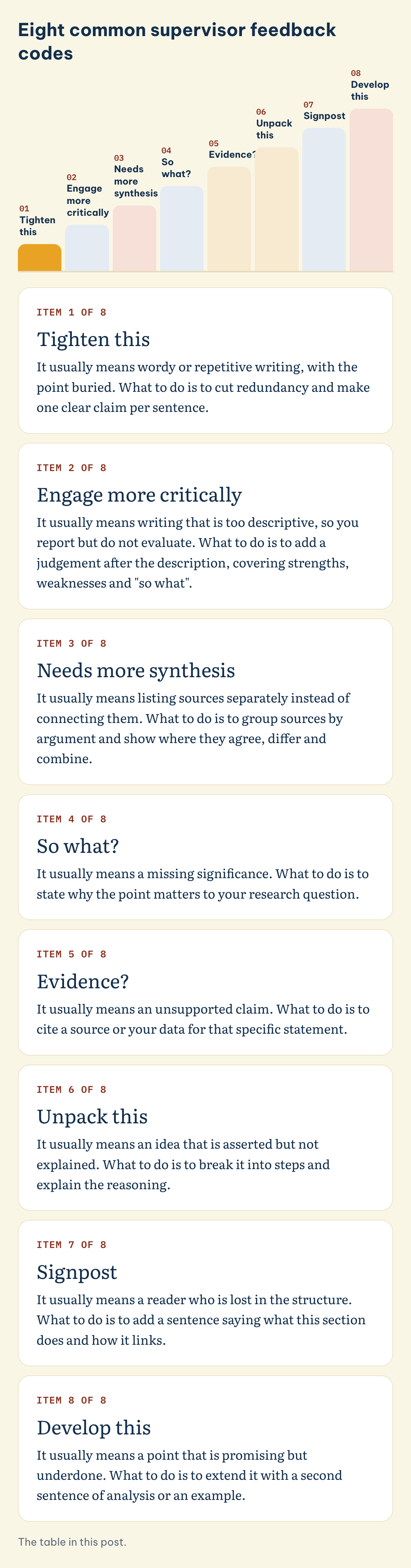
| Feedback code | What it usually means | What to do |
|---|---|---|
| Tighten this | Wordy or repetitive; the point is buried | Cut redundancy; make one clear claim per sentence |
| Engage more critically | Too descriptive; you report but do not evaluate | Add a judgement, strengths, weaknesses, "so what", after the description |
| Needs more synthesis | You list sources separately instead of connecting them | Group sources by argument; show where they agree, differ, and combine |
| So what? | The significance is missing | State why the point matters to your research question |
| Evidence? | A claim is unsupported | Cite a source or your data for that specific statement |
| Unpack this | An idea is asserted but not explained | Break it into steps and explain the reasoning |
| Signpost | The reader is lost in the structure | Add a sentence saying what this section does and how it links |
| Develop this | The point is promising but underdone | Extend it with a second sentence of analysis or an example |
Evidence: Molloy et al. (2020), also in Assessment & Evaluation in Higher Education, identified "making judgements about work quality" and "processing and using information" as core components of feedback literacy, the exact capacities each of these codes is trying to prompt. The codes are, in effect, shorthand requests to demonstrate those skills on the page.
Example: A student pinned a shortened version of this table above her desk and worked through her supervisor's comments one code at a time. What had looked like a wall of criticism became a checklist of 8 discrete edits, each with an obvious next step.
◆ Question 3 / 7 · Engage critically
"Engage more critically", decoding the single most common code
Direct answer: This code means your writing describes accurately but does not evaluate. Critical engagement is not negativity; it is judgement, weighing strengths against weaknesses, comparing positions, and stating what follows. The fix is to add an evaluative sentence wherever you have only reported what a source says.
Evidence: Carless and Boud (2018), building on the 7 principles of good feedback practice that Nicol and Macfarlane-Dick (2006) set out in Studies in Higher Education, place "making judgments" at the centre of feedback literacy: the ability to appraise quality, including one's own, is what markers reward as "critical." A descriptive paragraph answers "what?"; a critical one answers "how convincing?" and "so what?", moving from summary to appraisal is the single change that most often lifts a mark from a Pass in the 50 to 59 band to a Merit at 60 or above under UK conventions.
Where the missing move is a stock evaluative phrase rather than a missing idea, the Academic Phrasebank maintained by the University of Manchester is a fast fix, as are the writing guides published by the Royal Literary Fund and by Purdue OWL: it collects the exact sentence starters ("a limitation of this approach is...", "this finding is consistent with...") that turn a description into a judgement.
Example: A MAAS-mentored student wrote, "Porter's model identifies 5 forces." Her supervisor wrote "engage more critically." She revised it to, "Porter's model identifies 5 forces, but critics note it underplays collaboration between firms, which limits its usefulness for platform markets like the one this study examines." The facts were unchanged; the evaluation was new, and that was the point.
◆ Question 4 / 7 · Synthesis and tightening
"Needs more synthesis" and "tighten this", the structure-and-argument codes
Direct answer: "Needs more synthesis" means you are handling sources one at a time instead of weaving them into a single argument; the fix is to organise by theme or claim rather than by author. "Tighten this" means the writing is loose, cut repetition, merge overlapping sentences, and let one clear claim carry each point.
Evidence: Molloy et al. (2020) describe feedback literacy as including the capacity to process information and use it for future work, which is exactly what synthesis demands: not reporting each study in turn, but combining them to build your own position. Ryan et al. (2022) note that comments overloaded with several intentions are the hardest to act on, so treat a compound note like "tighten and synthesise" as 2 separate tasks and complete them one at a time.
Example: A literature review that ran "Smith found X. Nguyen found Y. Tran found Z." was marked "needs more synthesis." The student regrouped the same 3 studies under 1 claim, "Three studies converge on X, though Tran qualifies it in low-resource settings" and the paragraph argued instead of listed.
◆ Question 5 / 7 · Why ESL students struggle
Why are these codes especially hard for Vietnamese and ESL students?
Direct answer: There are 2 reasons. First, the codes rely on disciplinary jargon and cultural conventions that a second-language student has had less exposure to. Second, supervisors often soften criticism to protect feelings, which makes the real message harder to locate, a gentle "you might consider" can carry the same weight as a blunt "this is wrong."
Evidence: Ryan et al. (2022), writing in Teaching in Higher Education, found that sensemaking was specifically limited when comments were designed to mitigate against negative affect, meaning politeness can obscure the instruction, a pattern Winstone and Carless (2019) also flag when they argue that designing feedback processes has to account for how a student actually decodes a comment, not just what the marker meant to say. Winstone and Carless (2019) treat feedback as a process in which the student makes sense of comments and uses them to improve later work, so a code that has not changed your next draft has not yet worked as feedback. Derham et al. (2021) noted that academic language, jargon, and vague comments act as barriers to interpretation, and that terse interrogatives such as "Why?" require contextualisation to be useful, contextualisation an ESL student is less able to supply unaided. The difficulty is real and structural, not a failing on the student's part. Guidance from the Quality Assurance Agency for Higher Education treats clear assessment feedback as an institutional obligation, not an optional courtesy. A run of structure codes that never gets acted on is also the pattern that turns up later in an academic progress review, where the question is no longer one piece of work but a whole semester.
Example: A Vietnamese student read "you may wish to reconsider your framing" as an optional suggestion and left it unaddressed, losing marks. Her mentor explained that in UK and Australian academic register, "you may wish to" is frequently a firm instruction in polite clothing. The same softening appears at Northumbria University and the University of Sydney alike, so read it as register rather than as one supervisor's habit. She reframed the section, and the next draft was marked as resolved within 1 week.
◆ Question 6 / 7 · Ambiguous codes
What do you do when a code is genuinely ambiguous?
Direct answer: Ask, rather than guess. Feedback literacy explicitly includes seeking clarification, and a short, specific question to your supervisor, quoting the comment and proposing your interpretation, is a sign of engagement, not weakness. Guessing wrong costs a whole revision cycle, while a 2-line email costs nothing.
Boud and Molloy (2013), in their edited Routledge collection Feedback in Higher and Professional Education, describe it as a two-way dialogue rather than something delivered to a passive recipient, which is exactly why a clarifying question is participation in the process rather than an admission of confusion.
Evidence: Molloy et al. (2020) identify actively "seeking information" as one of the 7 groupings of feedback literacy, and Carless and Boud (2018) put the underlying reason plainly: "it is only students who can act to improve their learning" (Carless & Boud, 2018), which makes the student's move to clarify a legitimate and expected part of the process. The productive question is not "what did you mean?" but "when you wrote X, did you mean I should do Y?", offering your reading for confirmation.
Example: A student unsure whether "broaden your scope" meant more literature or a wider research question emailed her supervisor with both readings. The reply, "the literature, not the question", took 30 seconds to send and saved her a week of revising the wrong thing.
◆ Question 7 / 7 · Turning feedback into marks
How do you turn decoded feedback into a mark improvement?
Direct answer: Work through the comments in 3 passes: appreciate what each code is asking, judge which changes will most affect the grade, and act on them systematically rather than randomly. Decoding is only the first step; the mark moves when you close the loop and apply the change everywhere the same weakness appears.
Hattie and Timperley (2007), in a widely cited Review of Educational Research paper, frame this as 3 questions every piece of feedback is quietly answering, where am I going, how am I going, and where to next, and a code you cannot yet act on is usually one where you have not pinned down the third question. The same paper separates feedback aimed at the task, the process, self-regulation and the self, and Hattie and Timperley (2007) judged feedback about the self, such as praise, the least useful for learning. For dissertation feedback specifically, dissertation audit and review offers a second reader.
Evidence: Carless and Boud (2018) frame effective feedback use as appreciating feedback, making judgments, managing affect, and taking action, the last of which is where improvement actually happens. Molloy et al. (2020) add that the strongest students use feedback not only to fix the current piece but to change how they write the next one, so a code addressed once should become a habit across the remaining 3 or 4 chapters, not a one-off correction. Price et al. (2010) put the failure mode bluntly: a great deal of feedback effort is wasted precisely because nobody closes this loop, so the comment gets read once and never applied to the next piece of writing.
Example: A MAAS-mentored student who kept being told to "engage more critically" built the habit of adding 1 evaluative sentence after every source she cited. By her next assignment the code had stopped appearing; she had internalised what it asked for, which is the real goal of decoding feedback in the first place.
Frequently asked questions
What does "engage more critically" mean?
It means you describe accurately but do not evaluate. Add a judgement after each description, strengths, weaknesses, or why it matters to your argument, to move from summary to critical analysis.
What does "tighten this" mean?
Your writing is wordy or repetitive and the point is buried. Cut redundancy, merge overlapping sentences, and make one clear claim per sentence so the argument stands out.
Is "you may wish to reconsider" optional?
Usually not. In UK and Australian academic English, softened phrasing often carries a firm instruction. Treat polite suggestions as changes to make unless your supervisor signals otherwise.
Should I email my supervisor to clarify a comment?
Yes, when a code is genuinely ambiguous. Quote the comment and propose your interpretation, "did you mean I should do X?" so your supervisor can confirm in one line. Seeking clarification is part of good feedback literacy.
Why is the same feedback code appearing on every assignment?
Because the underlying habit has not changed yet. Apply the fix as a rule for all future writing, not just a one-time correction, and the code will stop recurring.
Can MAAS help me act on supervisor feedback?
Yes. MAAS Academic Mentoring pairs you with a mentor who translates your supervisor's comments into a concrete revision plan on work you wrote yourself, through a phase-by-phase model. Book a consultation through our contact page.
Ready to translate your feedback into a better mark?
A page of margin codes is not a verdict; it is a set of instructions in shorthand, and almost every one points to a specific, fixable change. A mentor who has guided research at your level can help you read your supervisor's comments accurately and turn them into a revision that answers them.
MAAS Academic Mentoring pairs you with a PhD or Master's-level mentor, chosen from 100+ experts of whom 23% hold a PhD, within 48 hours when our network already covers that field, or in about 2 weeks if MAAS has to recruit for it. During each live session the mentor annotates a Live Worksheet with you and helps you prepare the questions to take back to your supervisor. Your first 20-minute consultation is free. We coach; you stay the author, with a MAAS expert alongside you.
Book a feedback-decoding session with MAAS →
Related guides
- How do you write a methodology chapter you can defend?: turning "engage more critically" into a defensible method
- How do you write a literature review for a PhD as a Vietnamese student?: the chapter where "needs more synthesis" appears most
- How do you choose a dissertation topic that won't run out of literature?: the earlier decision that shapes how much feedback you can act on
- How do UK and Australian dissertation rubrics actually differ?: the standards your supervisor's codes are measuring against
- How do you prepare for a viva voce defence when English is your second language?: defending the changes your feedback asked for
- Academic Mentoring service: 1:1 mentoring that translates feedback into a revision plan
- Meet the MAAS expert network: the PhD-level mentors behind this guide
Tools & resources
- Manchester Academic Phrasebank, model phrases for adding critical evaluation to descriptive writing: https://www.phrasebank.manchester.ac.uk/
- University of Reading Study Advice, guidance on understanding and using tutor feedback: https://libguides.reading.ac.uk/reflection/feedback
References
- Carless, D., & Boud, D. (2018). The development of student feedback literacy: Enabling uptake of feedback. Assessment & Evaluation in Higher Education, 43(8), 1315–1325. https://doi.org/10.1080/02602938.2018.1463354
- Derham, C., Balloo, K., & Winstone, N. (2021). The focus, function and framing of feedback information: Linguistic and content analysis of in-text feedback comments. Assessment & Evaluation in Higher Education. Advance online publication. https://doi.org/10.1080/02602938.2021.1969335
- Molloy, E., Boud, D., & Henderson, M. (2020). Developing a learning-centred framework for feedback literacy. Assessment & Evaluation in Higher Education, 45(4), 527–540. https://doi.org/10.1080/02602938.2019.1667955
- Ryan, T., Henderson, M., Ryan, K., & Kennedy, G. (2022). Feedback in higher education: Aligning academic intent and student sensemaking. Teaching in Higher Education. Advance online publication. https://doi.org/10.1080/13562517.2022.2029394
- Sadler, D. R. (1989). Formative assessment and the design of instructional systems. Instructional Science, 18(2), 119–144. https://doi.org/10.1007/BF00117714
- Nicol, D. J., & Macfarlane-Dick, D. (2006). Formative assessment and self-regulated learning: A model and seven principles of good feedback practice. Studies in Higher Education, 31(2), 199–218. https://doi.org/10.1080/03075070600572090
- Hattie, J., & Timperley, H. (2007). The power of feedback. Review of Educational Research, 77(1), 81–112. https://doi.org/10.3102/003465430298487
- Boud, D., & Molloy, E. (Eds.). (2013). Feedback in higher and professional education: Understanding it and doing it well. Routledge.
- Winstone, N., & Carless, D. (2019). Designing effective feedback processes in higher education: A learning-focused approach. Routledge.
- Price, M., Handley, K., Millar, J., & O'Donovan, B. (2010). Feedback: All that effort, but what is the effect? Assessment & Evaluation in Higher Education, 35(3), 277–289. https://doi.org/10.1080/02602930903541007
This article is part of the MAAS Journal series for Vietnamese international postgraduate students. MAAS Academic Mentoring is an advisory partner; we coach students on interpreting and acting on feedback through a phase-by-phase delivery model. We do not write, submit, or guarantee the outcome of any student's work.
A free 20-minute consultation with MAAS Academic Mentoring, to talk through your supervisor's comments.
Book Free Discovery ▸