
◆ Thesis and dissertation
How do UK and Australian dissertation rubrics actually differ?
UK and Australian dissertation rubrics reward the same underlying qualities: critical argument, original contribution, and a defensible methodology. But they package, grade, and examine those qualities differently enough that a Vietnamese student moving between the two systems can be caught out. The differences that matter most sit not in the vocabulary of the marking criteria, which looks similar on paper, but in the grading scales, the structure of the degree, and how a thesis is finally examined.
This guide sets the two systems side by side, qualification frameworks, grade bands, what markers actually look for, and the single biggest difference, the UK viva versus the Australian examiner report so you can read whichever rubric you are handed with your eyes open.
◆ Question 1 / 7 · Qualification frameworks
Do UK and Australian dissertations sit in the same qualification framework?
Direct answer: No, each country has its own national framework, and the level numbers do not match. In the UK, a master's degree sits at FHEQ Level 7 and a doctorate at Level 8. In Australia, a master's sits at AQF Level 9 and a doctorate at Level 10. The labels differ, but both frameworks describe comparable postgraduate expectations.
Evidence: The Quality Assurance Agency for Higher Education (2024) sets out that a UK master's degree requires "a systematic understanding of knowledge" together with "originality in the application of knowledge" and the ability "to evaluate methodologies and develop critiques of them." The Australian Qualifications Framework Council (2013) describes an AQF Level 9 master's graduate in almost parallel terms, "cognitive skills to demonstrate mastery of theoretical knowledge and to reflect critically on theory and its application" and skills "to investigate, analyse and synthesise complex information, problems, concepts and theories." The wording is different; the intellectual demand is deliberately equivalent, because both frameworks map onto the same international qualification levels. The QAA framework document states the full master's descriptor this way: "a systematic understanding of knowledge, and a critical awareness of current problems and/or new insights, much of which is at, or informed by, the forefront of their academic discipline, field of study or area of professional practice" (Quality Assurance Agency for Higher Education, 2024, p. 24).
Example: A Vietnamese student who completed a taught master's in the UK and then began a research master's in Australia assumed "Level 7" and "Level 9" signalled a jump in difficulty. Her mentor showed her the two descriptors side by side: the numbers differ because the frameworks count levels differently, not because Australian work is two levels harder. Reading the descriptors, rather than the numbers, removed a false anxiety.
◆ Question 2 / 7 · Grading scales
How do the grading scales differ, and what counts as a good mark?
Direct answer: The grading scales are where students are most often surprised. UK and Australian marks are not interchangeable, and a number that looks strong in one system can mean something different in the other. UK postgraduate work is typically classified as Distinction, Merit, or Pass, while Australian universities generally use High Distinction, Distinction, Credit, and Pass bands tied to percentage ranges.
Evidence: The Quality Assurance Agency for Higher Education (2024) now includes, for the first time in the framework document, descriptors of the main degree classifications, reflecting how UK institutions band achievement against learning outcomes rather than against a fixed percentage. Australian universities, by contrast, commonly attach grade names to percentage bands, High Distinction from roughly 80%, Distinction from about 70%, Credit from about 60%, and Pass from 50%, though the exact thresholds are set by each institution rather than by the AQF, which defines learning outcomes but not a national grading scale. The practical consequence is that a UK "Merit" and an Australian "Distinction" are not the same judgement, and neither maps cleanly onto a Vietnamese GPA.
Example: A student reported a UK dissertation mark of 68 to a scholarship board that assumed Australian conventions, where 68 sits in the Credit band. Her mentor helped her explain, with the QAA descriptor attached, that 68 in the UK is a solid Merit near the Distinction boundary, a strong result, not a middling one. The confusion was in the scale, not the work.
◆ Question 3 / 7 · What markers look for
What are markers actually looking for in each system?
Direct answer: Beneath the different labels, both systems converge on the same three things: a critical rather than descriptive argument, an original or independent contribution however modest, and a methodology the writer can justify. A rubric names these as criteria; the difference between a pass and a distinction almost always lies in criticality, not in coverage.
Evidence: Haagsman et al. (2021), analysing 318 graded theses, found that scientific quality and structure predicted the overall grade far more strongly than presentation features such as a catchy title, evidence that markers weight substance over surface even when a rubric lists both. Both national frameworks reinforce this: the Quality Assurance Agency for Higher Education (2024) requires the student to "evaluate critically current research," and the Australian Qualifications Framework Council (2013) requires graduates "to reflect critically on theory and its application." A dissertation that describes the literature accurately but never evaluates it satisfies neither rubric fully, in either country.
Example: A MAAS-mentored student had a methodology chapter that listed every method she considered but justified none. Her mentor pointed to the shared demand in both frameworks, critique, not catalogue and she rewrote the chapter to argue why her chosen design answered her research question better than the alternatives. The same edit would have raised the mark under either the UK or the Australian rubric.
◆ Question 4 / 7 · The master's dissertation
How does the master's dissertation itself differ between the two systems?
Direct answer: The UK draws a practical line between a taught master's, where the dissertation is one capstone component, and a research master's such as an MRes or MPhil. Australia formalises this distinction within its framework, naming three separate master's types, which changes what the dissertation is expected to be.
Evidence: The Australian Qualifications Framework Council (2013) defines the Master's Degree (Research), the Master's Degree (Coursework), and the Master's Degree (Extended) as distinct qualifications with different balances of research and taught study, where a research master's must include a "substantial piece of research." The UK framework (Quality Assurance Agency for Higher Education, 2024) uses a single master's descriptor but expects a comparable research element, most visible in the dissertation. For a Vietnamese applicant, the effect is that an Australian "master's by research" and a UK "taught master's with dissertation" can carry very different research workloads under similarly named degrees.
Example: A student chose an Australian master's expecting a taught programme like the one her friend took in the UK, and found herself committed to a research thesis under the Master's (Research) descriptor. Her mentor had flagged the AQF distinction during admissions planning, so the workload was a deliberate choice rather than a surprise mid-degree.
◆ Question 5 / 7 · Viva or reports
How is a research degree examined, viva or examiner reports?
Direct answer: The choice between a viva and examiner reports is the largest and most consequential difference. A UK doctorate is examined by a written thesis followed by a compulsory viva voce, an oral defence before examiners. A traditional Australian doctorate is examined on the thesis alone, sent to two or three external examiners, often international, who each submit an independent written report and recommendation, usually with no oral component.
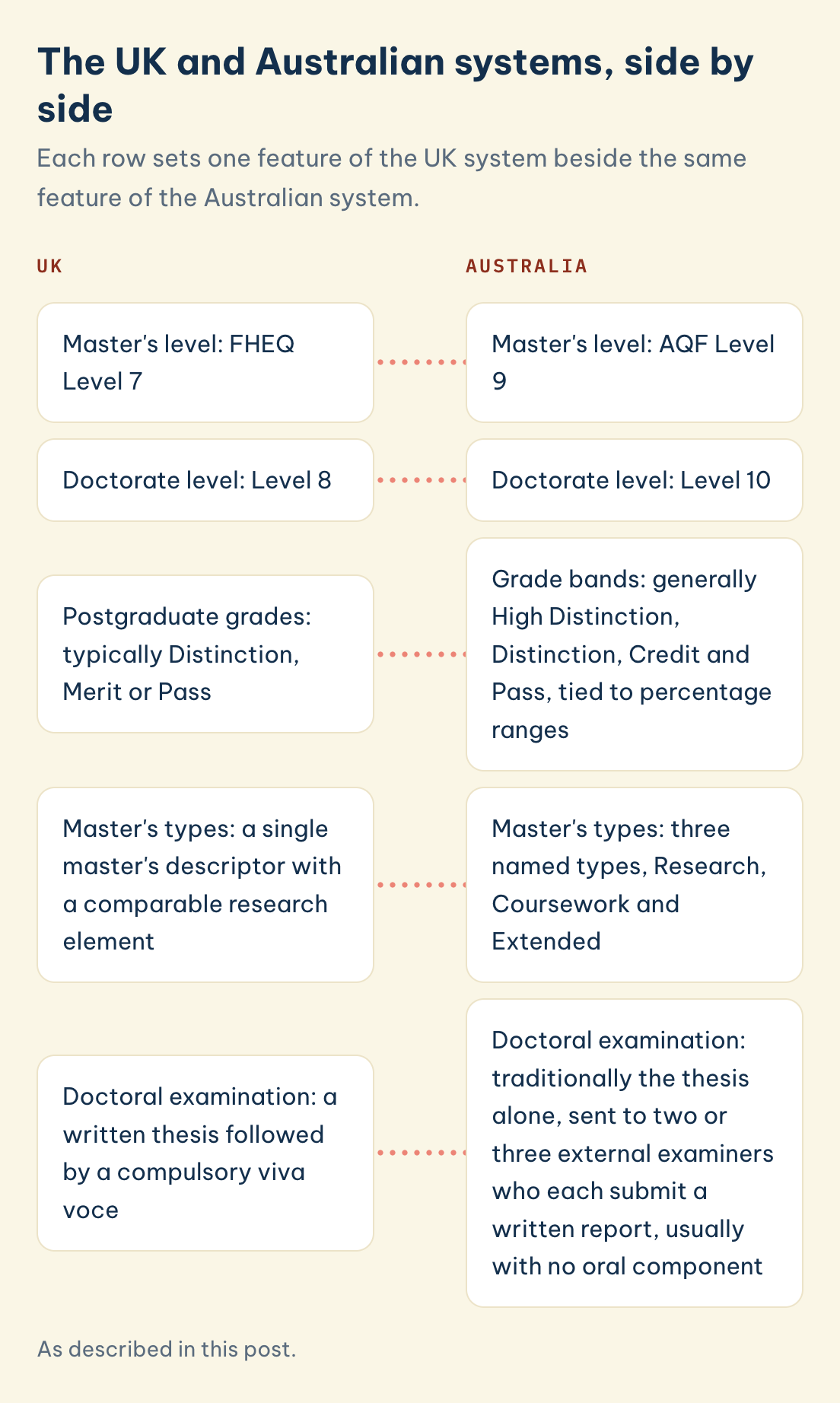
The UK and Australian systems, side by side
Each row sets one feature of the UK system beside the same feature of the Australian system.
UK
Australia
Master's level: FHEQ Level 7
Master's level: AQF Level 9
Doctorate level: Level 8
Doctorate level: Level 10
Postgraduate grades: typically Distinction, Merit or Pass
Grade bands: generally High Distinction, Distinction, Credit and Pass, tied to percentage ranges
Master's types: a single master's descriptor with a comparable research element
Master's types: three named types, Research, Coursework and Extended
Doctoral examination: a written thesis followed by a compulsory viva voce
Doctoral examination: traditionally the thesis alone, sent to two or three external examiners who each submit a written report, usually with no oral component
Save this figure
Evidence: McCulloch (2025) states plainly that "Australian universities generally do not follow that model of PhD examination, preferring instead to send theses to examiners and base decisions to award solely on examiner assessments of the thesis rather than involving an oral examination," and notes that the University of South Australia became the first Australian university to mandate an oral defence only in 2016. The study also found that where an oral defence does occur, more than a third of candidates saw a change in the grade the examiners had initially awarded, a reminder of how much the oral stage can matter where it exists. For a Vietnamese candidate, the choice between systems is partly a choice between defending your work in a room and defending it on the page.
Example: A doctoral candidate deciding between a UK and an Australian programme was anxious about the viva, having heard it described as an interrogation. Her mentor reframed it: in the UK she would defend her thesis in a structured conversation; in Australia the same defence would be written into her responses to examiner reports. Neither is easier, but knowing which one she was preparing for shaped how she practised.
◆ Question 6 / 7 · Why markers differ
Why do two markers sometimes give the same dissertation different grades?
Direct answer: Because a rubric is never applied mechanically. In both systems, examiners combine the explicit criteria written in the rubric with implicit standards of their own, and research shows they prioritise different criteria even when reading the same work. Understanding the rubric is necessary, but the underlying standards it points to matter more.
Evidence: Stolpe et al. (2021) found three distinct assessment profiles among thesis examiners, some focused on the logic of the text, some on the research process, some on the results and that these differences were not explained by discipline or institution, meaning the same thesis could receive different marks depending on who read it. Postmes et al. (2022) found that supervisors using a postgraduate rubric applied it flexibly and often omitted criteria that were, in fact, the most predictive of the final grade. The lesson for the student is not that grading is arbitrary, but that meeting the visible criteria alone is not enough, the strongest work satisfies the standard behind the rubric, not just the boxes on it.
Example: A MAAS-mentored student received conflicting feedback from her supervisor and second marker and read it as unfairness. Her mentor explained the likely cause, two examiners weighting the same rubric differently and helped her strengthen the criteria both had implicitly prioritised: a clearer contribution and a tighter argument. The revised thesis satisfied both readers.
◆ Question 7 / 7 · Using the rubric
How should a Vietnamese student use the rubric in either system?
Direct answer: Treat the rubric as a translation of the framework, not the framework itself. Read the qualification descriptor behind it, ask your supervisor how the criteria are weighted in your department, and map every chapter to the criteria that carry the most weight, criticality, contribution, and methodology, rather than spreading effort evenly across a checklist.
Evidence: Because the Quality Assurance Agency for Higher Education (2024) and the Australian Qualifications Framework Council (2013) both anchor their rubrics in learning outcomes rather than word counts, the reliable way to raise a mark in either system is to demonstrate those outcomes visibly. Haagsman et al. (2021) confirmed that the criteria markers weight most heavily are substantive, not presentational, so effort spent on argument and analysis returns more than effort spent on polish alone.
Example: A student preparing for an Australian submission and a UK re-application used the same core dissertation for both, adjusting only the framing, foregrounding the viva-style defence of her contribution for the UK reader and the self-contained written argument for the Australian examiners. One piece of work, read correctly for two rubrics, served both.
Frequently asked questions
Is a UK dissertation harder than an Australian one?
No. UK and Australian frameworks describe equivalent intellectual demands at each level; the level numbers differ (FHEQ Level 7 versus AQF Level 9 for a master's) because the two systems count levels differently, not because one is harder.
Do Australian PhDs have a viva like UK ones?
Traditionally no. Most Australian doctorates are examined on the thesis alone by external examiners' written reports, though a small but growing number of universities now include an oral defence. UK doctorates almost always require a viva voce.
How do UK and Australian grades compare?
They do not map directly. UK postgraduate work is usually Distinction, Merit, or Pass; Australian universities use High Distinction, Distinction, Credit, and Pass bands tied to percentages set by each institution. A UK 68 is a strong Merit, not the Credit that 68 would signal in Australia.
What do markers weight most in a dissertation?
Critical argument, an original or independent contribution, and a justified methodology, in both systems. Research shows substantive criteria predict the grade far more than presentation.
Why did my supervisor and second marker disagree?
Examiners apply the same rubric while weighting its criteria differently and adding implicit standards of their own. This is well documented and is why meeting the visible checklist alone rarely earns a distinction.
Can MAAS help me with a UK or Australian dissertation?
Yes. MAAS Academic Mentoring pairs Vietnamese students with mentors experienced in both systems, who translate the rubric into your specific topic and supervisor expectations through a phase-by-phase model. Book a consultation through our contact page.
Ready to read your rubric with confidence?
A rubric is only as useful as your ability to see the standard behind it and that standard, whether the document is British or Australian, rewards critical argument, a clear contribution, and a defensible method. A mentor trained in the academic system your university follows can show you where your marks are won.
MAAS Academic Mentoring pairs you with a PhD or Master's-level mentor (23% of our experts hold PhDs) within 48 hours when our network already covers that field, or in about two weeks if MAAS has to recruit for it, and matches on the country and academic system your university sits in, because that shapes how an argument is expected to be built. Your first 20-minute consultation is free. We coach; you stay the author, with a MAAS expert alongside you.
Book a dissertation mentoring consultation with MAAS →
Related guides
- How do you write a dissertation introduction that sets up a strong argument?: the chapter markers read first against the rubric
- How do you write a methodology chapter you can defend?: the criterion that separates a pass from a distinction
- How do you prepare for a viva voce defence when English is your second language?: the UK oral examination this comparison points to
- How do you write a literature review for a PhD as a Vietnamese student?: turning description into the critical evaluation both rubrics demand
- How do you decode common supervisor feedback codes?: reading the "engage more critically" comments these rubrics produce
- Dissertation mentoring resource hub: chapter-by-chapter templates and rubric checklists
- Meet the MAAS expert network: the PhD-level mentors behind this guide
Tools & resources
- Quality Assurance Agency for Higher Education, the UK Frameworks for Higher Education Qualifications: https://www.qaa.ac.uk/quality-code/qualifications-frameworks
- Australian Qualifications Framework, the AQF qualification descriptors: https://www.aqf.edu.au/framework/aqf-qualifications
References
- Australian Qualifications Framework Council. (2013). Australian qualifications framework (2nd ed.). https://www.aqf.edu.au/
- Haagsman, M. E., Snoek, B. L., Peeters, A., Scager, K., Prins, F. J., & van Zanten, M. (2021). Examiners' use of rubric criteria for grading bachelor theses. Assessment & Evaluation in Higher Education, 46(8), 1269–1284. https://doi.org/10.1080/02602938.2020.1864287
- McCulloch, A. (2025). Does the viva matter? PhD student experiences of the oral examination and its contribution to examination outcome and researcher development. Assessment & Evaluation in Higher Education. Advance online publication. https://doi.org/10.1080/02602938.2025.2566652
- Postmes, L., Bouwmeester, R. A. M., de Kleijn, R., & van der Schaaf, M. F. (2022). Supervisors' untrained postgraduate rubric use for formative and summative purposes. Assessment & Evaluation in Higher Education. Advance online publication. https://doi.org/10.1080/02602938.2021.2021390
- Quality Assurance Agency for Higher Education. (2024). The frameworks for higher education qualifications of UK degree-awarding bodies (2nd ed.). https://www.qaa.ac.uk/docs/qaa/quality-code/the-frameworks-for-higher-education-qualifications-of-uk-degree-awarding-bodies-2024.pdf
- Stolpe, K., Björklund, L., Lundström, M., & Åström, M. (2021). Different profiles for the assessment of student theses in teacher education. Higher Education. https://doi.org/10.1007/s10734-021-00692-w
This article is part of the MAAS Journal series for Vietnamese international postgraduate students. MAAS Academic Mentoring is an advisory partner; we coach students through a phase-by-phase delivery model with developmental feedback from PhD-level mentors. We do not write, submit, or guarantee the outcome of any student's work.
A free 20-minute consultation with MAAS Academic Mentoring, to read your rubric against the standard behind it.
Book Free Discovery ▸