
Pattern 01
A weak or missing niche
The field is reviewed thoroughly, but the gap is never stated sharply enough for the reader to see the contribution.
◆ Research methods
A dissertation introduction is the opening chapter that defines your research problem, states your aims, and shows examiners why the study matters. For Vietnamese postgraduate researchers writing in English, a clear introduction is what turns an examiner from a sceptic into a reader who wants to know what you found.
The introduction is the most re-read chapter in a thesis and the one supervisors send back most often. This guide answers the seven questions Vietnamese master's and doctoral students ask MAAS mentors most when they sit down to write chapter one.
◆ Question 1 / 7 · Purpose
Direct answer: The introduction has one job: to convince the reader that your research question is worth answering and that you are equipped to answer it. It establishes the topic, narrows to a specific problem, states your aim and questions, and signposts the chapters ahead. It frames the whole thesis rather than summarising your findings.
Evidence: Swales and Feak (2012) describe the introduction as the place where a writer creates a research space, moving the reader from a shared, general field down to the particular question only this study will address. It is an argument for relevance, not a literature dump; the detailed review belongs in its own chapter.
Example: A MAAS-coached master's student in management opened with 3 pages summarising every theory she had read. Her mentor helped her reframe the chapter around one question, "why does this problem matter, here, now?" and moved the summary into the literature review. Chapter one became 4 pages an examiner could follow in one sitting.
◆ Question 2 / 7 · Parts
Direct answer: A complete introduction contains a small set of recognisable components: background and context, the research problem, the aim and objectives, the research questions or hypotheses, the significance or rationale, the scope and limitations, and a short outline of the chapters. Naming each component as you draft stops you from leaving gaps an examiner will notice.
The seven parts of an introduction, at their usual size
Tap a part to see the question it answers. Widths follow the typical lengths in the table below.
Common length: 2 to 4 paragraphs
Background and context
What field and problem are we in?
Common length: 1 to 2 paragraphs
Research problem
What specifically is unresolved?
Common length: 1 paragraph
Aim and objectives
What will this study do?
Common length: A short list
Research questions or hypotheses
What exactly will you answer?
Common length: 1 to 2 paragraphs
Significance or rationale
Why does it matter?
Common length: 1 paragraph
Scope and limitations
What is in and out of bounds?
Common length: 1 paragraph
Thesis structure
Where is each chapter going?
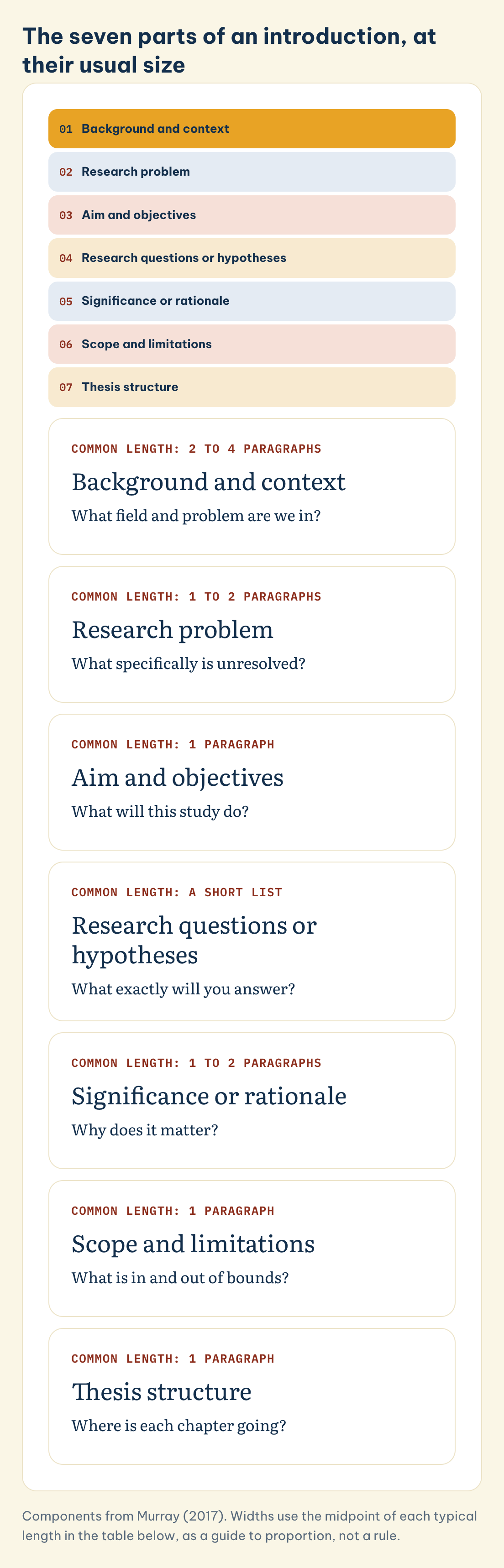
Evidence: University writing guides converge on these elements: background, problem, aim, questions, significance, scope, and thesis structure (Murray, 2017), a book now in its 4th edition from Open University Press and still the reference most UK supervisors hand to a new doctoral student. Each one answers a question in the reader's mind, what is this about, what is wrong, what will you do, why care, and where is it going.
Example: A Vietnamese doctoral candidate in education submitted a strong-background introduction with no explicit scope. Her examiner asked why three obvious sub-topics were absent. Working the component checklist below with a MAAS mentor, she added two sentences defining scope, and the question disappeared at the viva.
| Component | What it answers | Common length |
|---|---|---|
| Background and context | What field and problem are we in? | 2–4 paragraphs |
| Research problem | What specifically is unresolved? | 1–2 paragraphs |
| Aim and objectives | What will this study do? | 1 paragraph |
| Research questions / hypotheses | What exactly will you answer? | A short list |
| Significance / rationale | Why does it matter? | 1–2 paragraphs |
| Scope and limitations | What is in and out of bounds? | 1 paragraph |
| Thesis structure | Where is each chapter going? | 1 paragraph |
◆ Question 3 / 7 · Structure
Direct answer: Use a funnel: start wide with the established field, narrow to the gap others have left, then occupy that gap with your own study. This broad-to-narrow movement is the single most reliable structure for an academic introduction, and examiners are trained to look for it whether or not they name it.
Introductions analysed
45
PhD thesis introductions in Bunton's (2002) study
Disciplines covered
8
fields in which the same sequence recurred
The funnel: from the field to your study
Tap a band to see what that move does and how it usually sounds.
Move 1 / 4
Establish a territory
Show the field matters and review what is known.
“X has become a central concern…”
Move 2 / 4
Establish a niche
Name the gap, conflict, or unanswered question.
“However, little is known about…”
Move 3 / 4
Occupy the niche
State your aim, questions, and contribution.
“This study therefore examines…”
Move 4 / 4
Signpost
Outline the chapters that follow.
“Chapter 2 reviews… Chapter 3 sets out…”
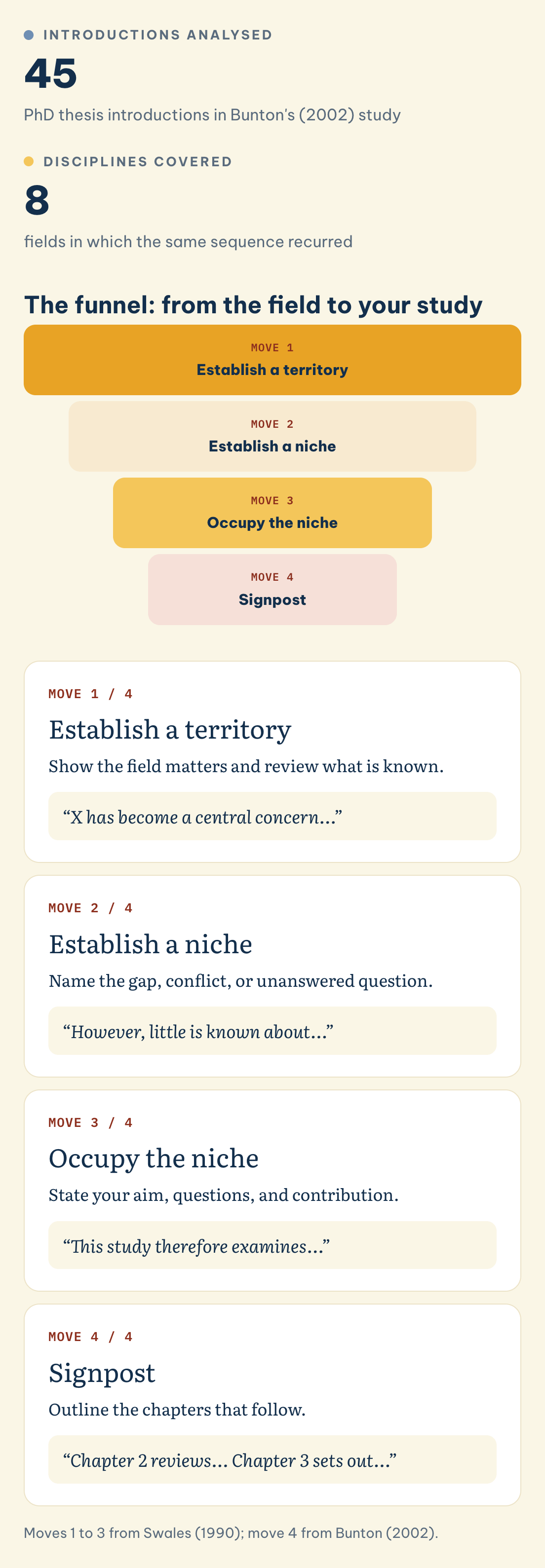
Evidence: Swales first sketched this pattern in a 1981 research report on article introductions, then formalised it in 1990 as the CARS model, Create a Research Space, built from three rhetorical moves. Bunton (2002) confirmed the pattern in PhD writing specifically, analysing 45 thesis introductions across eight disciplines and showing that the territory–niche–occupy sequence recurs across fields, extended by a final move that signposts the thesis structure. Samraj (2002) then showed the pattern is not identical everywhere: comparing introductions across disciplines, she found the niche move is signalled quite differently in the sciences than in the humanities, which is exactly why a template copied from a friend in another department can read as slightly off even when every move is technically present.
Example: A MAAS client in finance kept opening with his own variables, leaving the reader no map of the field. His mentor walked him through the three moves below. He rewrote move by move: 1 page on the field, one paragraph on the gap, one occupying it. The same content suddenly read like a contribution, not a list.
| Move (Swales, 1990) | What you do | Signal phrases |
|---|---|---|
| 1, Establish a territory | Show the field matters and review what is known | "X has become a central concern…" |
| 2, Establish a niche | Name the gap, conflict, or unanswered question | "However, little is known about…" |
| 3, Occupy the niche | State your aim, questions, and contribution | "This study therefore examines…" |
| 4, Signpost (Bunton, 2002) | Outline the chapters that follow | "Chapter 2 reviews… Chapter 3 sets out…" |
◆ Question 4 / 7 · Opening
Direct answer: Open with a claim of centrality, a sentence that shows the topic is important and current, not with a dictionary definition or a "since the dawn of time" line. Within the first paragraph, the reader should know your field, the kind of problem you address, and that the problem is live.
Two openings for the same chapter
From the example above.
Generic opening
“Health is important to everyone.”
Delays the point, so the reader has to work out why the chapter exists.
Claim of centrality
A specific, sourced claim about a measurable problem in the target population.
The same work in half the words, and an immediate reason to read on.
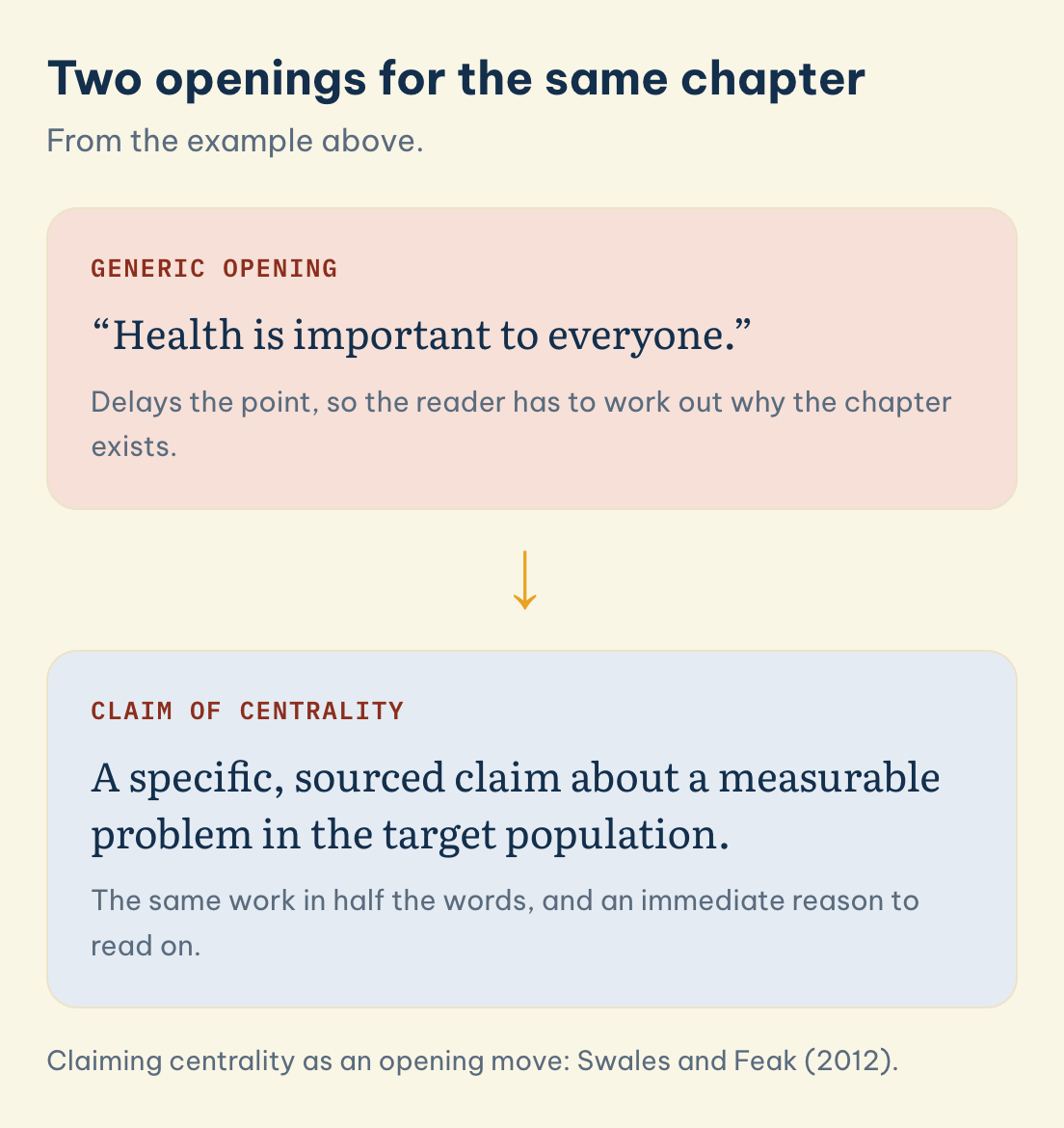
Evidence: Swales and Feak (2012) identify "claiming centrality" as the most common and most effective opening move in published research, precisely because it signals relevance immediately. Generic openings, by contrast, delay the point and make a reader work to find out why the chapter exists.
Example: A Vietnamese researcher in public health began with "Health is important to everyone." Her mentor suggested she replace it with a specific, sourced claim about a measurable problem in her target population, the same work in half the words, and an immediate reason to read on.
◆ Question 5 / 7 · Length
Direct answer: As a rough guide, the introduction runs about 5–10% of the whole thesis, a few pages for a master's dissertation, longer for a PhD but the structure matters more than a word count. Draft a rough version early to clarify your aim, then write the final version last, once you know what you actually found.
How long your introduction might run
Move the slider to your whole thesis length.
Introduction at 5 to 10%
5,000 to 10,000
words, as a rough guide; structure matters more than the count
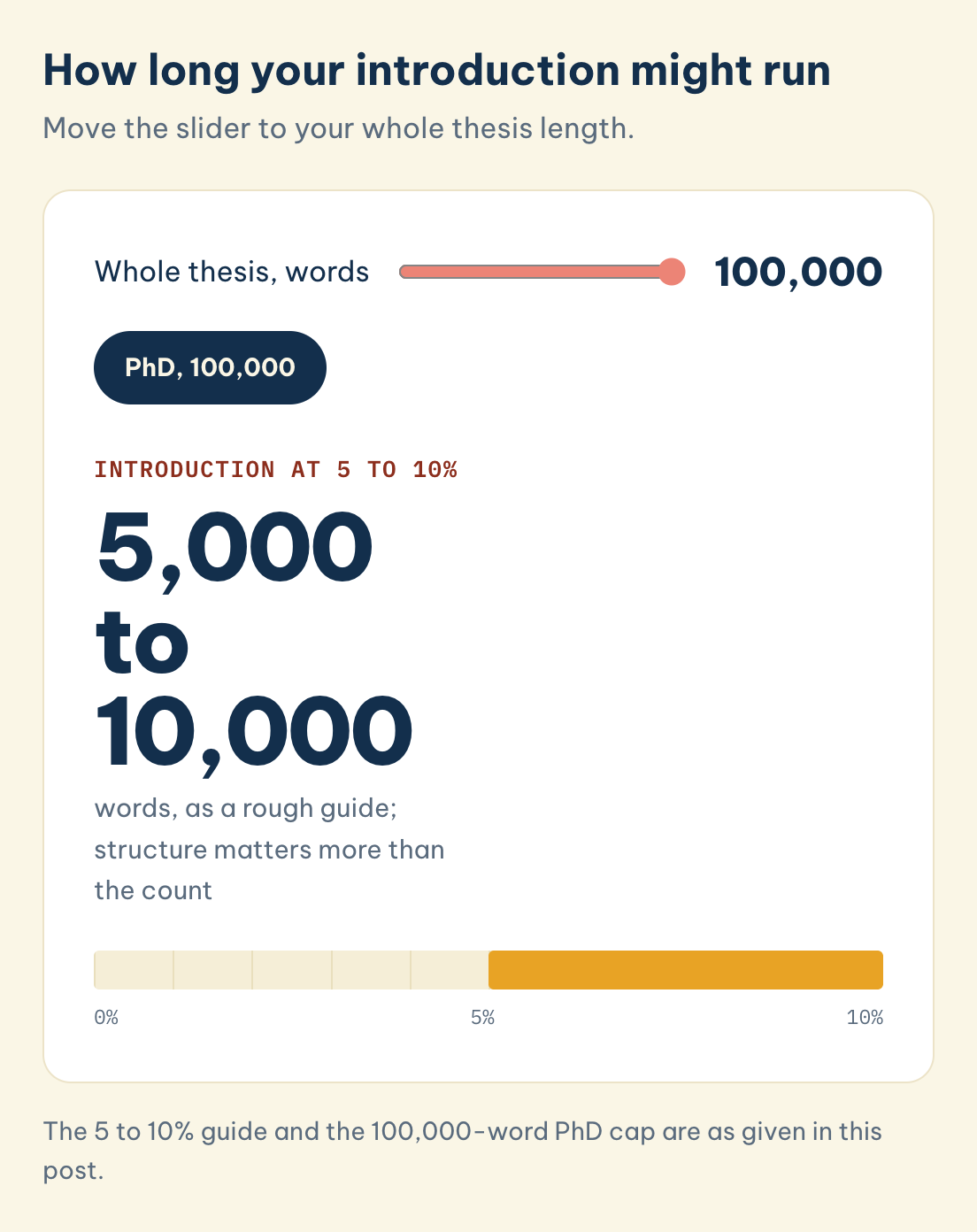
Evidence: Murray (2017) advises treating the introduction as a living chapter: draft it early to focus the project, then rewrite it after the findings are settled so the promises it makes match the results you deliver. An introduction frozen at the proposal stage almost always over-claims or points at questions the thesis no longer answers. The proportion matters more than it sounds: many UK universities cap a PhD thesis at around 100,000 words excluding references and appendices, which puts a 5-10% introduction at roughly 5,000 to 10,000 words, a length where a promise made in month two and never revisited is easy to lose track of.
If you want to practise the same moves on a shorter piece first, our guide to the essay introduction shows a three-part structure in a single paragraph.
Example: A MAAS doctoral client wrote a polished introduction in month two and never revisited it. At submission, three of its objectives no longer matched her analysis. Rewriting the chapter last, to align it with the real findings, took 2 days and removed her largest single source of examiner questions.
◆ Question 6 / 7 · ESL pitfalls
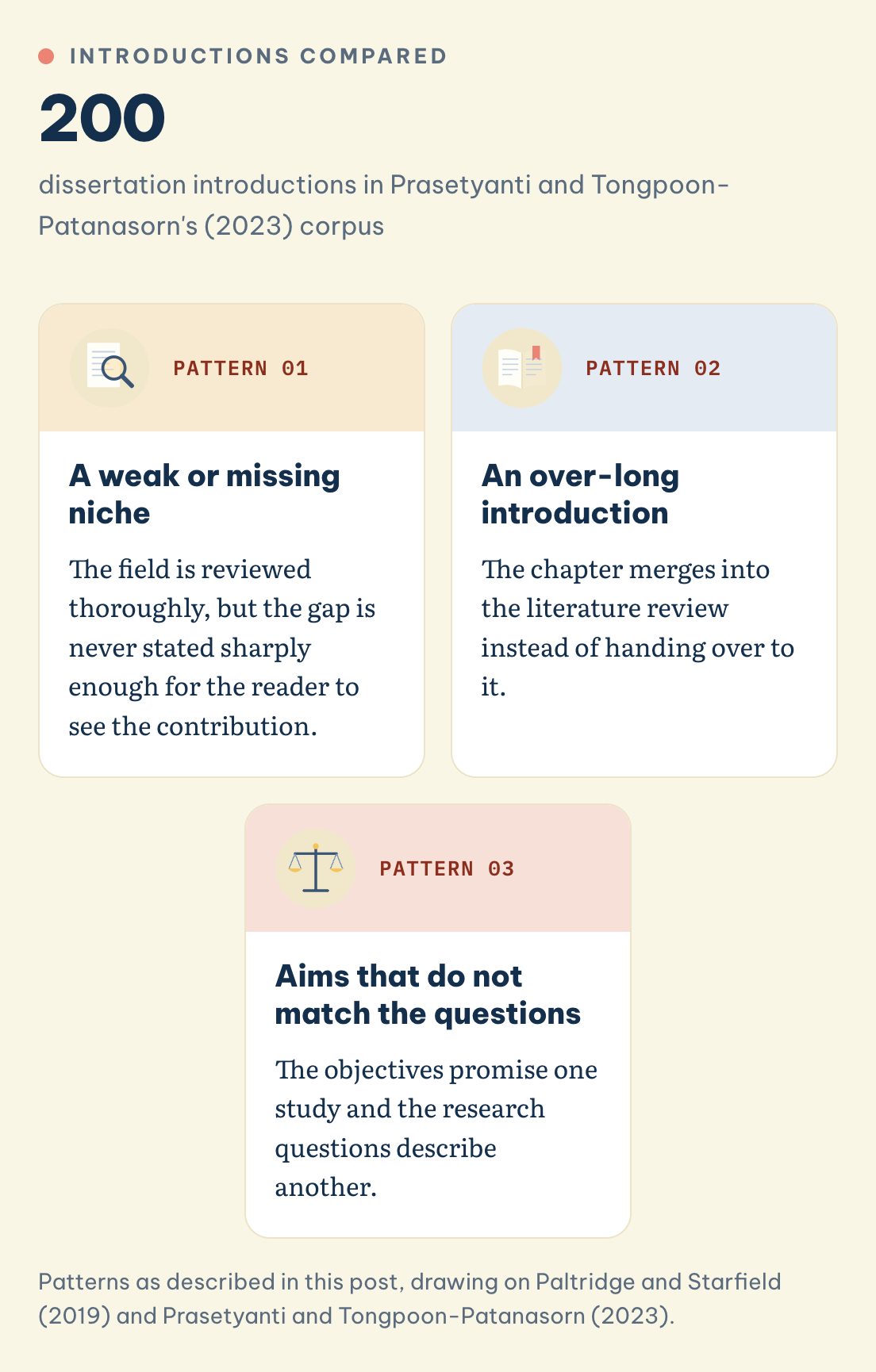
Direct answer: The most common pattern in second-language theses is a strong, well-read territory move followed by a weak or missing niche, the writer reviews the field thoroughly but never states the gap sharply enough for the reader to see the contribution. Other frequent issues are an over-long introduction that merges into the literature review and aims that do not match the questions.
Introductions compared
200
dissertation introductions in Prasetyanti and Tongpoon-Patanasorn's (2023) corpus
The field is reviewed thoroughly, but the gap is never stated sharply enough for the reader to see the contribution.
The chapter merges into the literature review instead of handing over to it.
The objectives promise one study and the research questions describe another.
Evidence: Paltridge and Starfield (2019) note that second-language thesis writers often master the descriptive parts of the introduction while underplaying the argumentative niche move that justifies the study. A move analysis by Prasetyanti and Tongpoon-Patanasorn (2023) comparing native-English and ESL doctoral introductions found the gap-establishing move was the least consistently developed among the second-language writers. Their corpus of 200 dissertation introductions shows that "the findings revealed that both NES and IND PhD students followed the moves and steps presented in the framework to create their introduction sections" (Prasetyanti & Tongpoon-Patanasorn, 2023, p. 468), so the underlying structure is shared, it is the execution of one move that ESL writers tend to underdevelop. Hyland (2000) traces part of this to how differently disciplines teach argument itself, describing academic writing as a set of disciplinary discourses rather than one shared skill, which means a strong niche move learned in one field does not automatically transfer to a supervisor trained in another.
Example: A Vietnamese PhD candidate's introduction reviewed forty studies impeccably but never said what was missing. Her MAAS mentor used the niche move as a checklist, one sentence beginning "However…" that named the gap and the contribution that had been buried in her data became visible in the first 3 pages.
◆ Question 7 / 7 · Revision
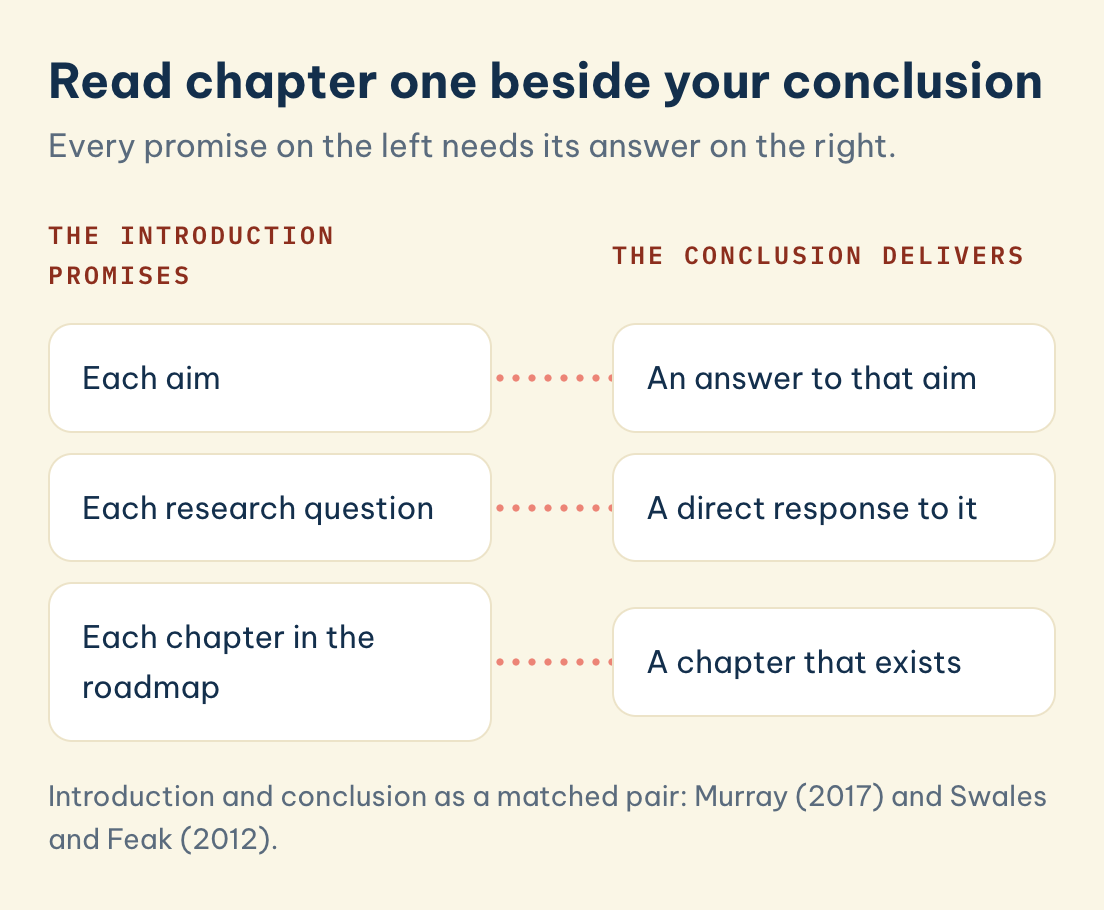
Direct answer: Treat revision as alignment-checking, not polishing. Read the introduction beside your conclusion and confirm that every aim is answered, every question is addressed, and every promised chapter exists. Where the thesis evolved, change the introduction to match the thesis, not the other way around.
Read chapter one beside your conclusion
Every promise on the left needs its answer on the right.
The introduction promises
The conclusion delivers
Each aim
An answer to that aim
Each research question
A direct response to it
Each chapter in the roadmap
A chapter that exists
Evidence: Murray (2017) and Swales and Feak (2012) both frame the introduction and conclusion as a matched pair the reader uses to judge whether the thesis delivered what it promised. Misalignment between the two is a clear signal to an examiner that a thesis was not fully revised. In the UK, a PhD is typically examined by two readers, one internal and one external, in a viva voce that commonly runs 2 to 3 hours, and an examiner preparing for that conversation usually rereads the introduction immediately before it starts, precisely to check the promise against what followed.
Example: A MAAS client's introduction promised a comparison her final thesis no longer made. Reading chapter one against chapter six side by side, her mentor flagged four mismatches. Fixing them through the phase-by-phase model turned a chapter that contradicted the thesis into one that previewed it.
Seven components recur: background and context, the research problem, aims and objectives, research questions or hypotheses, significance, scope and limitations, and a short chapter outline. University writing guides converge on this list (Murray, 2017), a book now in its 4th edition from Open University Press.
A common guide is 5–10% of the total word count, often a few pages for a master's dissertation and longer for a PhD. Treat this as a rough range, not a rule, and always follow your department's and supervisor's specific guidance over any general figure.
Both. Draft a rough version early to clarify your aim and questions, then write the final version last, after your findings are settled, so the chapter accurately promises what the thesis delivers.
The introduction frames the problem and argues why your study matters; the literature review surveys and evaluates existing work in depth. The introduction may sketch the field briefly, but the detailed critical reading belongs in its own chapter.
Yes, your aim, objectives, and research questions (and hypotheses, if your design uses them) should appear clearly in the introduction so the reader knows exactly what the thesis will answer before they turn the page.
AI can help you brainstorm structure or tighten sentences, but you must verify every claim, write the argument yourself, and follow your university's disclosure rules. The reasoning and the gap statement must be your own; treat AI as an assistant whose output you check, never as the author.
Yes. MAAS Academic Mentoring coaches Vietnamese researchers through the introduction, mapping the territory–niche–occupy structure, sharpening the gap statement, and aligning aims with findings, using a phase-by-phase model with postgraduate-qualified mentors. Book a consultation through our contact page.
The introduction sets the tone an examiner carries through every later chapter, and it is far easier to get right with a mentor who has already supervised research in your field. MAAS Academic Mentoring matches you with a mentor who holds a doctorate or a master's degree with supervisory experience, starting with a free 20-minute consultation. Of our experts, 23% hold doctorates. The match takes 48 hours when our network already covers that field, or about 2 weeks if MAAS has to recruit for it, and before the kick-off you see the mentor's anonymised capability profile. We coach; you stay the author, every step.
Book a dissertation mentoring consultation with MAAS →
This article is part of the MAAS Journal series for Vietnamese international postgraduate students and researchers. MAAS Academic Mentoring is an advisory partner; we coach authors through a phase-by-phase delivery model with developmental feedback from postgraduate-qualified mentors. We do not write, submit, or guarantee acceptance of work on an author's behalf.