
◆ Thesis and dissertation
How do you write a dissertation abstract?
A dissertation abstract is a short, stand-alone summary that states your study's aim, methods, key findings, and contribution to knowledge.
For Vietnamese postgraduate researchers writing in English, the abstract is the most-read and least-rehearsed part of a thesis, the few hundred words an examiner, a database, and a future reader meet first. This guide answers the seven questions Vietnamese master's and doctoral students ask MAAS mentors most when they compress an entire thesis into one paragraph.

◆ Question 1 / 7 · What it is for
What is a dissertation abstract actually for?
Direct answer: The abstract is a self-contained miniature of the whole thesis that lets a reader decide, in under a minute, what you studied, how, what you found, and why it matters. It is read first, indexed by databases, and quoted in search results so it works as both a summary and a gateway to the work.
Evidence: Swales and Feak (2009) describe the abstract as a distinct genre that must stand alone and make sense without the thesis attached. Hyland (2004) shows abstracts are not neutral summaries but persuasive, gatekeeping texts: across disciplines, writers use them to promote the significance of their work and win the reader's attention.
Example: A MAAS-coached master's student in management wrote an abstract that described her topic and aim but stopped before the results. Her mentor noted that a reader scanning a database would never learn what she had found and the paragraph was rebuilt so findings and contribution carried the most words.
◆ Question 2 / 7 · The moves
What moves should a dissertation abstract contain?
Direct answer: A complete abstract moves through a recognisable sequence: situate the research, state the purpose, describe the method, summarise the main results, and state the contribution. Naming each move as you draft stops the abstract from spending all its words on background and arriving at the findings too late, or not at all.
The five moves of a dissertation abstract
Tap a move to see what you write in it and its typical length, in the order the post gives them.
Step 1 of 5
Situate the research
The problem and why it matters. Typically 1 sentence.
Step 2 of 5
Present the research
Your aim, question or hypothesis. Typically 1 sentence.
Step 3 of 5
Describe the methodology
Design, data and analysis. Typically 1 to 2 sentences.
Step 4 of 5
Summarise the results
Your main findings, concretely. Typically 2 to 3 sentences.
Step 5 of 5
Discuss the research
Contribution, implication or recommendation. Typically 1 sentence.
Save this figure
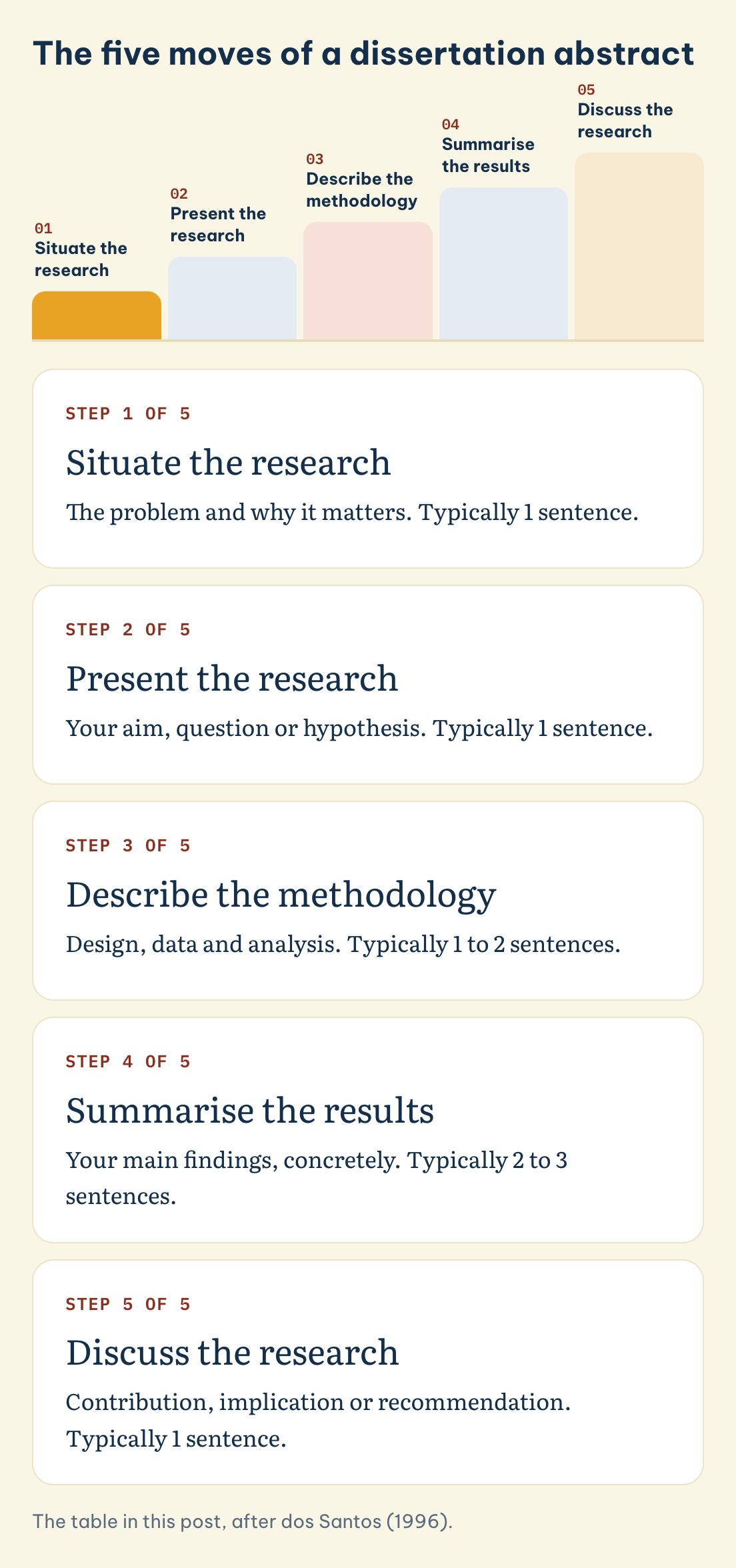
Evidence: Dos Santos (1996), in a study running 19 pages, identified a five-move structure for research abstracts, situating the research, presenting it, describing the methodology, summarising the results, and discussing the research. Pho (2008), analysing 30 abstracts drawn from 3 journals in applied linguistics and educational technology across a paper of 20 pages, found three of these moves obligatory in practice: presenting the research, describing the methodology, and summarising the results. Pho writes that "the results also indicate that a combination of certain linguistic features such as grammatical subjects, verb tense and voice can help distinguish moves in the abstract" (Pho, 2008).
Example: A Vietnamese doctoral candidate in education had an abstract that was two-thirds background. Her MAAS mentor used the move table below as a budget, one or two sentences per move and the rewritten version reached the method by sentence three and closed on a clear contribution.
| Move (dos Santos, 1996) | What you write | Typical length |
|---|---|---|
| 1, Situate the research | The problem and why it matters | 1 sentence |
| 2, Present the research | Your aim, question, or hypothesis | 1 sentence |
| 3, Describe the methodology | Design, data, and analysis | 1–2 sentences |
| 4, Summarise the results | Your main findings, concretely | 2–3 sentences |
| 5, Discuss the research | Contribution, implication, or recommendation | 1 sentence |
◆ Question 3 / 7 · Length and format
How long should a dissertation abstract be, and how is it formatted?
Direct answer: Most universities cap a dissertation abstract at roughly 250–350 words, set on its own page after the title page, written as one or a few unbroken paragraphs without citations, tables, or undefined abbreviations. Always follow your department's stated word limit over any general figure.
Evidence: The APA Publication Manual (American Psychological Association, 2020) caps an abstract at 150 to 250 words and asks for prose that is accurate, non-evaluative, coherent, and concise, with keywords beneath. Swales and Feak (2009) note that length conventions vary by field, which is why the binding number is the one in your university's thesis regulations.
Example: A MAAS client in public health wrote an abstract of 600 words that her institution's template would have truncated. Her mentor worked with her to map the five moves onto a limit of 300 words and suggested cutting method detail that belonged in chapter three, and the abstract fit the rule while keeping every essential claim.
| Level / type | Common word range | Notes |
|---|---|---|
| Master's dissertation abstract | 150–300 words | Check the department template first |
| PhD thesis abstract | 250–350 words | Some universities allow up to 500 |
| Journal article abstract | 150–250 words | Follows each journal's author guidelines |
| Structured abstract (some fields) | Labelled headings | Background, Methods, Results, Conclusion |
◆ Question 4 / 7 · Writing each move
How do you write each move, background, aim, method, results, conclusion?
Direct answer: Write the abstract move by move in plain past tense: one sentence of context, one naming your aim, one or two on what you did, two or three on concrete results, and a final sentence on what your study contributes. Lead with what is new, not with how long the field has existed.
Evidence: Lorés (2004), across a study of 23 pages, found that research abstracts tend to follow one of two organisations, an informational pattern mirroring the introduction-method-results-conclusion shape, or a more indicative, descriptive pattern and that the informational, results-forward type communicates a study's value most directly. Swales and Feak (2012) stress that abstracts work best when each sentence advances the reader rather than restating the title.
Example: A Vietnamese master's candidate in finance opened with three sentences on the importance of his sector. His MAAS mentor suggested he cut them to one and give the space to a specific results sentence, a measured effect size rather than "significant findings" so the abstract finally told the reader what the study established.
◆ Question 5 / 7 · When to write it
When should you write the abstract, and how do you condense a whole thesis?
Direct answer: Write the abstract last, once your results and conclusion are stable, then build it from the topic sentences of each chapter rather than from memory. Drafting it early forces you to summarise a thesis you have not finished, which is why early abstracts often promise findings the final study does not deliver.
Evidence: Swales and Feak (2009) treat the abstract as a text written in reflection on a completed piece, distilled from the work rather than composed alongside it. Their graduate-writing guidance (Swales & Feak, 2012) recommends assembling a summary from a paper's existing key sentences, then editing for flow, a reliable way to compress without losing the argument.
Example: A MAAS doctoral client kept rewriting her abstract throughout her candidature, and none matched her final results. Her mentor had her extract one sentence from each chapter's opening, stitch them into a draft, then polish, a half-day task that replaced months of guesswork.
◆ Question 6 / 7 · Keywords
What are keywords, and how do you choose them for discoverability?
Direct answer: Keywords are the handful of terms under the abstract that databases use to surface your thesis to the right readers. Choose words a searcher in your field would actually type, your method, population, context, and core concept and avoid words already in the title, which add nothing to retrieval.
Evidence: The APA Publication Manual (American Psychological Association, 2020) instructs authors to follow the abstract with keywords that capture the article's most important concepts for indexing and search. Dos Santos (1996) and Hyland (2004) both show the abstract is the unit databases and readers scan first, which makes its terminology, not just its prose, part of whether the work is found at all.
Example: A Vietnamese researcher's thesis on rural credit used only broad terms like "economics" and "Vietnam." Her MAAS mentor suggested she add the specific method and population, and the abstract became findable by the precise readers most likely to cite it.
◆ Question 7 / 7 · Mistakes to avoid
What abstract mistakes do Vietnamese and other ESL researchers make most?
Direct answer: The most common pattern in second-language abstracts is too much background and too little result, the writer establishes the field thoroughly but states the actual findings vaguely. Other frequent issues are the missing contribution move, over-hedged claims, and copying whole sentences from the introduction instead of distilling them.
Evidence: Pho (2008), studying abstracts from non-Anglophone contexts, found the results-summarising move present but variably realised, and authorial stance often muted. Paltridge and Starfield (2019) note that second-language thesis writers tend to master the descriptive, summarising moves while underplaying the evaluative move that states a study's significance.
Example: A Vietnamese master's candidate's abstract named her topic and method clearly but never said what her data showed. Her MAAS mentor applied a one-sentence checklist, "this study found that…" and the finding buried across her results chapter finally appeared where readers look for it first.
Frequently asked questions
What should a dissertation abstract include?
An abstract needs five moves in order: it situates the study, states its purpose, describes the method, reports the main results and states the contribution. Writing the move names in the margin as you draft keeps you from using up the word count on background and reaching the findings late or never. Most universities cap a dissertation abstract at roughly 250 to 350 words, so check your department's limit.
How long should a dissertation abstract be?
Most universities set a limit between 150 and 350 words depending on level and discipline, with PhD abstracts usually allowed more room than master's. Treat any general figure as a guide and follow your department's thesis regulations and template, which state the binding word limit.
Should the abstract include citations or references?
Usually not. An abstract is meant to stand alone, so most guidelines ask you to avoid citations, footnotes, and references within it. If a particular field or journal expects a citation, follow that specific instruction, but for a dissertation abstract the default is none.
When in the writing process should I write the abstract?
Write it last, after your results and conclusion are settled. Composing the abstract early forces you to summarise findings you have not finalised, which usually means rewriting it later anyway. Building it from your finished chapters is faster and more accurate.
What is the difference between an abstract and an introduction?
The abstract summarises the entire thesis, including results and conclusion, in a few hundred words and stands alone. The introduction opens the thesis, sets up the problem and questions, and does not reveal the findings. The abstract reports outcomes; the introduction sets up the journey.
What is a structured abstract?
A structured abstract uses labelled headings such as Background, Methods, Results, and Conclusion instead of a single paragraph. It is common in health and some social sciences. Check whether your discipline or target journal requires this format before choosing between structured and unstructured.
Can MAAS help me write my dissertation abstract?
Yes. MAAS Academic Mentoring coaches Vietnamese researchers through the abstract, mapping the moves, sharpening the results sentence, and choosing keywords for discoverability, using a phase-by-phase model with postgraduate-qualified mentors. Book a consultation through our contact page.
Ready to write an abstract that gets your thesis read?
The abstract is the first thing an examiner reads and the only part most database searchers ever see, easier to get right with a mentor who has guided research at your level before. MAAS Academic Mentoring pairs you with a mentor trained to doctoral level, or to master's level with supervision behind them, for a free consultation lasting 20 minutes, and matches you to the right advisor within 48 hours when our network already covers that field, or in about 2 weeks if MAAS has to recruit for it. Across our expert network, 23% hold doctorates. After every session the project coordinator sends you the minutes, the recording made with cameras off, and your next tasks. We coach; you stay the author, every step.
Book a dissertation mentoring consultation with MAAS →
Related guides
How do you write an abstract for a research paper?: the journal-article version of the abstract
How do you write a dissertation introduction?: the chapter your abstract previews
How do you write a dissertation conclusion?: the contribution your abstract must state in one sentence
How do you write the discussion section of a research paper?: where the results your abstract summarises are interpreted
How do you write research questions and objectives?: the aim your abstract names in a single line
How do you write a literature review as a PhD student?: the field your abstract situates the study in
How do you choose a Scopus journal?: where a strong abstract decides whether an editor reads on
Academic Mentoring service: full mentoring tiers for thesis and dissertation support
Dissertation Mentoring resource hub: chapter-by-chapter guides and templates
Meet the MAAS expert network: the postgraduate-qualified mentors who supervise and examine theses
Tools & resources
- Academic Phrasebank, The University of Manchester: signposting phrases for summaries and abstracts
- Writing an abstract, The University of Adelaide: a step-by-step planning guide
References
- American Psychological Association. (2020). Publication manual of the American Psychological Association (7th ed.). https://doi.org/10.1037/0000165-000
- Dos Santos, M. B. (1996). The textual organization of research paper abstracts in applied linguistics. Text, 16(4), 481–499. https://doi.org/10.1515/text.1.1996.16.4.481
- Hyland, K. (2004). Disciplinary discourses: Social interactions in academic writing (Michigan classics ed.). University of Michigan Press.
- Lorés, R. (2004). On RA abstracts: From rhetorical structure to thematic organisation. English for Specific Purposes, 23(3), 280–302. https://doi.org/10.1016/j.esp.2003.06.001
- Paltridge, B., & Starfield, S. (2019). Thesis and dissertation writing in a second language: A handbook for students and their supervisors (2nd ed.). Routledge.
- Pho, P. D. (2008). Research article abstracts in applied linguistics and educational technology: A study of linguistic realizations of rhetorical structure and authorial stance. Discourse Studies, 10(2), 231–250. https://doi.org/10.1177/1461445607087010
- Swales, J. M., & Feak, C. B. (2009). Abstracts and the writing of abstracts. University of Michigan Press.
- Swales, J. M., & Feak, C. B. (2012). Academic writing for graduate students: Essential tasks and skills (3rd ed.). University of Michigan Press.
This article is part of the MAAS Journal series for Vietnamese international postgraduate students and researchers. MAAS Academic Mentoring is an advisory partner; we coach authors through a phase-by-phase delivery model with developmental feedback from postgraduate-qualified mentors. We do not write, submit, or guarantee acceptance of work on an author's behalf.
A free 20-minute consultation with MAAS Academic Mentoring, to talk through your abstract move by move and your choice of keywords.
Book Free Discovery ▸