
◆ Publishing advisory
How do you write the discussion section of a research paper?
The discussion section of a research paper is where you interpret your findings, what they mean, why they matter, and how they fit prior work. It is interpretation and argument, not a place to repeat your results. For Vietnamese researchers and students, this is the part Q1 reviewers scrutinise hardest, because it shows whether you understand your own results or have simply reported numbers.
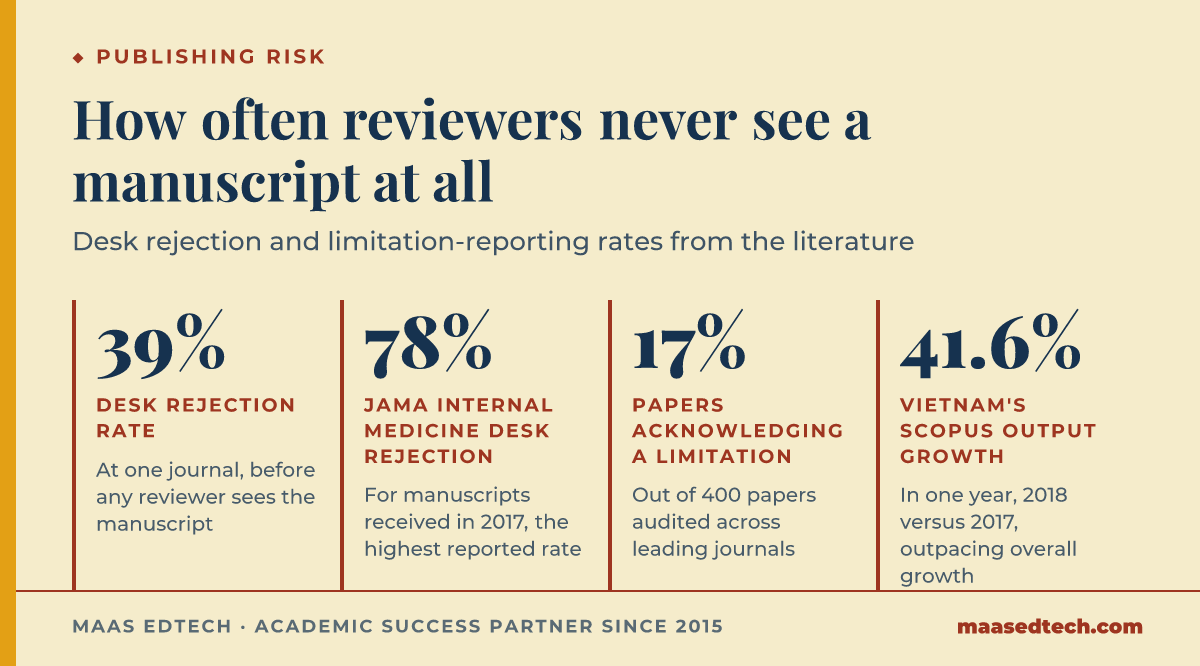
The stakes are structural, not only stylistic. Editors report pre-review rejection rates of 39% at their own journal and as high as 78% at JAMA Internal Medicine for manuscripts received in 2017 (Dantas-Torres, 2022), and a discussion that repeats results instead of arguing for their meaning is a documented reason a manuscript never reaches a reviewer at all.
This guide answers the seven questions Vietnamese researchers ask MAAS publishing mentors most often when they reach the discussion stage of a Scopus-targeted manuscript.

◆ Question 1 / 7 · What it is for
What is the discussion section, and what is it actually for?
Direct answer: The discussion is where you interpret your results and argue for their meaning; you state your main findings, compare them with existing literature, explain what they add, acknowledge limitations, and draw measured conclusions. It is interpretation and argument, not a second results section.
Evidence: Guidance for biomedical authors describes the discussion as the section that summarises the main findings, places them in the context of previous work, and considers implications and shortcomings of the study (Cals & Kotz, 2013). One influential framing compares it to a closing argument in court: you have presented the evidence in the results, and the discussion is where you persuade the reader what it means (Annesley, 2010).
Example: A Vietnamese first-time author brought a MAAS mentor a discussion that re-listed every table from her results. Her mentor showed that none of it interpreted anything and they rebuilt the section around what the findings meant, turning a summary into an argument a reviewer could engage with.
◆ Question 2 / 7 · Structure
How should you structure a discussion section?
Direct answer: Use a clear, predictable structure: open with the answer to your research question and your key findings, compare them with prior studies, explain the mechanisms or reasons, state limitations honestly, then give implications and a short conclusion. A structured discussion is easier to write and far easier for reviewers to follow.
The five elements of a discussion section
Tap an element to see what it does and the mistake to avoid.
Opening and key findings
What it does: answers the research question directly. Common mistake: repeating all results in full.
Comparison with literature
What it does: shows what is new or confirmatory. Common mistake: ignoring studies that disagree.
Interpretation and mechanism
What it does: explains why the result occurred. Common mistake: asserting cause from correlation.
Limitations
What it does: bounds the claims honestly. Common mistake: listing only trivial limitations.
Implications and conclusion
What it does: states practical or research value. Common mistake: overclaiming beyond the data.
Evidence: Editors have long argued that discussions should be structured rather than meandering, with a recommended sequence that moves from statement of principal findings, to strengths and weaknesses, to comparison with other studies, to meaning and unanswered questions (Docherty & Smith, 1999). That five-part sequence, published in BMJ in 1999, still underlies the biomedical-writing guidance that followed it, including Cals and Kotz (2013) and Ghasemi et al. (2019). A consistent organisation helps readers locate each element and signals disciplined reasoning.
| Discussion element | What it does | Common mistake |
|---|---|---|
| Opening / key findings | Answers the research question directly | Repeating all results in full |
| Comparison with literature | Shows what is new or confirmatory | Ignoring studies that disagree |
| Interpretation / mechanism | Explains why the result occurred | Asserting cause from correlation |
| Limitations | Bounds the claims honestly | Listing only trivial limitations |
| Implications & conclusion | States practical or research value | Overclaiming beyond the data |
Example: A MAAS-coached postgraduate had written a single unbroken page of discussion. Her mentor helped her map it onto these five elements; the same content, reordered, suddenly read as a logical case rather than a stream of observations, with no new data added.
◆ Question 3 / 7 · Opening
How do you open the discussion and state your key findings?
Direct answer: Open by answering your research question in one or two sentences, stating your most important finding in plain language. Do not reopen with background or method. The first paragraph should tell a busy reviewer what you found and why it matters before they read any further.
Evidence: The discussion should begin with the principal findings rather than a restatement of the introduction, and it should not simply recapitulate the results in numerical detail (Docherty & Smith, 1999). In their own words, "The discussion should begin with a restatement of the principal finding" (Docherty & Smith, 1999, p. 1224). Treating the opening as your strongest claim, the headline of your closing argument, keeps the section focused (Annesley, 2010).
Example: A Vietnamese researcher opened her discussion with three sentences of literature background before mentioning her own result. Her MAAS mentor moved her central finding to the first line; the revised opening immediately answered the question the title had promised, which is exactly what reviewers look for.
◆ Question 4 / 7 · Comparing
How do you compare your findings with previous research?
Direct answer: Place your results beside the existing literature: say where you agree with prior studies, where you disagree, and why the difference might exist, sample, setting, method, or measurement. This contextualisation is what turns a finding into a contribution, because it shows what your study adds to the field.
Evidence: Effective discussions contextualise results by comparing them with previous work and explaining agreements and discrepancies, supported by reasoning rather than assertion (Ghasemi et al. 2019). Single studies should also be read against relevant systematic reviews rather than cherry-picked individual papers, so the comparison is fair (Docherty & Smith, 1999).
Example: A MAAS Publishing Advisory client found a result that contradicted two well-known papers. Rather than hide it, her mentor helped her explain the discrepancy through a difference in population and measurement timing, a transparent comparison that strengthened the manuscript instead of weakening it.
◆ Question 5 / 7 · Limitations
How do you write the limitations honestly without sinking your paper?
Direct answer: State the limitations that genuinely affect how your results should be read, design, sample size, confounding, generalisability and explain their likely direction and impact. Honest, specific limitations build reviewer trust; vague or purely cosmetic ones, or none at all, raise suspicion.
Evidence: A keyword audit of 400 papers across leading medical and life-science journals found that only 17% used even one word acknowledging a limitation, and not a single article discussed how that limitation might affect its own conclusions (Ioannidis, 2007). Reviewers increasingly expect authors to surface the real weaknesses themselves, because an unmentioned limitation that a reviewer spots is far more damaging than one you disclose and contextualise.
Example: A Vietnamese postgraduate wanted to drop the limitations paragraph to look stronger. Her MAAS mentor advised the opposite: they named the cross-sectional design and modest sample explicitly, explained how each bounded the conclusions, and the reviewer later praised the section's candour.
◆ Question 6 / 7 · Implications
How do you state implications and conclusions without overclaiming?
Direct answer: Match every claim to your evidence. State what your findings imply for practice, policy, or future research, but keep the language proportional, avoid causal claims from correlational data and avoid generalising beyond your sample. End with a short, specific conclusion, not a grand restatement.
Evidence: Authors are cautioned not to overinterpret findings or extend conclusions beyond what the data support, and to distinguish what the study shows from what it merely suggests (Cals & Kotz, 2013). A disciplined discussion separates demonstrated results from speculation and labels the latter clearly (Ghasemi et al. 2019), the same discipline Annesley (2010) frames as the difference between a closing argument a jury accepts and one it does not.
Example: A MAAS client's draft concluded that her intervention "should be adopted nationally" on the basis of one small pilot. Her mentor reframed the claim as a justification for a larger trial, a proportionate implication that a Q1 reviewer would accept rather than flag as overreach.
◆ Question 7 / 7 · Mistakes to avoid
What discussion-section mistakes get a paper rejected, and how can Vietnamese and ESL researchers avoid them?
Direct answer: The recurring triggers are repeating results instead of interpreting them, ignoring contradictory literature, hiding limitations, overclaiming, and burying the key finding under background. Avoid them by drafting the discussion against a structure, then getting developmental feedback from a mentor who has reviewed papers from the other side of the desk.
Five discussion mistakes and the fix for each
Each row sets a mistake, and why reviewers reject it, beside the fix.
The mistake and why reviewers reject it
The fix
Repeating the results: it adds no interpretation.
Explain what each finding means.
Ignoring conflicting studies: it looks like selective reading.
Address disagreements directly.
Hiding limitations: it damages trust when spotted.
Disclose real constraints early.
Overclaiming implications: the evidence does not support it.
Keep claims proportional.
Key finding buried: the reviewer misses the contribution.
Lead with your main result.
Evidence: Discussions commonly fail when they restate results without interpretation or stretch conclusions past the evidence (Hess, 2004). Vietnamese university output in Scopus and Web of Science rose 41.6% in a single year, 2018 versus 2017, faster than the 34.7% rise in Vietnam's total publication count over the same period (Nguyen et al., 2021), so a well-argued discussion is a low-cost way for Vietnamese authors to lift a manuscript above the rejection threshold rather than losing it at the final hurdle.
| Mistake | Why reviewers reject it | The fix |
|---|---|---|
| Repeating the results | Adds no interpretation | Explain what each finding means |
| Ignoring conflicting studies | Looks like selective reading | Address disagreements directly |
| Hiding limitations | Damages trust when spotted | Disclose real constraints early |
| Overclaiming implications | Evidence does not support it | Keep claims proportional |
| Key finding buried | Reviewer misses the contribution | Lead with your main result |
Example: A MAAS mentor worked with a Vietnamese author through three rounds of feedback on her own draft: first agreeing the five discussion elements, then marking where the text narrated rather than interpreted, and finally commenting on the language for ESL clarity. The author stayed the author throughout, with the mentor advising at each stage rather than writing the section for her.
Where this guidance comes from
The structural advice above draws on peer-reviewed writing guidance published in BMJ, Clinical Chemistry, the Journal of Clinical Epidemiology, Respiratory Care, and the International Journal of Endocrinology and Metabolism between 1999 and 2019, not a single house style. It sits alongside separate meta-research on how discussions and limitations are actually written and reviewed in practice: a 400-paper audit published in the Journal of Clinical Epidemiology (Ioannidis, 2007), a desk-rejection study in Parasites & Vectors (Dantas-Torres, 2022), and a bibliometric study of Vietnamese universities in Heliyon (Nguyen et al., 2021). After the discussion is written, the abstract has to reflect it, which the abstract for a research paper guide covers.
Frequently asked questions
What should the discussion section of a research paper include?
Begin with the answer to your research question and your main findings, set them beside earlier studies, explain why the results came out as they did, admit the limitations, and finish with implications and a brief conclusion. The order mirrors a five-part sequence published in BMJ in 1999 (Docherty & Smith, 1999).
How long should the discussion section be?
There is no fixed length, but the discussion is usually similar in length to the introduction and shorter than a combined results section. Quality matters more than word count: a focused 2 to 4 pages that interpret clearly beats a long discussion that merely repeats data.
Can I combine the results and discussion sections?
Some journals allow a combined "Results and Discussion," and a few disciplines prefer it. Check the target journal's author guidelines first. If you combine them, still keep interpretation distinct from reporting so reviewers can see where evidence ends and argument begins.
Should the discussion repeat numbers from the results?
Cite key figures sparingly to anchor an interpretation, but do not re-tabulate the results. The discussion's job is to explain what the numbers mean, not to present them again. Refer back to tables and figures rather than reproducing them.
Where do limitations go, in the discussion or a separate section?
Most journals place limitations within the discussion, often just before the implications and conclusion. A few require a dedicated subsection. Either way, state them honestly and explain their impact rather than listing them as a formality.
How is the discussion different from the conclusion?
The discussion interprets and argues; the conclusion is a short, final synthesis of what the study showed and what it means. In many journals the conclusion is a closing paragraph of the discussion rather than a separate heading. Keep it specific and tied to your evidence.
How often are papers rejected before a reviewer even sees them?
Often. Dantas-Torres (2022) reports a pre-review, or "desk", rejection rate of 39% at his own journal and up to 78% at JAMA Internal Medicine for manuscripts received in 2017. Poor presentation and poor English sit among his ten most common triggers, both of which a clearly argued, well-structured discussion directly addresses.
Do reviewers really check whether I acknowledged my study's limitations?
Closely. Ioannidis (2007) found that only 17% of 400 papers surveyed across leading journals used even one word acknowledging a limitation, and none discussed how that limitation might change the conclusion. A discussion that names its limitations honestly stands out precisely because so few do.
Can MAAS help me write a stronger discussion section?
Yes. MAAS Publishing Advisory coaches Vietnamese researchers through interpreting findings, structuring the discussion, comparing with the literature, and writing honest limitations using a phase-by-phase model, with feedback from postgraduate-qualified mentors. Book a consultation through our contact page.
Ready to make your discussion section Q1-ready?
A strong discussion interprets your findings, places them in the literature, and bounds them honestly, and it is far easier to get right with an adviser who has answered reviewers on manuscripts of their own. In MAAS Publishing Advisory, the section review reaches the introduction and discussion after methods and results, and it ends with a read of the whole paper as one piece. Your adviser holds multiple Q1 or Q2 papers under their own name, and 23% of MAAS experts hold a PhD. MAAS matches you within 48 hours when our network already covers that field. If it does not, MAAS opens a dedicated recruitment round for your case, which usually takes about two weeks. Begin with a free 15-minute consultation. We coach; you stay the author, every step.
Book a Publishing Advisory consultation with MAAS Academic Mentoring →
Related guides
- How do you write the results section of a research paper?: report the findings your discussion then interprets
- How do you write the discussion chapter of a dissertation?: the longer thesis version of this same skill
- How do you choose the right statistical test for a Q1 publication?: get the analysis right before you interpret it
- How do you design a systematic review in the health sciences?: the method that frames what your discussion can claim
- How do you respond to reviewer comments for a Scopus journal?: defending your interpretation after submission
- How do you choose the right Scopus journal for your paper?: matching your contribution to the right home
- Publishing Advisory service: full service tiers for Scopus Q1/Q2 support
- Scopus publishing resource hub: guides across the whole submission journey
- Meet the MAAS experts: the postgraduate-qualified mentors behind our publishing advisory
References
- Annesley, T. M. (2010). The discussion section: Your closing argument. Clinical Chemistry, 56(11), 1671–1674. https://doi.org/10.1373/clinchem.2010.155358
- Cals, J. W. L., & Kotz, D. (2013). Effective writing and publishing scientific papers, part VI: Discussion. Journal of Clinical Epidemiology, 66(10), 1064. https://doi.org/10.1016/j.jclinepi.2013.04.017
- Dantas-Torres, F. (2022). Top 10 reasons your manuscript may be rejected without review. Parasites & Vectors, 15, Article 418. https://doi.org/10.1186/s13071-022-05543-w
- Docherty, M., & Smith, R. (1999). The case for structuring the discussion of scientific papers: Much the same as that for structuring abstracts. BMJ, 318(7193), 1224–1225. https://doi.org/10.1136/bmj.318.7193.1224
- Ghasemi, A., Bahadoran, Z., Mirmiran, P., Hosseinpanah, F., Shiva, N., & Zadeh-Vakili, A. (2019). The principles of biomedical scientific writing: Discussion. International Journal of Endocrinology and Metabolism, 17(3), Article e95415. https://doi.org/10.5812/ijem.95415
- Hess, D. R. (2004). How to write an effective discussion. Respiratory Care, 49(10), 1238–1241.
- Ioannidis, J. P. A. (2007). Limitations are not properly acknowledged in the scientific literature. Journal of Clinical Epidemiology, 60(4), 324–329. https://doi.org/10.1016/j.jclinepi.2006.09.011
- Nguyen, N. D., Nguyen, T. D., & Dao, K. T. (2021). Effects of institutional policies and characteristics on research productivity at Vietnam science and technology universities. Heliyon, 7(1), Article e06024. https://doi.org/10.1016/j.heliyon.2021.e06024
This article is part of the MAAS Journal series for Vietnamese international postgraduate students and researchers. MAAS Publishing Advisory is an advisory partner; we coach authors through a phase-by-phase delivery model with developmental feedback from postgraduate-qualified, Scopus-published mentors. We do not write, submit, or guarantee acceptance of work on an author's behalf.
A free 15-minute consultation with a MAAS publishing mentor, to talk through your discussion section and how you argue for your findings.
Book Free Discovery ▸