
◆ Thesis and dissertation
How do you write the discussion chapter of a dissertation?
The discussion chapter of a dissertation is where you interpret your findings, argue what they mean, and show examiners your contribution to knowledge.
For Vietnamese master's and doctoral students writing in English, the discussion chapter is the part an examiner reads most sceptically; it is where a thesis proves it understands its own results rather than merely reporting them.
The stakes are lower for outright failure than most candidates fear, but far from trivial in what gets asked for. A study of 26,076 PhD candidates across 14 UK universities who sat their viva between 2006 and 2017 found a 96% overall pass rate, yet only 5% of those who passed needed no amendments at all, 79% were sent away with minor corrections, and 16% faced major revisions (DiscoverPhDs, n.d.). The same analysis states plainly that "the PhD failure rate in the UK is 19.5%, with 16.2% of students leaving their PhD programme early, and 3.3% of students failing their viva" (DiscoverPhDs, n.d.), so the discussion chapter is not where most candidates lose their degree, but it is where most of the corrections land. Corrections of that kind are typically requested wherever a candidate's own reasoning, rather than the study's design, is on trial, which in most theses is the discussion chapter.
This guide answers the seven questions Vietnamese researchers ask MAAS mentors most often when they reach the discussion chapter.

◆ Question 1 / 7 · Discussion or findings
What is the discussion chapter, and how is it different from the findings chapter?
Direct answer: The findings (or results) chapter reports what you found; the discussion chapter interprets it. In the discussion you state your main findings in plain language, compare them with prior work, explain why they occurred, bound them with limitations, and argue what they contribute. It is interpretation and argument, not a second results chapter.
Evidence: Guidance for thesis writers distinguishes the reporting of results from the commenting on results, and shows that dissertations often blur the two, weakening the argument (Basturkmen, 2009). Editors describe the discussion itself as the section that summarises the principal findings, sets them against previous work, and considers their meaning and shortcomings (Docherty & Smith, 1999).
Example: A Vietnamese first-time doctoral candidate brought a MAAS mentor a discussion chapter that re-described every table from her findings chapter. Her mentor showed that not one paragraph interpreted anything, and they rebuilt the chapter around what each finding meant, turning a summary into an argument an examiner could engage with.
◆ Question 2 / 7 · Structure
How should you structure the discussion chapter?
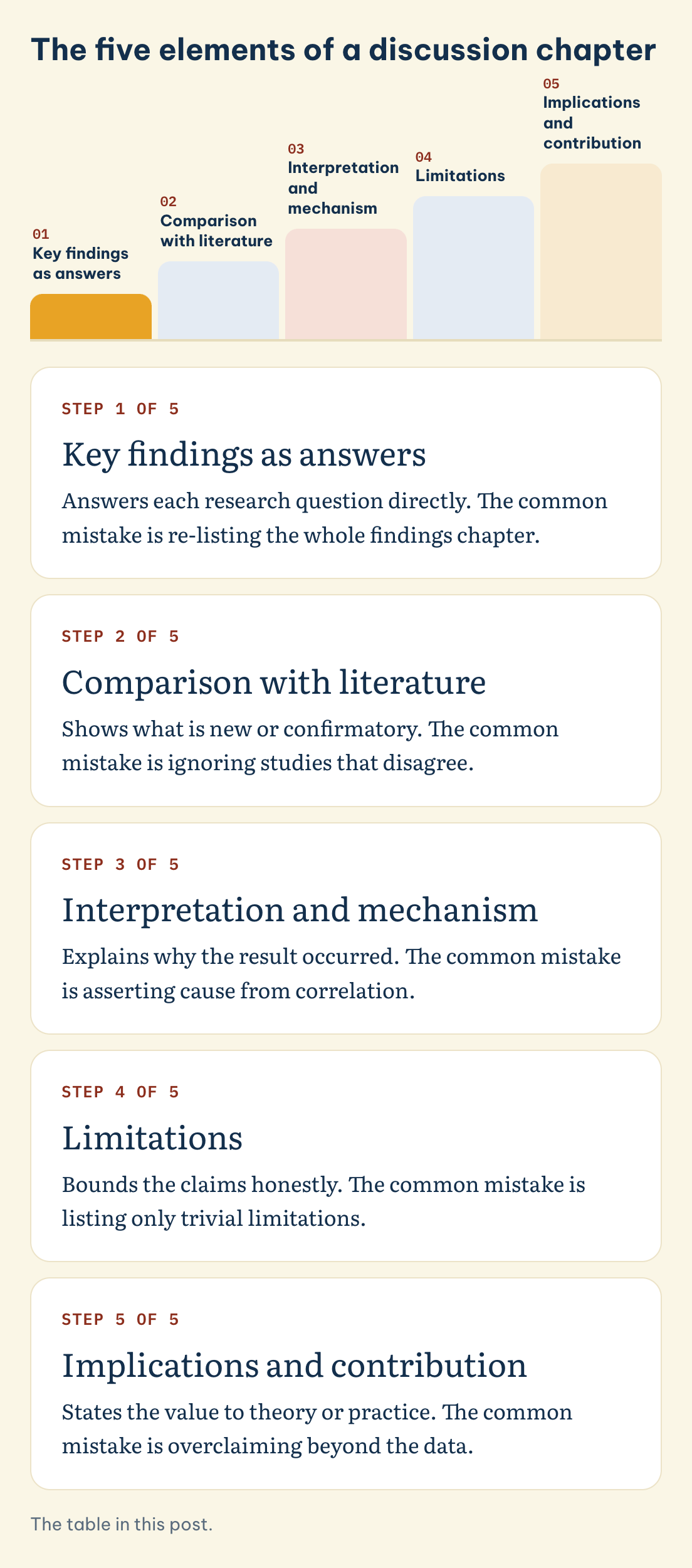
Direct answer: Use a predictable structure: open with your key findings as answers to your research questions, compare them with the literature, explain the mechanisms or reasons, state limitations honestly, then set out implications and a short conclusion. A structured discussion is easier to write and far easier for an examiner to follow.
The five elements of a discussion chapter
Tap an element to see what it does and the common mistake the post lists for it, in the order the post gives them.
Step 1 of 5
Key findings as answers
Answers each research question directly. The common mistake is re-listing the whole findings chapter.
Step 2 of 5
Comparison with literature
Shows what is new or confirmatory. The common mistake is ignoring studies that disagree.
Step 3 of 5
Interpretation and mechanism
Explains why the result occurred. The common mistake is asserting cause from correlation.
Step 4 of 5
Limitations
Bounds the claims honestly. The common mistake is listing only trivial limitations.
Step 5 of 5
Implications and contribution
States the value to theory or practice. The common mistake is overclaiming beyond the data.
Save this figure
Evidence: Editors argue that discussions should be structured rather than meandering, moving from a statement of principal findings, to strengths and weaknesses, to comparison with other studies, to meaning and unanswered questions (Docherty & Smith, 1999). That sequence, published in BMJ in 1999, still underlies the biomedical-writing guidance that followed it, including Cals and Kotz (2013). A consistent organisation helps a reader locate each element and signals disciplined reasoning (Hess, 2004).
| Discussion element | What it does | Common mistake |
|---|---|---|
| Key findings as answers | Answers each research question directly | Re-listing the whole findings chapter |
| Comparison with literature | Shows what is new or confirmatory | Ignoring studies that disagree |
| Interpretation / mechanism | Explains why the result occurred | Asserting cause from correlation |
| Limitations | Bounds the claims honestly | Listing only trivial limitations |
| Implications & contribution | States the value to theory or practice | Overclaiming beyond the data |
Example: A MAAS-coached postgraduate had written her discussion as one unbroken sequence of observations. Her mentor mapped it onto these five elements; the same content, reordered, read as a logical case rather than a stream of comments, with no new data added.
◆ Question 3 / 7 · Linking back
How do you link the discussion back to your research questions and framework?
Direct answer: Answer each research question explicitly, in the order you posed them, and read your findings through the conceptual or theoretical framework you set up earlier in the thesis. The discussion is where the framework earns its place; it should organise your interpretation, not sit unused in an early chapter.
Evidence: Handbooks for second-language thesis writers stress that the discussion must connect back to the study's aims and framing rather than drifting into general commentary, because examiners assess coherence across the whole thesis (Paltridge & Starfield, 2007). Commenting on results in a dissertation means relating each finding to the questions and concepts that generated it, not describing it in isolation (Basturkmen, 2009).
Example: A Vietnamese researcher's discussion never mentioned the theoretical framework from her chapter two. Her MAAS mentor helped her route each finding back through that framework and back to her three research questions; the chapter suddenly showed the thesis as one connected argument rather than separate parts.
◆ Question 4 / 7 · Comparing with the literature
How do you compare findings with the literature to show a contribution?
Direct answer: Place your results beside existing studies: say where you agree with prior work, where you disagree, and why the difference might exist, sample, setting, method, or measurement. This contextualisation is what turns a finding into a contribution to knowledge, which is the standard doctoral examiners apply.
Evidence: Effective discussions contextualise results by comparing them with previous work and explaining agreements and discrepancies through reasoning rather than assertion (Cals & Kotz, 2013). Dissertations that only report results without this comparative commentary read as incomplete to examiners, who expect the candidate to position the work in the field (Basturkmen, 2009).
Example: A MAAS Academic Mentoring client found a result that contradicted two well-known papers. Rather than hide it, her mentor helped her explain the discrepancy through a difference in population and timing, a transparent comparison that strengthened the thesis and gave her a confident answer to defend in the viva.
◆ Question 5 / 7 · Limitations
How do you write limitations and future research without weakening the thesis?
Direct answer: State the limitations that genuinely affect how your results should be read, design, sample size, confounding, generalisability and explain their likely direction and impact. Then propose future research that follows from them. Honest, specific limitations build examiner trust; vague or missing ones raise suspicion.
Evidence: A keyword audit of 400 papers across leading journals found that only 17% used even one word acknowledging a limitation, and not a single article discussed how that limitation might affect its own conclusions (Ioannidis, 2007). An unmentioned limitation that an examiner spots is far more damaging than one you disclose and contextualise, so surfacing the real weaknesses yourself is the safer strategy (Hess, 2004).
Example: A Vietnamese postgraduate wanted to delete his limitations section to look stronger. His MAAS mentor advised the opposite: they named the cross-sectional design and modest sample explicitly, explained how each bounded the conclusions, and framed a longitudinal follow-up as future work, a section the examiner later praised for its candour.
◆ Question 6 / 7 · Length and the viva
How long should the discussion chapter be, and how does it prepare you for the viva?
Direct answer: There is no fixed length, but the discussion is typically one of the longest chapters, comparable to the literature review and longer than the introduction or conclusion. More important than word count is that every claim can be defended aloud, the discussion is effectively your viva script.
Evidence: Because the discussion is where you argue the significance of the work, it is treated as your closing argument: you have presented the evidence in the findings, and the discussion persuades the reader what it means (Annesley, 2010). Handbooks note that examiners probe the discussion hardest in the oral defence, so a well-reasoned chapter is direct preparation for it (Paltridge & Starfield, 2007). With 79% of successful UK candidates sent away for minor corrections and a further 16% for major ones (DiscoverPhDs, n.d.), rehearsing your discussion chapter aloud before the viva is not a formality. It is preparation for the single most common outcome of the exam.
Example: A MAAS-coached doctoral candidate used her discussion chapter as her viva map: for each interpretation she had written, her mentor asked "how would you defend this out loud?" By the defence she could answer every examiner question because the reasoning was already on the page.
◆ Question 7 / 7 · Mistakes to avoid
What discussion-chapter mistakes fail Vietnamese and ESL candidates, and how can you avoid them?
Direct answer: The recurring triggers are repeating the findings instead of interpreting them, ignoring contradictory literature, hiding limitations, overclaiming, and never linking back to the research questions. Avoid them by drafting the discussion against a structure, then getting developmental feedback from a mentor who has examined theses from the other side of the table.
Evidence: Discussions commonly fail when they restate results without interpretation or stretch conclusions past the evidence (Hess, 2004). Vietnamese university output in Scopus and Web of Science rose 41.6% in a single year, 2018 versus 2017, faster than the 34.7% rise in Vietnam's total publication count over the same period (Nguyen et al., 2021), so a well-argued discussion chapter is a low-cost way for Vietnamese candidates to lift a thesis above the pass threshold rather than losing marks at the final chapter (Basturkmen, 2009).
| Mistake | Why examiners penalise it | The fix |
|---|---|---|
| Repeating the findings | Adds no interpretation | Explain what each finding means |
| Ignoring conflicting studies | Looks like selective reading | Address disagreements directly |
| Hiding limitations | Damages trust when spotted | Disclose real constraints early |
| Overclaiming the contribution | Evidence does not support it | Keep claims proportional |
| No link to research questions | Breaks thesis coherence | Answer each question explicitly |
Example: A MAAS mentor guided a Vietnamese candidate through the Outline → Draft → Final model: an outline fixing the five discussion elements, a draft that interpreted rather than repeated, and a final language polish for ESL clarity. The candidate stayed the author throughout, with the mentor advising at each stage rather than writing the chapter for her.
Where this guidance comes from
The structural advice above draws on peer-reviewed writing guidance published in BMJ, Clinical Chemistry, the Journal of Clinical Epidemiology, Respiratory Care, and the Journal of English for Academic Purposes between 1999 and 2013, alongside meta-research on how discussions are actually written and examined: a 400-paper audit in the Journal of Clinical Epidemiology (Ioannidis, 2007), a 26,076-candidate viva outcomes study (DiscoverPhDs, n.d.), and a bibliometric study of Vietnamese universities in Heliyon (Nguyen et al., 2021).
Frequently asked questions
Should the results and discussion be separate chapters in a dissertation?
In most social science and humanities theses they are separate, so reporting and interpretation stay distinct. Some science disciplines combine them into a "Findings and Discussion" chapter. Check your programme's rubric and your supervisor's preference before you decide, and keep interpretation clearly marked either way.
How long should the discussion chapter be?
There is no universal figure, but it is usually among the longest chapters, similar in weight to the literature review. Aim for enough depth to interpret every research question thoroughly rather than a target word count, and cut any paragraph that only re-describes the findings.
How is the discussion chapter different from the conclusion?
The discussion interprets and argues in detail; the conclusion is a short, final synthesis of what the study showed, its contribution, and its implications. The discussion does the heavy reasoning, and the conclusion lands the argument the discussion has built.
Do I need to cite new literature in the discussion?
Yes, usually. You will often introduce studies here that you compare your findings against, even if they were not in your literature review. The discussion is where comparison happens, so bringing in relevant work to explain agreements and discrepancies is expected.
How much should I repeat numbers from my findings chapter?
Cite key figures sparingly to anchor an interpretation, but do not re-tabulate results. Refer back to your findings tables rather than reproducing them, and spend the space explaining what the numbers mean for your research questions.
Can MAAS help me write a stronger dissertation discussion chapter?
Yes. MAAS Academic Mentoring coaches Vietnamese researchers through interpreting findings, structuring the chapter, linking back to the framework and research questions, and writing honest limitations, using a phase-by-phase model with PhD-level mentors. Book a consultation through our contact page.
Ready to write a discussion chapter examiners respect?
The discussion is where a thesis proves it understands its own results and it is far easier to get right with a mentor matched to your exact research area. MAAS Academic Mentoring pairs you with a mentor whose degree sits above yours, a doctorate or a master's with supervisory experience, for a free 20-minute consultation, and matches you to the right advisor within 48 hours when our network already covers that field, or in about two weeks if MAAS has to recruit for it. Among our experts, 23% hold doctorates. Findings and discussion fall inside the chapter-writing blocks, usually about 2 to 4 sessions per block, and each block ends with the draft you wrote reviewed for its logical structure. We coach; you stay the author, every step.
Book a dissertation mentoring consultation with MAAS →
Related guides
- How do you write the findings/results section of a research paper?: report the results your discussion then interprets
- How do you write a theoretical framework for a thesis?: the framework your discussion should read your findings through
- How do you write a dissertation conclusion?: the short synthesis that follows the discussion
- How should a dissertation's chapters break down by word count?: how much weight the discussion chapter carries
- How do you write the discussion section of a research paper?: the shorter journal-article version of the same skill
- How do you prepare for a viva voce defence as an ESL student?: defending the interpretation you argue here
- Dissertation mentoring resource hub: guides across the whole thesis journey
- Academic Mentoring service: phase-based coaching for master's and doctoral candidates
- Meet the MAAS experts: the PhD-level mentors behind our dissertation coaching
References
- Annesley, T. M. (2010). The discussion section: Your closing argument. Clinical Chemistry, 56(11), 1671–1674. https://doi.org/10.1373/clinchem.2010.155358
- Basturkmen, H. (2009). Commenting on results in published research articles and masters dissertations in language teaching. Journal of English for Academic Purposes, 8, 241–251.
- Cals, J. W. L., & Kotz, D. (2013). Effective writing and publishing scientific papers, part VI: Discussion. Journal of Clinical Epidemiology, 66(10), 1064. https://doi.org/10.1016/j.jclinepi.2013.04.017
- DiscoverPhDs. (n.d.). PhD failure rate: A study of 26,076 PhD candidates. Retrieved August 21, 2026, from https://www.discoverphds.com/advice/doing/phd-failure-rate
- Docherty, M., & Smith, R. (1999). The case for structuring the discussion of scientific papers: Much the same as that for structuring abstracts. BMJ, 318(7193), 1224–1225. https://doi.org/10.1136/bmj.318.7193.1224
- Hess, D. R. (2004). How to write an effective discussion. Respiratory Care, 49(10), 1238–1241.
- Ioannidis, J. P. A. (2007). Limitations are not properly acknowledged in the scientific literature. Journal of Clinical Epidemiology, 60(4), 324–329. https://doi.org/10.1016/j.jclinepi.2006.09.011
- Nguyen, N. D., Nguyen, T. D., & Dao, K. T. (2021). Effects of institutional policies and characteristics on research productivity at Vietnam science and technology universities. Heliyon, 7(1), Article e06024. https://doi.org/10.1016/j.heliyon.2021.e06024
- Paltridge, B., & Starfield, S. (2007). Thesis and dissertation writing in a second language: A handbook for supervisors. Routledge.
This article is part of the MAAS Journal series for Vietnamese international postgraduate students and researchers. MAAS Academic Mentoring is an advisory partner; we coach candidates through a phase-by-phase delivery model with developmental feedback from PhD-level mentors and thesis examiners. We do not write, submit, or guarantee acceptance of work on a candidate's behalf.
A free 20-minute consultation with MAAS Academic Mentoring, to talk through your discussion chapter and how you would defend it aloud.
Book Free Discovery ▸