
◆ Thesis and dissertation
How many words is a dissertation, and how long is each chapter?
Type your total word count and the table shows the words for each chapter.
Last updated: 2026-10-09
Category: thesis-dissertation
◆ Part 1 / 8 · Total
Your total word count
Rounded to whole words; any leftover word goes to the literature review.
| Chapter | Words | Share |
|---|---|---|
| Introduction | 1,000 | 10% |
| Literature review | 3,000 | 30% |
| Methodology | 2,000 | 20% |
| Results and discussion | 3,000 | 30% |
| Conclusion | 1,000 | 10% |
| Total | 10,000 | 100% |
Proportions from the dissertation guide of Plymouth Marjon University (Marjon Study Skills, 2019). If your handbook sets its own split, follow your handbook.
Two more totals
8,000 words
Rounded to whole words; any leftover word goes to the literature review.
| Chapter | Words | Share |
|---|---|---|
| Introduction | 800 | 10% |
| Literature review | 2,400 | 30% |
| Methodology | 1,600 | 20% |
| Results and discussion | 2,400 | 30% |
| Conclusion | 800 | 10% |
| Total | 8,000 | 100% |
15,000 words
Rounded to whole words; any leftover word goes to the literature review.
| Chapter | Words | Share |
|---|---|---|
| Introduction | 1,500 | 10% |
| Literature review | 4,500 | 30% |
| Methodology | 3,000 | 20% |
| Results and discussion | 4,500 | 30% |
| Conclusion | 1,500 | 10% |
| Total | 15,000 | 100% |

◆ Part 2 / 8 · Chapters
The chapters of a dissertation and the job each one does
Direct answer: A standard dissertation runs title page, abstract, contents, introduction, literature review, methodology, results, discussion, conclusion, bibliography and appendices. Each chapter answers one question: why the study matters, what is already known, how it was done, what was found, and what the finding means (University of Westminster, n.d.).
The chapters do not have to be the same length (University of Reading, n.d.). For the whole writing journey, see the full chapter-by-chapter dissertation guide. If your budget includes a theoretical framework, how to write a theoretical framework explains it. Each chapter has its own guide: the dissertation introduction, the methodology chapter and the conclusion.
◆ Part 3 / 8 · Budget rule
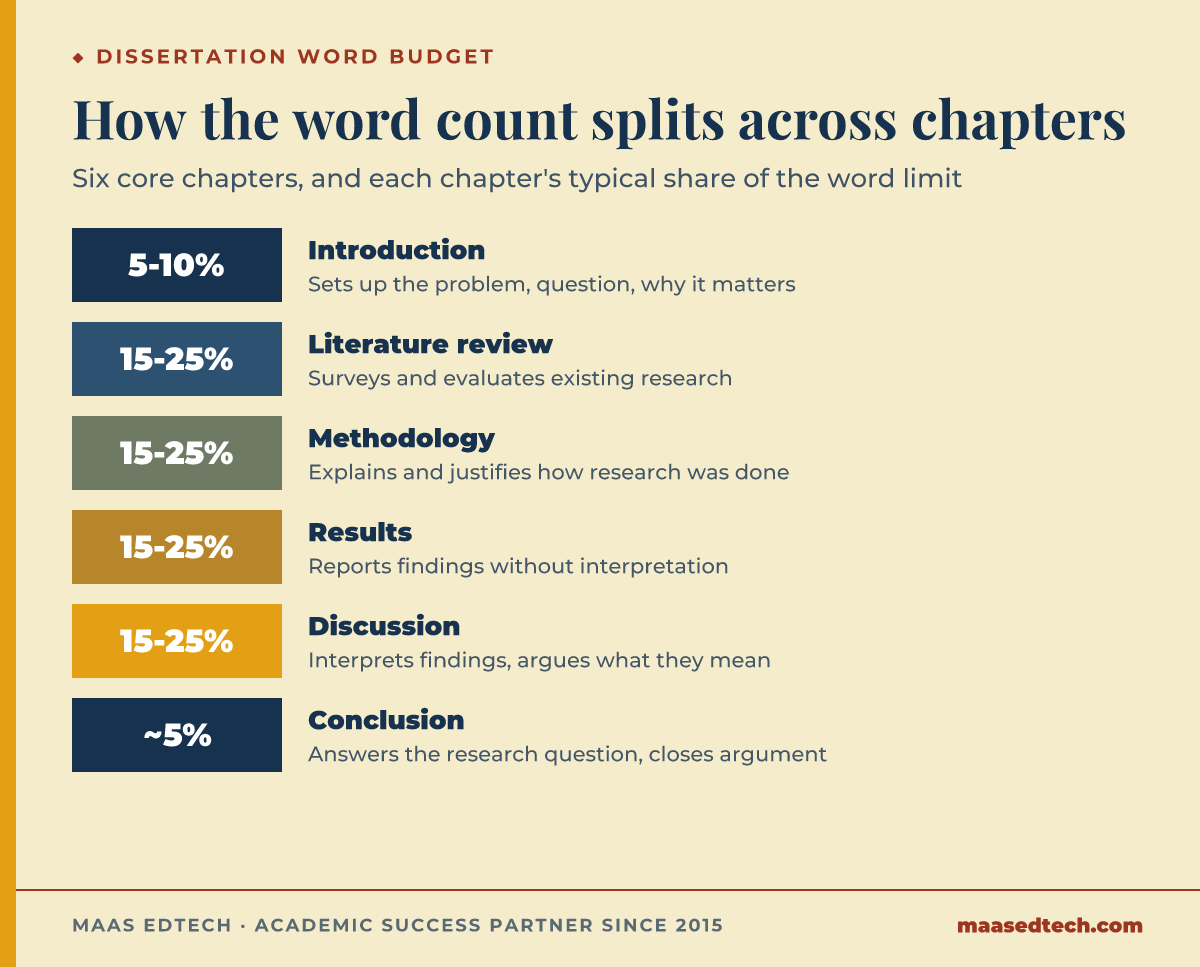
The word-budget rule: 5 to 10% intro, 15 to 25% per chapter, about 5% conclusion
Direct answer: Greetham's rule, quoted by the University of Hull (Greetham, as cited in University of Hull, n.d.), gives the introduction 5 to 10%, each chapter 15 to 25% and the conclusion about 5%. On 10,000 words that is 500 to 1,000 for the introduction, 1,500 to 2,500 per chapter and about 500 for the conclusion.
Introduction
5 to 10%
of the word limit, which is 500 to 1,000 words on 10,000
Each core chapter
15 to 25%
of the word limit, which is 1,500 to 2,500 words per chapter on 10,000
Greetham's word-budget rule
Share of the word limit for the introduction and for each chapter. The conclusion takes about 5%, which is about 500 words on 10,000.
Greetham and Hull are one source, not two: Hull's page quotes Greetham, and Hull's own line gives the conclusion 5 to 10% (Greetham, as cited in University of Hull, n.d.). The table above uses a different, single-figure split, from Marjon (Marjon Study Skills, 2019). Westminster gives the introduction roughly 10% and the conclusion 5 to 10% (University of Westminster, n.d.). A word budget is also an argument about which chapter carries the most weight, so the abstract and the conclusion deserve their own planning.
Your handbook beats any general rule
The document your marker holds is your programme handbook, and its word limit is a hard rule. Check any budget against it first; structure often varies by discipline, and looking at previously submitted work in your subject can help (University of Oxford, Department for Continuing Education, n.d.). Turning budgets into dates is covered in how to plan a dissertation timeline.
◆ Part 4 / 8 · Other guides
How do other university guides split a dissertation?
Direct answer: They differ, so none is the answer for every course. On 10,000 words with results and discussion merged, Marjon gives 3,000 words to results and discussion (Marjon Study Skills, 2019) and LSE about 4,000 (Department of Media and Communications, 2021).
Four ways a dissertation gets split
Tap a guide to see how it splits the word limit.
LSE
At LSE, a taught MSc dissertation of 10,000 to 12,000 words that is empirical has an introduction of about 700, a theoretical chapter of about 3,300 (literature review about 2,500, theoretical framework about 500, objectives about 300), methodology about 1,500, results and interpretation about 4,000 and a conclusion of about 500, written for 10,000 words and adjusted pro rata.
Edinburgh SPS
At Edinburgh SPS, a 15,000-word MSc has an introduction of about 2,500, three or four substantive chapters of about 2,500 to 3,000 each and a conclusion of about 1,000 to 2,000.
Staffordshire
At Staffordshire, a 7,500-word undergraduate project gives background 30 to 35%, methodology 20 to 25%, results 10% and discussion 30 to 35%, within plus or minus 10%.
Research theses
For research theses, the introduction and the conclusion take about 10% each, a core chapter of 8,000 to 12,000 words is a guideline, and a literature review runs at 15 to 30% of the thesis and is probably too long above 40%.
- LSE (taught MSc, 10,000 to 12,000 words, empirical): introduction about 700, a theoretical chapter about 3,300 (literature review about 2,500, theoretical framework about 500, objectives about 300), methodology about 1,500, results and interpretation about 4,000, conclusion about 500, written for 10,000 words and adjusted pro rata (Department of Media and Communications, 2021).
- Edinburgh SPS (15,000-word MSc): introduction about 2,500, three or four substantive chapters of about 2,500 to 3,000 each, conclusion about 1,000 to 2,000 (School of Social and Political Science, 2023).
- Staffordshire (7,500-word undergraduate project): background 30 to 35%, methodology 20 to 25%, results 10%, discussion 30 to 35%, within plus or minus 10% (Stanhope, n.d.).
- Research theses: introduction and conclusion about 10% each, and a core chapter of 8,000 to 12,000 words as a guideline (University of Melbourne, n.d.); an introduction of roughly 10% (Australian National University, n.d.). A literature review of 15 to 30% of the thesis, and probably too long above 40% (UNSW Sydney, n.d.).
◆ Part 5 / 8 · What counts
What counts toward the word limit, and what sits outside it?
Direct answer: The limit is set locally, and each university draws the line differently. Marjon excludes the abstract, contents, glossary, reference list, bibliography and appendices (Marjon Study Skills, 2019), while LSE counts footnotes and endnotes but not the bibliography or appendices (Department of Media and Communications, 2021). Confirm what sits inside your limit before you budget a single chapter.
LSE also counts abstracts in its 10,000 minimum and leaves out the table of contents (Department of Media and Communications, 2021). Edinburgh SPS counts footnotes and endnotes, in-text references, tables and diagrams but not the abstract, bibliography, appendices, cover page or contents (School of Social and Political Science, 2023). The Bristol research-degree code excludes references, appendices and lists of contents from the word count and requires postgraduate research students to include an abstract of no more than 300 words (University of Bristol, n.d.).
◆ Part 6 / 8 · Literature-based
When your dissertation is literature-based: no methods, no results
Direct answer: A literature-based dissertation collects no primary data, so it has no methodology and no results chapter. Themed chapters take their place. The only numeric split we found is Greetham's, quoted by Hull, at 5 to 10% for the introduction, 15 to 25% for each themed chapter and about 5% for the conclusion (University of York, n.d.).
A themed chapter does literature review work, and a literature review is selective synthesis, so see the literature review guide. The University of Sheffield (University of Sheffield, n.d.) puts it plainly: "It is about quality not quantity!"
◆ Part 7 / 8 · One chapter
Can results and discussion be one chapter?
Direct answer: Yes. In the social sciences, and often in shorter dissertations, findings and discussion may be combined into one thematically organised chapter (Oxford Brookes University, n.d.). LSE reports results and interpretation together as one chapter of about 40% of a 10,000-word dissertation (Department of Media and Communications, 2021).
Results report what you found; the discussion interprets it. Blurring the two is the usual reason a budget goes wrong (University of Southampton, n.d.). The University of Suffolk (University of Suffolk, n.d.) describes a piece that "consists of 3 main sections: introduction, main body and conclusion/summary".
◆ Part 8 / 8 · Pages, not words
My university counts pages, not words. What then?
Direct answer: Vietnamese guides in the sources we read count pages, so this calculator does not turn pages into words, and no source gives a conversion. Hue's internal medicine department, the VNUA IT faculty and Thuyloi University each set a page budget rather than a word budget.
Three Vietnamese page budgets
Each row shows a Vietnamese guide that sets pages rather than words.
Where
What it sets
Hue's internal medicine department
60 to 80 pages of content, with chapter 1 at 15 to 20 pages, chapter 2 at 10 to 15, chapter 3 at 15 to 20, chapter 4 at 15 to 20, and 1 to 2 pages each for the introduction and conclusion
The VNUA IT faculty
Core content of 50 to 80 pages, with shares of about 5 to 10%, 15 to 20%, 35 to 40%, 25 to 30% and 5% across five chapters
Thuyloi University
At most 100 pages for a master's thesis, with at least 50% presenting your own results and discussion
Hue's internal medicine department gives 60 to 80 pages of content, with chapter 1 at 15 to 20 pages, chapter 2 at 10 to 15, chapter 3 at 15 to 20, chapter 4 at 15 to 20, and 1 to 2 pages each for the introduction and conclusion (Bộ môn Nội, n.d.). The VNUA IT faculty gives core content of 50 to 80 pages with shares of about 5 to 10%, 15 to 20%, 35 to 40%, 25 to 30% and 5% across five chapters (Khoa Công nghệ thông tin, n.d.). Thuyloi University allows at most 100 pages for a master's thesis, with at least 50% presenting your own results and discussion (Trường Đại học Thủy lợi, n.d.).
When you want a second pair of eyes on your chapter plan
A word budget is easiest to get right before drafting starts. MAAS academic mentoring pairs you with a postgraduate-qualified mentor who works through the plan with you. Mentors question, advise and give structured feedback; the decisions and the writing remain your own.
Frequently asked questions
How many words is a dissertation?
There is no single length. The word limit is set by your programme handbook and it is a hard rule. Totals in the guides we read run from 5,000 to 12,000 words for undergraduate work (Marjon Study Skills, 2019), 10,000 to 12,000 for a taught MSc (Department of Media and Communications, 2021) and 15,000 to 20,000 for a master's thesis (Australian National University, n.d.).
How should a 12,000-word dissertation be split between chapters?
The table above gives 1,200 for the introduction, 3,600 for the literature review, 2,400 for the methodology, 3,600 for results and discussion and 1,200 for the conclusion, from one guide (Marjon Study Skills, 2019). Greetham, quoted by Hull, gives roughly 600 to 1,200 for the introduction, 1,800 to 3,000 per chapter and about 600 for the conclusion (Greetham, as cited in University of Hull, n.d.); LSE's pro rata structure gives 840, 3,960, 1,800, 4,800 and 600 (Department of Media and Communications, 2021). Follow the one your handbook points to.
How long should each chapter of a dissertation be?
As a general rule the introduction is 5 to 10% of the word limit, each chapter 15 to 25% and the conclusion about 5% (Greetham, as cited in University of Hull, n.d.). Other guides differ, and your handbook always takes priority.
What are the main chapters of a dissertation?
Introduction, literature review, methodology, results, discussion and conclusion, with title page, abstract and contents before and bibliography and appendices after (University of Westminster, n.d.).
Do all dissertations have a methodology and results chapter?
No. A dissertation that is an extended literature review involves no data collection, so it has neither; themed chapters explore concepts and theories instead (University of York, n.d.).
Can findings and discussion be one chapter?
Yes, in the social sciences and often in shorter dissertations, but both jobs must still be done (Oxford Brookes University, n.d.).
What is the difference between the results and discussion chapters?
Results give a direct account of what you found, without interpretation; the discussion interprets it. Stating original findings for the first time in the discussion is a common mistake (University of Southampton, n.d.).
Do I have to write the introduction first?
No. Because each chapter is self-contained, you can start with the easiest and return to the introduction later (University of Reading, n.d.).
How long should the dissertation abstract be?
It depends on the institution. Edinburgh SPS does not count the abstract (School of Social and Political Science, 2023); LSE suggests about 300 words and counts abstracts in its 10,000 minimum (Department of Media and Communications, 2021). Check your own handbook.
References
- Australian National University. (n.d.). Introductions: Length. Academic Skills. https://www.anu.edu.au/students/academic-skills/research-writing/introductions/length
- Bộ môn Nội, Trường Đại học Y Dược, Đại học Huế. (n.d.). Yêu cầu hình thức luận văn cao học, nội trú, CK2, tiến sĩ. https://www.bomonnoiydhue.edu.vn/huong-dan-viet-luan-van-luan-an/yeu-cau-hinh-thuc-luan-van-cao-hoc-noi-tru-ck2-tien-si.html
- Department of Media and Communications, London School of Economics and Political Science. (2021). MC499 dissertation handbook 2021/22. https://www.lse.ac.uk/media-and-communications/assets/documents/study/current-students/Dissertation-Handbook.pdf
- Khoa Công nghệ thông tin, Học viện Nông nghiệp Việt Nam. (n.d.). Hướng dẫn quy cách trình bày báo cáo khóa luận tốt nghiệp. https://fita.vnua.edu.vn/wp-content/uploads/2026/07/10_Huong-dan-quy-cach-trinh-bay-bao-cao-KLTN.pdf
- Marjon Study Skills. (2019). Dissertation guide. Plymouth Marjon University. https://bpb-eu-w2.wpmucdn.com/sites.marjon.ac.uk/dist/4/1340/files/2019/10/Dissertation-Guide.pdf
- Oxford Brookes University. (n.d.). Dissertations: Writing up and formatting. https://www.brookes.ac.uk/students/academic-development/online-resources/dissertations/writing-up-and-formatting
- School of Social and Political Science, University of Edinburgh. (2023). MSc dissertation handbook 2023-24. https://www.sps.ed.ac.uk/sites/default/files/assets/doc/PGT%20Dissertation/MSc%20Dissertation%20Handbook%202023-24.pdf
- Stanhope, E. (n.d.). Project write-up. In Research project student guide. https://bookdown.org/edward_stanhope/research_project_student_guide/project-write-up.html
- Trường Đại học Thủy lợi. (n.d.). Quy định đối với luận văn thạc sĩ. https://env.tlu.edu.vn/cao-hoc/quy-dinh-doi-voi-luan-van-thac-si-828
- University of Bristol. (n.d.). Dissertation content and format [Code of Practice for Research Degree Programmes]. Academic Quality and Policy Office. https://www.bristol.ac.uk/academic-quality/pg/code-of-practice/assessment/content-format/
- University of Hull. (n.d.). Literature-based projects: Dissertations and projects. https://libguides.hull.ac.uk/dissertations/literaturebased
- University of Melbourne. (n.d.). Writing thesis sections part 1. Graduate Research Services. https://students.unimelb.edu.au/academic-skills/graduate-research-services/writing-thesis-sections-part-1
- University of Oxford, Department for Continuing Education. (n.d.). Writing theses and dissertations. https://lifelong-learning.ox.ac.uk/about/writing-theses-and-dissertations
- University of Reading. (n.d.). Writing up your dissertation: Dissertations and major projects. https://libguides.reading.ac.uk/dissertations/writing-up
- University of Sheffield. (n.d.). How to write a literature review. StudySkills@Sheffield. https://sheffield.ac.uk/study-skills/writing/critical/literature-review
- University of Southampton. (n.d.). Results and Discussion: Writing the Dissertation: Guides for Success. https://library.soton.ac.uk/writing_the_dissertation/results_discussion
- University of Suffolk. (n.d.). Writing chapters: Dissertations. Learning and Teaching. https://libguides.uos.ac.uk/dissertations/writing-chapters
- University of Westminster. (n.d.). Standard: Dissertations 2: Structure. https://libguides.westminster.ac.uk/Dissertation-Structure/Standard
- University of York. (n.d.). Dissertations: Academic writing: a practical guide. https://subjectguides.york.ac.uk/academic-writing/dissertations
- UNSW Sydney. (n.d.). Literature review. Academic Skills. https://www.unsw.edu.au/student/managing-your-studies/academic-skills-support/toolkit/honours-postgraduate/literature-review
A free discovery call with a MAAS academic mentor, to talk through your chapter plan and your programme's word limit.
Book Free Discovery ▸