
◆ Thesis and dissertation
How to write a dissertation conclusion in 5 moves
To write a dissertation conclusion, work through five moves in order: purpose, findings and contribution, limits, implications, then future research. It is the final chapter that answers your research questions and shows what your study changed.
For Vietnamese postgraduate researchers writing in English, the conclusion is the chapter an examiner reads most closely against the introduction, where a thesis either lands its argument or quietly under-sells it. This guide answers the seven questions Vietnamese master's and doctoral students ask MAAS mentors most when they reach chapter six.

◆ Question 1 / 7 · What it is for
What is a dissertation conclusion actually for?
Direct answer: The conclusion has one job: to tell the reader what your study now allows the field to know that it did not know before. It answers the research questions you set, names your contribution, acknowledges limits, and points forward. It is an argument about significance, not a recap of every chapter.
Evidence: Bunton (2005), writing in the Journal of English for Academic Purposes and analysing 45 chapters from PhD theses across disciplines, found that a strong conclusion does far more than summarise; it revisits the study's purpose, consolidates the research space the thesis has built, and projects outward into applications and future work. The summary is a small part of a chapter whose real function is to claim the value of what was done.
Example: A MAAS-coached master's student in education wrote a conclusion that re-narrated her three findings and stopped. Her mentor asked one question, "so what is now true that wasn't before?" and the chapter was rebuilt around the answer, reading as a contribution rather than a recap.
◆ Question 2 / 7 · Versus the discussion
How is the conclusion different from the discussion chapter?
Direct answer: The discussion interprets your results in detail and argues what they mean; the conclusion stands above the whole thesis and states what it all adds up to. The discussion works close to the data; the conclusion works at the level of the field. Repeating the discussion in your conclusion is the single most common structural error.
The discussion chapter and the conclusion chapter, side by side
Each row sets one feature of the discussion chapter beside the same feature of the conclusion chapter.
Discussion chapter
Conclusion chapter
Altitude: close to the data
Altitude: above the whole thesis
Core question: what do the results mean?
Core question: what does the thesis contribute?
New interpretation: yes, this is where it belongs
New interpretation: no, synthesise only
Literature: compares findings to prior studies
Literature: restates the gap now filled
Forward look: brief
Forward look: central, covering future research and practice
Save this figure
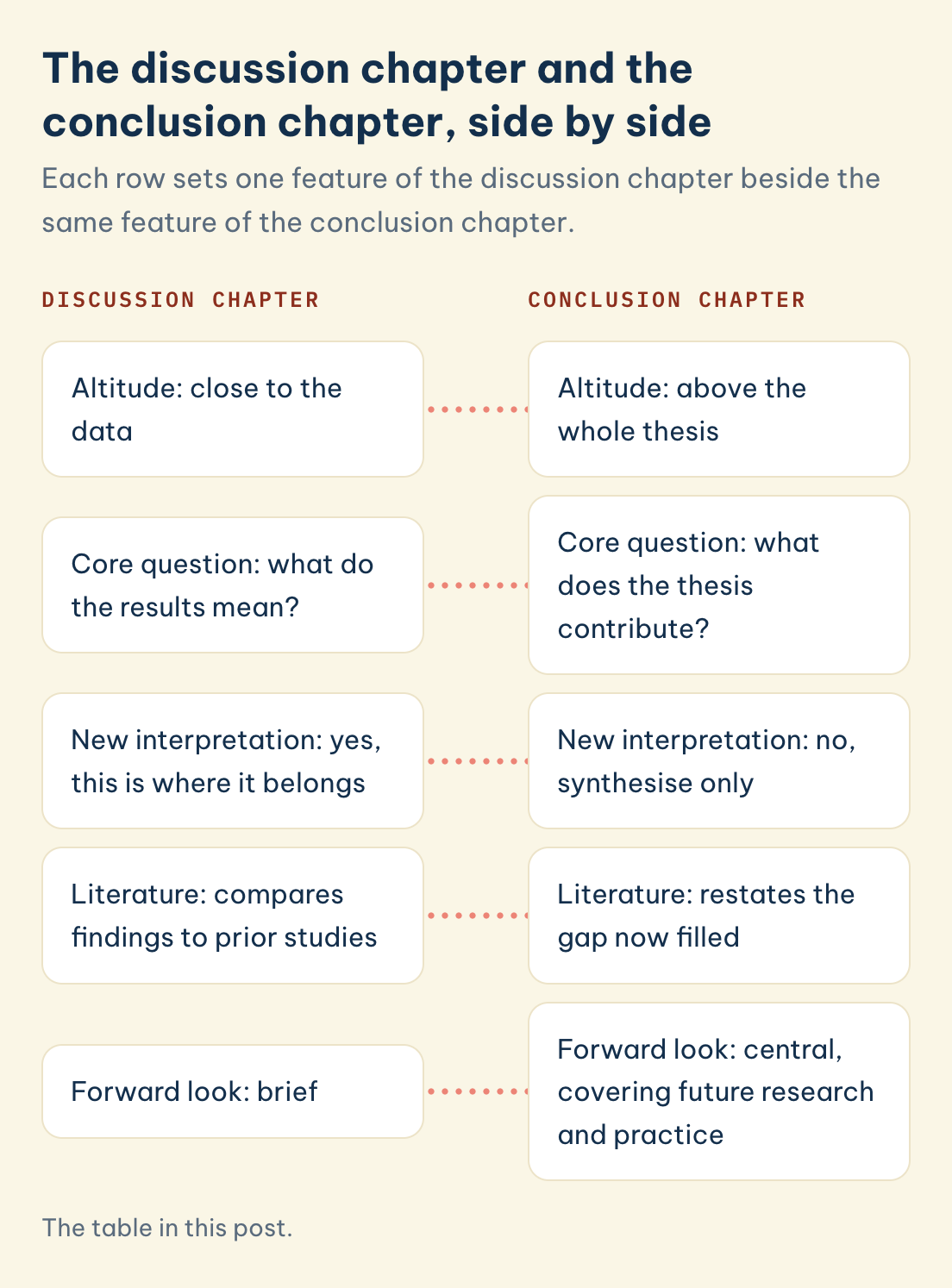
Evidence: Swales and Feak (2012), in Academic Writing for Graduate Students, describe the conclusion as the chapter that "zooms out", moving from specific results back to broad significance, the mirror image of the introduction's funnel. Where the discussion answers "what do these results mean?", the conclusion answers "why does this thesis matter, and what should happen next?"
Example: A Vietnamese doctoral candidate in management submitted a conclusion that was, in effect, a second discussion. Her MAAS mentor used the table below to separate the two chapters: the discussion kept the interpretation, the conclusion was cut to contribution, limits, and recommendations, and the redundancy an examiner would have flagged disappeared.
| Feature | Discussion chapter | Conclusion chapter |
|---|---|---|
| Altitude | Close to the data | Above the whole thesis |
| Core question | What do the results mean? | What does the thesis contribute? |
| New interpretation | Yes, this is where it belongs | No, synthesise only |
| Literature | Compares findings to prior studies | Restates the gap now filled |
| Forward look | Brief | Central (future research, practice) |
◆ Question 3 / 7 · The moves
What moves should a dissertation conclusion contain?
Direct answer: A complete conclusion moves through a recognisable sequence: restate the purpose and questions, consolidate what the study found and contributes, state limitations, give practical implications or recommendations, and propose future research. Naming each move as you draft stops you from ending the thesis on a summary and forgetting the contribution.
The five moves of a dissertation conclusion
Tap a move to see what you do and a signal phrase for it, following Bunton (2005).
Step 1 of 5
Restate purpose
Remind the reader what the thesis set out to do. Signal phrase: "This study set out to…"
Step 2 of 5
Consolidate the research space
Synthesise key findings and name the contribution. Signal phrase: "Taken together, these findings show…"
Step 3 of 5
State limitations
Define what the study could and could not establish. Signal phrase: "These results should be read in light of…"
Step 4 of 5
Practical implications
Show what the findings mean for practice or policy. Signal phrase: "For practitioners, this suggests…"
Step 5 of 5
Recommend future research
Point to the next questions your work opens. Signal phrase: "Future studies could examine…"
Save this figure
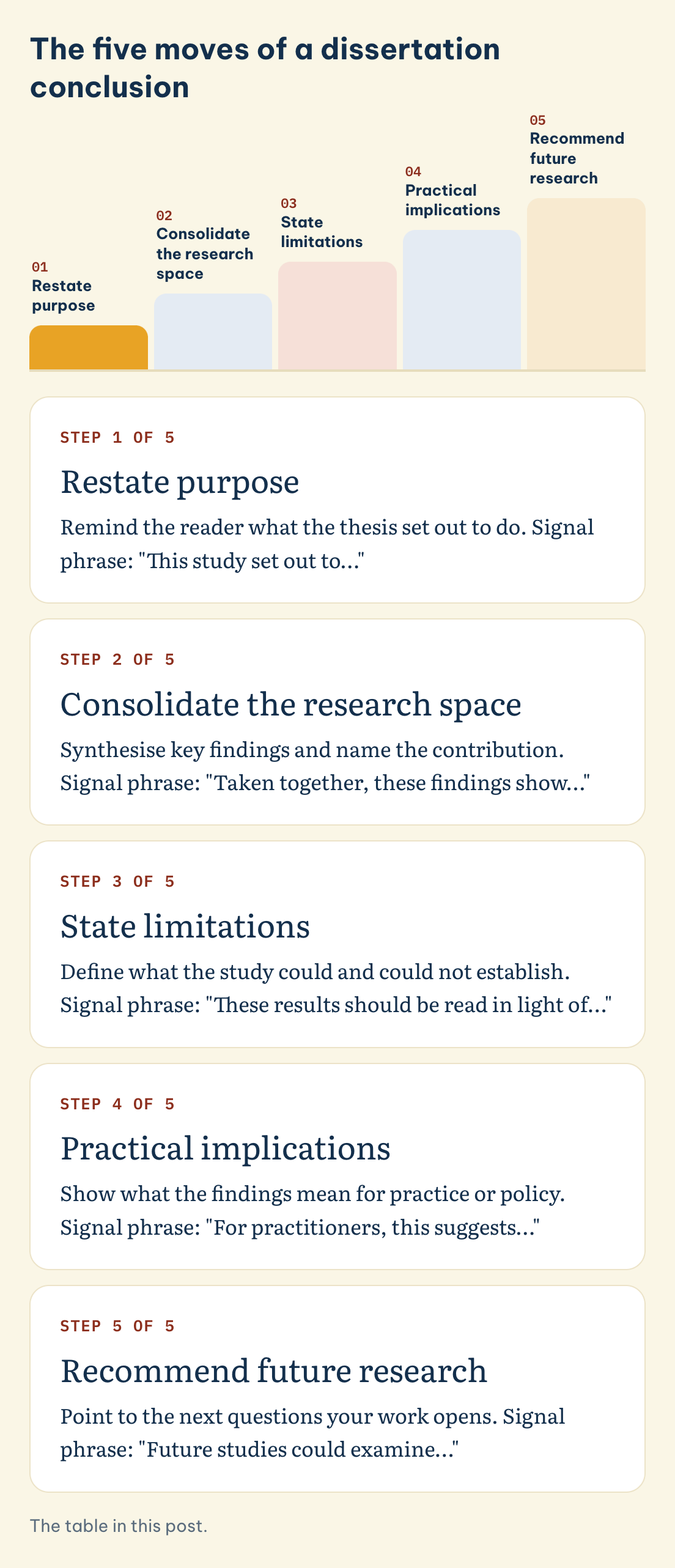
Evidence: Bunton (2005) identified the moves below as the recurring structure of PhD conclusions, with the consolidation of the research space, restating findings, claiming contribution, comparing to the literature, as the chapter's centre of gravity. Chen and Kuo (2012), writing in The Asian ESP Journal and studying master's theses in applied linguistics, confirmed a similar pattern at master's level, showing the structure scales down from doctoral work.
Example: A MAAS client in finance had a conclusion with strong findings but no explicit contribution or future-research move. Walking through the moves below, he added two short sections, one naming his theoretical contribution, one proposing follow-up studies and the examiner's "what next?" question was answered before it was asked.
| Move (Bunton, 2005) | What you do | Signal phrases |
|---|---|---|
| 1, Restate purpose and questions | Remind the reader what the thesis set out to do | "This study set out to…" |
| 2, Consolidate the research space | Synthesise key findings and name the contribution | "Taken together, these findings show…" |
| 3, State limitations | Define what the study could and could not establish | "These results should be read in light of…" |
| 4, Practical implications | Show what the findings mean for practice or policy | "For practitioners, this suggests…" |
| 5, Recommend future research | Point to the next questions your work opens | "Future studies could examine…" |
◆ Question 4 / 7 · Stating the contribution
How do you state your contribution to knowledge without over-claiming?
Direct answer: State your contribution in proportion to your evidence. Name what is genuinely new, empirical, theoretical, or practical, in one or two clear sentences, then bound it: this population, this context, this design. Examiners reward a precise, defensible claim far more than a sweeping one your data cannot support.
Evidence: Bunton (2005) found that successful conclusions consolidate the research space by explicitly linking findings back to the gap named in the introduction, rather than asserting broad importance. Murray (2017), in How to Write a Thesis, frames the contribution as a claim you must be able to defend at the viva, every word should survive the question "how do you know?"
Example: A Vietnamese PhD candidate in public health wrote that her study "transforms understanding" of a behaviour. Her MAAS mentor helped her reframe it as a specific, bounded empirical contribution, new evidence from an under-studied population, with the limits stated in the same breath. The smaller claim was stronger, and held up cleanly at the viva.
◆ Question 5 / 7 · Limitations
How do you write limitations and recommendations that strengthen the thesis?
Direct answer: Treat limitations as the honest foundation for your recommendations, not as an apology. State each real limit plainly, explain what it does and does not affect, and let it open directly into a targeted recommendation or future-research direction. A well-framed limitation makes a thesis look more credible, not less.
Evidence: Murray (2017) argues that examiners read limitations as a test of judgement: candidates who name their boundaries clearly show the critical self-awareness a doctorate certifies. Bunton (2005) shows recommendations and future-research moves are standard, expected components, their absence reads as an unfinished argument rather than a modest one.
Example: A MAAS doctoral client buried her sampling limitation in a defensive sentence. Her mentor suggested she turn it into a paired structure, the limit, then the future study it justifies. What had looked like a weakness became the springboard for her recommendations.
◆ Question 6 / 7 · Length and limits
How long should the conclusion be, and what should it never do?
Direct answer: As a rough guide, the conclusion runs roughly 5–8% of the thesis, often a few pages at master's level and longer for a PhD but completeness of the moves matters more than length. The one firm rule: a conclusion must never introduce new data, new results, or a new argument the body did not establish.
Evidence: Swales and Feak (2012) and Murray (2017) both warn that new material in a conclusion signals an analysis that was not finished in the right place; everything here should already be earned in the body. Bunton (2005) found that even short conclusions work when they complete the core moves, while long ones fail when they merely re-run the discussion.
For the shorter essay version of the same task, see how to write an essay conclusion that does more than repeat the introduction.
Example: A MAAS client in education slipped a fresh sub-finding into her conclusion because "it didn't fit anywhere else." Her mentor suggested she move it back into the results, where it could be properly evidenced, and the conclusion returned to its job, synthesis, not new analysis.
◆ Question 7 / 7 · Common mistakes
What conclusion mistakes do Vietnamese and other ESL researchers make most?
Direct answer: The most common pattern in second-language theses is a conclusion that summarises thoroughly but states the contribution weakly, the writer recaps each chapter yet never sharpens the single claim the examiner is waiting for. Other frequent issues are a missing future-research move and a conclusion that drifts back into discussion.
Evidence: Nguyen and Pramoolsook (2016), writing in the Global Journal of Foreign Language Teaching and analysing TESOL master's thesis conclusions written by Vietnamese postgraduates, found the deduction-and-contribution move present in every chapter but other moves only conventionally realised. Their study states directly that "these findings indicate not only a linear structure in composing the concluding chapters by this group of Vietnamese writers but also the rhetorical influence of Vietnamese written discourse on their English writing" (Nguyen & Pramoolsook, 2016, p. 2). Paltridge and Starfield (2019), in Thesis and Dissertation Writing in a Second Language, note more broadly that second-language thesis writers often master the descriptive, summarising moves while underplaying the evaluative move that claims significance.
Example: A Vietnamese master's candidate's conclusion summarised all 5 chapters but never said what the field should take from her work. Her MAAS mentor used the contribution move as a one-sentence checklist, "this thesis shows that…" and the claim implicit across 40 pages finally appeared where an examiner looks for it.
Frequently asked questions
How do I write a master's thesis conclusion?
Follow the same five moves as in a PhD conclusion, in the same order. Chen and Kuo (2012) studied master's theses in applied linguistics and found a pattern similar to the one Bunton (2005) reported across 45 doctoral conclusion chapters, so the structure scales down. A master's conclusion is often a few pages, around 5 to 8% of the thesis, and your department's guidance outranks any general figure.
How long should a dissertation conclusion be?
A common guide is 5–8% of the total word count, often a few pages for a master's dissertation and longer for a PhD. Treat this as a rough range, and always follow your department's and supervisor's specific guidance over any general figure.
What is the difference between the discussion and the conclusion?
The discussion interprets your results in detail and argues what they mean; the conclusion stands above the whole thesis and states what it all contributes, what its limits are, and what should happen next. Avoid re-running the discussion in your conclusion.
Can I introduce new findings in the conclusion?
No. The conclusion synthesises material the body already established. New data, results, or arguments belong in the relevant earlier chapter, where they can be properly evidenced before you draw on them.
How do I state my contribution without over-claiming?
Name what is genuinely new in one or two sentences and bound it to your population, context, and design. A precise, defensible contribution that survives the question "how do you know?" is stronger than a sweeping claim your data cannot support.
Should limitations go in the discussion or the conclusion?
Either can be conventional depending on your discipline and department, but the conclusion is a natural home when you pair each limitation with the recommendation or future-research direction it justifies. Follow your supervisor's preferred structure.
Can MAAS help me write my dissertation conclusion?
Yes. MAAS Academic Mentoring coaches Vietnamese researchers through the conclusion, mapping Bunton's moves, sharpening the contribution claim, and aligning the chapter with the introduction, using a phase-by-phase model with postgraduate-qualified mentors. Book a consultation through our contact page.
How long is a dissertation conclusion, at a glance?
As a rough guide the conclusion runs 5 to 8% of the thesis, drawn from Bunton's (2005) study of 45 chapters, often a few pages at master's level and longer for a PhD, with completeness of the five moves mattering more than page count.
Ready to write a conclusion examiners remember?
The conclusion is the last thing an examiner reads and decides what they carry into the viva, far easier to get right with a postgraduate-qualified mentor, or a master's-level one with supervisory experience. MAAS Academic Mentoring draws on a network where 23% of experts hold doctorates, starts with a free consultation lasting 20 minutes, and matches you to the right advisor within 48 hours when our network already covers that field, or in about 2 weeks if MAAS has to recruit for it. Once the chapters are in, finalisation covers referencing, formatting and an originality self-check before you submit. We coach; you stay the author, every step.
Book a dissertation mentoring consultation with MAAS →
Related guides
- How do you write a dissertation introduction?: the chapter your conclusion must answer back to
- How do you write the discussion section of a research paper?: where interpretation belongs before the conclusion
- How do you write the discussion chapter of a dissertation?: the chapter that interprets your findings before this conclusion
- How do you write research questions and objectives?: the questions your conclusion must close
- How do you identify a research gap for your paper?: the gap your conclusion claims to have filled
- How do you write a literature review as a PhD student?: the field your contribution speaks back to
- How do you write a PhD research proposal?: where your thesis argument first takes shape
- Academic Mentoring service: full mentoring tiers for thesis and dissertation support
- Dissertation Mentoring resource hub: chapter-by-chapter guides and templates
- Meet the MAAS expert network: the postgraduate-qualified mentors who supervise and examine theses
Tools & resources
- Academic Phrasebank, The University of Manchester: signposting phrases for concluding and recommending
- Conclusions, Australian National University: a thesis conclusion planning resource
References
- Bunton, D. (2005). The structure of PhD conclusion chapters. Journal of English for Academic Purposes, 4(3), 207–224. https://doi.org/10.1016/j.jeap.2005.03.004
- Chen, T.-Y., & Kuo, C.-H. (2012). A genre-based analysis of the information structure of master's theses in applied linguistics. The Asian ESP Journal, 8(1), 24–52.
- Murray, R. (2017). How to write a thesis (4th ed.). Open University Press.
- Nguyen, T. T. L., & Pramoolsook, I. (2016). A move-based analysis of TESOL master's thesis conclusion chapters by Vietnamese postgraduates. Global Journal of Foreign Language Teaching, 6(1), 2–12.
- Paltridge, B., & Starfield, S. (2019). Thesis and dissertation writing in a second language: A handbook for students and their supervisors (2nd ed.). Routledge.
- Swales, J. M., & Feak, C. B. (2012). Academic writing for graduate students: Essential tasks and skills (3rd ed.). University of Michigan Press.
This article is part of the MAAS Journal series for Vietnamese international postgraduate students and researchers. MAAS Academic Mentoring is an advisory partner; we coach authors through a phase-by-phase delivery model with developmental feedback from postgraduate-qualified mentors. We do not write, submit, or guarantee acceptance of work on an author's behalf.
A free 20-minute consultation with MAAS Academic Mentoring, to talk through your conclusion chapter.
Book Free Discovery ▸