
◆ PhD application
How do you write a PhD research proposal?
A PhD research proposal sets out your research question, your method, and a realistic timeline that convinces a supervisor the project is feasible. For Vietnamese researchers applying to programmes in Australia, the UK, or at home, this short document often decides whether an application moves forward, because it shows the reader you can think like an independent researcher before you have even started.
A proposal is a pitch and a plan at the same time. This guide answers the seven questions Vietnamese postgraduate applicants ask MAAS mentors most often when they sit down to write their first one. Three sources anchor the guidance below: University of Stirling's own template caps the opening summary at 250 words and supplies the section-by-section structure this guide follows, the University of Cambridge Faculty of Education sets a hard limit of 1,500 words for its own PhD applicants, and Monash University's writing guidance supplies the timeline and feasibility framing. Word limits are set by each department, so treat these two figures as illustrations of the range rather than a target for your own proposal. One scope note before you read on: this page covers the PhD admissions document; if you are proposing the dissertation inside a taught bachelor's or master's programme, the dissertation proposal guide is written for that approval gate instead. Support for the proposal itself is described under research proposal writing. Which stage a proposal template applies to is the subject of PhD proposal template.

◆ Question 1 / 7 · What it is for
What is a PhD research proposal and what is it for?
Direct answer: A PhD research proposal is a structured document that states what you want to research, why it matters, and how you will do it over 3 to 4 years. Its job is to convince a supervisor and admissions panel that your question is original, important, and feasible within the time and resources available.
Evidence: The University of Cambridge, Faculty of Education (n.d.) describes the proposal as an opportunity to outline the research you intend to conduct, how you plan to go about it, and how the work might contribute to a theoretical or empirical evidence base. The University of Stirling (n.d.) states that "A good proposal needs to outline the aims of your PhD study and give some indication of how you will conduct your proposed research". The University of Stirling (n.d.) also asks the proposal to demonstrate two things, that you are capable of independent critical thinking and analysis and that you can communicate your ideas clearly, while showing the originality of the research and that it can be completed in the timeframe.
Example: A Vietnamese applicant came to MAAS with a passionate two-page essay about education technology but no clear question. Her mentor reframed the document around one answerable question and a defined method. The revised proposal was the same length but read like a plan, and two supervisors replied to her enquiry within 2 weeks rather than ignoring it.
◆ Question 2 / 7 · Sections
What sections should a PhD research proposal include?
Direct answer: Most proposals follow a standard skeleton: a working title, an abstract, background and rationale, aims and research questions, a focused literature review, methodology, a timeline, and a short bibliography. Always check your target department's template first, because required headings, word limits, and the depth of the literature review vary by institution and funder.
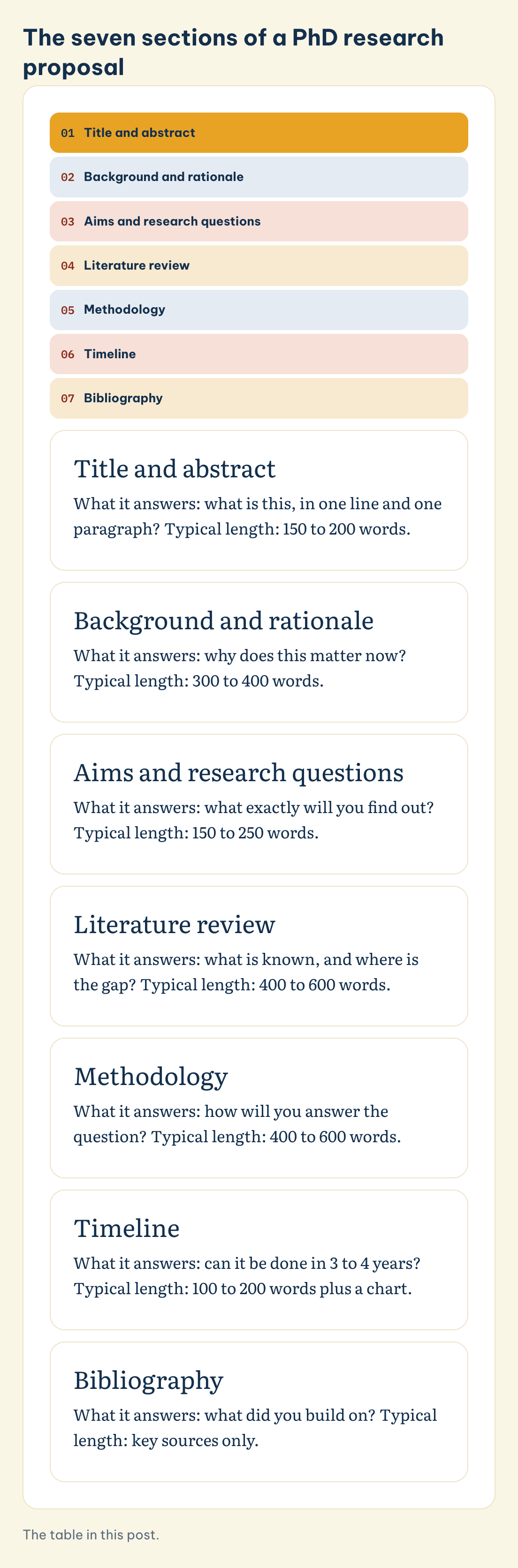
The seven sections of a PhD research proposal
Tap a section to see what it answers and its typical length in a proposal of about 2,000 words.
Title and abstract
What it answers: what is this, in one line and one paragraph? Typical length: 150 to 200 words.
Background and rationale
What it answers: why does this matter now? Typical length: 300 to 400 words.
Aims and research questions
What it answers: what exactly will you find out? Typical length: 150 to 250 words.
Literature review
What it answers: what is known, and where is the gap? Typical length: 400 to 600 words.
Methodology
What it answers: how will you answer the question? Typical length: 400 to 600 words.
Timeline
What it answers: can it be done in 3 to 4 years? Typical length: 100 to 200 words plus a chart.
Bibliography
What it answers: what did you build on? Typical length: key sources only.
Save this figure
Evidence: The University of Stirling (n.d.) sets out seven sections for a proposal: title, abstract, context, research questions, methods, significance, and bibliography. Monash University guidance groups these into context, rationale, aims, the literature that frames the study, and the methods used to gather data (Monash University, n.d.).
Example: A MAAS client targeting a UK social-sciences programme had written 5 pages of dense, unheaded prose. Her mentor restructured the same material under the seven standard sections below. Nothing was deleted, but the panel could now find her research question, method, and timeline in seconds and her feasibility suddenly looked obvious.
| Section | What it answers | Typical length (of a ~2,000-word proposal) |
|---|---|---|
| Title & abstract | What is this, in one line and one paragraph? | 150–200 words |
| Background & rationale | Why does this matter now? | 300–400 words |
| Aims & research questions | What exactly will you find out? | 150–250 words |
| Literature review | What is known, and where is the gap? | 400–600 words |
| Methodology | How will you answer the question? | 400–600 words |
| Timeline | Can it be done in 3–4 years? | 100–200 words + chart |
| Bibliography | What did you build on? | Key sources only |
◆ Question 3 / 7 · The research question
How do you write a research question that is original and feasible?
Direct answer: Narrow a broad interest into one specific, answerable question, then sense-check it against time, data access, and your own skills. A strong PhD question is original enough to add new knowledge and small enough to finish in 3 to 4 years. Most weak proposals fail here: the question is a topic, not a question.
Evidence: The University of Stirling (n.d.) asks the abstract to set out the central question you wish to address, and reminds applicants to reflect on the key research question so the proposal is sufficiently focused and possible to complete in the timeframe. Aims relate to what you want to achieve, while research questions show how you will achieve those aims (Monash University, n.d.).
Example: A Vietnamese candidate in public health arrived with "I want to study mental health in students." Over two MAAS sessions this became "How do peer-support programmes affect anxiety among first-year Vietnamese students at one Australian university?", one population, one intervention, one measurable outcome. Supervisors could immediately see the project was finishable.
◆ Question 4 / 7 · Literature and gap
How do you write the literature review and show the research gap?
Direct answer: A proposal literature review is selective, not exhaustive. Map the key debates, group sources by theme rather than listing them one by one, and end by naming the specific gap your project fills. The reviewer is checking whether you understand the field well enough to add something new, not whether you have read everything.
Evidence: A thorough, well-conceptualised literature review is the foundation of substantial research, yet most doctoral students receive little training in how to analyse and synthesise the literature, so many reviews are poorly structured (Boote & Beile, 2005). Boote and Beile (2005) argue this training gap is exactly why so many proposal-stage reviews read as an annotated list rather than an argument. University guidance recommends positioning your study by showing what has been done, the gaps, and how previous work relates to your proposed research (Monash University, n.d.).
Example: A MAAS mentee in marketing had a review that summarised twelve papers in twelve paragraphs with no through-line. Her mentor coached her to reorganise it under three debates and to end each with what was still unknown. The same sources now built a clear argument that her question was a genuine gap, not a repeat.
◆ Question 5 / 7 · Methodology
How do you describe your methodology convincingly?
Direct answer: State your design (qualitative, quantitative, or mixed), your data collection method, your sampling and sample size, and how you will analyse the data and justify each choice against your question. The reader should finish the section confident that you know how to actually execute the project, not just that you have heard of the methods.
Evidence: The University of Stirling (n.d.) says a methods section should outline and justify your research methods, give details of any fieldwork or empirical data collection, and explain how you hope to analyse your findings. The qualitative-quantitative-mixed framework that most proposal templates ask you to name against is the one Creswell and Creswell (2018) set out as the standard way to classify a study's design before you justify it. The match between question and method matters more than methodological sophistication for its own sake (Maxwell, 2013).
Example: A Vietnamese engineering applicant wrote "I will use surveys and interviews" with no detail. His MAAS mentor pushed for specifics: 200 survey responses for the quantitative phase, then 15 follow-up interviews, with the sampling logic and analysis software named. The proposal went from a wish to a workable plan a supervisor could resource.
◆ Question 6 / 7 · Timeline
How do you present a realistic timeline and prove feasibility?
Direct answer: Break the 3-to-4-year project into stages, literature review, ethics approval, data collection, analysis, and writing-up and show roughly when each happens, often as a Gantt chart. Feasibility is the quiet test behind every proposal: an ambitious question with no credible plan to finish reads as naive, not impressive.
Evidence: A proposal timeline schedules the stages of the work so the project can be planned, resourced, and finished within realistic deadlines, and it is often presented as a Gantt chart (Monash University, n.d.). The University of Stirling (n.d.) suggests considering the main milestones for each year of the PhD, the challenges you might encounter, and how you might overcome them, while the University of Cambridge, Faculty of Education (n.d.) asks applicants to justify why their proposed methods are feasible and suitable. Supervisors weigh feasibility heavily, because a project that cannot be completed in the funded period is a risk regardless of how original it is.
Example: A MAAS client mapped four years onto a simple chart: Year 1 literature review and ethics, Year 2 fieldwork, Year 3 analysis, Year 4 writing. Seeing it laid out, she realised her fieldwork needed 9 months, not 3, and adjusted before submitting. Her supervisor later said the honest timeline was what made the proposal credible.
◆ Question 7 / 7 · Length and mistakes
How long should a PhD proposal be, and what are the common mistakes?
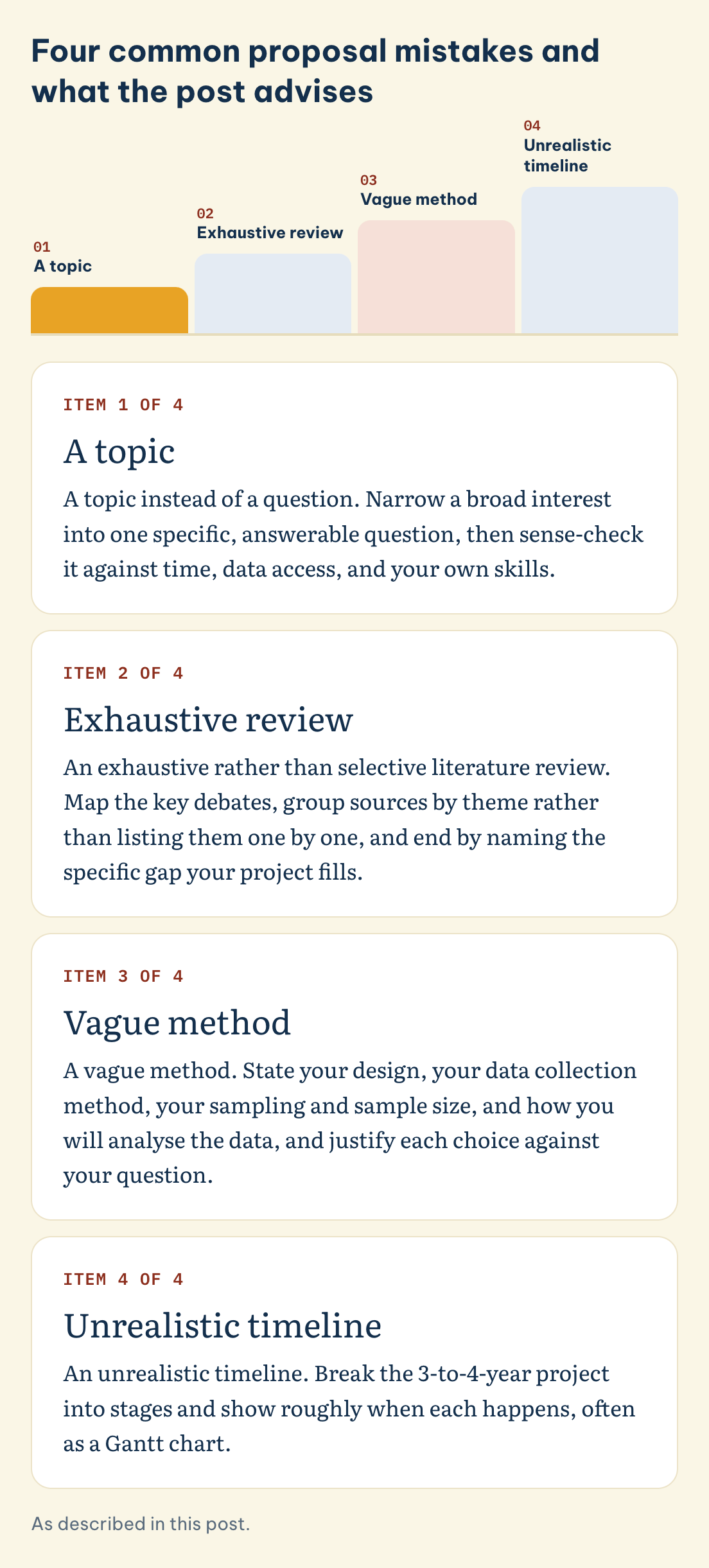
Direct answer: Most PhD proposals run between roughly 1,500 and 3,000 words, depending on the institution and funder, so the discipline is fitting a complete argument into a tight space. The most common mistakes are a topic instead of a question, an exhaustive rather than selective literature review, a vague method, and an unrealistic timeline.
Four common proposal mistakes and what the post advises
Tap a mistake to see how the post suggests avoiding it.
Item 1 of 4
A topic
A topic instead of a question. Narrow a broad interest into one specific, answerable question, then sense-check it against time, data access, and your own skills.
Item 2 of 4
Exhaustive review
An exhaustive rather than selective literature review. Map the key debates, group sources by theme rather than listing them one by one, and end by naming the specific gap your project fills.
Item 3 of 4
Vague method
A vague method. State your design, your data collection method, your sampling and sample size, and how you will analyse the data, and justify each choice against your question.
Item 4 of 4
Unrealistic timeline
An unrealistic timeline. Break the 3-to-4-year project into stages and show roughly when each happens, often as a Gantt chart.
Save this figure
Evidence: Two of the university sources used here show how differently limits are set. The University of Cambridge, Faculty of Education (n.d.) caps the whole proposal at 1,500 words, including footnotes, appendices, figures, and tables but excluding references, while the University of Stirling (n.d.) limits only the abstract, to 250 words. Because limits differ, always follow your target department's own guidance on length and headings. Cambridge also asks for clear, jargon-free writing, using technical language only where the project requires it (University of Cambridge, Faculty of Education, n.d.).
Example: A Vietnamese applicant submitted the same 4,000-word proposal to three universities; two rejected it for exceeding their 2,000-word limit before reading the content. Her MAAS mentor helped her cut it to a focused 1,900 words and tailor the framing to each department. The next round produced two interview invitations.
Frequently asked questions
How long does it take to write a good PhD research proposal?
For an applicant with a clear topic, a solid first draft usually takes two to four weeks, followed by a round or two of feedback and revision. Rushing it is a false economy, because the proposal shapes the supervisor's first and strongest impression of you.
Do I need to have read everything before I write the proposal?
No. A proposal literature review is selective. You need to know the key debates and the gap you are filling, not every paper ever written. Depth on the most relevant sources matters more than breadth.
Should I contact a potential supervisor before writing the proposal?
Usually yes. A short enquiry that outlines your question lets a supervisor signal fit and interest, and their early input often sharpens the proposal. Many departments expect you to have made contact before you formally apply.
Can I change my research question after I am accepted?
Often, yes, proposals evolve once a project begins, and supervisors expect refinement, consistent with Maxwell's (2013) view of qualitative design as an interactive, iterative process rather than a fixed plan. But the proposal must still stand on its own as a feasible plan, because that is what the admissions panel is assessing now.
How is a PhD proposal different from a master's proposal?
A PhD proposal must demonstrate originality and the capacity for independent research sustained over several years, with a larger and more justified methodology. A master's proposal is shorter in scope and timeline, though the structure is similar.
Can MAAS help me write my PhD research proposal?
Yes. MAAS Academic Mentoring coaches Vietnamese applicants through proposal development, sharpening the research question, structuring the literature review, and pressure-testing the methodology and timeline, using a phase-by-phase model, with the author keeping full ownership of the work. Book a consultation through our contact page.
Ready to turn your topic into a fundable proposal?
A research proposal is the highest-leverage page in a PhD application, and it is far easier to write with a mentor whose academic level sits above yours. MAAS Academic Mentoring, whose expert network is 23% doctorate holders, gives you a free 20-minute consultation first, then matches you to the right advisor within 48 hours when our network already covers that field, or in about two weeks if MAAS has to recruit for it. The proposal phase usually takes about 3 to 4 sessions and ends with a complete proposal on the template the university asks for. We coach phase by phase; you stay the author at every step.
Book a proposal consultation with MAAS Academic Mentoring →
Related guides
- How do you write research questions and objectives?: turning a topic into a specific, answerable question
- How do you write the literature review for a PhD as a Vietnamese student?: building the selective review your proposal needs
- How do you write a conceptual framework?: mapping the concepts that frame your study
- A complete guide to writing a theoretical framework: the theory that anchors your research design
- How do you write the methodology in your essay or thesis?: justifying design, sampling, and analysis
- What should a CV for a PhD application include and omit?: the CV that supports the proposal
- Academic Mentoring service: one-to-one PhD and dissertation coaching
- Dissertation Mentoring resource hub: proposal, framework, and methodology templates
- Meet the MAAS experts: PhD-level mentors who have supervised and examined research
References
- Boote, D. N., & Beile, P. (2005). Scholars before researchers: On the centrality of the dissertation literature review in research preparation. Educational Researcher, 34(6), 3–15. https://doi.org/10.3102/0013189X034006003
- Creswell, J. W., & Creswell, J. D. (2018). Research design: Qualitative, quantitative, and mixed methods approaches (5th ed.). SAGE Publications.
- Maxwell, J. A. (2013). Qualitative research design: An interactive approach (3rd ed.). SAGE Publications.
- Monash University. (n.d.). Features of a research proposal. Student Academic Success. Retrieved June 13, 2026, from https://www.monash.edu/student-academic-success/excel-at-writing/how-to-write/research-proposal/features-of-a-research-proposal
- University of Cambridge, Faculty of Education. (n.d.). Writing a research proposal: Guidance for PhD applicants. Retrieved June 13, 2026, from https://www.educ.cam.ac.uk/courses/postgraduate/doctoral/downloads/GUIDE_phd_research_proposal.pdf
- University of Stirling. (n.d.). Guidance on how to write a research proposal. Retrieved June 13, 2026, from https://www.stir.ac.uk/research/research-degrees/how-to-apply-for-our-research-degrees/guidance-on-how-to-write-a-research-proposal/
This article is part of the MAAS Research Methods series for Vietnamese international postgraduate students and researchers. MAAS Academic Mentoring is an advisory partner; we coach researchers through a phase-by-phase delivery model with developmental feedback from PhD-level mentors. We do not write, submit, or guarantee acceptance of work on a researcher's behalf.
A free 20-minute consultation with a MAAS adviser, to talk through your research question and how you structure your proposal.
Book Free Discovery ▸