
◆ Thesis and dissertation
How do you write a conceptual framework, step by step?
To write a conceptual framework, state your research question, list the concepts it implies, source each one, draw labelled arrows between them, and explain every relationship in prose. If your supervisor has asked for a "conceptual framework" and you are not sure how it differs from the theoretical framework you already drafted, you are in good company, this is the single most common point of confusion Vietnamese postgraduates bring to MAAS mentors. This guide answers the seven questions students ask most when they sit down to build one.
◆ Question 1 / 7 · Definition
What is a conceptual framework and how is it different from a theoretical framework?
Direct answer: A conceptual framework is the researcher's own map of how a study's key concepts connect, built for one research question. A theoretical framework borrows an established, named theory from the literature. The theoretical framework is something you select; the conceptual framework is something you construct, drawing on multiple theories, empirical findings, and your own working assumptions.
Two frameworks, side by side
Each row compares what the two terms usually mean.
Theoretical framework
Conceptual framework
Borrows an established, named theory from the literature
The researcher's own map of how a study's key concepts connect, built for one research question
Something you select
Something you construct, drawing on multiple theories, empirical findings, and your own working assumptions
Used when one established theory clearly maps onto your problem and you intend to test or apply it
Used when no single existing theory fully fits your research question, when your study is exploratory or mixed-methods, or when you are combining ideas from more than one tradition
Evidence: Miles, Huberman, and Saldaña (2014) define a conceptual framework as the system of concepts, assumptions, and beliefs that explains "the main things to be studied and the presumed relationships among them." Maxwell (2013) is explicit that a conceptual framework is something the researcher builds, not finds ready-made; it integrates theory, prior research, and experiential knowledge. Grant and Osanloo (2014) are cited constantly in this debate, but their house metaphor describes the theoretical framework rather than this one: "We believe the blueprint is an appropriate analogy of the theoretical framework of the dissertation" (Grant & Osanloo, 2014, p. 12). They give the conceptual framework a separate definition, as the researcher's understanding of how the research problem will best be explored, the direction the research has to take, and the relationship between the variables in the study (Grant & Osanloo, 2014, p. 16). That definition, not the blueprint image, is the one this guide follows.
Example: A Vietnamese Education Master's candidate at the University of Melbourne had already written a theoretical framework around Vygotsky's sociocultural theory, but her supervisor still wanted a conceptual framework. Her MAAS mentor explained the difference: Vygotsky supplied the theoretical lens; the conceptual framework was the diagram showing how teacher scaffolding, peer interaction, and language gains connected in her specific classroom study. Same theory, different job. Once she saw the distinction, the chapter took an afternoon.
◆ Question 2 / 7 · When to use
When should you use a conceptual framework instead of a theoretical framework?
Direct answer: Use a conceptual framework when no single existing theory fully fits your research question, when your study is exploratory or mixed-methods, or when you are combining ideas from more than one tradition. Use a theoretical framework when one established theory clearly maps onto your problem and you intend to test or apply it.
Many dissertations contain both: a theoretical framework section that names the lens, and a conceptual framework diagram that operationalises it. Check your programme's house style, some UK and Australian departments use the two terms interchangeably, which is exactly why students get confused.
Evidence: Jabareen (2009) argues that conceptual frameworks are the appropriate tool for qualitative and interdisciplinary research, where the goal is understanding rather than prediction from a single theory. Ravitch and Riggan (2017) position the conceptual framework as the argument for why your study matters and why your methods will answer your question, a job a borrowed theory alone cannot do.
Example: A Vietnamese Public Health candidate at UNSW was studying vaccine hesitancy among Vietnamese migrant communities. No single theory covered the cultural, informational, and access factors she cared about. Her MAAS Senior Educational Scientist mentor steered her away from forcing one theory and toward a conceptual framework that combined the Health Belief Model with trust and access constructs from migration studies. The combined model fit her data; a single theory would have left half her findings unexplained.
◆ Question 3 / 7 · Building blocks
What are the building blocks of a conceptual framework?
Direct answer: A conceptual framework has four building blocks. First, your key concepts or variables, the things your study is actually about. Second, the relationships between them, which concept influences which, and in what direction. Third, the boundaries, what your framework deliberately leaves out. Fourth, the sources, where each concept and each proposed relationship comes from (a theory, a prior study, or a justified assumption). If any concept in your diagram has no source behind it, that is the part of your framework an examiner will push on first.
The four building blocks
Tap a block to see what it holds.
Key concepts
These are your key concepts or variables, the things your study is actually about.
Relationships
These show which concept influences which, and in what direction.
Boundaries
These say what your framework deliberately leaves out.
Sources
These show where each concept and each proposed relationship comes from, which may be a theory, a prior study, or a justified assumption.
Evidence: Maxwell (2013) names 4 sources every conceptual framework draws on: experiential knowledge, existing theory and research, pilot or exploratory findings, and thought experiments. Miles et al. (2014) recommend mapping concepts as labelled boxes with directional arrows so the proposed relationships are explicit rather than implied.
Example: A Vietnamese Business candidate at the University of Manchester listed eight concepts in her first draft framework with arrows running everywhere. Her MAAS Executive Business Strategist mentor applied the four-block test: three of the eight concepts had no source and no clear relationship to the others. Cutting them left a five-concept model where every arrow traced back to either resource-based theory or her pilot interviews. The examiner's comment: "clear and defensible."
◆ Question 4 / 7 · Five steps
How do you build a conceptual framework step by step?
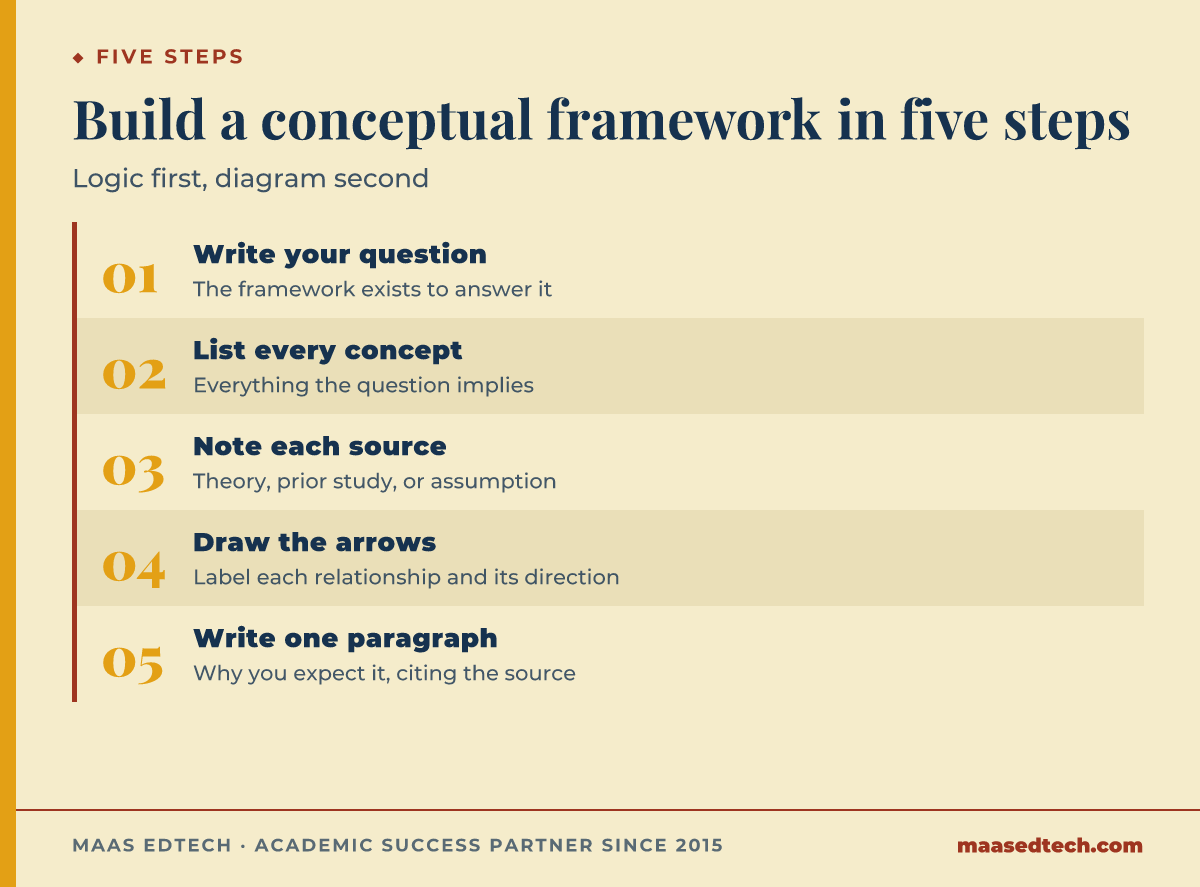
Direct answer: Five steps. (1) Write your research question at the top of a blank page, the framework exists to answer it. (2) List every concept the question implies. (3) For each concept, note its source (theory, prior study, or assumption). (4) Draw the relationships between concepts as directional arrows and label each one. (5) Write one paragraph per relationship explaining why you expect it, citing the source. Build the logic first, then make the diagram, students who start with the diagram usually end up with a pretty picture that does not match their argument.
Five steps from question to argument
Tap a step to see what it asks of you.
Step 1 of 5
State the question
Write your research question at the top of a blank page, because the framework exists to answer it.
Step 2 of 5
List the concepts
List every concept the question implies.
Step 3 of 5
Source each one
For each concept, note its source, whether a theory, a prior study, or an assumption.
Step 4 of 5
Draw the arrows
Draw the relationships between concepts as directional arrows and label each one.
Step 5 of 5
Write the argument
Write one paragraph per relationship explaining why you expect it, citing the source.
Evidence: Jabareen (2009) sets out a multi-phase procedure, mapping data sources, reading and categorising concepts, integrating them, and validating the framework, that mirrors these steps. Jabareen (2009) breaks that procedure into eight phases: mapping data sources, reading and categorising, identifying and naming concepts, deconstructing and categorising them, integrating, synthesising, validating, and rethinking the framework as new material arrives. Ravitch and Riggan (2017) stress that the written argument, not the diagram, is the framework; the diagram is a summary of an argument you must be able to defend in prose.
Example: A Vietnamese AI Master's candidate at the University of Edinburgh built her conceptual framework for a study on algorithmic fairness by writing the five relationship paragraphs first. Her MAAS Principal AI Architect mentor reviewed the prose before any diagram was drawn. Because the logic was sound, the final diagram was trivial to produce and survived the viva without a single challenge to its structure.
◆ Question 5 / 7 · Diagram
How do you turn a conceptual framework into a diagram?
Direct answer: Represent each concept as a labelled box and each relationship as a labelled, directional arrow. Independent variables or inputs go on the left, outcomes on the right, mediating and moderating concepts in between. Keep it to 1 page. Every box and every arrow must correspond to something you discussed in the text, a diagram that contains concepts not explained in prose, or prose that describes relationships not shown in the diagram, signals a framework that has not been thought through. Add a caption and, if you adapted the structure from a published model, an attribution line beneath it.
Evidence: Miles et al. (2014) treat the visual map as a core analytic tool, not decoration, the act of drawing forces you to commit to specific relationships. The advice is not new: Miles and Huberman first published this sourcebook in 1984, and the mapping method survived 3 decades and the addition of a third co-author, Saldaña, largely unchanged, which says something about how durable the underlying idea is. UK and Australian methodology handbooks consistently recommend the input-process-output left-to-right convention for readability.
Example: A Vietnamese Finance candidate at Monash drew her conceptual framework with bidirectional arrows everywhere "to be safe." Her Senior Financial Strategist mentor at MAAS pointed out that a bidirectional arrow is a claim of mutual causation she could not test with her cross-sectional data. They converted them to single-direction arrows matching her hypotheses. The cleaner diagram matched her methodology exactly, and her analysis chapter wrote itself from it.
◆ Question 6 / 7 · Methodology
How do you connect a conceptual framework to your methodology and hypotheses?
Direct answer: Each relationship arrow in your framework should become either a hypothesis (quantitative) or a research sub-question (qualitative), and each concept should map to something you actually measure or observe. This is the bridge that turns a diagram into a research design: if an arrow cannot be operationalised, either the concept is too vague to measure or the method is wrong for the question. Trace every hypothesis back to a specific arrow, and every variable back to a specific box. An examiner reading your methodology chapter should be able to hold your conceptual framework beside it and see a one-to-one match.
Evidence: Grant and Osanloo (2014) argue that whichever framework a study commits to should govern the methodology, analysis, and interpretation chapters, and when those chapters drift from it the dissertation loses coherence. Creswell and Creswell (2018) make the same point: the framework should drive the choice of variables, instruments, and analysis.
Example: A Vietnamese Education candidate at UCL had a four-arrow conceptual framework but only three hypotheses. Her MAAS mentor flagged the orphan arrow, a proposed link between teacher feedback and student motivation that she had drawn but never tested. They either had to add a hypothesis and a measure or remove the arrow. She added the measure; the framework and methodology lined up, and the discussion chapter had a clear structure to follow.
◆ Question 7 / 7 · Mistakes
How do you avoid common mistakes in a conceptual framework?
Direct answer: Four mistakes account for most "needs revision" feedback. First, a diagram with no underlying written argument, pretty but undefendable. Second, concepts with no source, which read as personal opinion. Third, more concepts than your study can actually investigate, which signals a lack of focus.
Fourth, a framework that never reappears after Chapter 2, if your analysis and discussion chapters do not refer back to it, examiners conclude it was decorative. Fix all four by treating the framework as a working tool you return to in every later chapter, not a hoop to jump through once.
Evidence: Ravitch and Riggan (2017) note that the most common weakness in student conceptual frameworks is treating them as a one-time chapter rather than a guiding logic the whole dissertation should reflect. Maxwell (2013) warns specifically against frameworks built only from existing theory while ignoring the researcher's own experiential knowledge and pilot data.
Example: A Vietnamese DBA candidate at the University of Sunderland presented a strong conceptual framework in Chapter 2, then never mentioned it again. Her MAAS Executive Business Strategist mentor had her add one short paragraph at the start of the analysis chapter and one in the discussion, each referring back to specific arrows in the framework. No new content was needed, just the connective tissue. The revised dissertation read as a single coherent argument and was accepted with minor corrections.
Frequently asked questions
Can a dissertation have both a conceptual and a theoretical framework?
Yes, and many do. The theoretical framework names the established theory you are working from; the conceptual framework shows how the specific concepts in your study connect, often operationalising that theory for your particular question. Present the theory first, then the conceptual model that applies it.
Is a conceptual framework only for qualitative research?
No. Conceptual frameworks are common in qualitative and mixed-methods work, but quantitative dissertations use them too; there, the framework's arrows typically become testable hypotheses and its boxes become measured variables.
How long should a conceptual framework section be?
At Master's level, roughly 1,500–3,000 words plus a one-page diagram. The written argument matters more than the diagram, a tight section where every concept is sourced beats a long one padded with unexplained boxes.
Do I need to draw a diagram, or is text enough?
A diagram is strongly expected in most UK and Australian dissertations because it makes your proposed relationships explicit at a glance. Build the written argument first, then summarise it as a one-page diagram.
Where does the conceptual framework sit in the dissertation?
Usually in Chapter 2, after or alongside the literature review and theoretical framework, before the methodology chapter that it is meant to shape. Follow your supervisor's house style.
What should a conceptual framework contain?
Four things: the key concepts your study is about, the relationships between them, the boundaries that say what you leave out, and the source behind each concept and relationship. Any concept with no source should be cut, as the Manchester candidate found when three of her eight concepts had to go.
Can MAAS help me build a conceptual framework?
Yes. MAAS Academic Mentoring and the Dissertation Mentoring resource hub include structured coaching on conceptual frameworks, concept mapping, source-checking, and diagram review under a phase-by-phase model, with feedback from PhD-level mentors within 48 hours.
Related resources
- Conceptual vs theoretical framework: how to tell the two apart and decide which one your dissertation needs
- Theoretical framework guide: the named-theory chapter your conceptual framework usually operationalises
- Literature review guide for PhD students: the chapter that surfaces the concepts your framework connects
- Methodology guide: where your framework's arrows become hypotheses and measures
- Viva voce preparation guide: defending your framework choices under cross-examination
- Dissertation Mentoring resource hub: PhD-led advisory across proposal, framework, methodology, drafting, and viva
- Academic Mentoring service: 1:1 coaching with PhD-level mentors
Ready to build your conceptual framework? Book a free 20-minute consultation, bring your research question and we will match you to a mentor in your discipline within 48 hours when our network already covers that field. If it does not, MAAS opens a dedicated recruitment round for your case, which usually takes about 2 weeks.
References
- Creswell, J. W., & Creswell, J. D. (2018). Research design: Qualitative, quantitative, and mixed methods approaches (5th ed.). SAGE Publications.
- Grant, C., & Osanloo, A. (2014). Understanding, selecting, and integrating a theoretical framework in dissertation research: Creating the blueprint for your "house". Administrative Issues Journal: Connecting Education, Practice, and Research, 4(2), 12–26. https://doi.org/10.5929/2014.4.2.9
- Jabareen, Y. (2009). Building a conceptual framework: Philosophy, definitions, and procedure. International Journal of Qualitative Methods, 8(4), 49–62. https://doi.org/10.1177/160940690900800406
- Maxwell, J. A. (2013). Qualitative research design: An interactive approach (3rd ed.). SAGE Publications.
- Miles, M. B., Huberman, A. M., & Saldaña, J. (2014). Qualitative data analysis: A methods sourcebook (3rd ed.). SAGE Publications.
- Ravitch, S. M., & Riggan, M. (2017). Reason & rigor: How conceptual frameworks guide research (2nd ed.). SAGE Publications.
This article is part of the MAAS Journal series for Vietnamese international postgraduate students. MAAS Academic Mentoring is an advisory partner; we coach students through a phase-by-phase delivery model with developmental feedback from PhD-level mentors. We do not write, submit, or guarantee grades on a student's behalf.
A free discovery call with a MAAS expert, to talk through your own research question and your supervisor's expectations.
Book Free Discovery ▸