
◆ Publishing advisory
How do you write the results section of a research paper?
The results section of a research paper reports your findings objectively and without interpretation, using text, tables, and figures together. For Vietnamese researchers and students, it is the factual core of a Scopus-targeted manuscript: get it wrong and reviewers stop trusting the rest of the paper.
This guide answers the seven questions Vietnamese researchers ask MAAS publishing mentors most often at the results stage.
Five papers anchor the guidance below. Kotz and Cals (2013a) set the section order, recruitment, sample, primary analyses, secondary analyses, then ancillary findings, and the rule against interpreting inside the results. Annesley (2010) frames results as evidence laid on the table for the discussion to argue over later. Mensh and Kording (2017) tie that order to a single central question the whole paper should answer. Schulz, Altman and Moher (2010), writing the CONSORT statement for reporting randomised trials, separate objective reporting, participant flow, baseline data, and outcomes with estimates, from the inferences that belong to the discussion. Wasserstein and Lazar (2016), in the American Statistical Association's statement on p-values, argue that a p-value alone hides the direction, size and precision that a confidence interval shows.

◆ Question 1 / 7 · What it is for
What is the results section, and what is it actually for?
Direct answer: The results section presents the findings of your study factually and in an organised order, without interpreting them. It reports what you observed, recruitment, sample characteristics, primary outcomes, then secondary and unexpected findings and lets the data speak. Interpretation, meaning, and comparison with other work belong in the discussion.
Evidence: The results section gives a clear, concise, objective description of findings and is written mostly in the past tense, with the findings presented without interpretation because that belongs in the discussion (Kotz & Cals, 2013a). The section should show the data themselves rather than tell the reader what to conclude, the evidence is laid on the table so the discussion can later argue its meaning (Annesley, 2010).
Example: A Vietnamese first-time author brought a MAAS mentor a results section full of phrases like "this important finding proves." Her mentor showed that each was an interpretation, not a result, and they moved every judgement to the discussion, leaving a section that simply reported the numbers, which reviewers found far more credible.
◆ Question 2 / 7 · Structure
How should you structure a results section?
Direct answer: Follow a predictable order that mirrors your methods: recruitment or response, characteristics of the sample, findings from the primary analyses, then secondary analyses, and finally any unexpected findings. For every method you described, there should be a corresponding result. This makes the section easy to write and easy for a reviewer to audit.
The five elements of a results section, in order
Tap an element to see what it reports and the mistake to avoid.
Recruitment and response
It reports how you obtained the sample, often with a flow diagram. The common mistake is skipping straight to outcomes.
Sample characteristics
It reports demographics and baseline variables (Table 1). The common mistake is burying key descriptors in prose.
Primary analyses
It reports the findings that answer your main question. The common mistake is mixing in secondary results.
Secondary analyses
It reports pre-planned additional findings. The common mistake is presenting them as primary.
Ancillary and unexpected
It reports post hoc, hypothesis-generating findings. The common mistake is implying they were planned.
Save this figure
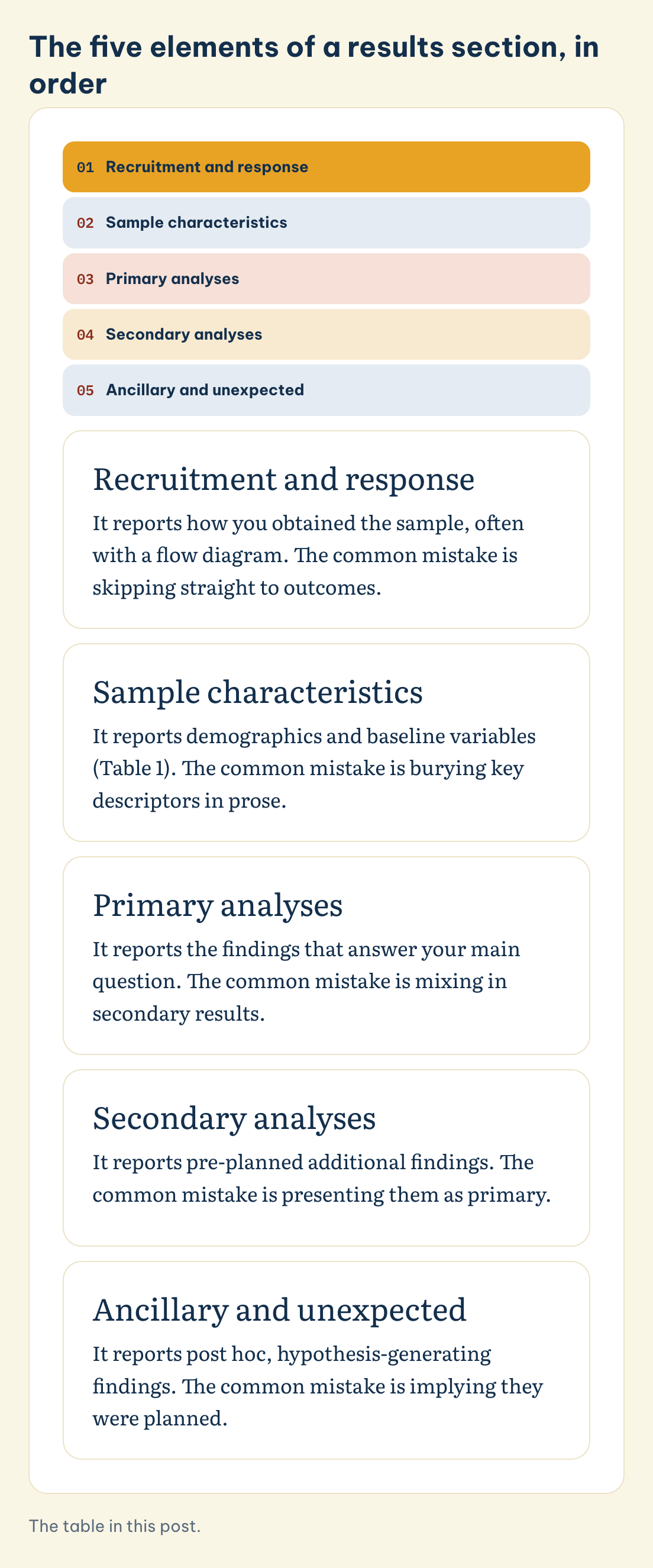
Evidence: A common, effective order is recruitment/response, sample characteristics, primary analyses, secondary analyses, and ancillary findings, with the results mirroring the methods so that every "what you did" has a matching "what you found" (Kotz & Cals, 2013a). Structuring the whole paper around a single central question keeps the results focused on the findings that answer it rather than every number you collected (Mensh & Kording, 2017).
| Results element | What it reports | Common mistake |
|---|---|---|
| Recruitment / response | How you obtained the sample (often a flow diagram) | Skipping straight to outcomes |
| Sample characteristics | Demographics and baseline variables (Table 1) | Burying key descriptors in prose |
| Primary analyses | The findings that answer your main question | Mixing in secondary results |
| Secondary analyses | Pre-planned additional findings | Presenting them as primary |
| Ancillary / unexpected | Post hoc, hypothesis-generating findings | Implying they were planned |
Example: A MAAS-coached postgraduate had reported her outcomes before describing her participants. Her mentor suggested she reorder the section to lead with recruitment and a Table 1 of sample characteristics; the same data suddenly read as a disciplined sequence a reviewer could follow.
◆ Question 3 / 7 · Text or tables
How do you decide what goes in the text versus tables and figures?
Direct answer: Use tables and figures for larger quantities of data, and use the text to highlight only the findings that support your hypothesis or that were unexpected. Do not repeat a table in full in the prose. The text and the display items should work together, not duplicate each other.
Evidence: The results section works best as a dynamic interplay between text and figures or tables, with the most important data shown in both and tables or figures used to carry larger quantities of data (Kotz & Cals, 2013a). Tables and figures should be self-explanatory and are the right vehicle for dense numerical results, while the text points the reader to what matters most (Kotz & Cals, 2013b).
Example: A Vietnamese researcher had retyped an entire 20-row table into sentences. Her MAAS mentor suggested she cut the prose to 2 sentences highlighting the rows that mattered and let the table carry the rest, the section shrank by roughly 1 page and read far more clearly.
◆ Question 4 / 7 · Reporting statistics
How do you report statistics correctly?
Direct answer: Report effect sizes, such as mean differences, odds ratios, or relative risks, together with their 95% confidence intervals, and give absolute numbers alongside percentages. Never report a result with a p-value alone. Use consistent decimals and pair every measure of central tendency with its measure of spread.
A proportion
33 of 150
participants (22%) is how to write a proportion, rather than a bare percentage with no denominator
Confidence interval
95%
is the interval to report with every effect size, because a p-value alone hides the size and direction of an effect
How to report four kinds of statistic
Tap a statistic to see how to report it and what to avoid.
Statistic 1 / 4
Group difference
Report an effect size with its 95% CI. Avoid stating only p < 0.05.
Statistic 2 / 4
Proportion
Report the absolute count and the percentage, such as 33/150 (22%). Avoid a percentage with no denominator.
Statistic 3 / 4
Central tendency
Report the mean (SD) or the median (IQR). Avoid a bare mean with no spread.
Statistic 4 / 4
Significance
Report it as statistically significant, with the test. Avoid using the word significant loosely.
Save this figure
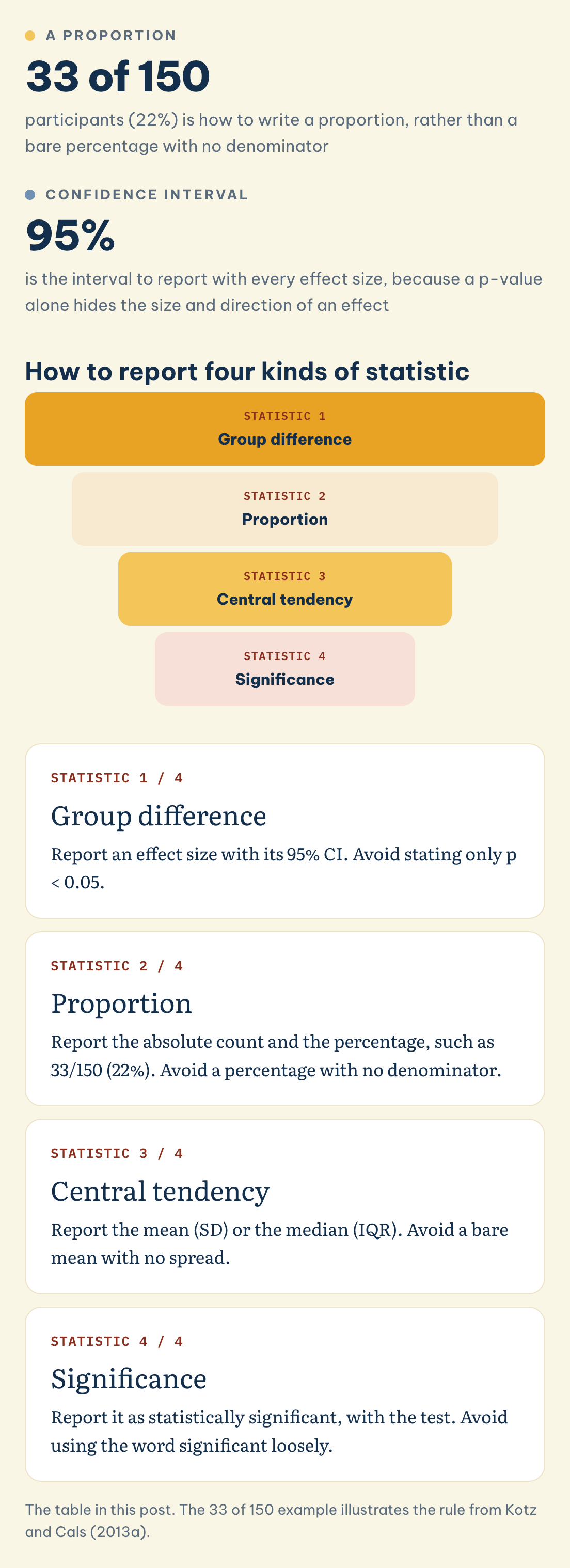
Evidence: Authors should provide effect sizes with 95% confidence intervals, never report results with p-values only, and always give absolute numbers in addition to relative measures, with means reported alongside standard deviations and medians alongside interquartile ranges (Kotz & Cals, 2013a). If the two measures of spread in your SPSS output blur together, the guide to standard deviation vs variance explains which one belongs in the text. In practice that means writing a proportion as, for example, 33 of 150 participants (22%) rather than a bare percentage with no denominator, because the count is what lets a reader judge how far the finding can generalise. Confidence intervals are more informative than p-values because they show the direction, size, and precision of an effect, and interpretation based on p-values alone can be misleading (Wasserstein & Lazar, 2016). The ASA's own statement is direct about the limit: "a p-value, or statistical significance, does not measure the size of an effect or the importance of a result" (Wasserstein & Lazar, 2016, p. 132).
| Statistic | Report it as | Avoid |
|---|---|---|
| Group difference | Effect size + 95% CI | Stating only "p < 0.05" |
| Proportion | Absolute count and percentage, e.g. 33/150 (22%) | Percentage with no denominator |
| Central tendency | Mean (SD) or median (IQR) | A bare mean with no spread |
| Significance | "Statistically significant" with the test | "Significant" used loosely |
Example: A MAAS Publishing Advisory client reported every comparison as "significant (p < 0.05)." Her mentor helped her add effect sizes and confidence intervals; the same results became interpretable, and a Q1 reviewer who would have flagged the original accepted the revised reporting.
Where the difficulty is the analysis rather than the writing, Data & Coding Projects walks through the method and the output with you until you can explain each result yourself.
◆ Question 5 / 7 · Tense and language
What tense and language should the results section use?
Direct answer: Write the results in the past tense and in neutral language. Avoid words that smuggle in interpretation, such as "remarkably," "strikingly," or "proves." Use the same wording and the same order for similar results rather than reaching for synonyms, which only confuses readers.
Evidence: The results section is mostly written in the past tense, and authors are advised to avoid words such as "remarkably" or "strikingly" that imply interpretation, and to use similar wording for similar results rather than varying it for style (Kotz & Cals, 2013a). Presenting findings as data to be shown, not conclusions to be argued, keeps the neutral tone reviewers expect (Annesley, 2010).
Example: A Vietnamese postgraduate writing in English as a second language had used three different phrasings for the same comparison. Her MAAS mentor helped her standardise them into one pattern; the consistency made the ESL prose read as precise rather than uncertain.
◆ Question 6 / 7 · Results or discussion
How is the results section different from the discussion?
Direct answer: The results report; the discussion interprets. The results state what you found, in order, with the supporting statistics. The discussion explains what those findings mean, how they compare with prior work, and what their limitations and implications are. Keeping the two apart is one of the clearest signals of a disciplined author.
The results report, the discussion interprets
Each row sets what belongs in the results against what belongs in the discussion.
The results section
The discussion
It reports what you observed: recruitment, sample characteristics, primary outcomes, then secondary and unexpected findings.
It holds interpretation, meaning, and comparison with other work.
It states what you found, in order, with the supporting statistics.
It explains what those findings mean, how they compare with prior work, and what their limitations and implications are.
It holds the objective information: participant flow, baseline data, and outcomes with estimates (Schulz et al. 2010).
It holds the inferences drawn later.
Save this figure
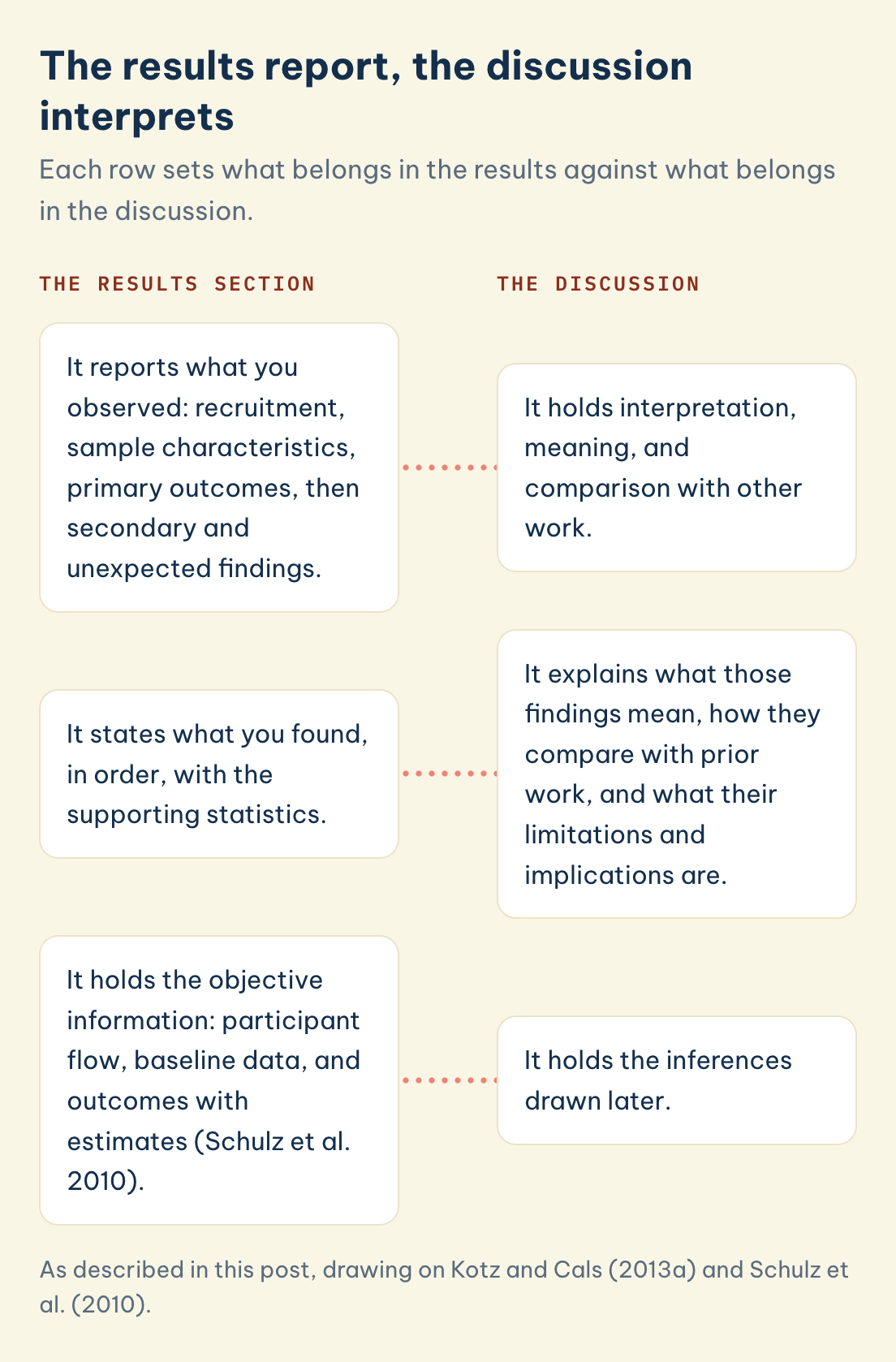
Evidence: Findings should be presented in the results without interpretation, because interpretation belongs in the discussion (Kotz & Cals, 2013a). Reporting standards reinforce this division by specifying what objective information, participant flow, baseline data, outcomes with estimates, belongs in the results, separate from the inferences drawn later (Schulz et al. 2010).
Example: A MAAS client kept drifting into "this suggests" within her results. Her mentor worked with her phase by phase to fix which sentences were findings and which were interpretation, so the results reported and the discussion argued, with no overlap.
◆ Question 7 / 7 · Mistakes to avoid
What results-section mistakes get a paper rejected, and how can Vietnamese and ESL researchers avoid them?
Direct answer: The recurring triggers are interpreting findings in the results, reporting p-values without effect sizes, duplicating tables in the text, presenting outcomes before the sample is described, and inconsistent reporting. Avoid them by drafting against a structure and getting feedback from a mentor who has assessed manuscripts from the reviewer's side.
Evidence: Results commonly fail when authors interpret rather than report, omit confidence intervals, or repeat display items in full in the prose (Kotz & Cals, 2013a; Wasserstein & Lazar, 2016). Annesley (2010) makes the underlying discipline explicit: show your cards, meaning present the evidence itself, rather than telling the reviewer what conclusion to draw before the discussion has earned it. As more Vietnamese researchers target Scopus Q1 and Q2 journals, a clean, correctly reported results section is a low-cost way to clear the methodological bar rather than lose a sound study to avoidable errors.
| Mistake | Why reviewers reject it | The fix |
|---|---|---|
| Interpreting in the results | Blurs evidence and argument | Move judgements to the discussion |
| p-values without effect sizes | Hides the size and precision | Add estimates with 95% CIs |
| Duplicating tables in text | Wastes space, adds nothing | Highlight only key rows |
| Outcomes before the sample | Reviewer cannot judge validity | Lead with recruitment and Table 1 |
| Inconsistent reporting | Looks careless | Use one order and one wording |
Example: A MAAS mentor guided a Vietnamese author phase by phase: first agreeing the reporting order, then reading the author's own draft for interpretation that had slipped in, and finally advising on language for ESL clarity. The author stayed the author throughout, with the mentor advising at each stage rather than writing the section.
Frequently asked questions
How long should the results section be?
There is no fixed length; the results section is usually concise because tables and figures carry most of the data. Report every finding that answers your research question, leave out numbers that do not, and let display items carry the dense results.
Should the results section include p-values?
You can report p-values, but never on their own. Pair them with effect sizes and 95% confidence intervals so readers see the direction, size, and precision of the effect (Wasserstein & Lazar, 2016). A confidence interval is more informative than a p-value reported in isolation.
Can I combine the results and discussion sections?
Some journals allow a combined "Results and Discussion," and a few disciplines prefer it. Check the target journal's author guidelines first. If you combine them, still keep reporting visibly distinct from interpretation so reviewers can see where evidence ends and argument begins.
What tense should the results section be written in?
Mostly the past tense, because you are reporting what you observed in a completed study (Kotz & Cals, 2013a). Use neutral wording and avoid interpretive adverbs such as "remarkably" or "strikingly," which belong to the discussion rather than the report of findings.
Do tables and figures repeat the text?
No. Tables and figures should be self-explanatory and carry the detailed data, while the text highlights only the most important or unexpected findings (Kotz & Cals, 2013b). Repeating a full table in prose wastes space and adds nothing for the reader or the reviewer.
Can MAAS help me write a stronger results section?
Yes. MAAS Publishing Advisory coaches Vietnamese researchers through structuring results, choosing what belongs in tables versus text, and reporting statistics correctly using a phase-by-phase model, with feedback from postgraduate-qualified mentors. Book a consultation through our contact page.
Ready to make your results section Q1-ready?
A strong results section reports your findings clearly and saves interpretation for the discussion, which is far easier with an adviser who has been through peer review as an author. MAAS Publishing Advisory starts its section review with the abstract, tables and figures, and it runs the international track across 26 one-to-one sessions or the domestic track across 14 sessions. Your adviser holds multiple Q1 or Q2 papers under their own name, and 23% of MAAS experts hold a PhD. MAAS matches you within 48 hours when our network already covers that field. If it does not, MAAS opens a dedicated recruitment round for your case, which usually takes about two weeks. The free 20-minute consultation is the place to start. We coach; you stay the author, every step.
Book a Publishing Advisory consultation with MAAS Academic Mentoring →
Related guides
- How do you write an abstract for a research paper?: summarising your results without misreporting them
- How do you write the methods section of a research paper?: describe the procedures behind your results
- How do you write the discussion section of a research paper?: interpret what your results report
- How do you choose the right statistical test for a Q1 publication?: get the analysis right first
- How do you report effect sizes and confidence intervals?: the magnitude numbers your results section needs
- How do you design a systematic review in the health sciences?: the method behind your results
- Which reporting guidelines should you use for your research paper?: CONSORT, PRISMA, and the results
- How do you describe charts in IELTS Writing Task 1?: describing data in words under exam conditions
- Publishing Advisory service: full service tiers for Scopus Q1/Q2 support
- Scopus publishing resource hub: guides across the whole submission journey
- Meet the MAAS experts: the postgraduate-qualified mentors behind our publishing advisory
References
- Annesley, T. M. (2010). Show your cards: The results section and the poker game. Clinical Chemistry, 56(7), 1066–1070. https://doi.org/10.1373/clinchem.2010.148148
- Kotz, D., & Cals, J. W. L. (2013a). Effective writing and publishing scientific papers, part V: Results. Journal of Clinical Epidemiology, 66(9), 945. https://doi.org/10.1016/j.jclinepi.2013.04.003
- Kotz, D., & Cals, J. W. L. (2013b). Effective writing and publishing scientific papers, part VII: Tables and figures. Journal of Clinical Epidemiology, 66(11), 1197. https://doi.org/10.1016/j.jclinepi.2013.04.016
- Mensh, B., & Kording, K. (2017). Ten simple rules for structuring papers. PLOS Computational Biology, 13(9), Article e1005619. https://doi.org/10.1371/journal.pcbi.1005619
- Schulz, K. F., Altman, D. G., & Moher, D. (2010). CONSORT 2010 statement: Updated guidelines for reporting parallel group randomised trials. BMJ, 340, c332. https://doi.org/10.1136/bmj.c332
- Wasserstein, R. L., & Lazar, N. A. (2016). The ASA's statement on p-values: Context, process, and purpose. The American Statistician, 70(2), 129–133. https://doi.org/10.1080/00031305.2016.1154108
This article is part of the MAAS Journal series for Vietnamese international postgraduate students and researchers. MAAS Publishing Advisory is an advisory partner; we coach authors through a phase-by-phase delivery model with developmental feedback from postgraduate-qualified, Scopus-published mentors. We do not write, submit, or guarantee acceptance of work on an author's behalf.
A free 20-minute consultation with a MAAS publishing mentor, to talk through your results section and how you report your statistics.
Book Free Discovery ▸