
◆ Publishing advisory
Which reporting guideline does your study need?
A reporting guideline is a checklist of what your paper must include and using the right one for your study type is now expected at most good journals. For Vietnamese researchers targeting Scopus Q1/Q2, picking and following the correct guideline is one of the cheapest ways to avoid a desk rejection: it signals that your methods are complete, transparent, and reproducible before a reviewer reads a single result.
This guide maps each study type to its reporting guideline, PRISMA, CONSORT, STROBE, CARE, TRIPOD+AI and shows how to use the checklist when you submit, in the plain terms MAAS publishing mentors use with first-time authors.

◆ Section 1 / 8 · What they are
What are reporting guidelines, and why do journals require them?
Direct answer: A reporting guideline is a structured checklist of the minimum information a particular type of study must report so that readers can judge and reproduce it. Journals increasingly require the matching completed checklist at submission, and a missing or wrong one is a common, avoidable cause of desk rejection.
Evidence: The EQUATOR Network (n.d.), Enhancing the QUAlity and Transparency Of health Research, maintains the central library of these guidelines and exists precisely because incomplete reporting wastes research and undermines trust. The network defines the term precisely: a reporting guideline is "a checklist, flow diagram, or structured text to guide authors in reporting a specific type of research, developed using explicit methodology" (EQUATOR Network, n.d.). Each guideline is study-type specific: there is no single checklist for every paper.
Example: A Vietnamese author MAAS coached submitted a strong cohort study but attached no reporting checklist. The editor asked for one before review even began. Her mentor identified STROBE as the correct guideline, mapped each item to a page and line, and the resubmission moved straight into peer review.
◆ Section 2 / 8 · Finding yours
How do you find the right guideline for your study type?
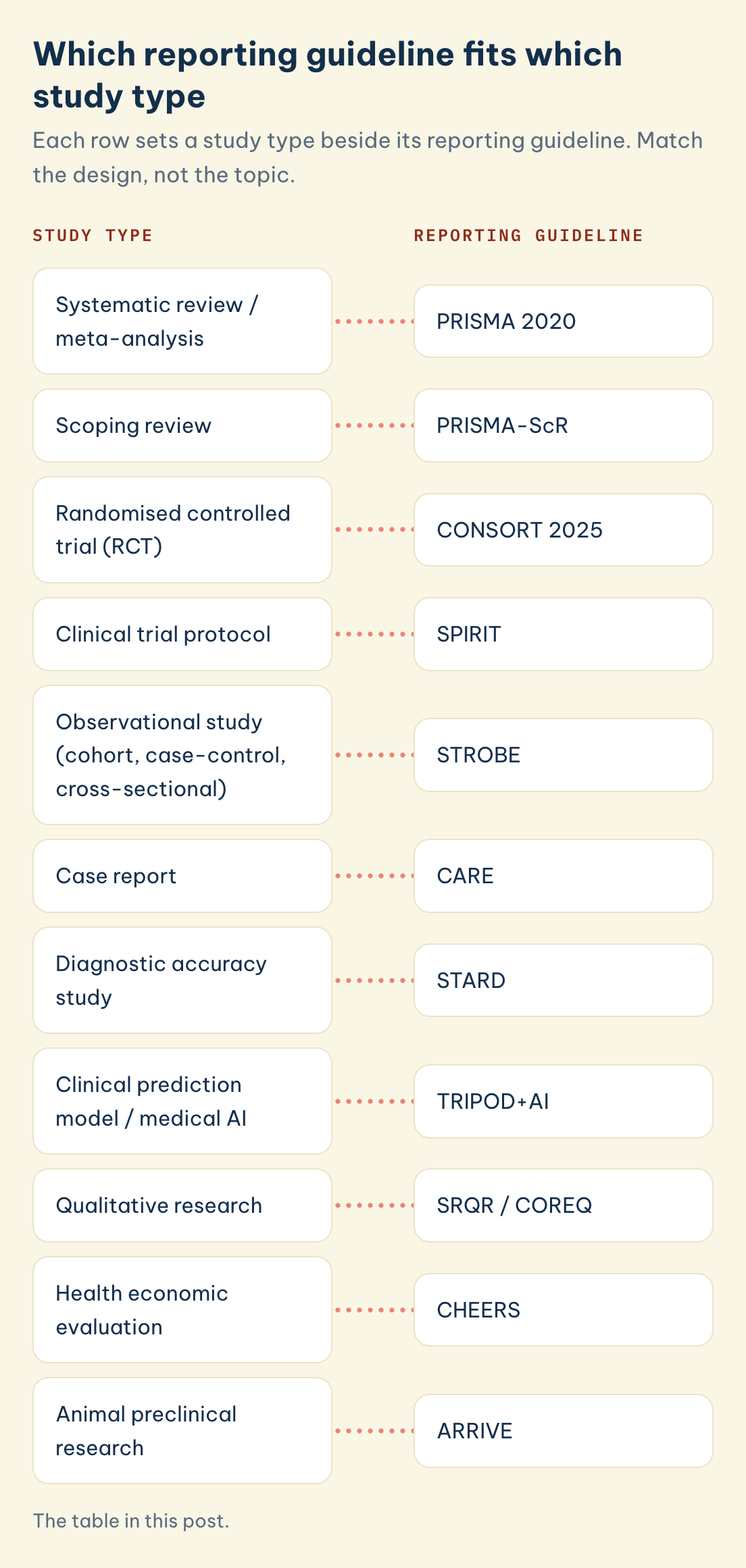
Direct answer: Match the guideline to your study design, not your topic. Use the table below as a starting point, then confirm the latest version on the EQUATOR Network, which indexes hundreds of guidelines and their extensions.
Which reporting guideline fits which study type
Each row sets a study type beside its reporting guideline. Match the design, not the topic.
Study type
Reporting guideline
Systematic review / meta-analysis
PRISMA 2020
Scoping review
PRISMA-ScR
Randomised controlled trial (RCT)
CONSORT 2025
Clinical trial protocol
SPIRIT
Observational study (cohort, case-control, cross-sectional)
STROBE
Case report
CARE
Diagnostic accuracy study
STARD
Clinical prediction model / medical AI
TRIPOD+AI
Qualitative research
SRQR / COREQ
Health economic evaluation
CHEERS
Animal preclinical research
ARRIVE
Save this figure
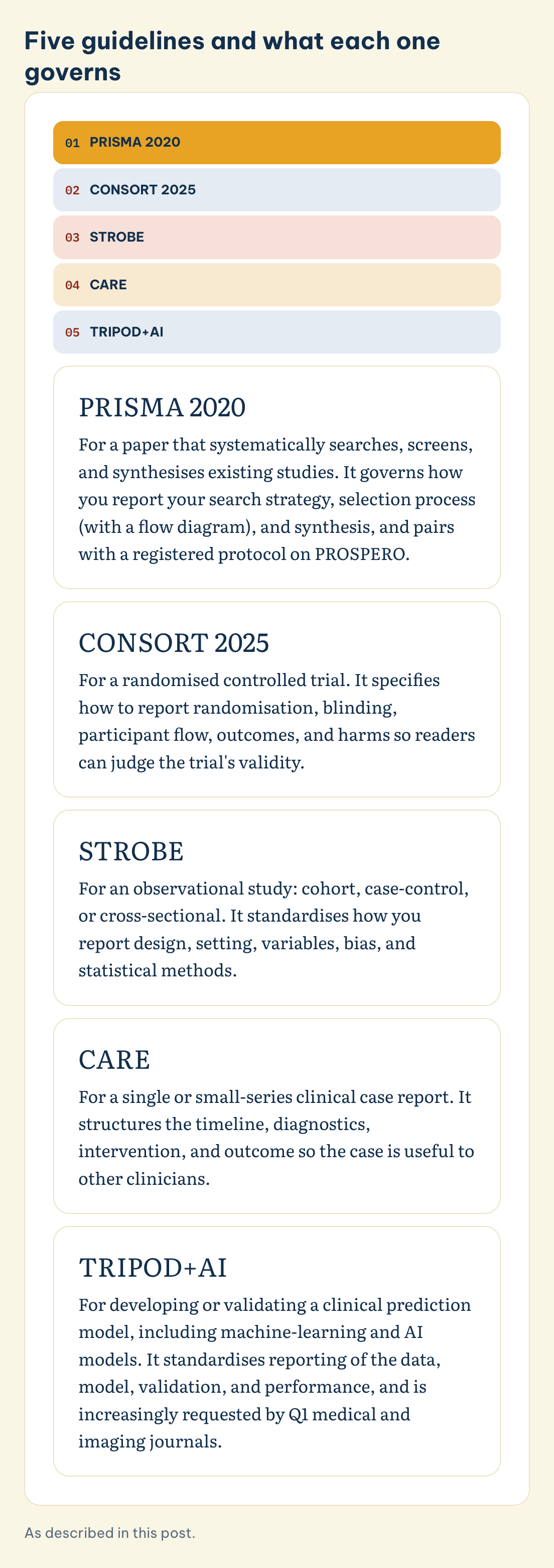
Five guidelines and what each one governs
Tap a guideline to see which study it is for and what it governs.
PRISMA 2020
For a paper that systematically searches, screens, and synthesises existing studies. It governs how you report your search strategy, selection process (with a flow diagram), and synthesis, and pairs with a registered protocol on PROSPERO.
CONSORT 2025
For a randomised controlled trial. It specifies how to report randomisation, blinding, participant flow, outcomes, and harms so readers can judge the trial's validity.
STROBE
For an observational study: cohort, case-control, or cross-sectional. It standardises how you report design, setting, variables, bias, and statistical methods.
CARE
For a single or small-series clinical case report. It structures the timeline, diagnostics, intervention, and outcome so the case is useful to other clinicians.
TRIPOD+AI
For developing or validating a clinical prediction model, including machine-learning and AI models. It standardises reporting of the data, model, validation, and performance, and is increasingly requested by Q1 medical and imaging journals.
Save this figure
| Study type | Reporting guideline |
|---|---|
| Systematic review / meta-analysis | PRISMA 2020 |
| Scoping review | PRISMA-ScR |
| Randomised controlled trial (RCT) | CONSORT 2025 |
| Clinical trial protocol | SPIRIT |
| Observational study (cohort, case-control, cross-sectional) | STROBE |
| Case report | CARE |
| Diagnostic accuracy study | STARD |
| Clinical prediction model / medical AI | TRIPOD+AI |
| Qualitative research | SRQR / COREQ |
| Health economic evaluation | CHEERS |
| Animal preclinical research | ARRIVE |
Evidence: The EQUATOR Network (n.d.) hosts these guidelines and their extensions and is the authoritative place to confirm you are using the current version, guidelines are revised periodically, as CONSORT was in 2025 (Hopewell et al. 2025).
Example: A researcher assumed "PRISMA" applied because she was "reviewing the literature." Her study was actually a scoping review, so the correct guideline was PRISMA-ScR. Matching design to guideline, not topic to guideline, saved a reviewer correction.
◆ Section 3 / 8 · PRISMA reviews
PRISMA: systematic reviews and meta-analyses
Direct answer: Use PRISMA 2020 if your paper systematically searches, screens, and synthesises existing studies. It governs how you report your search strategy, selection process (with a flow diagram), and synthesis and pairs with a registered protocol on PROSPERO.
Evidence: Page et al. (2021) published the PRISMA 2020 statement as the updated standard for reporting systematic reviews and meta-analyses, requiring transparent reporting of the full search and the study-selection flow so the review can be reproduced.
Example: A first-time author's review was a single-database search with no recorded strings. Mapping it to PRISMA 2020 exposed the gap; rebuilding the search across standard databases and adding a PRISMA flow diagram turned an unverifiable review into a defensible one.
◆ Section 4 / 8 · CONSORT trials
CONSORT: randomised controlled trials
Direct answer: Use CONSORT 2025 if you ran a randomised controlled trial. It specifies how to report randomisation, blinding, participant flow, outcomes, and harms so readers can judge the trial's validity.
Evidence: Hopewell et al. (2025) published the CONSORT 2025 statement as the updated guideline for reporting randomised trials, replacing the long-standing 2010 version. Pair it with prospective trial registration (for example, on a recognised registry) before you enrol participants.
Example: An author reporting a trial omitted the participant flow diagram and harm data. His mentor walked through the CONSORT 2025 checklist item by item; completing the missing items pre-empted the exact questions a reviewer would have raised.
◆ Section 5 / 8 · STROBE observational
STROBE: observational studies
Direct answer: Use STROBE if your study is observational, cohort, case-control, or cross-sectional. It standardises how you report design, setting, variables, bias, and statistical methods.
Evidence: von Elm et al. (2007) introduced the STROBE statement to improve the reporting of observational research, which is otherwise prone to under-reporting of bias and confounding. STROBE is the default expectation for non-experimental clinical and epidemiological studies.
Example: A public-health cross-sectional survey was strong on data but silent on how the sample was selected and how confounders were handled. STROBE turned those silences into reported, defensible methods.
◆ Section 6 / 8 · CARE case reports
CARE: case reports
Direct answer: Use the CARE guideline for a single (or small-series) clinical case report. It structures the timeline, diagnostics, intervention, and outcome so the case is useful to other clinicians.
Evidence: Gagnier et al. (2013) developed the CARE guidelines through consensus to raise the completeness and usefulness of case reports, a common publication route for early-career clinicians.
Example: A junior doctor's interesting case lacked a clear chronological timeline. Restructuring it to CARE made the clinical story reproducible and review-ready.
◆ Section 7 / 8 · TRIPOD+AI models
TRIPOD+AI: prediction models and medical AI
Direct answer: Use TRIPOD+AI if you develop or validate a clinical prediction model, including machine-learning and AI models. It standardises reporting of the data, model, validation, and performance, increasingly requested by Q1 medical and imaging journals.
Evidence: Collins et al. (2024) published the TRIPOD+AI statement, a 27-item checklist updating the 2015 TRIPOD statement to cover regression and machine-learning prediction models, with emphasis on external validation and transparency.
Example: A Vietnamese medical-AI author reported a high accuracy on one dataset. Mapping the paper to TRIPOD+AI surfaced the missing external validation and reporting items, the difference between a likely desk rejection and a competitive Q1 submission.
◆ Section 8 / 8 · Using the checklist
How do you actually use a reporting checklist when you submit?
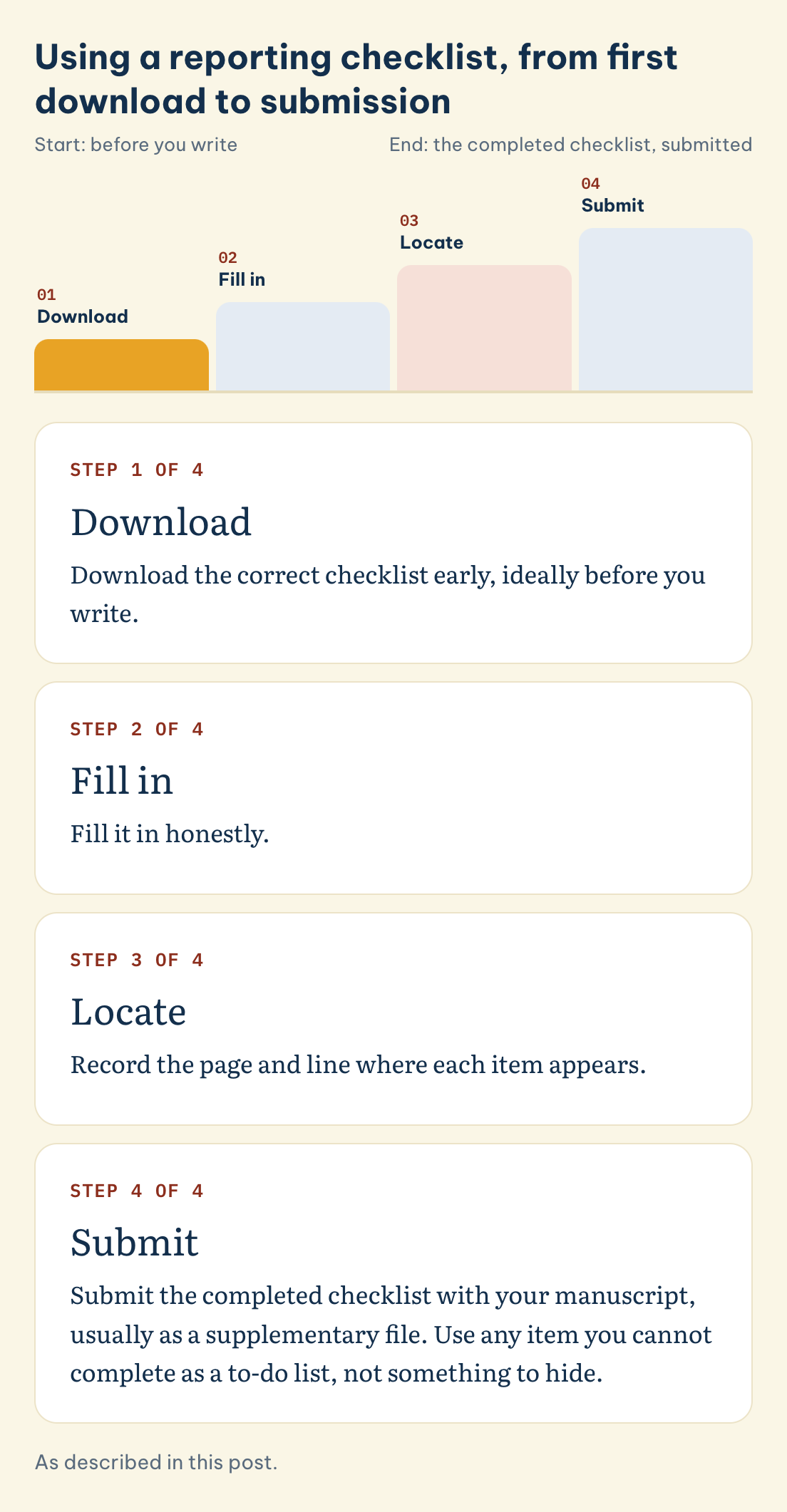
Direct answer: Download the correct checklist early, ideally before you write, fill it in honestly, record the page and line where each item appears, and submit the completed checklist with your manuscript (usually as a supplementary file). Use any item you cannot complete as a to-do list, not something to hide.
Using a reporting checklist, from first download to submission
Tap a step to see what you do. The post describes them in this order.
Step 1 of 4
Download
Download the correct checklist early, ideally before you write.
Step 2 of 4
Fill in
Fill it in honestly.
Step 3 of 4
Locate
Record the page and line where each item appears.
Step 4 of 4
Submit
Submit the completed checklist with your manuscript, usually as a supplementary file. Use any item you cannot complete as a to-do list, not something to hide.
Save this figure
Evidence: The EQUATOR Network (n.d.) recommends using the relevant guideline from the outset of writing rather than retrofitting it at the end, because the checklist shapes a complete methods section rather than just documenting one. Page et al. (2021) similarly build page-or-line location into PRISMA reporting.
Example: A MAAS mentor has every Publishing Advisory author complete the matching checklist during the Outline stage, so gaps become revision tasks long before submission. The author writes and submits; the mentor advises through a phase-by-phase model, never writing or submitting on the author's behalf.
Frequently asked questions
Do I have to submit a reporting checklist even if the journal does not ask?
Following the guideline is good practice regardless, and completing the checklist strengthens your paper. Many journals now require it, and submitting one proactively signals rigour, check the author guidelines for your target journal.
What if no guideline exactly fits my study?
Search the EQUATOR Network, which indexes hundreds of guidelines and extensions; most designs have one. If your study genuinely combines designs, use the closest core guideline and explain your choice in the methods.
Is PRISMA the same as a systematic review method?
No. PRISMA is a reporting guideline, how to write up the review. The conduct of the review (protocol, searching, appraisal) follows methodological handbooks. You need both.
Which guideline applies to a medical-AI imaging study?
For a prediction or imaging AI model, TRIPOD+AI is the core reporting guideline; imaging-specific checklists may also apply. Confirm the current expectations in your target journal's author guidelines.
Does MAAS complete the checklist for me?
No. MAAS mentors coach you to complete it and map each item to your manuscript, but you are the author and you submit. We advise; we do not write or submit on your behalf.
Book a Publishing Advisory consultation with MAAS Academic Mentoring →
Related guides
- How do you keep your research paper from being retracted?: the integrity rules behind transparent reporting
- Who qualifies as an author on a research paper?: ICMJE criteria, CRediT, and ORCID
- How do you publish a medical imaging AI study in a Q1 journal?: TRIPOD+AI and CLAIM in practice
- How do you make an AI health study reproducible for a Q1 journal?: the transparency layer beneath every reporting checklist
- How do you design a systematic review in the health sciences?: applying PRISMA from the protocol up
- Scopus Publishing Advisory: the full pillar on legitimate Q1/Q2 publishing
- Meet the MAAS experts: the PhD-level mentors behind our publishing advisory
References
- Collins, G. S., Moons, K. G. M., Dhiman, P., Riley, R. D., Beam, A. L., Van Calster, B., Ghassemi, M., Liu, X., Reitsma, J. B., van Smeden, M., Boulesteix, A. L., Camaradou, J. C., Celi, L. A., Denaxas, S., Denniston, A. K., Glocker, B., Golub, R. M., Harvey, H., Heinze, G. ... Logullo, P. (2024). TRIPOD+AI statement: Updated guidance for reporting clinical prediction models that use regression or machine learning methods. BMJ, 385, Article e078378. https://doi.org/10.1136/bmj-2023-078378
- EQUATOR Network. (n.d.). What is a reporting guideline? Retrieved June 23, 2026, from https://www.equator-network.org/
- Gagnier, J. J., Kienle, G., Altman, D. G., Moher, D., Sox, H., & Riley, D. (2013). The CARE guidelines: Consensus-based clinical case reporting guideline development. Journal of Medical Case Reports, 7, Article 223. https://doi.org/10.1186/1752-1947-7-223
- Hopewell, S., Chan, A.-W., Collins, G. S., Hróbjartsson, A., Moher, D., Schulz, K. F., Tunn, R., Aggarwal, R., Berkwits, M., Berlin, J. A., Bhandari, N., Butcher, N. J., Campbell, M. K., Chidebe, R. C. W., Elbourne, D., Farmer, A., Fergusson, D. A., Golub, R. M., Goodman, S. N., . . . Boutron, I. (2025). CONSORT 2025 statement: Updated guideline for reporting randomised trials. BMJ, 389, Article e081123. https://doi.org/10.1136/bmj-2024-081123
- Page, M. J., McKenzie, J. E., Bossuyt, P. M., Boutron, I., Hoffmann, T. C., Mulrow, C. D., Shamseer, L., Tetzlaff, J. M., Akl, E. A., Brennan, S. E., Chou, R., Glanville, J., Grimshaw, J. M., Hróbjartsson, A., Lalu, M. M., Li, T., Loder, E. W., Mayo-Wilson, E., McDonald, S. ... Moher, D. (2021). The PRISMA 2020 statement: An updated guideline for reporting systematic reviews. BMJ, 372, Article n71. https://doi.org/10.1136/bmj.n71
- von Elm, E., Altman, D. G., Egger, M., Pocock, S. J., Gøtzsche, P. C., & Vandenbroucke, J. P. (2007). The Strengthening the Reporting of Observational Studies in Epidemiology (STROBE) statement: Guidelines for reporting observational studies. PLoS Medicine, 4(10), Article e296. https://doi.org/10.1371/journal.pmed.0040296
This article is part of the MAAS Journal series for Vietnamese international postgraduate students and researchers. MAAS Publishing Advisory is an advisory partner; we coach authors through a phase-by-phase delivery model with developmental feedback from PhD-level, Scopus-published mentors. We do not write, submit, or guarantee acceptance of work on an author's behalf.
A free 20-minute consultation with a MAAS publishing mentor, to talk through which reporting guideline fits your study.
Book Free Discovery ▸