
◆ Publishing advisory
Which Q1 checklist for medical AI studies should you use?
Direct answer: The right Q1 checklist for medical AI studies is the reporting checklist that matches what your paper builds. CLAIM 2024 fits AI applied to medical images, and TRIPOD+AI (27 items) fits clinical prediction models. A journal may ask for either at submission, so read its author instructions before you fix the methods section.
Two audits put numbers on what happens when a medical AI paper skips this step. A review of machine learning models for COVID-19 imaging screened 2,212 papers and found that none of the 62 that survived quality review was ready for clinical use. A survey of 516 eligible studies of diagnostic AI on medical images found that only 6% tested their model on external data. The rest of this guide shows where those failures sit in a checklist, and how to find them in your own draft first.
◆ Question 1 / 6 · Choosing the checklist
Which Q1 checklist for medical AI studies fits your paper?
Direct answer: Choose your Q1 checklist for medical AI studies by what the paper builds. A model applied to images follows CLAIM, a model that predicts a clinical outcome from patient data follows TRIPOD+AI, and a project aimed at hospital deployment adds the FUTURE-AI principles.
CLAIM criteria
51%
of 215 deep-learning papers excluded from a COVID-19 imaging review failed at least three mandatory CLAIM criteria (Roberts et al., 2021)
TRIPOD+AI
27
items make up the checklist published in The BMJ in 2024, with a further 13 items for abstracts (Collins et al., 2024)
Three guidelines and when to use each
Tap a guideline to see when to use it and what it focuses on.
Guideline 1 / 3
CLAIM (2024 update)
Use it when your study builds or tests an AI model on medical images. Tejani et al. (2024) published the 2024 update, and it is registered with the EQUATOR Network.
Guideline 2 / 3
TRIPOD+AI
Use it when you develop or evaluate a clinical prediction model, whether it uses regression or machine learning. It has 27 items plus 13 for abstracts and supersedes the 37-item TRIPOD checklist of 2015.
Guideline 3 / 3
FUTURE-AI
Use it when designing a tool for real clinical deployment. It sets out 6 principles and 30 best practices from 117 experts in 50 countries, and it is not a reporting checklist.
Save this figure
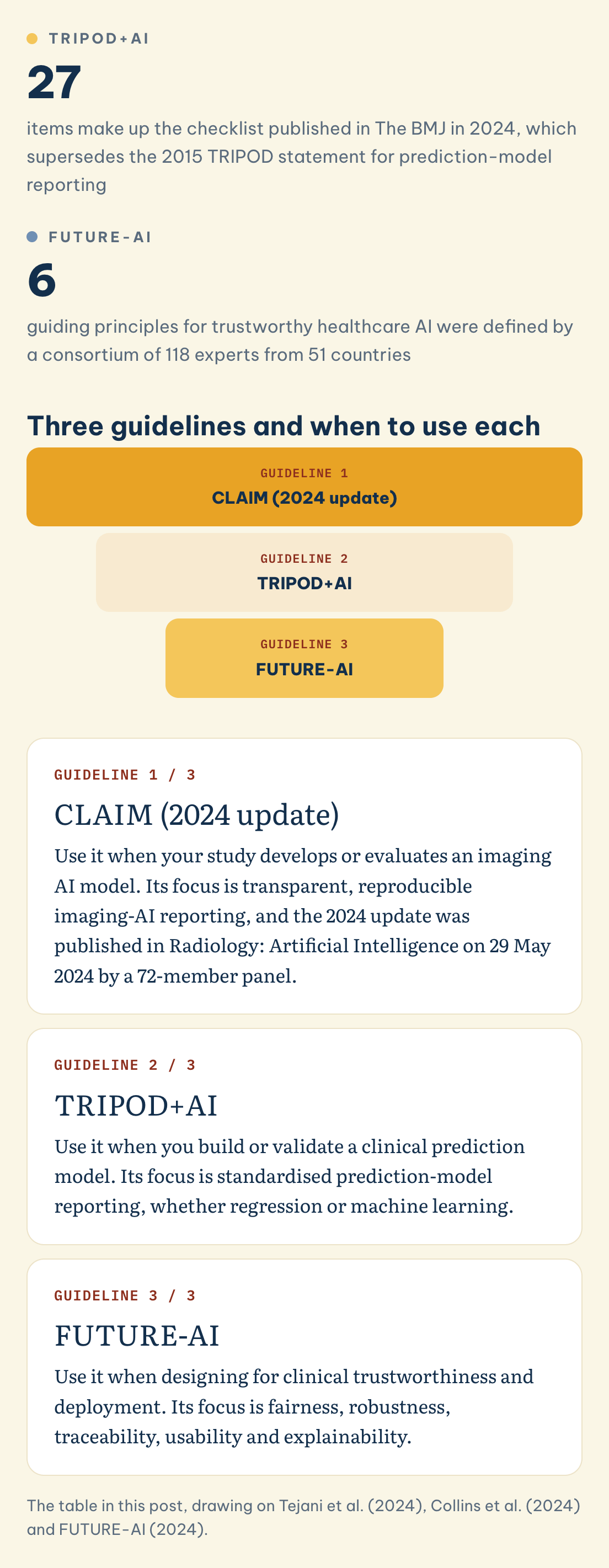
Two guidelines carry most of the load. The Checklist for Artificial Intelligence in Medical Imaging, known as CLAIM, tells authors what to report when a study builds or tests an AI model on medical images. Tejani et al. (2024) published the 2024 update of the checklist, and it is registered with the EQUATOR Network, which promotes reporting guidelines in health research. TRIPOD+AI tells authors what to report when a study develops or evaluates a prediction model, whether it uses regression or machine learning. Collins et al. (2024) present it as a 27-item checklist with a 13-item checklist for abstracts and state that it replaces the 37-item TRIPOD checklist of 2015.
The two overlap when an imaging model predicts a diagnosis or prognosis. Read both, follow the one that fits the design better, and say in the methods which one you used. Collins et al. (2024) place CLAIM beside TRIPOD+AI in a table of reporting guidelines for machine-learning health research, with CLAIM covering "medical imaging studies using artificial intelligence".
| What the paper builds | Checklist | Items | Source |
|---|---|---|---|
| An AI model on medical images | CLAIM 2024 update | 2024 update of the original | Tejani et al. (2024) |
| A clinical prediction model | TRIPOD+AI | 27, plus 13 for abstracts | Collins et al. (2024) |
| A tool designed for real clinical deployment | FUTURE-AI | 30 best practices, 6 principles | Lekadir et al. (2025) |
Source: the three guideline papers in References, read on 2026-10-27.
◆ Question 2 / 6 · Where papers fail
How often do medical AI papers fail the checklist, and where?
Direct answer: Often, and at the same places each time. Of 215 deep-learning papers excluded from a COVID-19 imaging review, 110 (51%) failed at least three mandatory CLAIM criteria, and in a survey of 516 diagnostic AI studies only 31 (6%) used external validation.
Roberts et al. (2021) searched for machine learning models that detect or predict COVID-19 from chest radiographs and CT scans. They identified 2,212 studies, screened 415, assessed 320 in full text and kept 62 after quality review. Of the 215 excluded deep-learning papers, 110 (51%) failed at least three mandatory CLAIM criteria, and the most common gaps were insufficient documentation of final model selection (61%, 132 papers), of preprocessing (58%, 125 papers) and of training details (49%, 105 papers). The authors concluded that none of the models they reviewed was of potential clinical use. The review covers one disease in a period of rushed publication, so the rates are not a general estimate for all medical AI.
Kim et al. (2019) looked at a broader field. From 2,748 collected articles they found 516 eligible studies of diagnostic AI on medical images. Only 31 (6%) used external validation, 4 (0.8%) were prospective, 15 (2.9%) were multi-institutional and 5 (1.0%) used a diagnostic cohort, and no study met all three design features the authors asked for. This is a 2019 sample, so newer papers may do better, but the same three items still appear in current checklists.
You can use these audits as a quick self-test. Treat this as a Q1 checklist for medical AI studies and count the mandatory items you cannot document from your own methods section. If the count reaches three, your paper sits where more than half of the excluded papers in Roberts et al. (2021) sat, and the gap is cheaper to close before submission than after a desk rejection.
◆ Question 3 / 6 · What reviewers read first
Which CLAIM items do reviewers read first?
Direct answer: Reviewers open the items on data partitioning, external testing, statistical uncertainty and error analysis, because those decide whether the reported score can be trusted. Fill the lines that cover those topics first, using the numbering in the published CLAIM 2024 checklist.
Four CLAIM topics reviewers read first
Tap a topic to see what the post says about it.
Partition level
State the level at which training, tuning and test sets are separated. For images the safe level is the patient.
External testing
Report evaluation on data from another source, or an explicit and justified statement of why it was not done.
Uncertainty
Give confidence intervals when metrics are compared.
Failure cases
Show examples of the cases the model got wrong, so a reader can judge the headline score without guessing.
Save this figure
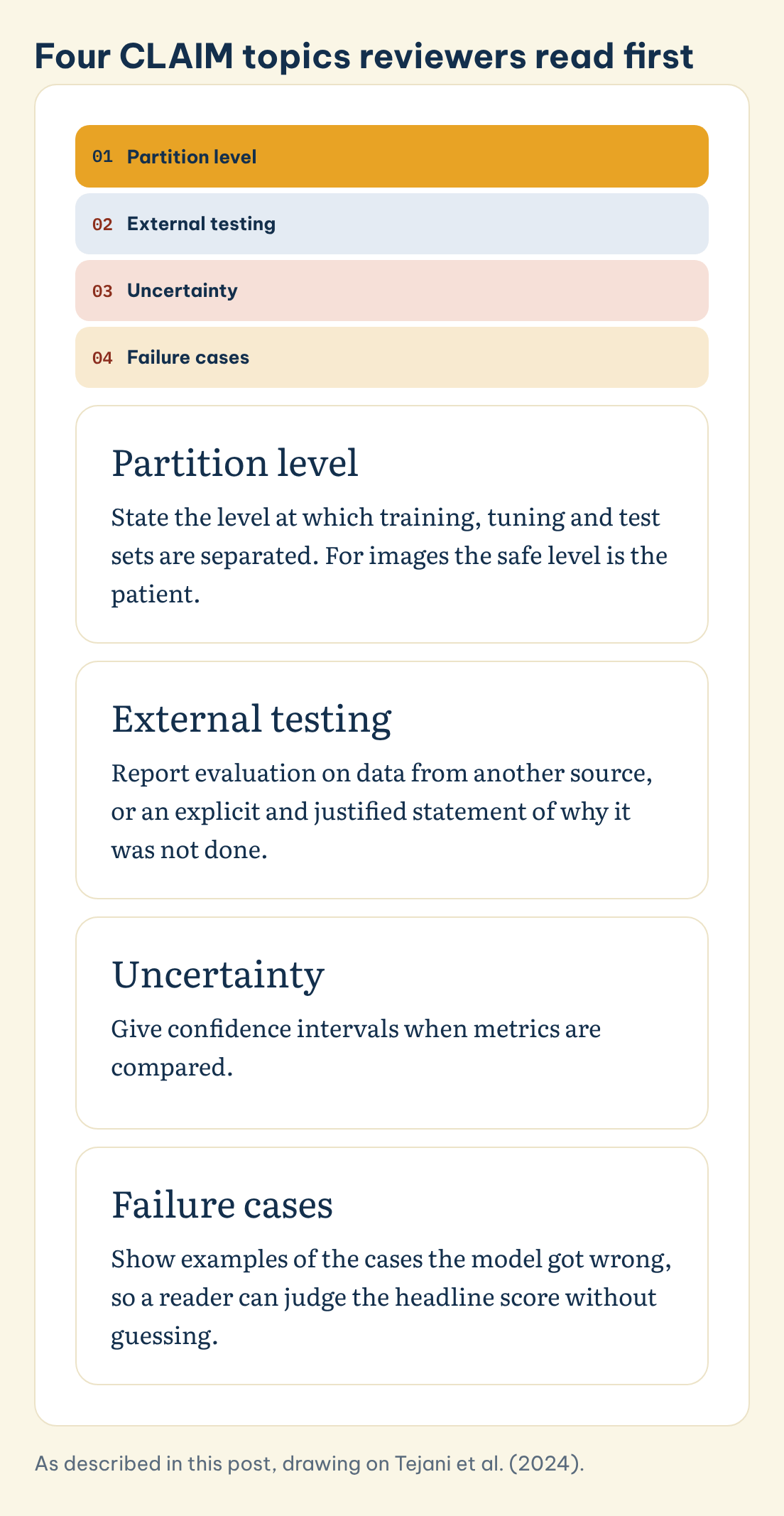
The partitioning items carry the most weight. They ask authors to state the level at which training, tuning and test sets are separated, and for images the safe level is the patient, as the next section shows. The items on external testing ask for evaluation on data from another source, or an explicit and justified statement of why it was not done. Reviewers also look for confidence intervals when metrics are compared, and for examples of the cases the model got wrong. A paper that supplies all four lets a reader judge the headline score without guessing.
The table below maps manuscript sections to the topics of the CLAIM 2024 update. It is an editing tool built by MAAS from the topics the checklist covers, not part of the guideline, so check each line against the published item numbers before you submit.
| Manuscript section | CLAIM topics to fill first | Where authors usually fall short |
|---|---|---|
| Data | How data are partitioned | Split level not stated |
| Methods | How the model is evaluated | Test-set size not justified |
| Results | Uncertainty and external testing | No confidence intervals, no external testing |
| Discussion | Error analysis | No failure cases shown |
| Supplement | Access to code and data | No statement on access to code and data |
Source: topics covered by the CLAIM 2024 update (Tejani et al., 2024); mapping by MAAS, 2026-10-27.
◆ Question 4 / 6 · Leakage and sharing
Why does a random split by image leak, and how big is the problem?
Direct answer: When one patient contributes several images, a random split by image places most test images next to a sibling from the same patient in training. The example below shows that this happens to about 99.8% of test images, which is why reviewers ask authors to state the split level.
Koçak et al. (2025) write that "a common and serious source of bias in model validation lies in data leakage", and give the case of repeated scans of one patient appearing in both training and validation sets. A short calculation shows how fast that happens. Suppose a dataset holds 4,000 images from 800 patients, 5 images each, and you assign each image to training or test at random with an 80/20 split. For one test image, each of the 4 other images from the same patient lands in training with probability 0.8, so the chance that none does is 0.2 to the fourth power, or 0.16%. About 99.8% of test images therefore have a same-patient sibling in training, and the model can score well by recognising the patient and not the disease. Splitting by patient before any image is touched removes the problem.
The calculation above is an illustration worked out by MAAS, not a result from a study, and the exact figure depends on how many images each patient has. Reviewers who see a random split by image usually ask for a patient-level split, so state the level in the methods and in the checklist.
Sharing is the second concern. Lee et al. (2025) reviewed AI model-development studies in five leading radiology journals in 2022 and found that 107 of 268 studies (39.9%) made their model publicly available. Among 113 deep-learning studies, 13 (11.5%) shared fully, and training code was available in 25 (22.1%). Koçak et al. (2025) add that fewer than about 6% of articles in radiology journals share the data used to build the model. Prepare the patient-level split table and a statement on code and data access before you submit, because both answer questions reviewers would otherwise ask in round one. The fuller workflow is in our guide to reproducible AI health research.
◆ Question 5 / 6 · TRIPOD+AI and FUTURE-AI
When does TRIPOD+AI replace CLAIM, and where does FUTURE-AI fit?
Direct answer: Use TRIPOD+AI when the main product is a prediction model for diagnosis, prognosis or risk, and CLAIM when it is an AI method applied to images. FUTURE-AI is a development and deployment framework, so it can support design claims but does not replace a reporting checklist.
TRIPOD+AI grew out of a 2015 statement for regression models. Collins et al. (2024) explain that machine learning methods had spread and the older checklist needed updating, so the new version gives one guidance for prediction model studies whatever the modelling method. It also defines the term "evaluation data" for data used to estimate performance, which must be separate from the training data so that no participant appears in both.
Lekadir et al. (2025) describe a consortium formed in 2021 of 117 interdisciplinary experts from 50 countries. Over two years they reached consensus on six guiding principles (fairness, universality, traceability, usability, robustness and explainability) and 30 best practices that cover the AI lifecycle from design to monitoring. The paper itself separates its role from reporting guidelines: TRIPOD+AI and CLAIM "do not provide best practices for the actual development and deployment of the AI tools, but promote standardised and complete reporting" (Lekadir et al., 2025). A claim of deployment readiness without evidence invites criticism, so use FUTURE-AI language only for claims your data can support, such as a bias analysis across patient groups.
A paper that does both jobs, for example an imaging model that predicts survival from a scan plus clinical variables, can need TRIPOD+AI logic for the prediction part and CLAIM items for the imaging part. Pick one checklist as the formal submission and bring the missing items of the other into the methods.
◆ Question 6 / 6 · Testing journal fit
How do you test journal fit before writing the methods?
Direct answer: Read the scope, page limit and data policy of the target journal first, then match your contribution to them. IEEE Transactions on Medical Imaging, for example, limits an initial submission to ten pages and treats sharing code and test data as best practice.
The author instructions of IEEE Transactions on Medical Imaging (TMI) are explicit. The journal states that an initial submission over ten pages including references is returned without review, and that printed papers beyond eight pages carry a charge of US$250 per page for pages nine and ten (IEEE Transactions on Medical Imaging, 2025). On reproducibility the wording is measured: "Upon publication, TMI considers it best practice to share custom computer code and test data in a way that allows readers to reproduce the published results" (IEEE Transactions on Medical Imaging, 2025).
The same method works for any target. Write down the journal's scope, page limit and data policy and set them beside your paper. If a clinical evaluation of an existing method adds no new method, a clinical imaging journal is the honest fit. Our guides to choosing a Scopus journal and to Q1 versus Q2 journals cover the indexing side.
Frequently asked questions
Does every medical AI manuscript need CLAIM or TRIPOD+AI?
Not always. Some journals require a completed checklist at submission and some do not, so the author instructions decide. Even when it is optional, filling in the right checklist early shows which parts of the methods lack detail.
Is CLAIM 2024 the same as the original CLAIM?
No. The 2024 update revises the original guideline, so cite the 2024 update and not the original.
Can one paper follow both CLAIM and TRIPOD+AI?
Yes, but submit only one as the formal checklist. Choose the guideline that matches the main product, and bring the missing items of the other into the methods so reviewers see one complete description.
Is external testing always decisive in a Q1 review?
No rule applies to every journal, but reviewers commonly expect authors to describe external testing or to state and justify why it was not done. Naming the limit is safer than silence, and the discussion should say how far the results generalise.
Does MAAS promise that a journal will accept my paper?
No. Acceptance belongs to the journal's editors and reviewers. A MAAS publishing adviser comments on methods, reporting and journal fit at each stage, and you remain the author of the paper at every step.
Book a checklist read before you submit
Once the manuscript has a shape, a publishing adviser from MAAS Scopus publishing advisory can read your methods against the checklist that fits your design and mark the items still missing. The adviser has published in indexed journals and gives developmental feedback in writing and in one conversation, covering the data split, statistical reporting and fit with the journal's scope.
The work is staged. You write the paper, decide what to change and submit it yourself, while the adviser comments on drafts and writes no section. The service sets no grade target and promises no acceptance, because that decision rests with the journal. If the adviser assigned to you does not suit your field, you can ask for a different adviser at any time and MAAS will arrange it.
Related guides
Direct answer: Four MAAS guides extend this one in more depth. They cover the journal-choice step that follows the checklist, the reproducibility workflow behind code and data sharing and TMI's code policy, the cover letter that states fit, and how quartiles are assigned.
- How do you choose the right Scopus journal?: match your contribution to a journal's scope and index, the step after choosing a checklist
- How do you make health AI research reproducible for Q1?: the code, data and documentation reviewers look for
- Journal cover letter guide: state fit and novelty before an editor decides whether to send the paper out for review
- Q1 vs Q2 journals explained: how quartiles are assigned and what they do and do not tell you
References
- Collins, G. S., Moons, K. G. M., Dhiman, P., Riley, R. D., Beam, A. L., Van Calster, B., Ghassemi, M., Liu, X., Reitsma, J. B., van Smeden, M., Boulesteix, A.-L., Camaradou, J. C., Celi, L. A., Denaxas, S., Denniston, A. K., Glocker, B., Golub, R. M., Harvey, H., Heinze, G., ... Logullo, P. (2024). TRIPOD+AI statement: Updated guidance for reporting clinical prediction models that use regression or machine learning methods. BMJ, 385, Article e078378. https://doi.org/10.1136/bmj-2023-078378
- IEEE Transactions on Medical Imaging. (2025). Instruction to authors (Revision 10.2). https://ieeetmi.org/authors-instructions/
- Kim, D. W., Jang, H. Y., Kim, K. W., Shin, Y., & Park, S. H. (2019). Design characteristics of studies reporting the performance of artificial intelligence algorithms for diagnostic analysis of medical images: Results from recently published papers. Korean Journal of Radiology, 20(3), 405–410. https://doi.org/10.3348/kjr.2019.0025
- Koçak, B., Ponsiglione, A., Stanzione, A., Bluethgen, C., Santinha, J., Ugga, L., Huisman, M., Klontzas, M. E., Cannella, R., & Cuocolo, R. (2025). Bias in artificial intelligence for medical imaging: Fundamentals, detection, avoidance, mitigation, challenges, ethics, and prospects. Diagnostic and Interventional Radiology, 31(2), 75-88. https://doi.org/10.4274/dir.2024.242854
- Lee, T., Lee, J. H., Yoon, S. H., Park, S. H., & Kim, H. (2025). Availability and transparency of artificial intelligence models in radiology: A meta-research study. European Radiology, 35(9), 5287-5298. https://doi.org/10.1007/s00330-025-11492-6
- Lekadir, K., Frangi, A. F., Porras, A. R., Glocker, B., Cintas, C., Langlotz, C. P., Weicken, E., Asselbergs, F. W., Prior, F., Collins, G. S., Kaissis, G., Tsakou, G., Buvat, I., Kalpathy-Cramer, J., Mongan, J., Schnabel, J. A., Kushibar, K., Riklund, K., Marias, K., ... Starmans, M. P. A. (2025). FUTURE-AI: International consensus guideline for trustworthy and deployable artificial intelligence in healthcare. BMJ, 388, Article e081554. https://doi.org/10.1136/bmj-2024-081554
- Roberts, M., Driggs, D., Thorpe, M., Gilbey, J., Yeung, M., Ursprung, S., Aviles-Rivero, A. I., Etmann, C., McCague, C., Beer, L., Weir-McCall, J. R., Teng, Z., Gkrania-Klotsas, E., Rudd, J. H. F., Sala, E., & Schönlieb, C.-B. (2021). Common pitfalls and recommendations for using machine learning to detect and prognosticate for COVID-19 using chest radiographs and CT scans. Nature Machine Intelligence, 3(3), 199–217. https://doi.org/10.1038/s42256-021-00307-0
- Tejani, A. S., Klontzas, M. E., Gatti, A. A., Mongan, J. T., Moy, L., Park, S. H., Kahn, C. E., & CLAIM 2024 Update Panel. (2024). Checklist for Artificial Intelligence in Medical Imaging (CLAIM): 2024 update. Radiology: Artificial Intelligence, 6(4), Article e240300. https://doi.org/10.1148/ryai.240300
Written for researchers preparing a medical AI paper for an indexed journal. MAAS advisers give developmental feedback on drafts and plans, and we do not write sections, submit papers for authors or guarantee acceptance.
A free 20-minute consultation with a MAAS publishing mentor, to talk through your medical-AI study and its reporting checklist.
Book Free Discovery ▸