Chỗ dựa 01
Phương pháp đối chiếu đúng bảng kiểm
Bám theo bảng kiểm báo cáo cải thiện rõ chất lượng bản thảo.

◆ Cố vấn công bố
Trả lời thẳng: Bài AI hình ảnh y khoa muốn vào tạp chí Q1 cần tính mới về lâm sàng, kiểm chứng trên dữ liệu ngoài và cách báo cáo minh bạch, vì độ chính xác cao thôi thì chưa đủ. Một tạp chí nhóm phân vị cao nhất như IEEE Transactions on Medical Imaging ít chấm theo chỉ số nổi bật, mà xem phương pháp có chặt chẽ, lặp lại được và hữu ích trên lâm sàng hay không.
Bài này dành cho nhà nghiên cứu Việt Nam bước vào những lĩnh vực như chẩn đoán hình ảnh, giải phẫu bệnh hay hình ảnh sơ sinh. Bạn sẽ chọn được bảng kiểm báo cáo, chọn tạp chí khớp với đóng góp của mình, dựng phần kiểm chứng mà người phản biện Q1 chờ đợi và chuẩn bị mã nguồn, dữ liệu trước khi nộp. Nội dung đi theo bảy câu hỏi mà nhà nghiên cứu Việt Nam hay hỏi cố vấn công bố của MAAS nhất trước khi gửi một bản thảo AI y khoa tới tạp chí Q1.
◆ Câu hỏi 1 / 7 · Điều làm bài đủ sức
Trả lời trực tiếp: Một nghiên cứu AI y khoa đủ sức vào Q1 thường kết hợp bốn thứ, gồm một vấn đề có ý nghĩa lâm sàng, một đóng góp về phương pháp vượt được các mốc so sánh gần đây, phần kiểm chứng đứng vững trên dữ liệu mô hình chưa từng thấy, và cách báo cáo đủ minh bạch để người khác lặp lại được. Độ chính xác cao trên một bộ dữ liệu riêng thì chưa đủ.
Nói cách khác, người phản biện không hỏi mô hình của bạn đạt bao nhiêu phần trăm, mà hỏi con số đó có còn đúng khi đem sang bệnh viện khác, máy chụp khác hay không, và có ai ngoài nhóm bạn kiểm lại được hay không.
IEEE (n.d.), trong hướng dẫn tác giả của IEEE Transactions on Medical Imaging, kỳ vọng bài có so sánh chặt chẽ với các mốc gần đây trên những bộ chuẩn đã được thiết lập, chứ không chỉ báo cáo kết quả trên một bộ dữ liệu tự dựng, và ngày càng kỳ vọng cam kết công khai mã nguồn. Koçak và cộng sự (2025) cùng Lee và cộng sự (2025), qua các nghiên cứu về chính cách giới nghiên cứu báo cáo, cho thấy bài AI hình ảnh y khoa hay thổi phồng hiệu năng, chẳng hạn khẳng định mình vượt trội mà không kiểm định thống kê chặt chẽ, và tương đối ít mô hình được công khai để bên thứ ba kiểm chứng độc lập.
Một nhà nghiên cứu Việt Nam được MAAS đồng hành có một mô hình hình ảnh sơ sinh với độ chính xác báo cáo rất cao, nhưng chỉ dùng dữ liệu của một cơ sở và không có kiểm định ý nghĩa thống kê. Cố vấn gợi ý đặt lại công trình quanh một khoảng trống lâm sàng rõ ràng, và nhà nghiên cứu đó bổ sung kiểm chứng trên dữ liệu ngoài cùng phép so sánh thống kê với hai mốc gần đây. Bản thảo chuyển từ chỗ nhiều khả năng bị từ chối tại bàn thành một bài nộp Q1 có sức cạnh tranh.
◆ Câu hỏi 2 / 7 · Bảng kiểm báo cáo
Trả lời trực tiếp: Hãy dùng bảng kiểm báo cáo khớp với loại nghiên cứu và nộp nó cùng bản thảo. Với mô hình AI hình ảnh, CLAIM là bảng kiểm cốt lõi. Với mô hình dự đoán lâm sàng, hãy dùng TRIPOD+AI, và căn thiết kế tổng thể theo các nguyên tắc về độ tin cậy của FUTURE-AI. Nhiều tạp chí Q1 hiện yêu cầu một trong các bảng này ngay lúc nộp bài.
TRIPOD+AI
27
mục là độ dài của bảng kiểm công bố trên The BMJ năm 2024, thay thế tuyên bố TRIPOD 2015 cho phần báo cáo mô hình dự đoán
FUTURE-AI
6
nguyên tắc dẫn đường cho AI y tế đáng tin cậy do một liên minh 118 chuyên gia từ 51 quốc gia định ra
Ba hướng dẫn và khi nào dùng từng cái
Chạm vào một hướng dẫn để xem khi nào dùng nó và nó tập trung vào điều gì.
Hướng dẫn 1 / 3
CLAIM (bản cập nhật 2024)
Dùng khi nghiên cứu của bạn xây dựng hoặc đánh giá một mô hình AI hình ảnh. Trọng tâm là báo cáo AI hình ảnh minh bạch, lặp lại được, và bản cập nhật 2024 được công bố trên Radiology: Artificial Intelligence ngày 29/05/2024, do một hội đồng 72 thành viên xây dựng.
Hướng dẫn 2 / 3
TRIPOD+AI
Dùng khi bạn xây dựng hoặc kiểm chứng một mô hình dự đoán lâm sàng. Trọng tâm là chuẩn hoá báo cáo mô hình dự đoán, cả hồi quy lẫn học máy.
Hướng dẫn 3 / 3
FUTURE-AI
Dùng khi thiết kế hướng tới độ tin cậy và khả năng triển khai lâm sàng. Trọng tâm là công bằng, bền vững, truy vết được, dễ dùng và giải thích được.
Bảng kiểm báo cáo (reporting guideline) là danh sách những thông tin một bài thuộc loại nghiên cứu nhất định phải trình bày, để người đọc đánh giá và lặp lại được công trình. Bảng dưới đây tóm tắt khi nào dùng bảng nào.
Tejani và cộng sự (2024) công bố bản cập nhật 2024 của Checklist for Artificial Intelligence in Medical Imaging, tức CLAIM, trên Radiology: Artificial Intelligence ngày 29/05/2024, do một hội đồng 72 thành viên xây dựng, và bảng kiểm này được lưu trên EQUATOR Network. TRIPOD+AI là bảng kiểm 27 mục công bố trên The BMJ năm 2024, thay thế tuyên bố TRIPOD 2015 cho phần báo cáo mô hình dự đoán. Collins và cộng sự (2024) viết: "TRIPOD+AI aims to promote the complete, accurate, and transparent reporting of studies that develop a prediction model or evaluate its performance" (p. 1), tức bảng kiểm nhằm giúp báo cáo đầy đủ, chính xác và minh bạch các nghiên cứu xây dựng hoặc đánh giá mô hình dự đoán. FUTURE-AI Consortium (2024), một liên minh 118 chuyên gia từ 51 quốc gia, định ra sáu nguyên tắc dẫn đường cho AI y tế đáng tin cậy.
| Hướng dẫn | Năm | Dùng khi nào | Trọng tâm |
|---|---|---|---|
| CLAIM (bản cập nhật) | 2024 | Nghiên cứu của bạn xây dựng hoặc đánh giá một mô hình AI hình ảnh | Báo cáo AI hình ảnh minh bạch, lặp lại được |
| TRIPOD+AI | 2024 | Bạn xây dựng hoặc kiểm chứng một mô hình dự đoán lâm sàng | Chuẩn hoá báo cáo mô hình dự đoán, cả hồi quy lẫn học máy |
| FUTURE-AI | 2024 | Thiết kế hướng tới độ tin cậy và khả năng triển khai lâm sàng | Công bằng, bền vững, truy vết được, dễ dùng, giải thích được |
Một tác giả AI giải phẫu bệnh được MAAS đồng hành tự điền CLAIM theo từng dòng ngay ở giai đoạn viết bản thảo. Ba mục nhà nghiên cứu đó chưa trả lời được là nguồn gốc dữ liệu, bộ kiểm tra ngoài và phần phân tích các ca mô hình sai, và ba mục ấy trở thành danh sách việc cần sửa của bạn ấy. Xử lý xong chúng, bài chắc hơn hẳn trước khi người phản biện đọc tới.
◆ Câu hỏi 3 / 7 · Chọn tạp chí
Trả lời trực tiếp: Hãy ghép đóng góp của bạn với phạm vi tạp chí trước khi viết thư gửi ban biên tập. Bài nặng phương pháp hợp với tạp chí kỹ thuật như IEEE Transactions on Medical Imaging hay Medical Image Analysis, còn nghiên cứu theo hướng lâm sàng hợp với Radiology: Artificial Intelligence. Hãy đọc các số gần đây và kiểm tra tạp chí có trong Scopus hoặc Web of Science không.
Khi đọc các số gần đây, bạn cũng nên xác nhận tạp chí có quen với bộ chuẩn (benchmark) mà bạn dùng hay không, vì một tạp chí kỹ thuật thường chờ bài so sánh trên đúng những bộ chuẩn mà cộng đồng của nó đã thống nhất.
IEEE (n.d.) cho biết IEEE TMI kỳ vọng so sánh chặt chẽ trên các bộ chuẩn đã thiết lập, như fastMRI cho tái dựng ảnh hay dữ liệu thử thách AAPM cho CT, áp giới hạn khoảng 10 trang và đòi đóng góp về phương pháp phải hiện rõ ngay ở phần mở đầu. Lệch phạm vi vẫn là lý do phổ biến nhất khiến bản thảo bị loại ở khâu sàng lọc của ban biên tập trước cả vòng phản biện, nên chọn tạp chí khớp là một quyết định sớm có tính quyết định.
Một nghiên cứu sinh Việt Nam muốn gửi một nghiên cứu chẩn đoán thiên về lâm sàng tới một tạp chí nặng về phương pháp kỹ thuật. Cố vấn MAAS chỉ ra chỗ lệch và cùng bạn ấy so hai tạp chí hình ảnh Q1 khớp hơn với đóng góp của bài. Bản nộp lại vì vậy đọc lên vừa vặn tự nhiên với tạp chí, thay vì một lần cố với quá tầm.
◆ Câu hỏi 4 / 7 · Dữ liệu và kiểm chứng
Trả lời trực tiếp: Người phản biện Q1 chờ đợi phần kiểm chứng trên dữ liệu mô hình chưa từng thấy khi huấn luyện, tốt nhất là một bộ dữ liệu ngoài từ cơ sở hoặc máy chụp khác, kèm cách chia tập huấn luyện, kiểm định và kiểm tra sạch sẽ, không có bệnh nhân nào xuất hiện ở hai tập. Kiểm chứng ngoài và kiểm soát rò rỉ dữ liệu nay là yêu cầu nền.
Rò rỉ dữ liệu (data leakage) xảy ra khi thông tin từ tập kiểm tra lọt vào quá trình huấn luyện, khiến mô hình trông giỏi hơn thực tế. Người phản biện coi hai điều trên là mức tối thiểu chứ không phải điểm cộng, và bài thiếu chúng thường bị hỏi lại ngay từ vòng đầu.
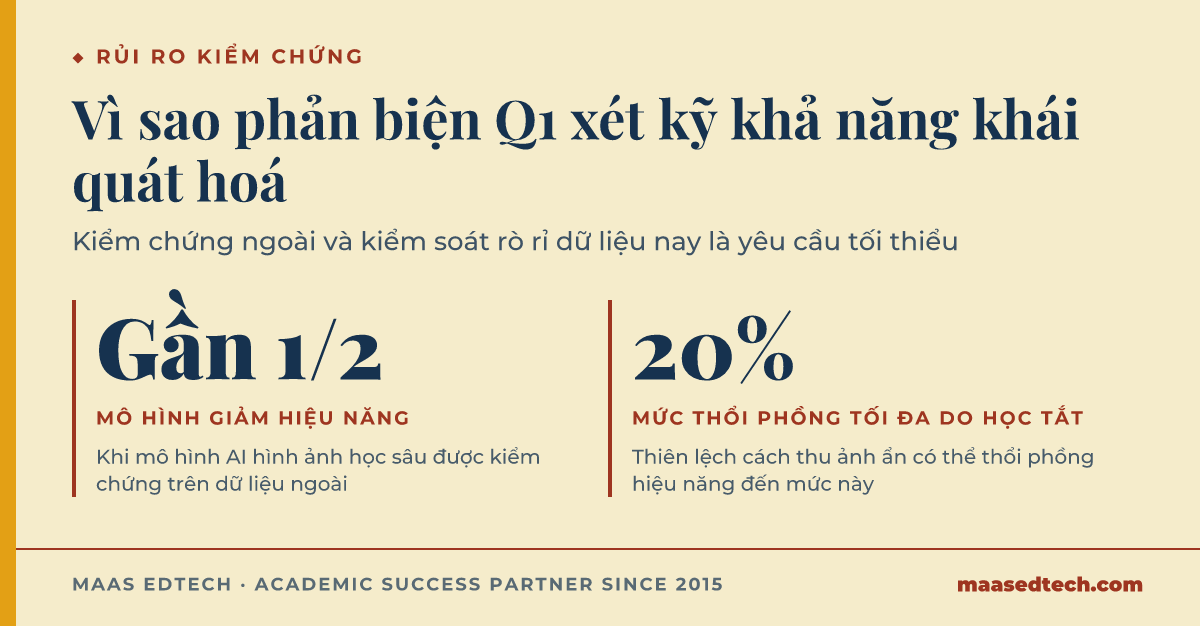
Koçak và cộng sự (2025) chỉ ra rằng rò rỉ dữ liệu là một nguồn sai lệch thường gặp và nghiêm trọng, chẳng hạn khi các lần chụp khác nhau của cùng một bệnh nhân nằm ở cả tập huấn luyện lẫn tập kiểm định, làm hiệu năng nhìn thấy được bị thổi phồng. Gần một nửa số mô hình học sâu được kiểm chứng trên dữ liệu ngoài tụt hiệu năng ít nhất ở mức vừa phải, còn hiện tượng học tắt (shortcut learning), tức mô hình bám vào thiên lệch ẩn của quá trình thu ảnh, có thể khiến hiệu năng bị ước lượng cao hơn thực tế tới 20%. Vì vậy người phản biện soi rất kỹ khả năng khái quát hoá.
Một khách hàng của dịch vụ Cố vấn Công bố MAAS đã huấn luyện và kiểm tra mô hình trên ảnh của cùng một bệnh viện. Cố vấn gợi ý hướng tìm một bộ dữ liệu công khai nhỏ để làm phép kiểm độc lập, và nhà nghiên cứu đó tự tìm dữ liệu, ghi rõ cách tách tập huấn luyện với tập kiểm tra, rồi báo cáo trung thực mức tụt hiệu năng. Người phản biện đánh giá cao sự minh bạch này chứ không trừ điểm.
◆ Câu hỏi 5 / 7 · Vì sao mô hình mạnh vẫn trượt
Trả lời trực tiếp: Ngay cả một mô hình chính xác vẫn có thể bị từ chối khi bài tuyên bố quá tay, bỏ qua kiểm định thống kê, thiếu kiểm chứng ngoài hoặc giấu các ca mô hình sai. Người phản biện đọc những dấu hiệu đó như tín hiệu rằng kết quả có thể không đứng vững, và ở tầm Q1 thì trách nhiệm chứng minh thuộc về tác giả chứ không thuộc về người phản biện.
Bốn điều khiến một mô hình chính xác vẫn bị từ chối
Chạm vào một lý do để xem bài viết nói gì về nó.
Tuyên bố quá tay
Các nghiên cứu về cách giới nghiên cứu báo cáo cho thấy bài AI hình ảnh y khoa hay thổi phồng hiệu năng, theo Koçak và cộng sự (2025) cùng Lee và cộng sự (2025).
Bỏ qua kiểm định thống kê
Koçak và cộng sự (2025) ghi nhận rằng bài AI hình ảnh y khoa thường khẳng định mình vượt trội mà không có kiểm định ý nghĩa thống kê.
Thiếu kiểm chứng ngoài
Kiểm chứng ngoài còn hạn chế, cộng với thiên lệch và hiện tượng học tắt, là những lý do lặp đi lặp lại khiến các nghiên cứu có phương pháp hứa hẹn vẫn trượt vòng phản biện Q1.
Giấu các ca mô hình sai
Người phản biện đọc dấu hiệu này như tín hiệu rằng kết quả có thể không đứng vững, và ở tầm Q1 thì trách nhiệm chứng minh thuộc về tác giả.
Một bài có ý tưởng tốt vì vậy vẫn có thể trượt chỉ vì cách trình bày kết quả. Phần lớn những lỗi này sửa được trước khi nộp, và chi phí sửa lúc đó thấp hơn nhiều so với sau một lần bị từ chối.
Koçak và cộng sự (2025) ghi nhận rằng bài AI hình ảnh y khoa thường khẳng định mình vượt trội mà không có kiểm định ý nghĩa thống kê, trong khi thiên lệch và hiện tượng học tắt còn làm suy giảm thêm hiệu năng nhìn thấy được. Cộng với phần kiểm chứng ngoài còn hạn chế, đây là những lý do lặp đi lặp lại khiến các nghiên cứu có phương pháp hứa hẹn vẫn trượt vòng phản biện Q1.
Một tác giả ngành kỹ thuật được MAAS đồng hành tuyên bố mô hình của mình "vượt trội" so với công trình trước, dựa trên một lần chạy duy nhất. Cố vấn gợi ý chạy lặp nhiều lần, thêm khoảng tin cậy và một kiểm định ý nghĩa, rồi hạ giọng tuyên bố xuống đúng mức dữ liệu chống đỡ được, và tác giả đó tự làm các bước này. Bản trung thực và được kiểm kỹ ấy khó bị người phản biện bác hơn nhiều.
◆ Câu hỏi 6 / 7 · Khả năng lặp lại
Trả lời trực tiếp: Hãy tính tới khả năng lặp lại ngay từ đầu, tức chia sẻ mã nguồn, ghi rõ dữ liệu cùng các bước tiền xử lý, và nêu lập trường rõ ràng về việc công khai dữ liệu và mô hình. Ngay cả khi công khai mã chưa bắt buộc tuyệt đối, một bản thảo thiếu cam kết về khả năng lặp lại vẫn có thể bị soi kỹ hơn ở các tạp chí hàng đầu.
Khả năng lặp lại (reproducibility) nghĩa là một nhóm khác, dùng cùng mã, cùng dữ liệu và cùng cách xử lý, có thể thu được kết quả tương tự. Với AI y khoa, đây là cách duy nhất để người đọc tin rằng hiệu năng bạn báo cáo không phải kết quả của một lần chạy may mắn.
IEEE (n.d.) cho biết ở IEEE TMI, việc công khai mã nguồn, mô hình và dữ liệu ngày càng được kỳ vọng, và bài không có cam kết công khai mã có thể bị soi thêm. Tejani và cộng sự (2024) thiết kế bản cập nhật CLAIM 2024 với mục đích rõ ràng là thúc đẩy minh bạch và khả năng lặp lại, khi yêu cầu tác giả ghi lại nguồn dữ liệu, chi tiết mô hình và cách đánh giá để người khác kiểm chứng được công trình.
Một nhà nghiên cứu Việt Nam lo rằng chia sẻ mã sẽ để lộ phần việc còn dang dở. Cố vấn MAAS gợi ý cách tổ chức một kho mã sạch, có tài liệu đi kèm, một giấy phép rõ ràng và một bản khai về khả năng tiếp cận dữ liệu, và nhà nghiên cứu đó tự dựng kho mã theo hướng ấy. Điều bạn ấy coi là rủi ro trở thành một tín hiệu uy tín giúp bài nộp mạnh hơn.
◆ Câu hỏi 7 / 7 · Làm bài chắc hơn
Trả lời trực tiếp: Hãy dựa vào ba thứ, gồm phương pháp đã đối chiếu với đúng bảng kiểm báo cáo, tiếng Anh rõ và gọn, và phản hồi mang tính hướng dẫn từ người từng phản biện cho tạp chí Q1. Bắt được lỗ hổng phương pháp và lỗi ngôn ngữ trước khi nộp là điều tách một bài bị từ chối tại bàn khỏi một bài vào được vòng phản biện.
Lời khuyên
3
chỗ dựa mà bài viết khuyên nhà nghiên cứu Việt Nam dùng để bài AI y khoa chắc hơn
Bám theo bảng kiểm báo cáo cải thiện rõ chất lượng bản thảo.
Ngôn ngữ yếu vẫn là nguyên nhân lặp lại gây ấn tượng đầu tiên xấu ở các tạp chí quốc tế.
Phản hồi từ người từng phản biện cho tạp chí Q1 giúp bắt lỗ hổng phương pháp và lỗi ngôn ngữ trước khi nộp.
Với tác giả viết tiếng Anh như ngôn ngữ thứ hai, hai lớp kiểm này nên đi theo thứ tự, phương pháp trước rồi ngôn ngữ sau, vì chỉnh câu chữ cho một phần phương pháp còn hổng là tốn công hai lần.
Chiến lược nghiên cứu của Việt Nam đặt mục tiêu tăng 15–20% mỗi năm số công bố thuộc WoS, Scopus và Q1, đồng thời gắn tiến độ của nghiên cứu sinh với công bố quốc tế, nên nhu cầu về công trình AI y khoa chặt chẽ, báo cáo tử tế đang tăng. Bám theo bảng kiểm báo cáo cải thiện rõ chất lượng bản thảo, còn ngôn ngữ yếu vẫn là nguyên nhân lặp lại gây ấn tượng đầu tiên xấu ở các tạp chí quốc tế.
Một cố vấn MAAS đồng hành cùng một tác giả AI y khoa người Việt theo từng giai đoạn. Ở giai đoạn đầu, tác giả dựng dàn ý bám theo CLAIM, sang giai đoạn giữa viết bản thảo có kiểm chứng ngoài và kiểm định ý nghĩa, rồi ở giai đoạn cuối rà lại ngôn ngữ và khả năng lặp lại. Tác giả đó vẫn là tác giả xuyên suốt, còn cố vấn góp ý ở từng giai đoạn chứ không viết bài thay.
Ngày càng là có. Nhiều tạp chí y khoa và hình ảnh thuộc Q1 yêu cầu CLAIM hoặc TRIPOD+AI ngay lúc nộp, và ngay cả khi không bắt buộc, điền một bảng kiểm vẫn làm bài chắc hơn và trả lời trước nhiều câu hỏi của người phản biện. Hãy đọc hướng dẫn tác giả của tạp chí trước.
Không phải trường hợp nào cũng bắt buộc, nhưng nó được chờ đợi ở phần lớn nghiên cứu hình ảnh theo hướng lâm sàng. Nếu thật sự không thể có bộ dữ liệu ngoài, hãy minh bạch về giới hạn đó và dùng kiểm chứng nội bộ chặt chẽ, không để rò rỉ dữ liệu bệnh nhân giữa các tập. Giấu lỗ hổng rủi ro hơn là khai ra.
Điều đó tuỳ vào đóng góp của bạn. Một phương pháp mới có mốc so sánh mạnh hợp với tạp chí kỹ thuật, còn một đánh giá theo hướng lâm sàng hợp với tạp chí hình ảnh lâm sàng. Hãy chọn nơi công bố theo đóng góp mạnh nhất của bài thay vì đuổi theo tạp chí có chỉ số ảnh hưởng cao nhất.
Không phải lúc nào cũng bắt buộc, nhưng các tạp chí hàng đầu ngày càng chờ đợi một bản khai về công khai mã và dữ liệu, và cam kết về khả năng lặp lại giúp người phản biện đón nhận bài tốt hơn. Hãy chuẩn bị một kho mã có tài liệu đi kèm, kể cả khi bạn chỉ công khai kèm điều kiện.
Hãy tính bằng tháng chứ đừng tính bằng tuần. Dựng phần kiểm chứng ngoài, viết theo chuẩn bảng kiểm và đi qua vòng phản biện đều tốn thời gian, nên lịch trình thực tế từ một bản thảo đã hoàn thiện tới quyết định đầu tiên thường là vài tháng.
Cố vấn Công bố của MAAS đồng hành cùng nhà nghiên cứu Việt Nam theo từng giai đoạn, từ đánh giá tính khả thi, căn phương pháp theo bảng kiểm báo cáo, chọn tạp chí, tới chuẩn bị hồ sơ sẵn sàng nộp. Dịch vụ nhận cả nghiên cứu sinh lẫn học viên cao học. Bạn vẫn là tác giả và người nộp bài, còn quyết định nhận đăng thuộc về ban biên tập và người phản biện của tạp chí.
Một bản thảo AI y khoa thành hay bại ở mức chặt chẽ và cách báo cáo, và hai điều đó được định đoạt từ lâu trước khi biên tập viên đọc tới phần kết quả. Làm đúng hai điều ấy dễ hơn nhiều khi có một cố vấn từng công bố trên các tạp chí thuộc danh mục chỉ mục. Với tác giả ngành AI và Khoa học máy tính, Cố vấn Công bố của MAAS có thể thêm vào giai đoạn phương pháp một khối tuỳ chọn gồm hướng dẫn thiết kế thí nghiệm, dựng pipeline code và chạy experiment, và đội ngũ cố vấn trải khắp nhiều ngành, trong đó có y tế công cộng, kỹ thuật và hệ thống thông tin.
Mỗi cố vấn đều có nhiều bài Q1 hoặc Q2 đứng tên chính mình, và 23% chuyên gia của MAAS có bằng PhD. Khi bạn đặt buổi tư vấn miễn phí 20 phút, MAAS ghép cố vấn trong vòng 48 giờ nếu mạng lưới đã có người phù hợp. Nếu chưa có, MAAS mở một đợt tuyển riêng cho hồ sơ của bạn, và việc này thường mất khoảng hai tuần. Nếu cố vấn được ghép chưa hợp với lĩnh vực hoặc tạp chí bạn nhắm, bạn có thể đề nghị đổi cố vấn. MAAS không hứa tạp chí nhận bài, và bạn vẫn là tác giả ở từng bước.
Đặt lịch tư vấn Cố vấn Công bố cùng MAAS →
Bài viết này thuộc series MAAS Journal dành cho nghiên cứu sinh và nhà nghiên cứu Việt Nam đang học tập ở nước ngoài. Cố vấn Công bố của MAAS là một đối tác cố vấn, đồng hành cùng tác giả theo từng giai đoạn với phản hồi mang tính hướng dẫn từ các cố vấn có công bố đứng tên mình. MAAS không viết bài, không nộp bài thay tác giả và không bảo đảm bài được chấp nhận.
Một buổi tư vấn miễn phí 20 phút với cố vấn công bố của MAAS, để cùng xem nghiên cứu AI y khoa của bạn và bảng kiểm báo cáo.
Đặt buổi tư vấn miễn phí ▸