
Check 01
The most recent year
Verify the quartile on Scimago Journal Rank for the most recent year and cross-check it with Scopus CiteScore (Scimago Lab, n.d.; Elsevier, n.d.-a).
◆ Publishing advisory
The difference between Q1 and Q2 journals is rank: within a Scopus subject category, Q1 is the top 25% by citation impact and Q2 the next 25%. For Vietnamese researchers facing promotion and PhD requirements, knowing the real difference between Q1 and Q2 and when each is the smarter target, often decides whether a paper is published on time or stuck in review for a year.
Quartiles look simple but hide important nuances: the same journal can be Q1 in one field and Q2 in another, and the labels are recalculated every year. This guide answers the seven questions Vietnamese postgraduate researchers ask MAAS publishing mentors most often about journal quartiles.

◆ Question 1 / 7 · What a quartile is
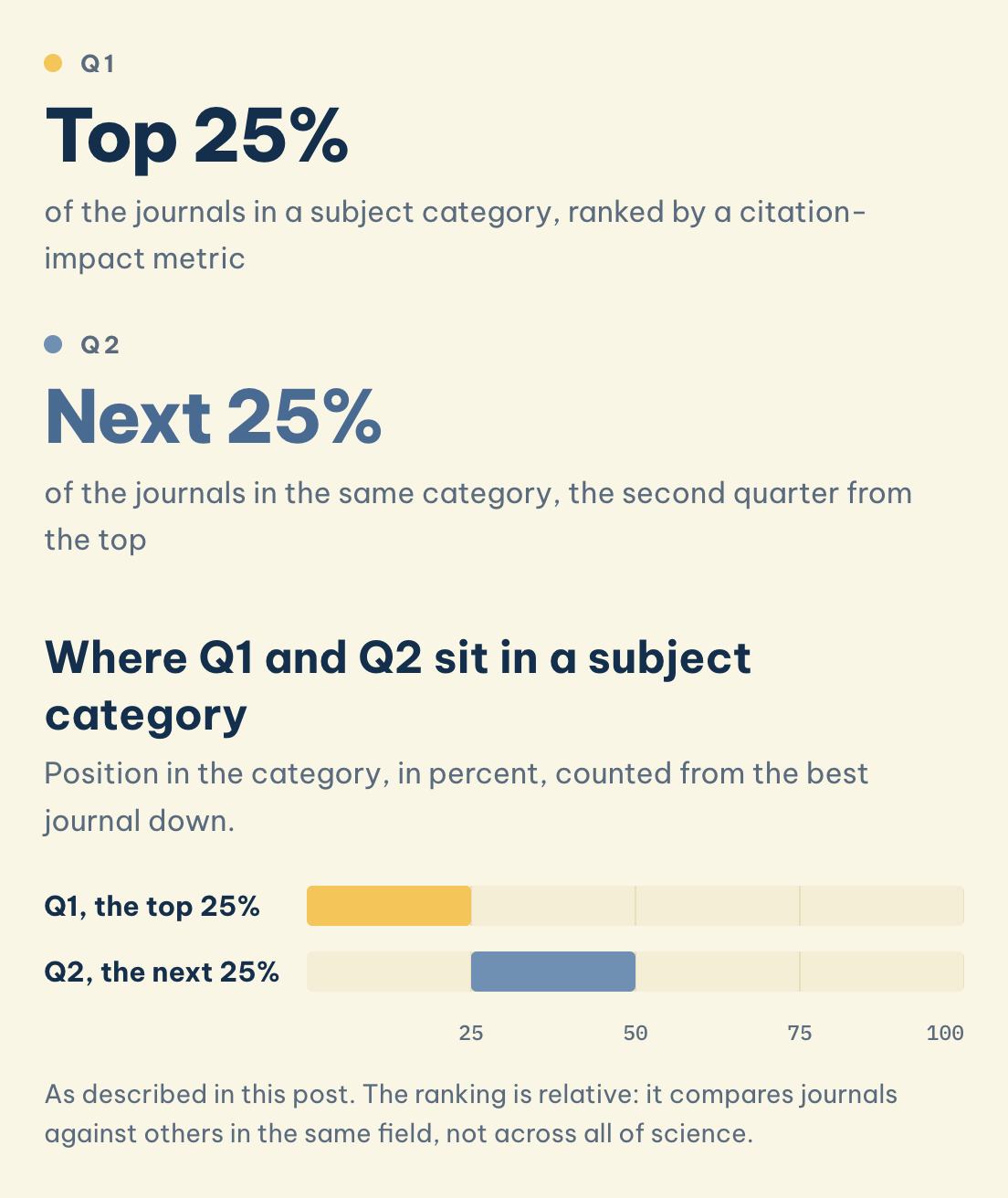
Direct answer: A quartile divides all journals in a subject category into four equal groups by a citation-impact metric, from best to worst. Q1 is the top 25%, Q2 the second 25%, Q3 the third 25%, and Q4 the bottom 25%. The ranking is relative; it compares journals against others in the same field, not across all of science.
Q1
Top 25%
of the journals in a subject category, ranked by a citation-impact metric
Q2
Next 25%
of the journals in the same category, the second quarter from the top
Where Q1 and Q2 sit in a subject category
Position in the category, in percent, counted from the best journal down.
Evidence: Scimago Journal Rank (SJR) and Scopus CiteScore both publish quartile bands by subject category and year (Scimago Lab, n.d.). SJR ranks journals using a citation metric weighted by the prestige of the citing journals, then splits each subject category into four quartiles (Scimago Lab, n.d.). CiteScore, calculated by Scopus, uses average citations per document over a window of 4 years and also reports a quartile per category. Elsevier describes the metric this way: "calculated using data from Scopus, CiteScore metrics help you evaluate journals, book series and conference proceedings to empower well-informed decisions" (Elsevier, n.d.-a).
Example: A Vietnamese education researcher assumed "Q1" was an absolute global rank. Her MAAS mentor showed her on Scimago that quartile is computed within a single subject category so a Q1 in a small specialist field and a Q1 in a large competitive field are both "Q1" but represent very different journal pools. Understanding this changed how she shortlisted her targets.
◆ Question 2 / 7 · The Q1/Q2 line
Direct answer: The boundary between Q1 and Q2 is simply the 75th percentile line within a subject category. A journal just above it is Q1; a journal just below it is Q2. The two can be almost identical in quality, a tiny difference in citation metric can move a journal across the line in either direction from one year to the next.
Evidence: Because quartiles are recalculated annually by Scimago and Scopus, journals near a boundary routinely shift between Q1 and Q2 year to year as citation patterns change. This is why experienced authors treat the Q1/Q2 border as a band rather than a hard wall, and check the most recent year's ranking before submitting.
Example: A MAAS Publishing Advisory client targeted a journal listed as Q1 in an older reference, but her mentor checked the current Scimago data and found it had slipped to Q2 that year. They confirmed it still met her university's Q1/Q2 requirement and proceeded, the borderline status did not change the paper's value, only its label.
◆ Question 3 / 7 · One or several
Direct answer: No. A journal indexed in more than one subject category can hold a different quartile in each. The same journal might be Q1 in "Education" and Q2 in "Social Sciences (miscellaneous)." When a requirement says "Q1," you usually only need the journal to be Q1 in at least one of its categories, but always confirm which category your institution counts.
Evidence: Scimago lists every category a journal belongs to with its quartile in each, and many multidisciplinary journals show a spread of quartiles across categories. Scopus CiteScore similarly reports rank by each category the journal is indexed under.
Example: A Vietnamese finance candidate found her target journal was Q2 in "Finance" but Q1 in "Economics and Econometrics." Her MAAS mentor confirmed her department accepted the best-category quartile, so the journal qualified as Q1 for her promotion file. Without checking the per-category breakdown, she would have wrongly ruled it out.
◆ Question 4 / 7 · Q1 or Q2
Direct answer: Target the highest quartile where your paper is genuinely competitive, not the highest that exists. Q1 carries more prestige and citation reach but is more selective and slower; Q2 is widely accepted for most Vietnamese requirements and often faster. A realistic Q2 acceptance beats an unrealistic Q1 rejection every time.
Q1 and Q2 on six factors
Tap a factor to see the two quartiles side by side.
Position
A Q1 journal sits in the top 25% of its category, and a Q2 journal sits at 25 to 50%.
Prestige
Q1 has higher prestige and citation reach, and Q2 is solid and field-respected.
Selectivity
Q1 is more competitive, and Q2 is more attainable.
Review speed
The typical review speed at Q1 is often slower, and at Q2 it is often faster.
MOET and most Vietnamese rules
Both count for MOET and most Vietnamese rules, and Q2 usually carries equal weight.
Best for
Q1 suits the strongest papers with no hard deadline, and Q2 suits good papers on a timeline.
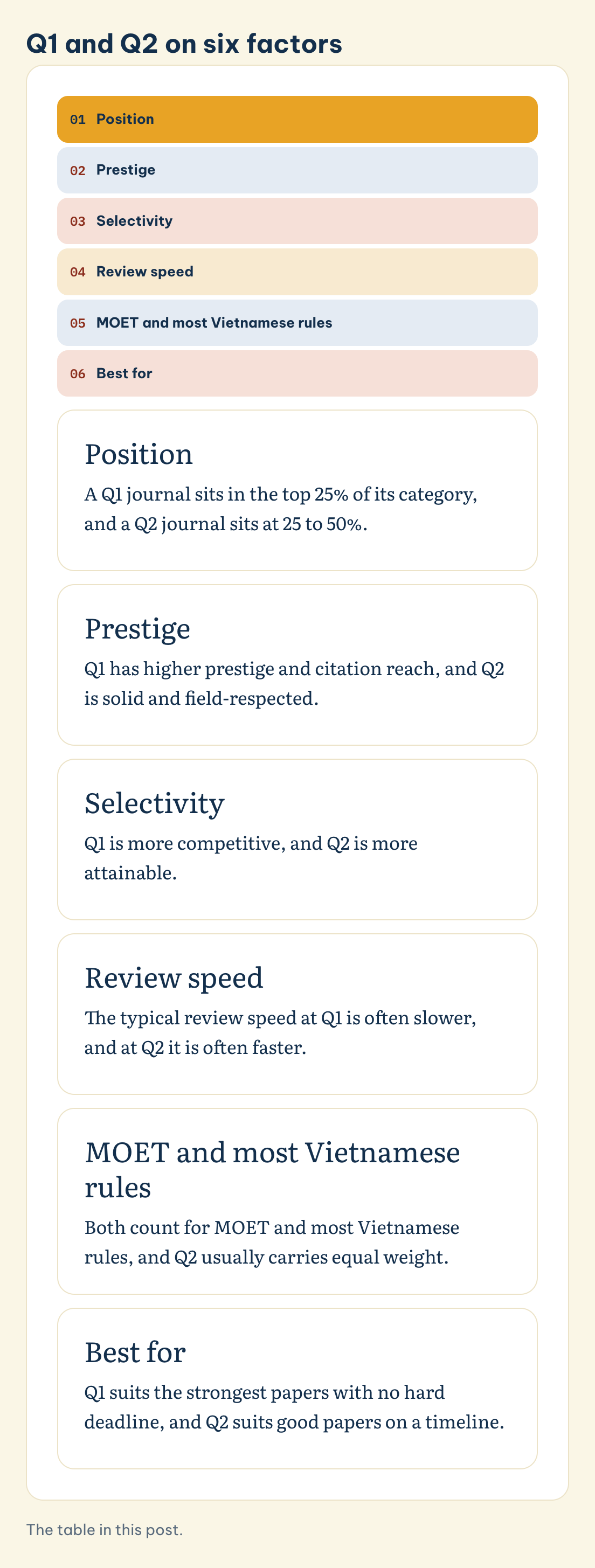
Evidence: Vietnam's Ministry of Education and Training recognises Scopus and Web of Science-indexed publications in its academic-title criteria, and most Vietnamese university promotion and PhD rules count both Q1 and Q2 toward the requirement. The table below summarises the practical trade-offs MAAS mentors weigh with each researcher.
| Factor | Q1 journal | Q2 journal |
|---|---|---|
| Position in category | Top 25% | 25–50% |
| Prestige / citation reach | Higher | Solid, field-respected |
| Selectivity | More competitive | More attainable |
| Typical review speed | Often slower | Often faster |
| Counts for MOET / most VN rules | Yes | Yes (usually equal weight) |
| Best for | Strongest papers, no hard deadline | Good papers on a timeline |
Example: A MAAS-coached lecturer needed one Q-ranked paper for Associate Professor candidacy on a deadline of 9 months. Rather than gamble on a slow Q1, her mentor set a well-fitted Q2 as the primary target. She was accepted in time and met the MOET criterion, the Q2 served her goal better than a riskier Q1 would have.
◆ Question 5 / 7 · Worth for promotion
Direct answer: Not necessarily. For most Vietnamese promotion and PhD criteria, Q1 and Q2 publications both satisfy the requirement, and a published Q2 is worth infinitely more than an unpublished Q1 still circulating in review. Where a funding scheme or ranking explicitly rewards Q1, weigh that against the realistic odds and timeline for your specific paper.
Evidence: MOET's academic-title framework and many institutional KPIs recognise Scopus/WoS-indexed Q1 and Q2 output; some competitive grants or university bonus schemes weight Q1 more heavily. The correct target therefore depends on your institution's exact rule, which a MAAS mentor checks before recommending a quartile strategy.
Example: A doctoral candidate believed only Q1 would "count" and delayed submission for months chasing one. Her MAAS mentor confirmed her programme accepted Q2 for graduation, redirected her to a strong Q2 with a faster turnaround, and she graduated on schedule. The fixation on Q1 had been costing her time with no real benefit.
◆ Question 6 / 7 · Checking a quartile
Direct answer: Verify the quartile on Scimago Journal Rank (SJR) for the most recent year and cross-check with Scopus CiteScore. Use the journal's per-category breakdown, not a single number from an email or the journal's own marketing. Always confirm the journal is still actively indexed in Scopus, because indexing can be discontinued.
A quartile may no longer hold
2 years ago
is an example of a quartile citation that may no longer hold, because quartiles are recalculated every year, so check the current source list
Verify the quartile on Scimago Journal Rank for the most recent year and cross-check it with Scopus CiteScore (Scimago Lab, n.d.; Elsevier, n.d.-a).
Use the journal's per-category breakdown, not a single number from an email or the journal's own marketing.
Always confirm the journal is still actively indexed in Scopus, because Scopus periodically removes journals that fail quality checks from its public source list (Elsevier, n.d.-b).
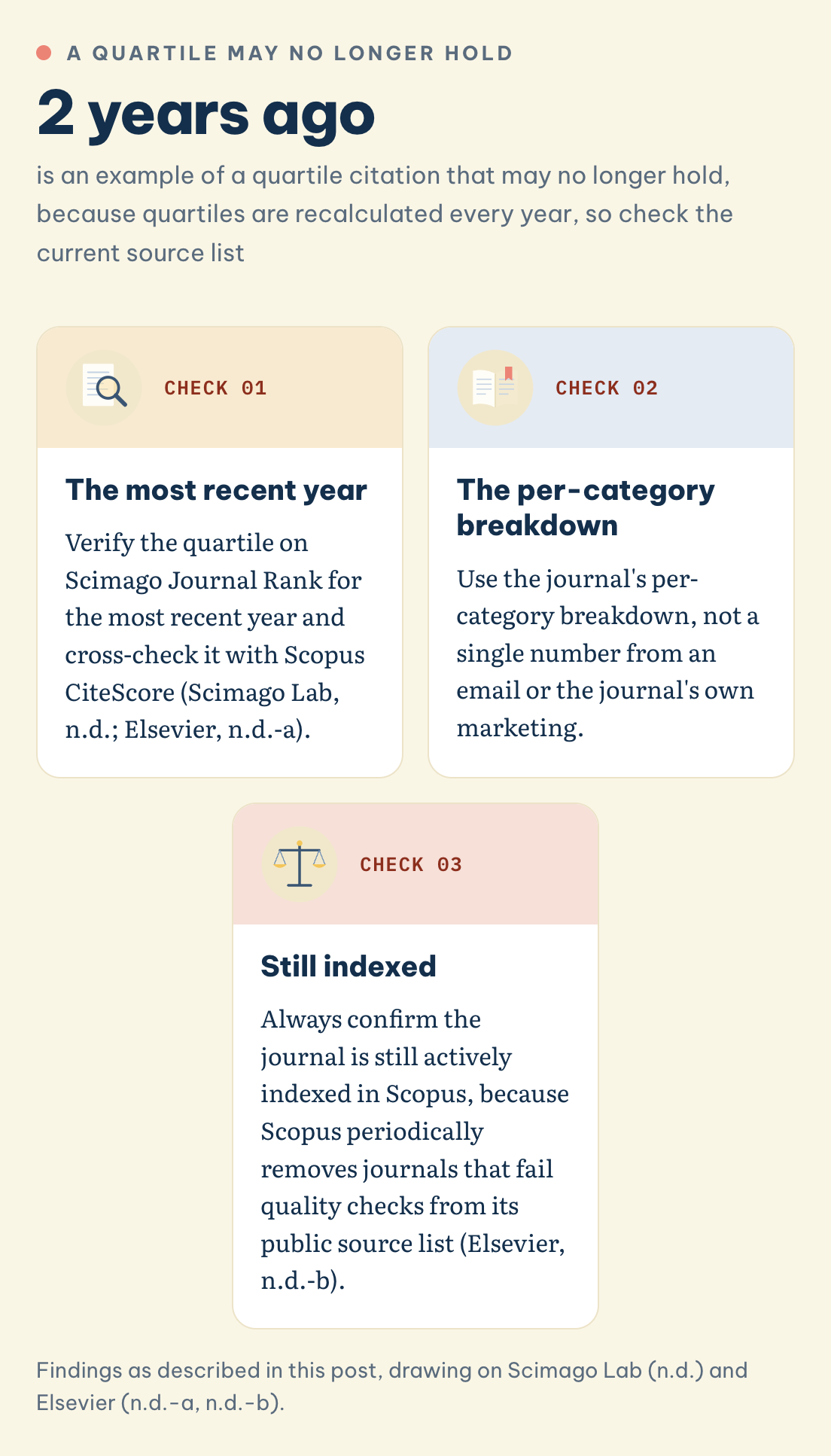
Evidence: Scimago provides free, year-by-year quartile data by category (Scimago Lab, n.d.), and Scopus publishes CiteScore quartiles on each source's page (Elsevier, n.d.-a). Scopus periodically removes journals that fail quality checks and drops them from its public source list (Elsevier, n.d.-b), so a quartile cited from 2 years ago may no longer hold, verification against the current source list is essential. A journal's quartile is not the same signal as its listing in the Directory of Open Access Journals (n.d.): DOAJ tracks open-access practice, not citation impact, so being listed there says nothing about whether a journal is Q1 or Q2.
Example: A Vietnamese researcher received an email claiming a journal was "Q1 Scopus." Her MAAS mentor checked Scimago and the Scopus source list, found the journal had been discontinued for quality reasons, and steered her to a legitimately indexed Q2 instead. Verifying the current quartile protected both her record and her fees.
◆ Question 7 / 7 · Borderline Q1 or safe Q2
Direct answer: Weigh three things: how close the paper's fit is to each journal's scope, your deadline, and the journal's review speed. If the Q1 is a strong scope fit and you have time, try it first with the Q2 as a planned backup. If the deadline is tight or the Q1 fit is shaky, lead with the Q2. Decide the full sequence before submitting so a rejection becomes an instant redirect.
Choosing between a borderline Q1 and a safe Q2
Tap a step to see what to weigh and what to decide.
Step 1 of 4
Weigh three things
Weigh how close the paper's fit is to each journal's scope, your deadline, and the journal's review speed.
Step 2 of 4
Strong fit and time
If the Q1 is a strong scope fit and you have time, try it first with the Q2 as a planned backup.
Step 3 of 4
Tight deadline
If the deadline is tight or the Q1 fit is shaky, lead with the Q2.
Step 4 of 4
Decide the sequence
Decide the full sequence before submitting so a rejection becomes an instant redirect.
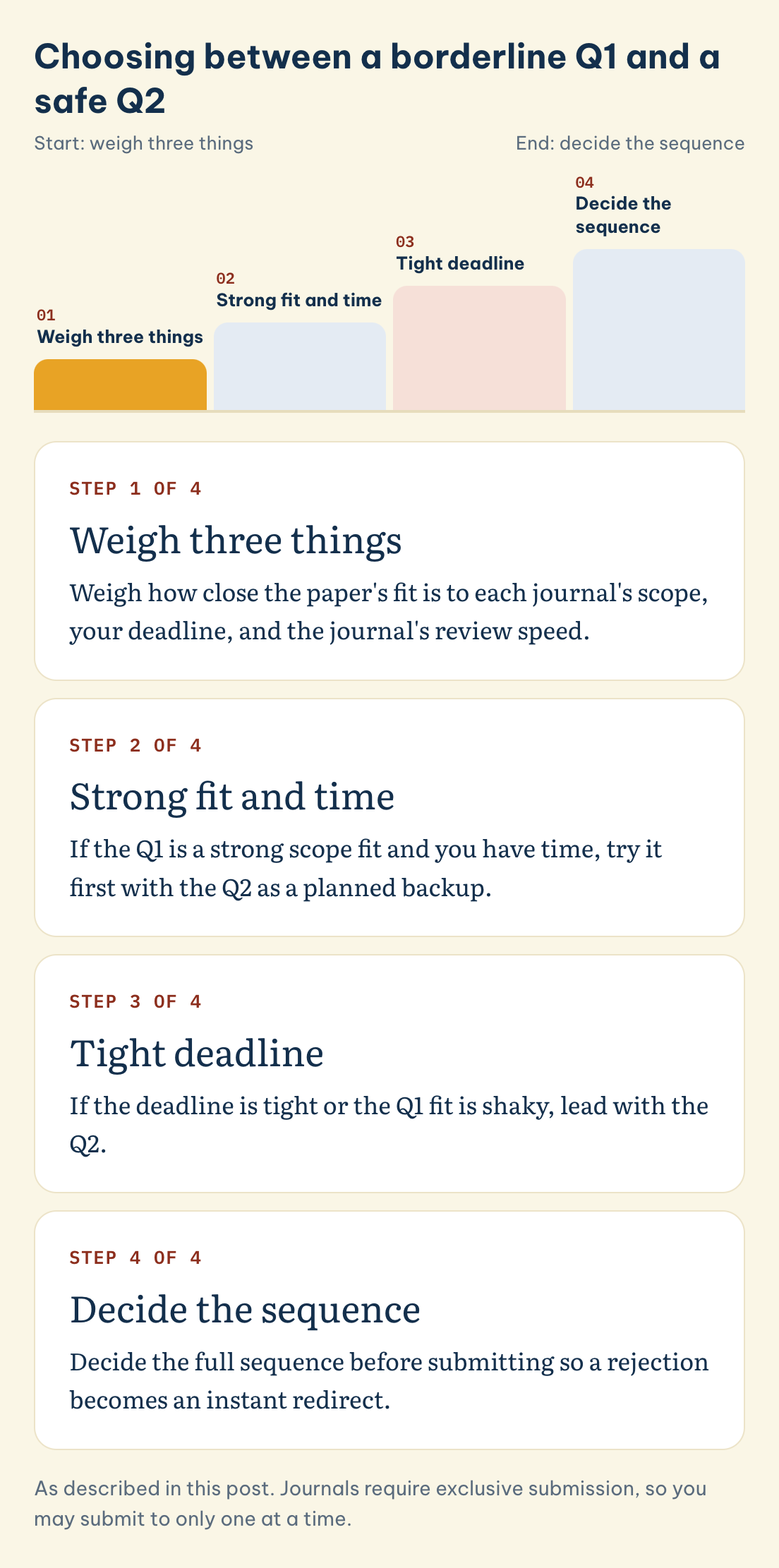
Evidence: Because journals require exclusive submission; you may submit to only one at a time, a pre-planned tiered shortlist is the only way to keep momentum. MAAS journal matching uses scope fit, citation-network alignment, and realistic acceptance probability to rank a primary, backup, and fallback target for each paper.
Example: A MAAS client had a borderline Q1 and a safe Q2 in mind. Her mentor judged the Q1 scope fit excellent and her timeline comfortable, so they submitted to the Q1 first with the Q2 pre-loaded as backup. The Q1 returned a major revision and ultimately accepted and if it had not, she could have moved to the Q2 within days.
Q1 has higher citation impact within its category, but a Q2 where your paper genuinely fits is a better choice than a Q1 where it does not. Most Vietnamese promotion and PhD rules accept both Q1 and Q2.
Yes. A journal indexed in several subject categories can be Q1 in one and Q2 in another. Check the per-category breakdown on Scimago and confirm which category your institution counts.
Yes. Scimago and Scopus recalculate quartiles every year, so a journal near the Q1/Q2 border can move between them. Always check the most recent year before you submit.
Both rank journals into quartiles by citation impact within a category. SJR (Scimago) weights citations by the prestige of the citing journal; CiteScore (Scopus) uses average citations per document over four years. They usually agree closely.
MOET recognises Scopus and Web of Science-indexed publications in its academic-title criteria; most rules accept both Q1 and Q2. Confirm your exact institutional requirement, as some grants weight Q1 more.
Yes. MAAS Publishing Advisory coaches Vietnamese researchers through quartile strategy, scope-fit analysis, and building a tiered shortlist, using a phase-by-phase model. Book a consultation through our contact page.
The Q1-versus-Q2 decision is not about prestige alone; it is about matching your paper's strength, scope, and deadline to the journal most likely to publish it. MAAS Publishing Advisory opens with a kick-off in which the adviser gives a frank assessment of whether your idea, as currently framed, can reach the tier you are aiming for, and it later builds a shortlist of 3–5 journals that fit. Advisers hold multiple Q1 or Q2 papers under their own name, and 23% of MAAS experts hold a PhD. MAAS matches you within 48 hours when our network already covers that field. If it does not, MAAS opens a dedicated recruitment round for your case, which usually takes about two weeks. Start with a free 20-minute consultation. We coach; you stay the author, every step.
Book a Publishing Advisory consultation with MAAS Academic Mentoring →
This article is part of the MAAS Journal series for Vietnamese international postgraduate students and researchers. MAAS Publishing Advisory is an advisory partner; we coach authors through a phase-by-phase delivery model with developmental feedback from PhD-level, Scopus-published mentors. We do not write, submit, or guarantee acceptance of work on an author's behalf.
A free 20-minute consultation with a MAAS publishing mentor, to talk through your target journals and the rule your institution counts.
Book Free Discovery ▸