
◆ Publishing advisory
Who qualifies as an author on a scientific research paper? ICMJE rules
You qualify as an author on a scientific research paper only if you meet all four ICMJE authorship criteria, not merely because you funded, supervised, or collected data. For Vietnamese researchers preparing a first Scopus submission or building a promotion dossier, getting authorship right is both an integrity issue and a career one: journals, the ICMJE, and Vietnamese promotion bodies all judge which author position you hold, not only that your name appears.
This guide answers the questions Vietnamese researchers ask MAAS publishing mentors most often about who counts as an author, how to declare contributions with CRediT, what first and corresponding author actually mean, and why you need an ORCID before you submit.

◆ Question 1 / 7 · Who qualifies
Who qualifies as an author on a research paper?
Direct answer: Under the ICMJE recommendations, an author must meet all four criteria: (1) substantial contributions to the work's conception, design, or data; (2) drafting or critically revising it; (3) final approval of the published version; and (4) agreement to be accountable for the work. Meeting only some means acknowledgement, not authorship.
The four ICMJE criteria, all of which must be met
Tap a criterion to see what it asks.
Substantial contribution
Substantial contributions to the work's conception, design, or data.
Drafting or revising
Drafting the work or critically revising it.
Final approval
Final approval of the published version.
Accountability
Agreement to be accountable for the work.
Save this figure
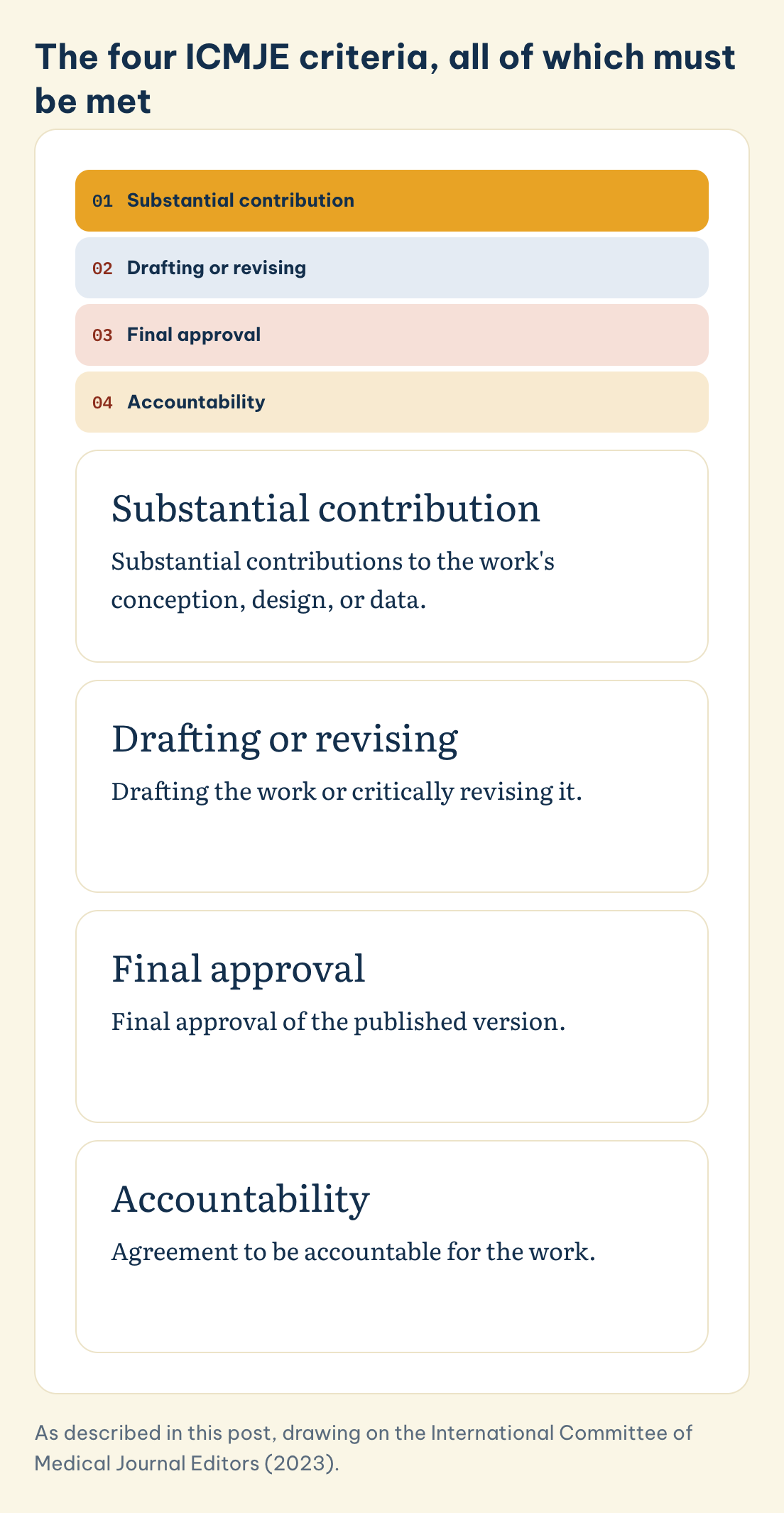
Evidence: The International Committee of Medical Journal Editors (2023) states that all four criteria must be satisfied, and that contributions such as acquiring funding, general supervision of a research group, or data collection alone do not justify authorship. The recommendations explain why the standard is strict: the ICMJE writes that "authorship confers credit and has important academic, social, and financial implications" (International Committee of Medical Journal Editors, 2023), which is exactly why the four criteria exist, to make sure that credit tracks contribution. The same recommendations note that everyone who meets all four criteria should be listed, leaving a qualifying contributor off is also a violation. Although the ICMJE writes for medical journals, the four-criteria standard is the de facto reference across most Scopus-indexed fields.
Example: A Vietnamese engineering master's graduate MAAS coached assumed her lab head should be first author "as a courtesy." Her mentor walked her through the ICMJE criteria: the supervisor had approved the final draft but had not contributed to design, analysis, or drafting. They restructured the by-line so the student, who did the work, was first author, and the supervisor was correctly placed and credited for supervision. The submission was stronger and the authorship defensible.
◆ Question 2 / 7 · Author or contributor
What is the difference between an author and a contributor?
Direct answer: An author meets all four ICMJE criteria and takes public responsibility for the work. A contributor helped, with funding, data collection, language editing, or technical support but does not meet all four criteria. Contributors belong in the Acknowledgements section, not the by-line.
An author and a contributor
Each row sets an author against a contributor.
Author
Contributor
Meets all four ICMJE criteria and takes public responsibility for the work.
Helped, with funding, data collection, language editing or technical support, but does not meet all four criteria.
Is listed in the by-line.
Belongs in the Acknowledgements section, not the by-line.
Save this figure
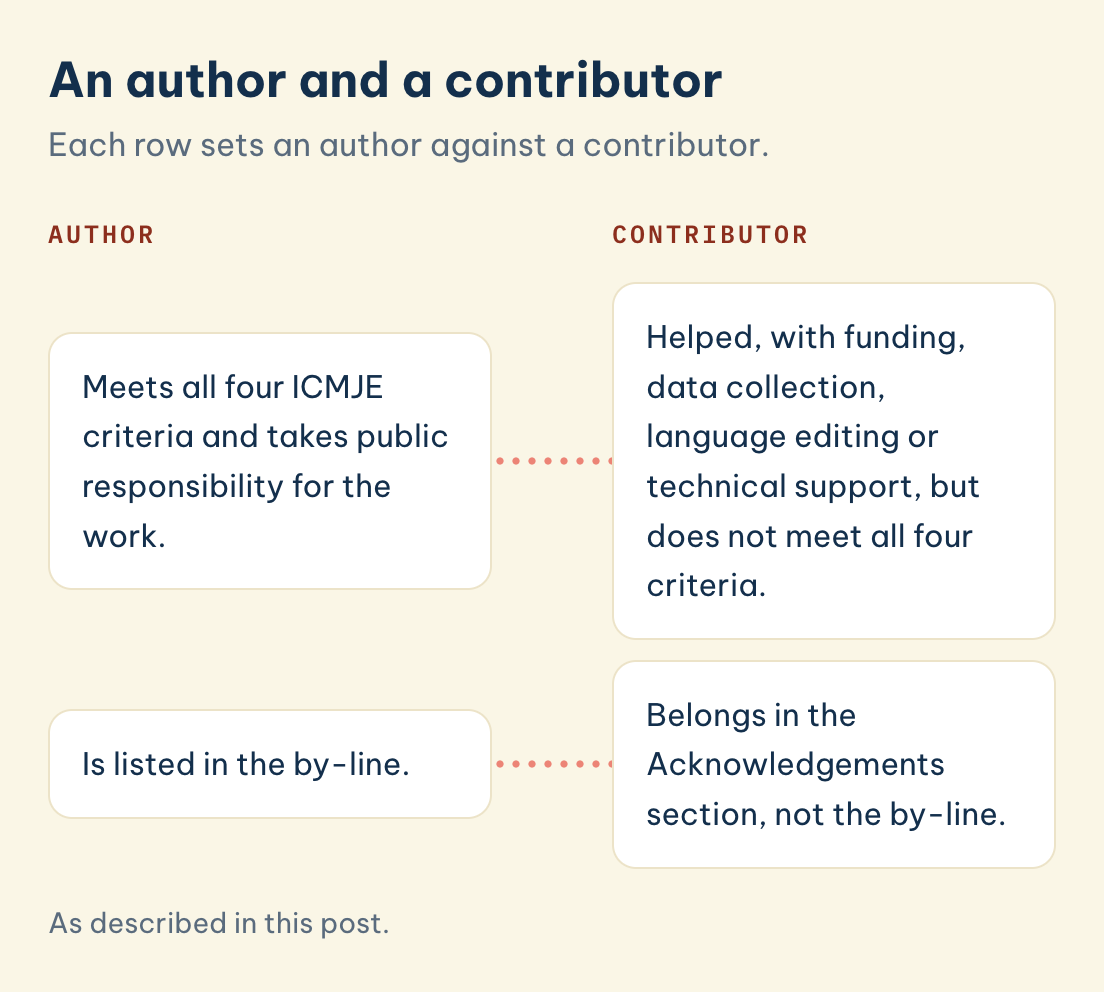
Evidence: The Committee on Publication Ethics (n.d.) advises journals to keep clear, transparent policies on who contributed and in what capacity, precisely so that the difference between an author and an acknowledged contributor is documented rather than negotiated after the fact. Treating a non-qualifying helper as an author or hiding a qualifying one, are both recognised authorship problems.
Example: A statistician who ran one analysis at a colleague's request, with no role in design or interpretation, is acknowledged, unless the collaboration deepens into shared interpretation and drafting, at which point they may cross the ICMJE threshold and should be reassessed as an author.
◆ Question 3 / 7 · CRediT
What is CRediT, and how do you report contributions?
Direct answer: CRediT (Contributor Roles Taxonomy) is a standardised list of 14 roles that lets each paper state exactly what each person did. Many Scopus and Q1 journals now require a CRediT statement at submission. You map each author to one or more roles rather than leaving readers to guess from name order.
Evidence: CRediT was introduced by Brand et al. (2015) to replace ambiguous author lists with explicit, structured attribution, and is now maintained by the National Information Standards Organization (NISO, n.d.). A consortium of editors and publishers (McNutt et al. 2018) recommended that journals adopt CRediT together with ORCID to make contributions transparent and to reduce authorship disputes.
The 14 CRediT roles are:
| Conceptualization | Data curation | Formal analysis |
| Funding acquisition | Investigation | Methodology |
| Project administration | Resources | Software |
| Supervision | Validation | Visualization |
| Writing – original draft | Writing – review & editing |
Example: A three-author public-health paper used CRediT to record that the first author led Conceptualization, Investigation, and Writing – original draft; the second handled Formal analysis and Visualization; and the supervisor covered Supervision and Writing – review & editing. The funder's contribution sat under Funding acquisition. No one had to argue about order, the roles made each contribution visible.
◆ Question 4 / 7 · Author positions
First author, corresponding author, last author, what do they mean?
Direct answer: First author is usually the person who did the most work and led the writing. Corresponding author manages submission, peer review correspondence, and post-publication queries and takes responsibility for the integrity of the process. Last author is, by convention in many fields, the senior researcher or group lead. The conventions vary by discipline, so confirm them with your target journal and co-authors early.
CRediT roles
14
roles make up the standardised list that lets each paper state exactly what each person did
Author positions
3
are explained in the post, and the conventions vary by discipline, so confirm them with your target journal and co-authors early
What the three author positions usually mean
Tap a position to see what it usually means.
Position 1 / 3
First author
Usually the person who did the most work and led the writing.
Position 2 / 3
Corresponding author
Manages submission, peer review correspondence and post-publication queries, and takes responsibility for the integrity of the process.
Position 3 / 3
Last author
By convention in many fields, the senior researcher or group lead.
Save this figure
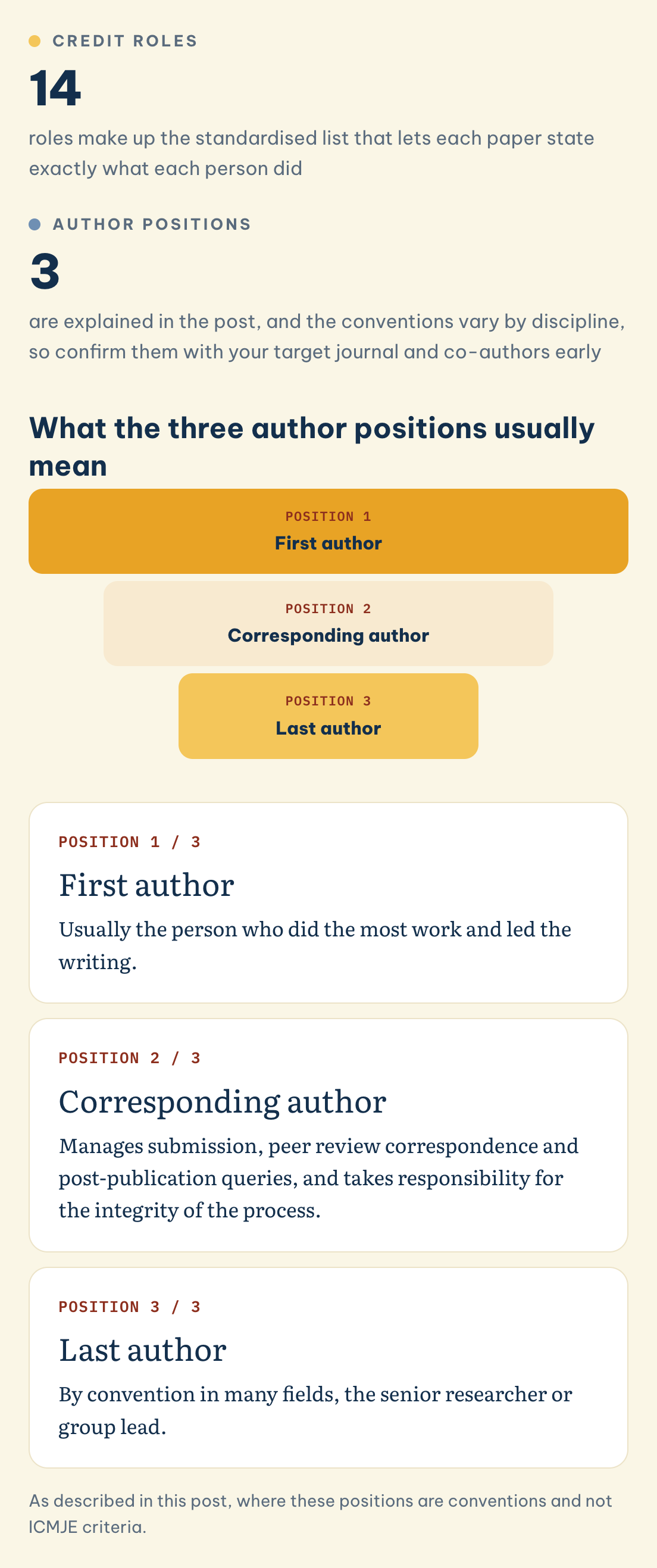
Evidence: These positions are conventions, not ICMJE criteria, the ICMJE (2023) defines who is an author, not the order. But the positions carry real weight: Vietnamese promotion and graduation rules (for example, the requirements behind PhD graduation and Associate Professor/Professor titles) typically count being first author or corresponding author ("tác giả chính"), so the position you hold can determine whether a paper "counts" toward your dossier.
Example: A doctoral candidate listed fourth on a five-author paper found it did not satisfy his graduation requirement, which needed him as first or corresponding author. MAAS coaching focuses on planning author roles before the work starts, so the position matches both the contribution and the career requirement, never by inflating a claim, only by aligning real contribution with the right role.
◆ Question 5 / 7 · Why avoid them
What are gift, ghost, and guest authorship and why avoid them?
Direct answer: Gift (or guest/honorary) authorship lists someone who did not meet the criteria, often a senior figure added for prestige. Ghost authorship omits someone who did qualify, often a professional writer or junior researcher. Both are integrity violations that can trigger correction or retraction, and buying or selling an authorship slot is academic misconduct.
Evidence: Wislar et al. (2011) surveyed six high-impact medical journals and found that 21% of articles showed evidence of honorary authorship, ghost authorship, or both so this is common, not rare. COPE (n.d.) treats authorship manipulation as a misconduct issue requiring investigation. Paper mills that sell authorship slots are a growing threat, and a purchased by-line is detectable and damaging once discovered.
Example: A researcher was offered a "co-author" position on a paper outside her field for a fee. Her MAAS mentor flagged it as a paper-mill solicitation, accepting it would have meant claiming a paper she did not write, risking her record and any future promotion case. She declined, and instead built her own first-author paper through the Outline → Draft → Final model.
◆ Question 6 / 7 · ORCID
What is ORCID, and why do you need one before you submit?
Direct answer: ORCID is a free, persistent digital identifier that uniquely distinguishes you from every other researcher, including those who share your name or use different name orders and diacritics. Create one before you submit; most major publishers now ask for it, and some require the corresponding author to have one.
Evidence: Haak et al. (2012) introduced ORCID specifically to solve name-ambiguity in scholarly communication, a frequent problem for Vietnamese authors, whose names are often romanised inconsistently across databases. McNutt et al. (2018) recommended ORCID alongside CRediT as core infrastructure for transparent, correctly attributed authorship. Linking your ORCID ensures every paper, review, and dataset is reliably credited to you across Scopus and journal systems.
Example: A researcher publishing as "Nguyen, T." found her work split across three different author profiles in citation databases, fragmenting her citation count right before a promotion review. Registering an ORCID and linking her past papers consolidated her record into one verifiable identity.
◆ Question 7 / 7 · Preventing disputes
How do you prevent authorship disputes on a multi-author paper?
Direct answer: Agree on authorship and order at the start of the project, write it down, revisit it if contributions change, and record final contributions with CRediT. Most disputes come from unspoken assumptions, not bad faith.
Evidence: COPE (n.d.) recommends that teams set authorship expectations early and that journals have a documented process for handling disputes, guidance that exists precisely because end-of-project disagreements are common. A CRediT statement, agreed before submission, turns a vague hierarchy into an explicit record (Brand et al. 2015).
Example: A MAAS-coached team used a one-page authorship agreement at kick-off: provisional order, CRediT roles, and a rule that any member who later took on a substantially larger role could be re-evaluated. When the analysis expanded mid-project, they adjusted roles by the agreement rather than by seniority, no dispute, and a defensible by-line at submission.
Frequently asked questions
What are the ICMJE authorship criteria?
The International Committee of Medical Journal Editors (2023) sets four tests that you must pass together: a substantial role in conception, design or data; a role in drafting or critically revising the text; sign-off on the version that gets published; and accepting accountability for the work. Passing only some earns an acknowledgement, and paying for funding, supervising generally or collecting data on their own do not count.
Does paying for a journal's article processing charge make me an author?
No. Funding acquisition is a contribution that can be recorded under CRediT, but paying a fee, including an APC, does not by itself meet the ICMJE authorship criteria. Authorship rests on intellectual contribution, drafting, approval, and accountability.
Can a supervisor insist on being last or first author automatically?
No. Author position should reflect actual contribution, not rank. A supervisor who only provided general oversight should be acknowledged or credited for Supervision under CRediT, not given a by-line position by default.
Is ORCID mandatory to publish in a Scopus journal?
It varies by publisher, but an increasing number require the corresponding author to provide an ORCID, and nearly all accept it. Because it is free and solves name ambiguity, create one before you submit regardless.
What is "tác giả chính" in international terms?
Vietnamese promotion and graduation rules generally treat "tác giả chính" as the first author or the corresponding author. Confirm the exact definition in your institution's current regulation, because the position that "counts" can differ by scheme.
Does MAAS add its mentors as authors on my paper?
Never. MAAS is an advisory partner, our mentors coach you and give developmental feedback, but they do not meet authorship criteria on your work and are never listed as authors. You are the author throughout.
Book a Publishing Advisory consultation with MAAS Academic Mentoring →
Related guides
- How do you choose the right Scopus journal for your paper?: matching your contribution to the right Q1/Q2 venue
- How do you avoid predatory journals when publishing your research?: spotting paper-mill and predatory authorship solicitations
- How do you publish a medical imaging AI study in a Q1 journal?: reporting standards for a high-bar field
- How do you respond to reviewer comments on a Scopus submission?: handling revisions as the corresponding author
- Scopus Publishing Advisory: the full pillar on legitimate Q1/Q2 publishing
- Meet the MAAS experts: the PhD-level mentors behind our publishing advisory
References
- Brand, A., Allen, L., Altman, M., Hlava, M., & Scott, J. (2015). Beyond authorship: Attribution, contribution, collaboration, and credit. Learned Publishing, 28(2), 151–155. https://doi.org/10.1087/20150211
- Committee on Publication Ethics (COPE). (n.d.). Authorship [Discussion document]. Retrieved June 23, 2026, from https://publicationethics.org/guidance/discussion-document/authorship
- Haak, L. L., Fenner, M., Paglione, L., Pentz, E., & Ratner, H. (2012). ORCID: A system to uniquely identify researchers. Learned Publishing, 25(4), 259–264. https://doi.org/10.1087/20120404
- International Committee of Medical Journal Editors (ICMJE). (2023). Defining the role of authors and contributors. https://www.icmje.org/recommendations/browse/roles-and-responsibilities/defining-the-role-of-authors-and-contributors.html
- McNutt, M. K., Bradford, M., Drazen, J. M., Hanson, B., Howard, B., Jamieson, K. H., Kiermer, V., Marcus, E., Pope, B. K., Schekman, R., Swaminathan, S., Stang, P. J., & Verma, I. M. (2018). Transparency in authors' contributions and responsibilities to promote integrity in scientific publication. Proceedings of the National Academy of Sciences, 115(11), 2557–2560. https://doi.org/10.1073/pnas.1715374115
- National Information Standards Organization (NISO). (n.d.). CRediT (Contributor Roles Taxonomy). Retrieved June 23, 2026, from https://credit.niso.org/
- Wislar, J. S., Flanagin, A., Fontanarosa, P. B., & DeAngelis, C. D. (2011). Honorary and ghost authorship in high impact biomedical journals: A cross sectional survey. BMJ, 343, Article d6128. https://doi.org/10.1136/bmj.d6128
This article is part of the MAAS Journal series for Vietnamese international postgraduate students and researchers. MAAS Publishing Advisory is an advisory partner; we coach authors through a phase-by-phase delivery model with developmental feedback from PhD-level, Scopus-published mentors. We do not write, submit, or guarantee acceptance of work on an author's behalf.
A consultation with MAAS Publishing Advisory, to talk through the authorship questions on your paper.
Book Free Discovery ▸