
◆ Publishing integrity
How do you keep your research paper from being retracted?
A paper gets retracted when its findings can no longer be trusted, and most causes are integrity mistakes you can prevent before you submit. For Vietnamese researchers building a publication record, a retraction is far more damaging than a rejection: it stays on your permanent record and can undo years of work. The practices that cause most retractions, salami slicing, text recycling, redundant publication, and undisclosed AI use, are avoidable once you know the rules.
This guide explains the research-integrity standards from COPE and the ICMJE that keep your paper safe, in the plain terms MAAS publishing mentors use with first-time authors. The ICMJE traces back to a 1978 meeting of medical journal editors in Vancouver, still informally called the Vancouver Group, with its first manuscript and reference-format requirements published in 1979, and COPE followed in 1997, extending the same idea beyond medicine to the wider research literature.

◆ Question 1 / 7 · What gets retracted
What actually gets a research paper retracted?
Direct answer: A retraction is issued when a paper's findings are unreliable, whether from misconduct (fabrication, falsification, plagiarism, image manipulation) or serious honest error or when the work breaches publication ethics, such as redundant publication or undisclosed conflicts. It is a correction of the scholarly record, not primarily a punishment.
Evidence: The Committee on Publication Ethics (2019) states that editors should retract when there is clear evidence the findings are unreliable, when the work has been published elsewhere without proper attribution, or when it reports unethical research and that the purpose is to correct the literature, not to punish authors. The scale is growing: more than 10,000 papers were retracted in 2023, a record, and the retraction rate, the share of published papers that are eventually withdrawn, has more than trebled over the past decade and passed 0.2% in 2022 (Van Noorden, 2023). A single publisher, Hindawi, accounted for more than 8,000 of the 2023 total after a review found compromised peer review at some of its special-issue journals (Van Noorden, 2023).
Example: A Vietnamese author MAAS coached worried a reviewer would "report" her for a minor referencing slip. Her mentor reassured her: honest, correctable errors lead to a correction, not a retraction. What she needed to avoid were the systematic issues below and her paper had none.
◆ Question 2 / 7 · Salami slicing
What is salami slicing, and when is it acceptable to split a study?
Direct answer: Salami slicing is breaking one study into the smallest possible "publishable units" to produce several papers from data that should be reported together. It is a form of redundant publication and is discouraged. Splitting is legitimate only when each paper answers a genuinely distinct research question and the related papers cite each other transparently.
Evidence: Šupak Smolčić (2013) defines salami publication as two or more articles derived from a single study that share hypothesis, methodology, or results and warns it is hard for software to detect because the text may differ even when the substance overlaps. Šupak Smolčić states that "Salami publication can be roughly defined as a publication of two or more articles derived from a single study" (Šupak Smolčić, 2013, p. 237). The test is scientific: does each paper stand as a distinct, complete contribution, or were the data sliced just to inflate a count?
Example: A researcher with one survey dataset wanted 3 papers, one per demographic subgroup. Her MAAS mentor showed that the subgroups answered the same question and belonged in one robust paper; slicing them would risk a redundant-publication finding. A second, genuinely different question in the same dataset, however, justified a separate paper that cross-referenced the first.
◆ Question 3 / 7 · Text recycling
What is text recycling (self-plagiarism), and how much reuse is allowed?
Direct answer: Text recycling, or self-plagiarism, is reusing your own previously published wording in a new paper. It is judged case by case: reusing some standard methods wording can be acceptable if disclosed and cited, but recycling substantial passages in the introduction, results, or discussion is not.
Evidence: The Committee on Publication Ethics (n.d.) advises that editors weigh the amount and location of overlap, recycled methods text is more defensible than recycled discussion and that the key safeguards are transparency, citing the earlier work, and declaring any overlapping material at submission. Disclosing related work up front is what separates acceptable reuse from misconduct.
Example: An author reused three sentences describing an established lab protocol across two papers. On her mentor's advice she cited the first paper and noted the overlap in her cover letter, turning a potential flag into a transparent, accepted practice. Recycling her earlier discussion section, by contrast, would have been a real problem.
◆ Question 4 / 7 · Duplicate publication
What is duplicate or redundant publication?
Direct answer: Duplicate (redundant) publication is publishing the same paper, or a substantially overlapping one, in more than one journal, including submitting to two journals at the same time. It is a recognised reason for retraction.
Evidence: The International Committee of Medical Journal Editors (2023) states that authors should not submit the same manuscript to more than one journal concurrently, and that redundant publication without transparent cross-referencing and editor consent is unacceptable. Legitimate secondary publication (for example, in another language) is possible only with the consent of both editors and a clear citation to the original.
Example: A researcher eager to speed things up considered submitting to two Q2 journals at once. His MAAS mentor flagged this as a clear ethics breach that could blacklist him with both journals. They instead built a ranked list, submit to the first, and only move to the next after a decision.
◆ Question 5 / 7 · Retraction or concern
What is a retraction or expression of concern and what does it mean for you?
Direct answer: A retraction removes a paper's claims from the trusted record while keeping the article visible, marked "Retracted." An expression of concern is a softer notice editors issue when there are credible worries but an investigation is not yet complete. Both attach to your name in databases, which is why prevention matters so much more than cure.
Evidence: The Committee on Publication Ethics (2019) recommends an expression of concern when evidence is inconclusive or an investigation is ongoing, and a retraction once unreliability is established. Because these notices are indexed alongside the original, they follow an author's record, a strong incentive to get integrity right before submission.
Example: A candidate found a co-author on a previous paper had reused data without disclosure, triggering an expression of concern. The episode shaped how she ran her next project: a written authorship and data agreement up front, so every co-author's contribution and data source was transparent from day one.
◆ Question 6 / 7 · Disclosing AI use
How do you disclose AI use (ChatGPT and similar) in your paper?
Direct answer: You may use AI tools to assist, for example, to improve language but you must disclose how you used them, in both your cover letter and your manuscript. AI cannot be listed as an author, and you remain fully responsible for everything in the paper, including any errors or fabricated references the tool introduces.
Evidence: The International Committee of Medical Journal Editors (2023) states that chatbots cannot be authors because they cannot take responsibility for the accuracy, integrity, and originality of the work, and that authors must disclose AI-assisted technologies at submission and describe how they were used. Undisclosed AI use is an emerging integrity issue, so transparency protects you.
Example: A researcher used an AI tool to polish her English and, on her mentor's advice, added one sentence to her methods and cover letter stating exactly that. When a reviewer asked, her disclosure was already on record, the honest, documented version was never a problem.
◆ Question 7 / 7 · Before you submit
How do you protect yourself before you submit?
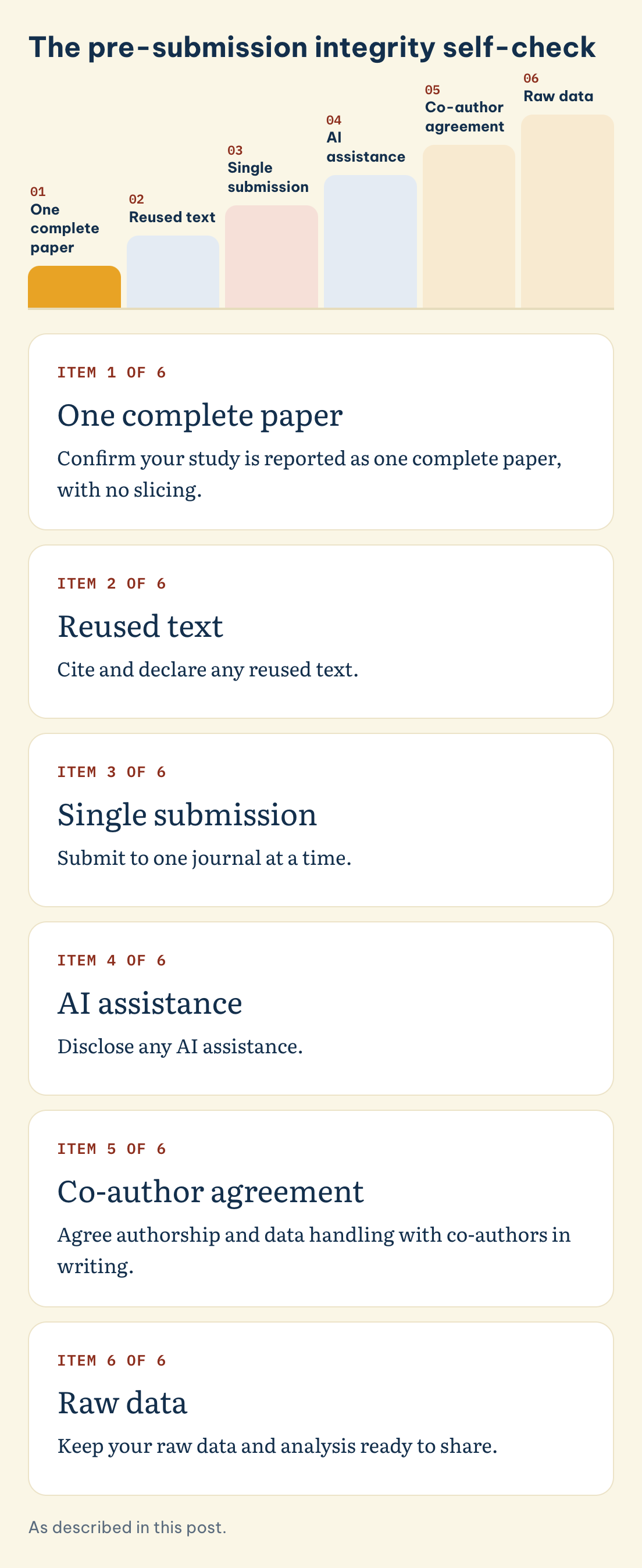
Direct answer: Run an integrity self-check: confirm your study is reported as one complete paper (no slicing), cite and declare any reused text, submit to one journal at a time, disclose any AI assistance, agree authorship and data handling with co-authors in writing, and keep your raw data and analysis ready to share.
The pre-submission integrity self-check
Tap an item to see one check from the post's pre-submission list.
Item 1 of 6
One complete paper
Confirm your study is reported as one complete paper, with no slicing.
Item 2 of 6
Reused text
Cite and declare any reused text.
Item 3 of 6
Single submission
Submit to one journal at a time.
Item 4 of 6
AI assistance
Disclose any AI assistance.
Item 5 of 6
Co-author agreement
Agree authorship and data handling with co-authors in writing.
Item 6 of 6
Raw data
Keep your raw data and analysis ready to share.
Save this figure
Evidence: A consortium of editors and publishers (McNutt et al. 2018) argued that transparency, clear contribution records, disclosed methods, and accountable authorship, is the most effective defence of research integrity. The same logic applies before submission: what you declare openly cannot later be held against you as a hidden breach.
Example: A MAAS mentor walks every Publishing Advisory author through a pre-submission integrity pass during the Final stage, overlap check, disclosure statements, authorship and data agreements, using a phase-by-phase model. The author stays the author throughout; the mentor advises, never writes or submits on their behalf.
Frequently asked questions
Is reusing my own thesis text in a paper self-plagiarism?
Reusing your own unpublished thesis is generally acceptable because a thesis is not usually a formal publication, but disclose it to the editor and check the journal's policy. Reusing text from your own published paper is text recycling and must be cited and declared.
Can I be retracted for an honest mistake?
Usually not. Honest, correctable errors lead to a correction or corrigendum, not a retraction. Retraction is reserved for findings that are unreliable or for ethics breaches.
Does using ChatGPT to edit my English count as misconduct?
No, provided you disclose it. Using AI to improve language is acceptable when you state how you used it in the cover letter and manuscript and you verify every output but AI cannot be an author and cannot be trusted to generate citations.
How do I know if splitting my study is salami slicing?
Ask whether each paper answers a genuinely different research question and stands as a complete contribution. If the only reason to split is to get more papers, it is salami slicing.
Does MAAS write or submit my paper for me?
Never. MAAS is an advisory partner, mentors coach you and run integrity checks, but you write, you disclose, and you submit. You are the author and the accountable researcher throughout.
Book a Publishing Advisory consultation with MAAS Academic Mentoring →
Related guides
- Who qualifies as an author on a research paper?: ICMJE criteria, CRediT, and avoiding gift or ghost authorship
- How do you avoid predatory journals when publishing your research?: the journal-side integrity check
- How do you choose the right Scopus journal for your paper?: submitting to one legitimate venue at a time
- How do you publish a medical imaging AI study in a Q1 journal?: transparent reporting in a high-bar field
- Is 18% similarity on Turnitin bad, and what score is too high?: what a text-similarity percentage does and does not signal about text recycling and self-plagiarism
- Scopus Publishing Advisory: the full pillar on legitimate Q1/Q2 publishing
- Meet the MAAS experts: the PhD-level mentors behind our publishing advisory
References
- Committee on Publication Ethics. (2019). Retraction guidelines (Version 2). https://doi.org/10.24318/cope.2019.1.4
- Committee on Publication Ethics. (n.d.). Text recycling guidelines for editors. Retrieved June 23, 2026, from https://publicationethics.org/guidance/endorsed-guidance/text-recycling-guidelines-editors
- International Committee of Medical Journal Editors. (2023). Recommendations for the conduct, reporting, editing, and publication of scholarly work in medical journals. https://www.icmje.org/recommendations/
- McNutt, M. K., Bradford, M., Drazen, J. M., Hanson, B., Howard, B., Jamieson, K. H., Kiermer, V., Marcus, E., Pope, B. K., Schekman, R., Swaminathan, S., Stang, P. J., & Verma, I. M. (2018). Transparency in authors' contributions and responsibilities to promote integrity in scientific publication. Proceedings of the National Academy of Sciences, 115(11), 2557–2560. https://doi.org/10.1073/pnas.1715374115
- Šupak Smolčić, V. (2013). Salami publication: Definitions and examples. Biochemia Medica, 23(3), 237–241. https://doi.org/10.11613/BM.2013.030
- Van Noorden, R. (2023). More than 10,000 research papers were retracted in 2023, a new record. Nature, 624(7992), 479–481. https://doi.org/10.1038/d41586-023-03974-8
This article is part of the MAAS Journal series for Vietnamese international postgraduate students and researchers. MAAS Publishing Advisory is an advisory partner; we coach authors through a phase-by-phase delivery model with developmental feedback from PhD-level, Scopus-published mentors. We do not write, submit, or guarantee acceptance of work on an author's behalf.
A free 20-minute consultation with MAAS Publishing Advisory, to talk through an integrity check of your manuscript before you submit.
Book Free Discovery ▸