
Blind spot 01
Printed books and graphics
Turnitin "only checks against selected electronic sources (not printed books)" and "will not detect similarities in graphical materials, such as diagrams, images or equations" (University of Bristol, n.d.).
◆ Academic integrity
An 18% similarity score on Turnitin is usually not bad by itself, because it measures text overlap, not plagiarism; what matters is whether any match is an uncited paraphrase. Most international students panic at the wrong number. They see a Turnitin similarity score of 18% and assume they are about to be reported for plagiarism, when in reality the percentage is only the start of the story, not the verdict. This guide answers the questions Vietnamese students ask MAAS mentors most often when a similarity report lands in their inbox the night before a deadline.
Is 18% similarity on Turnitin bad? An 18% similarity score is usually not bad by itself. Turnitin measures text overlap, not plagiarism. If most of that 18% is cited quotes, your reference list, and standard phrasing, it is normal. What matters is whether any match is uncited paraphrase, read the report match by match, not the headline number.
◆ Question 1 / 9 · Meaning
Direct answer: The similarity score is the percentage of your text that matches sources in Turnitin's database: other student papers, journals, websites, and books. It measures text overlap, nothing more, not a plagiarism score or a pass-fail judgement. A high score can be innocent (quotes, reference lists, common phrases), and a low score can still hide plagiarism if paraphrased badly without citing.
Evidence: Turnitin's own guidance states explicitly that the Similarity Report "does not check for plagiarism"; it identifies matching text and leaves interpretation to the instructor. The percentage is generated by their matching algorithm; the academic judgement is human (Foltýnek et al. 2020; University of Melbourne, n.d.-a).
Example: A Vietnamese Business student at RMIT came to a MAAS advisor terrified of a 31% score. Reviewing the report together, 22 of those percentage points were her correctly quoted and cited interview transcript plus the reference list. The genuinely overlapping text was under 9%, all properly attributed. The "scary" number was an artefact of how the report counts quotes, not a problem at all.
◆ Question 2 / 9 · Safe score
Direct answer: No and anyone who gives you a fixed number is misleading you. There is no universal threshold. Different universities, faculties, and even individual markers set different expectations, and the rubric usually matters more than any percentage. As a working orientation many UK and Australian markers grow more attentive above roughly 15-20%, but a 25% report made entirely of cited quotes is fine, while a 10% report built from one uncited paraphrased paragraph is a real integrity problem.
Evidence: Most university academic-integrity pages refuse to publish a "safe" cut-off precisely because it invites students to write to a number instead of writing honestly. The University of Melbourne states that similarity percentage alone does not determine misconduct, the source and context of each match does (University of Melbourne, n.d.-a). The same page makes the identical point about the newer AI-detection flag on your report: "an AI writing detection report alone is not sufficient evidence for an allegation" (University of Melbourne, n.d.-a), a high number is a prompt to look closer, not a verdict.
Example: A Vietnamese postgraduate at the University of Leeds asked her MAAS mentor to help her get "under 10%." The mentor reframed the goal: instead of chasing a number, they audited each match. Two matches were uncited paraphrases, a genuine issue they fixed by adding citations and rewording in her own voice. The final score was 14%, higher than her target, but every match was now legitimate and defensible.
◆ Question 3 / 9 · 14%
Direct answer: Usually not. A 14% Turnitin score measures overlap, not plagiarism, and no universal safe number exists. Markers tend to look harder from roughly 15-20%, so 14% sits just under that band, but one long block from a single source is the pattern that worries them.
In practice the make-up matters more than the figure. A 14% report spread across cited quotes, the reference list and standard phrasing is normal, so read the report match by match, not the headline number.
◆ Question 4 / 9 · Matches
Direct answer: Normal matches are quotations you cited, your reference list, technical terms, standard methodology phrasing, and the assignment question itself. Warning-sign matches are long continuous strings from a single source, paraphrases close to the original with no citation, and matched text that you do not recognise. The skill is reading the colour-coded report match by match, not staring at the headline percentage.
Evidence: Turnitin breaks the report into individual sources ranked by contribution. Their documentation recommends reviewing each match's source and context rather than the aggregate figure, which is exactly how experienced markers read it.
Example: A Vietnamese Engineering student at Monash had a single 14% match to one website. That concentration, one source, one long block, is the pattern markers worry about. His MAAS advisor showed him the block was an uncited definition he had pasted as a placeholder and forgotten. He rewrote it in his own words and added the citation; the concentrated match disappeared.
◆ Question 5 / 9 · Inflation
Direct answer: Turnitin matches everything by default, including your bibliography and direct quotes, because they are by definition identical to the source. This routinely adds several percentage points that have nothing to do with originality. Most instructors exclude quotes and bibliography when interpreting the report, and Turnitin offers filters to do exactly that but the raw score you see first often includes them.
Raw score
27%
what a Vietnamese Law student at the University of Sydney saw first
After the filter
12%
all of it correctly cited case law
One report, counted two ways
Similarity score in percent, before and after the standard quote-and-bibliography exclusion filter.
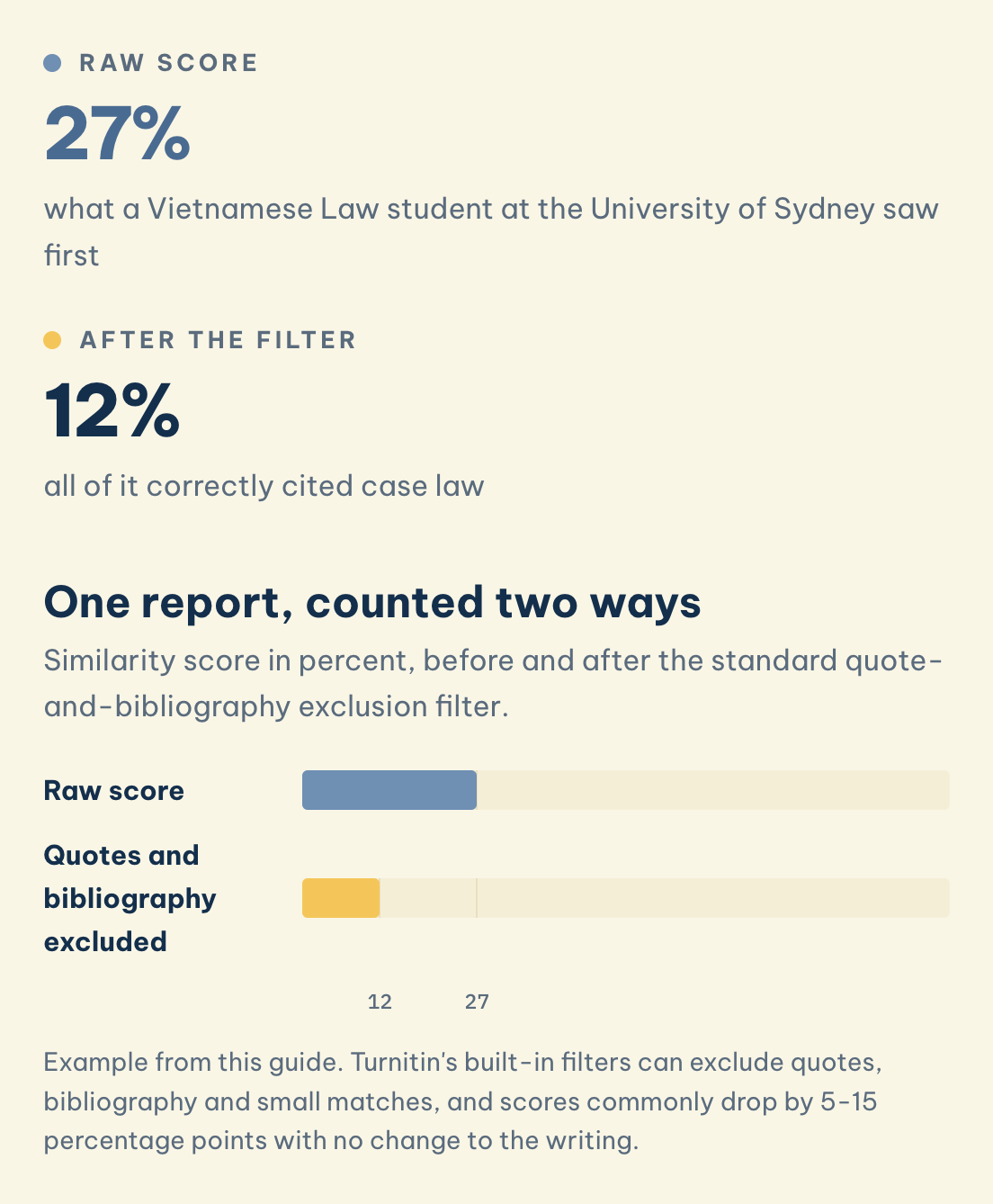
Evidence: Turnitin provides built-in filters to exclude quotes, bibliography, and small matches under a set word count. When these filters are applied, similarity scores commonly drop by 5-15 percentage points with no change to the actual writing.
Example: A Vietnamese Law student at the University of Sydney saw 27% and assumed the worst. Her MAAS advisor applied the standard quote-and-bibliography exclusion filter while reviewing the report; the score fell to 12%, all of it correctly cited case law. Nothing in her writing changed, only how the report counted standard legal citations.
◆ Question 6 / 9 · Genuine match
Direct answer: Fix it properly, do not try to trick the detector. If text is too close to a source, do two things: cite the source, and rewrite the idea in your own words and sentence structure so it reflects your understanding rather than a thin disguise of the original. The goal is genuine paraphrasing, restating an idea you understand, not running text through a spinner to fool the algorithm, which produces unreadable prose and is itself an integrity violation.
Evidence: University academic-integrity policies treat "patchwriting", swapping a few words while keeping the source's structure, as a form of plagiarism even when a citation is present. Proper paraphrasing requires both attribution and genuine restructuring, a distinction every integrity policy makes.
Example: A Vietnamese Education student at the University of Auckland had three paraphrased paragraphs flagged. Rather than reword them mechanically, her MAAS mentor walked her through the underlying argument until she could explain it in her own words, then she rewrote each paragraph from her understanding and added the citation. The rewrites read better and matched honestly, because they were genuinely hers.
If you would rather not judge that line alone, this is exactly what the Academic Integrity Check is for: a specialist reads each flagged passage with you, separates the matches that are fine from the ones that genuinely need reworking, and shows you how to rebuild the argument in your own words before you submit.
◆ Question 7 / 9 · Prevention
Direct answer: Cite as you write, never as an afterthought. Keep quotation marks around anything copied verbatim the moment you paste it, log the source immediately, and paraphrase from your understanding rather than from the source text sitting open beside you. If you build the habit of attributing sources during drafting, the similarity report becomes a confirmation step rather than a crisis.
Evidence: Much student plagiarism is unintentional rather than deliberate, lost citations, forgotten quotation marks, and source text copied as a "placeholder" that never gets rewritten. Building attribution habits during drafting prevents most integrity flags before any detector is involved.
Example: After one stressful report, a Vietnamese Marketing student at RMIT adopted a simple rule from her MAAS advisor: every pasted sentence gets quotation marks and a source note in the same keystroke. Her next three assignments came back with clean, fully-attributed reports and she stopped dreading the submission button.
◆ Question 8 / 9 · Limits
Direct answer: A text-matching tool only finds what sits in its database, so printed books, restricted-access content and work held only at another institution can pass unmatched. Foltýnek et al. (2020) tested 15 systems and found one Slovak open-access paper that none of them located. Paraphrase and translation are caught poorly too.
Systems tested
15
text-matching systems in Foltýnek et al.'s (2020) test, on documents in 8 languages
Turnitin "only checks against selected electronic sources (not printed books)" and "will not detect similarities in graphical materials, such as diagrams, images or equations" (University of Bristol, n.d.).
"The database is more limited for languages other than English" (University of Bristol, n.d.), and "translation plagiarism is very seldom picked up by software systems" (Foltýnek et al., 2020).
On reworded text, "all systems fell short in catching similarity at a satisfactory level" (Foltýnek et al., 2020).
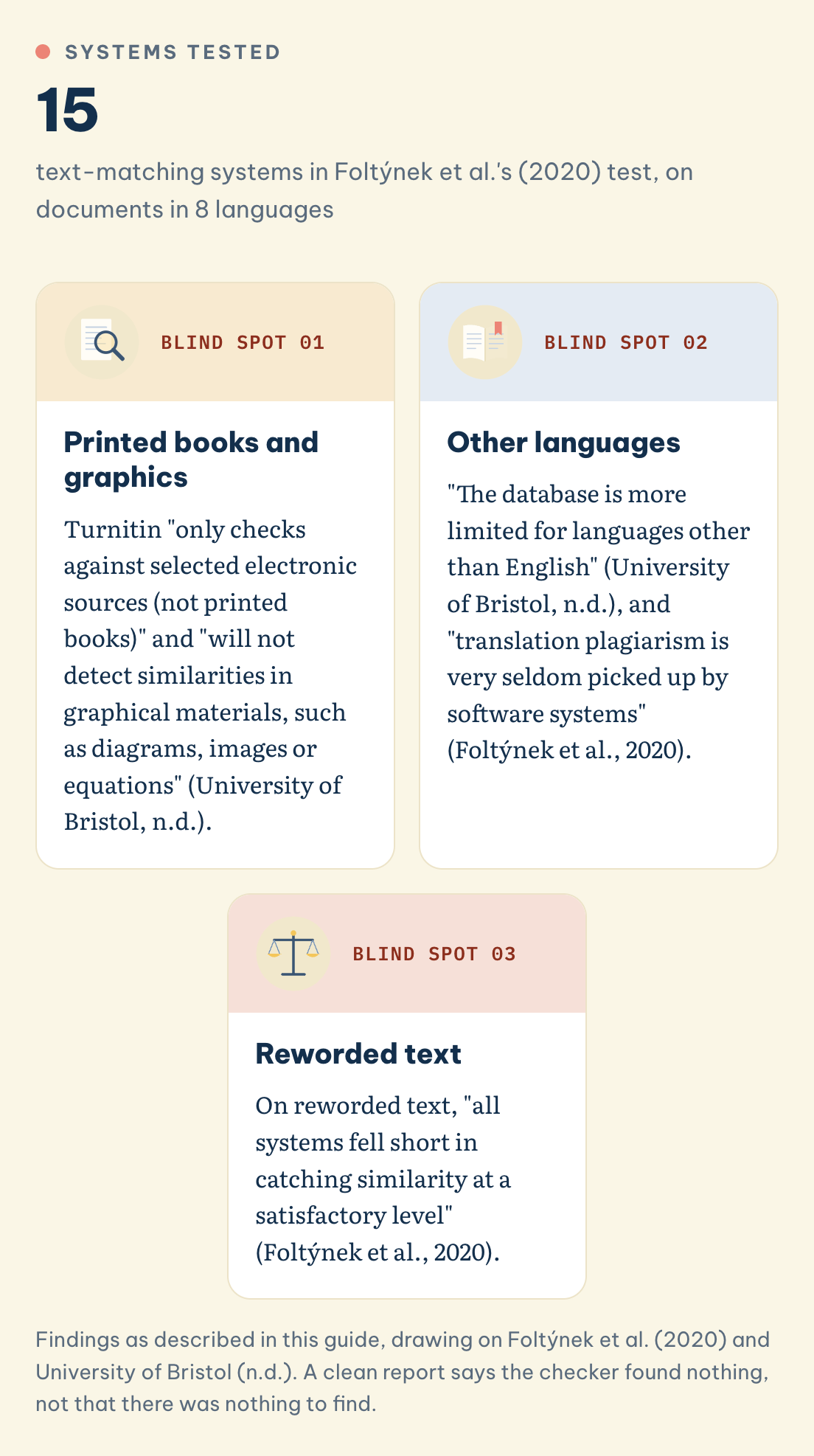
Universities publish these limits openly. Guidance from Bristol's Digital Education Office lists among its considerations that Turnitin "only checks against selected electronic sources (not printed books)", that "it will not detect similarities in graphical materials, such as diagrams, images or equations", and that "the database is more limited for languages other than English" (University of Bristol, n.d.). Reading's Academic Integrity Toolkit sharpens the point, warning that the database may not even hold "the full text of sources you've consulted" (University of Reading, n.d.).
The size of that gap has been measured, not merely asserted. Foltýnek et al. (2020) contacted 63 vendors, secured agreement from 20, and tested 15 systems on documents in 8 languages. A Slovak paper in an open-access journal "was not found by any of the systems", a Czech thesis from 2010 was located by exactly 1 system, and an open-access book in Turkish by 1. Restricted-access documents were excluded on purpose, so paywalled material was never measured at all. Across 16 single-source documents and 8 multi-source ones, judged against 23 objective criteria, their verdict was flat: "Software cannot determine plagiarism" (Foltýnek et al., 2020).
Two categories fail almost completely. On reworded text, Foltýnek et al. (2020) report that "all systems fell short in catching similarity at a satisfactory level", and on material carried across languages that "translation plagiarism is very seldom picked up by software systems". Neither finding is a loophole. Both are reasons a score cannot clear you, because a marker at Bristol or Melbourne who knows the field recognises a borrowed argument that no algorithm flagged.
Whether your own earlier work matches depends on a setting you never see. Turnitin (n.d.-a) documents 3 storage options an instructor picks per assignment: a "Standard repository" holding papers globally, an "Institutional repository" accessible only to your university, and "No repository", where a report is produced but "submissions will not be stored". An essay submitted last year under the third option leaves nothing to match against, while several drafts saved under the second give the opposite surprise, and Turnitin (n.d.-b) names it: multiple drafts in a private repository can mean "your final draft has resulted in a score of 100%". Resubmitting is not an instant fix either, because the same guidance warns that a replaced file may not generate a fresh report for a full 24 hours.
The practical conclusion runs one way only. Reading (n.d.) frames it as a warning, not a reassurance: "You can't rely on a low percentage score to mean that your work is free from plagiarism." A clean report says the checker found nothing, not that there was nothing to find.
◆ Question 9 / 9 · No check
Direct answer: Ask your lecturer first. Turnitin (2026) states that students cannot self-check a paper unless the institution has enabled Draft Coach, and advises contacting your instructor about a practice assignment. Many universities already run one. Free web checkers are the risky route, because your draft may be stored.
Four routes when your university runs no check
Tap a route to see what it offers.
Route 1 of 4
Ask your lecturer
Ask for a temporary practice submission point, which is the route Turnitin (2026) itself recommends.
Route 2 of 4
Draft Coach
Where Draft Coach is enabled, there are three similarity checks per document, and the report is private to you.
Route 3 of 4
Word Editor
Word Editor searches the open web and nothing more, so treat it as a prompt to check your own attribution while writing.
Route 4 of 4
A person
Ask for a meeting with your module lead or academic tutor, who can provide discipline-specific guidance.
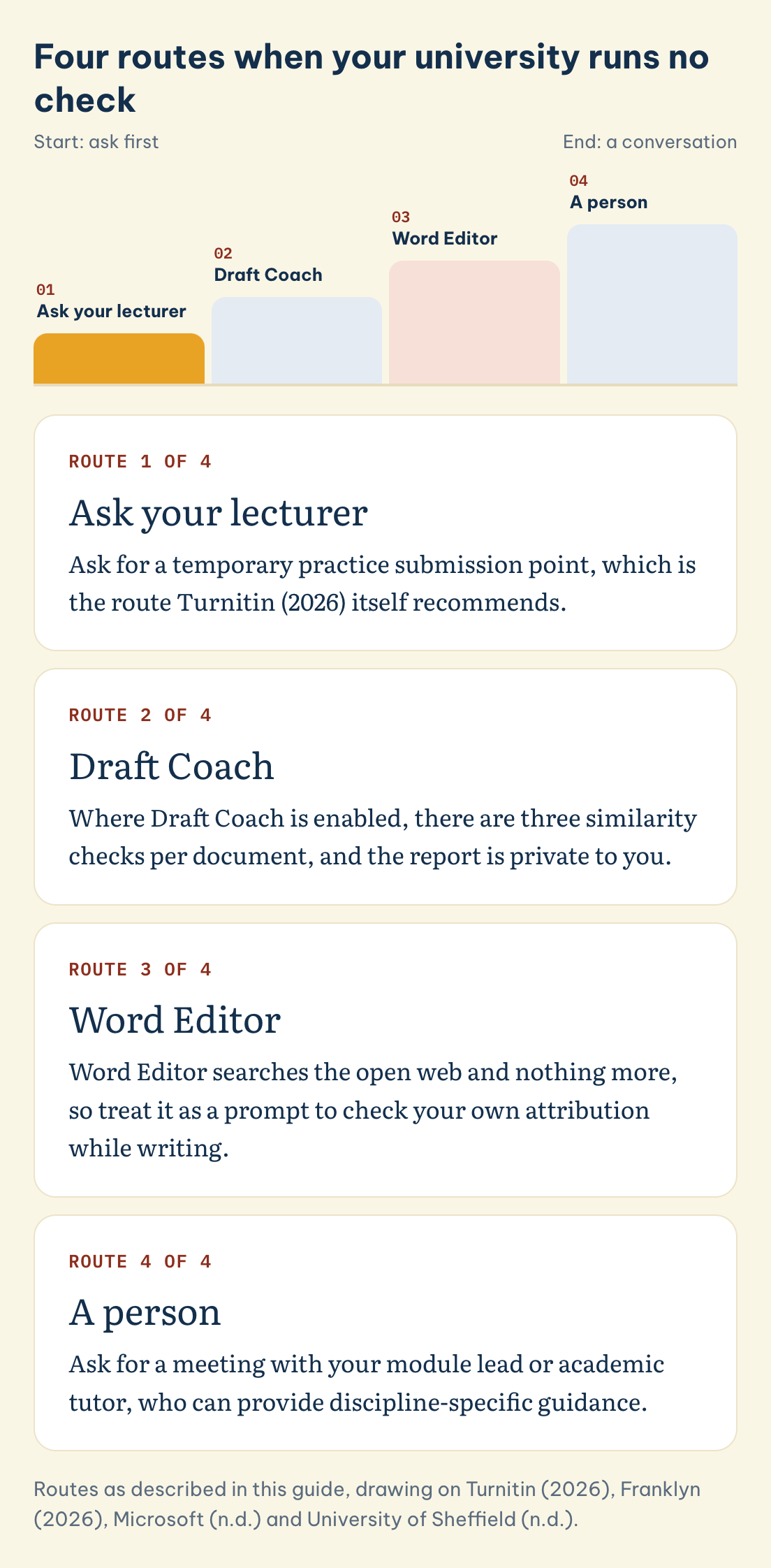
Turnitin (2026) answers this question for students directly: you "cannot self-check a paper within Turnitin without uploading it to an official assignment created by your instructor, unless your institution has enabled Turnitin Draft Coach", and for a check beforehand you "will need to contact your instructor directly to ask if they are willing to set up a temporary, separate practice assignment". The same page adds that where an instructor has disabled resubmissions, the first attempt is final. Asking is the first step, not the last resort.
Where Draft Coach is enabled, the allowance is small enough to plan around. Franklyn (2026), writing for Reading, records "three similarity checks available per document" and settles the question students actually worry about: the report "is private to you and your document will not be submitted to Turnitin's repository of papers". Guidance from the University of Derby (n.d.) states the same limit independently, and marks where it stops: the Similarity Check runs 3 times per document while Citations Check and Grammar Guide are unlimited.
Several universities open a draft route without Draft Coach at all. Guidance from Curtin University Library (n.d.) states that "many units may allow you to submit a draft to Turnitin before the final submission", and tells students to ask a lecturer or tutor because "there may be a separate Turnitin submission point for this purpose". A service at the University of Nottingham (2025) called Test Your Text settles the storage question: submissions there are "not stored in the Turnitin repository database". Its advice on reading a result travels well: "The ideal is definitely not a 0% match."
Policy sometimes guarantees that access rather than leaving it to luck. At the London School of Economics and Political Science (LSE), policy requires that every student see at least 1 formative similarity report each academic year, and the LSE verdict on the number is unusually direct (London School of Economics and Political Science, 2024): "The similarity score (%) is flawed." That same 2024 policy observes that essay writing companies "can produce papers with low similarity scores (%)", the clearest available statement that a low figure proves nothing about authorship.
Free online checkers are where the real risk sits. McPhie (2026), answering for Brunel University London, warns that free tools compare against a far smaller pool than an institutional service, so a clean result leaves a false impression of originality. Inaccuracy is not the worst of it. Uploading is treated as misconduct in its own right. La Trobe University (2026) classifies contract cheating to include a student who "uploads any student work or copyright material to a file-sharing website that allows anyone to download the documents", and its policy provides for penalties that reach suspension, exclusion, or revocation of an award. That is the part students underestimate, because the file you shared to be helpful stays available long after you graduate.
One ordinary desktop option exists at the drafting stage. Documentation from Microsoft Support describes a similarity check inside Word for Microsoft 365: from the Home tab you "select Editor", then "scroll down to Similarity and select Check for similarity", and Editor reports how much content matches text found online "(indicated as a percent), and the number of distinct passages in the document for you to review", offering a citation for each (Microsoft, n.d.). Word Editor searches the open web and nothing more, so treat it as a prompt to check your own attribution while writing rather than a substitute for your institution's report.
The most useful step is often not a tool at all. Study guidance at the University of Sheffield (n.d.) points students to 301 Academic Skills, which "offers 1:1 Study Skills, Maths or Statistics appointments", and adds that you "should also consider asking for a meeting with your module lead or academic tutor as they will be able to provide discipline-specific guidance". A 30-minute conversation about attributing a difficult source fixes the problem a report would only have described.
Not necessarily. If those 20 points are cited quotes, your reference list, and standard phrasing, it is fine. If even 5% is uncited paraphrase from one source, that is the real problem. Read the report match by match, not by the headline number.
It detects paraphrasing that stays close to the source wording or structure (patchwriting). Genuine paraphrasing, where you restate an idea you understand in your own structure, produces little to no match. The fix for flagged paraphrase is to understand the idea and rewrite it, plus cite.
In the raw score, yes, because they match their sources exactly. Most instructors apply Turnitin's filters to exclude quotes and bibliography when interpreting your report, which usually lowers the score noticeably.
Disguising matches with a spinning tool is itself an integrity violation and usually produces unreadable text that markers spot instantly. The legitimate way to reduce a genuine match is to cite the source and genuinely rewrite the idea in your own words.
Ask the lecturer for a temporary practice submission point, which is the route Turnitin (2026) itself recommends. Where the answer is no, spend that time on attribution instead: check every paraphrase against the source it came from, and confirm each in-text citation has a matching reference entry. Reading (n.d.) is explicit that a low score would not have cleared you anyway.
Yes. The Academic Integrity Check provides a plain-language interpretation of every flag, an action checklist of what to fix versus what is already fine, and optional formatting and proofreading on your own draft, an audit of your work, not a rewrite of it.
Worried about a similarity report before you submit? Book a free consultation, a MAAS advisor will read the report with you and help you remediate your own work in line with your institution's integrity policy.
This article is academic-integrity guidance and does not replace your own work or your institution's policy.
A free 20-minute discovery call with a MAAS advisor, to talk through your own report and your institution's integrity policy.
Book Free Discovery ▸